
What Is a Sales Qualified Lead? Your Guide to Closing More Deals
Learn what is a sales qualified lead and how to build a system that moves prospects from curious to customer. Get proven steps for higher conversions.
As a founder, your time is everything. Spending it chasing every person who shows a flicker of interest is the fastest way to burn out, not scale your SaaS.
The secret to scaling distribution is learning how to spot a Sales Qualified Lead, or SQL. This isn't just another contact in your CRM; it's a prospect who has been properly vetted and is primed for a real sales conversation.

Why Focusing on SQLs Matters for Founders
Let's be real. We've all been there. You get a notification—someone followed you on Twitter or downloaded your free guide—and your heart skips a beat. You dive into their DMs, ready to launch your pitch, only to get radio silence or a polite, "Oh, I was just browsing."
This is a classic trap for founders: mistaking early interest for buying intent.
The hard truth is, this approach wastes countless hours on dead-end conversations. It stuffs your pipeline with unqualified names, making it impossible to give your attention to the people who are actually on the verge of making a purchase. This is precisely why learning to tell the window shoppers from the serious buyers is so critical for your business.
From Vague Interest to Ready-to-Buy
So, what is a Sales Qualified Lead, really? An SQL is a potential customer who has been researched and vetted, first by your marketing efforts and then by your sales team, and is deemed ready for the next step: a direct sales pitch. They’ve gone past the initial "what is this?" stage and are now actively evaluating solutions to their problem.
It’s about more than just matching your ideal customer profile. It’s about their behavior and their stated intent.
An SQL is someone who not only has the problem you solve but is actively looking for the solution right now. Their actions shout, "I'm ready to talk," not just, "I'm interested in learning more."
When you get this right, your sales efforts become surgically precise. Your conversion rates go up, and you start building a revenue stream you can actually predict. You stop spraying and praying and start targeting only the leads with the highest chance of closing.
Building a System That Finds Your SQLs
The end goal isn't just to memorize a definition; it's to create a reliable system that consistently brings these high-intent leads to the surface. It doesn't matter if your strategy is content marketing, paid ads, or direct outreach on platforms like Twitter—the objective is always the same: filter for intent.
For example, a founder using an outreach automation tool like DMpro can set up campaigns on Twitter to engage users who post about specific pain points. The first automated message acts as a quick filter. Only the people who reply with genuine interest get passed on for a real, one-on-one conversation.
This simple pre-qualification step ensures you're only investing your personal time in potential SQLs.
Building a great system starts with a solid foundation. If you want to dig deeper into the nuts and bolts, our guide on how to qualify sales leads is the perfect place to start.
To help you visualize where SQLs fit into the broader journey, let's break down the different stages a person goes through before they're ready to buy.
Lead Stages At a Glance
| Lead Stage | Description | Typical Action |
|---|---|---|
| Suspect | Anyone who could potentially be a customer. A big, unfiltered list. | Cold outreach, initial brand awareness ads. |
| Prospect | A suspect who fits your ideal customer profile (ICP). | Added to a targeted marketing list. |
| Lead | A prospect who has shown initial interest (e.g., followed you on Twitter). | Nurtured with general content. |
| MQL | A lead who has engaged with marketing (e.g., downloaded an e-book). | Added to an email nurturing sequence. |
| SQL | An MQL who has shown buying intent (e.g., requested a demo). | Handed off to the sales team for a call. |
Understanding this progression is key. It helps you meet potential customers where they are, giving them the right information at the right time, and ensures your sales team only gets involved when the timing is perfect.
The Difference Between MQLs and SQLs Explained
It’s easy to get lost in sales jargon, but getting the difference between a Marketing Qualified Lead (MQL) and a Sales Qualified Lead (SQL) right is non-negotiable. Get this wrong, and you'll jump into conversations way too early, scaring off prospects who just aren't ready yet.
Think of it like this: an MQL is someone who raises their hand with curiosity. They've downloaded your e-book or followed you on Twitter. They’re saying, "I'm interested in learning more," but they're still just browsing.
An SQL, on the other hand, is the person who walks up to the counter, wallet in hand. They've moved past simple curiosity and are showing clear buying intent. They’re saying, "I have a problem, you might have the solution, and I'm ready to talk about it now."
From Browsing to Buying
The journey from MQL to SQL is all about tracking behavior and intent. A lead crosses over from MQL to SQL when their actions signal they are actively evaluating a purchase. Pushing too soon feels desperate; waiting too long gives competitors an opening.
Here’s a simple breakdown of the signals that separate the two:
- MQL Actions (Top of Funnel): Downloading a whitepaper, following you on Twitter, or opening your marketing emails. These are low-commitment actions that show initial interest.
- SQL Actions (Bottom of Funnel): Requesting a product demo, visiting your pricing page multiple times, or asking specific questions about features. These actions scream urgency and intent.
A key mistake founders make is treating every MQL like they're ready to buy. Nurturing is crucial. An MQL needs more value and education, while an SQL needs a direct, personal conversation.
Making the Handoff Count
A smooth handoff from marketing (MQL stage) to sales (SQL stage) is everything. This process is often managed by assigning points to different actions a lead takes. This is a core part of what's known as lead scoring, a method to objectively measure how ready a lead is to talk to sales.
For example, when a lead from a Twitter outreach campaign replies to an automated message from a tool like DMpro, they might still be an MQL. But if they follow up by asking for your pricing deck, that’s a strong signal they’ve crossed the threshold into SQL territory. At that point, it’s time for a real person to step in immediately.
This systematic approach ensures your sales team only spends their valuable time on conversations that are actually likely to convert.
Your Essential Lead Qualification Checklist
So, how do you really know if a lead is ready for a sales conversation? It's not about gut feelings. It's about having a clear, repeatable process to spot the difference between a window shopper and a serious buyer.
This is where qualification frameworks come in. They give you a simple checklist to run through, ensuring you’re focusing your energy in the right places. For most SaaS founders, one of the most effective and time-tested frameworks is BANT.
The BANT Framework Explained
BANT is a straightforward acronym that stands for four critical questions you need answered before you can truly call a lead "sales-qualified." It’s designed to cut through the noise and prevent you from chasing deals that were never going to happen.
Here’s how it breaks down:
- Budget: Can they actually afford what you're selling? This is a tough but necessary question to ask early on. If the money isn't there, the conversation is a non-starter.
- Authority: Are you talking to the person who can actually make the final call and sign the check? Getting to the decision-maker is key.
- Need: Do they have a real, painful problem that your product directly solves? Without a genuine need, there's no urgency, and without urgency, there's no sale.
- Timeline: When are they planning to make a decision? "This quarter" is a huge green light. "Maybe sometime next year" tells you they're not quite ready for a sales pitch just yet.
This simple decision tree shows how you can start separating Marketing Qualified Leads (MQLs) from potential SQLs based on their actions. Someone downloading an ebook is just exploring, but someone requesting a demo is showing clear buying intent.
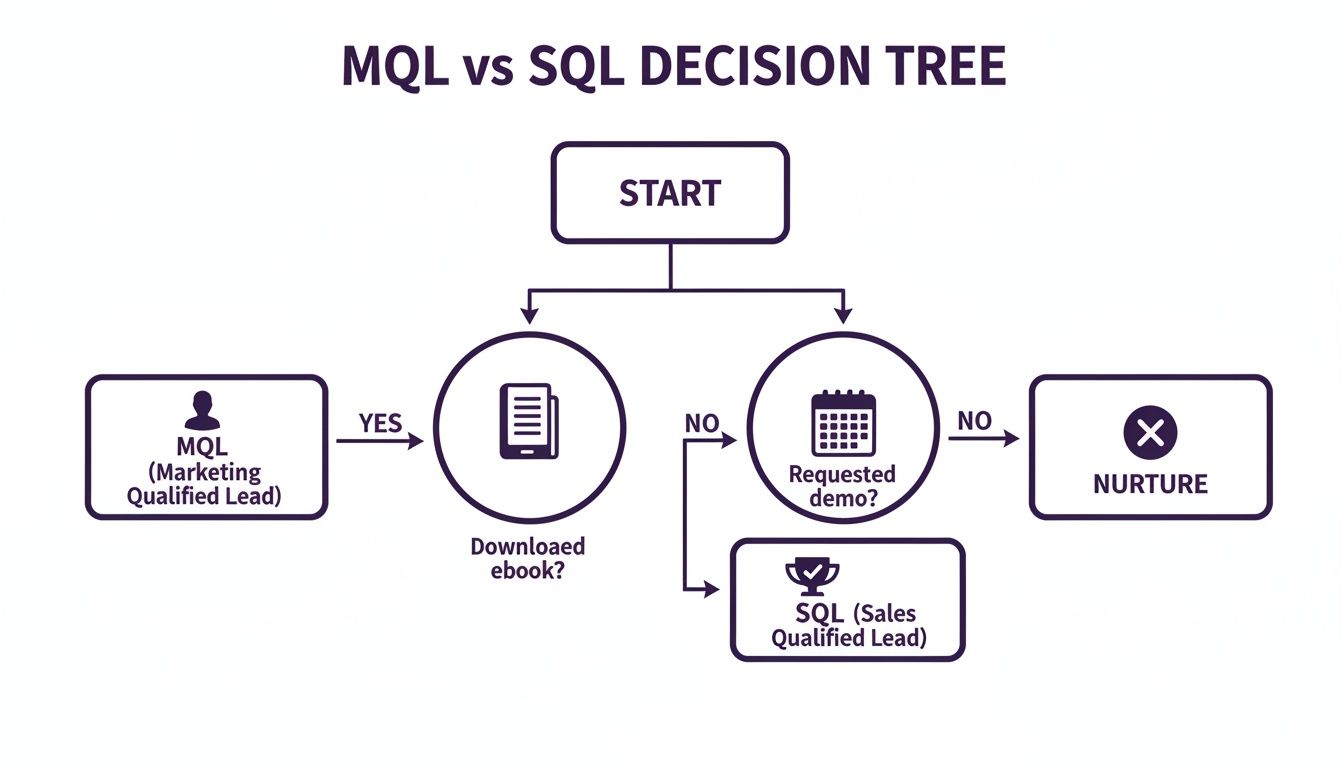
As you can see, high-intent actions are a clear sign that a lead is moving from a passive learner to an active buyer. This is the moment they become a potential SQL.
Using a framework like BANT ensures your sales team invests its most precious resource—time—on prospects who have both the means and the motivation to become a customer.
A strong qualification process isn't about rejecting leads. It's about prioritizing your focus on the opportunities most likely to turn into revenue.
SQL Qualification Frameworks
While BANT is a fantastic starting point, it's not the only game in town. Different business models call for different approaches. Here’s a quick look at a few popular frameworks for SaaS.
| Framework | Stands For | Best For |
|---|---|---|
| BANT | Budget, Authority, Need, Timeline | Traditional, straightforward sales cycles where budget is a primary constraint. |
| CHAMP | Challenges, Authority, Money, Prioritization | Putting the customer's problems first; great for solution-oriented selling. |
| MEDDIC | Metrics, Economic Buyer, Decision Criteria, Decision Process, Identify Pain, Champion | Complex, enterprise-level deals with long sales cycles and multiple stakeholders. |
| GPCT | Goals, Plans, Challenges, Timeline | Modern SaaS sales where you act more as a consultant helping them hit their goals. |
Choosing the right framework really depends on who you sell to and how you sell. Don't be afraid to test one out and adapt it to what your team learns on the front lines. The goal is to create a consistent, reliable system for identifying your best leads.
To take your process a step further, you can also explore how AI lead scoring can automatically analyze lead behavior and firmographic data to pinpoint the most promising prospects, helping you scale your efforts without losing that critical precision.
How to Generate More SQLs on Autopilot
<iframe width="100%" style="aspect-ratio: 16 / 9;" src="https://www.youtube.com/embed/1x2W_a5EFb8" frameborder="0" allow="autoplay; encrypted-media" allowfullscreen></iframe>Pinpointing what makes a lead "sales-qualified" is one piece of the puzzle. The real challenge for founders is building a machine that finds them for you, day in and day out. If you're trying to scale distribution on a platform like Twitter, outreach automation is your secret weapon.
Let’s be honest: manual outreach is a grind. You can easily burn through your entire day searching profiles, scrolling through tweets, and sending DMs one by one. That's just not a scalable way to grow a SaaS. To build a real pipeline, you need a system.
This is where outreach automation tools step in to do the heavy lifting. Instead of you doing all the repetitive, manual work, you set up a process that finds and pre-qualifies potential customers for you.
Automating Your Outreach on Twitter
Imagine you could automatically find people on Twitter who are talking right now about a problem your SaaS solves. Tools like DMpro.ai let you do just that by setting up campaigns that look for specific keywords in tweets or bios.
These keywords are basically buying signals lighting up all over the platform. Someone tweeting, "any recommendations for a good project management tool?" is telling you they have an immediate need. An automated, friendly first message can quickly check their interest and weed out the noise before a lead ever lands in your inbox.
This completely flips the script on lead generation. You stop shouting into the void and start building a system that brings high-intent prospects to you, freeing you up to work on your product or close deals.
The point of outreach automation isn't just to send more DMs. It's to start more of the right conversations. By the time a lead needs your personal attention, they're already warmed up and partially qualified.
Building Your SQL Generation Engine
To get that steady flow of SQLs, your automation needs a smart strategy. Think of it as a funnel that’s working for you 24/7, warming up prospects and handing off only the most promising ones.
Here’s a simple but powerful way to set it up:
- Define Your Triggers: What specific words, phrases, or hashtags do your ideal customers use when they need help? This could be anything from "how to improve team productivity" to a direct mention of a competitor. Get specific.
- Craft a Conversational Opener: Your first automated DM should never be a hard sell. It needs to be a simple, helpful question that opens a door. The goal is just to start a dialogue and see if they're interested.
- Filter and Escalate: Their reply tells you everything. A positive response that confirms they have the problem you solve is a green light. That's your cue to jump in personally and take the conversation to the next level.
Using the right lead generation automation tools means you can build this entire system without touching a line of code. And if you really want to put your growth on autopilot, you can even explore how a chatbot for lead generation can handle those initial chats for you across different platforms.
How to Perfect the Sales Handoff
The moment a lead becomes an SQL is a critical handoff point, and frankly, it's where a lot of businesses drop the ball. A clunky transition from your outreach efforts to a real sales conversation can kill all the momentum you’ve built.

Think about it from your sales team's perspective. They need the full story. What was that initial DM on Twitter about? Did they mention a specific pain point in their reply?
Giving your salesperson this context isn't just a nice-to-have; it's essential. It stops the prospect from having to repeat their whole story and lets your rep dive straight into a meaningful conversation. It’s the difference between a warm, productive chat and a cold, frustrating interrogation.
Setting Clear Rules for Follow-Up
This is where you need to get organized. A Service Level Agreement (SLA) between your marketing (or outreach) and sales teams is a game-changer. It's really just a simple set of rules that defines how quickly your sales team must follow up with a brand-new SQL.
Don't overcomplicate this. The main goal is speed.
A fast, informed follow-up sends a powerful message: "We're organized, we're professional, and we value your time." This simple act can dramatically increase your chances of closing the deal.
Your SLA should specify a clear follow-up window—ideally within a few hours, not days. This urgency is everything because SQLs are prospects who have shown a strong likelihood of buying. If you want to dive deeper, there are some great insights on how SQLs drive the sales process on Thomasnet.com.
If you’re using a tool like DMpro for Twitter outreach, the handoff becomes even more crucial. When a prospect replies positively to one of your automated messages, that’s your trigger. An SLA ensures someone from your team steps in immediately to turn that flicker of interest into a real conversation before it goes cold.
Key Metrics for Tracking SQL Success
You can’t improve what you don't measure. As a founder, it's easy to get lost in the daily hustle, but to truly know if your SQL process is working, you have to look at the numbers. Tracking a few key metrics is the only way to get a clear, data-backed view of how healthy your sales funnel really is.
Think of these metrics as the dashboard for your growth engine. Without them, you’re flying blind.
Core Conversion Rates
First up is your Lead-to-SQL Conversion Rate. This metric shows what percentage of all your incoming leads—from every channel—are actually good enough to be handed over to sales. If this number is low, it’s a big red flag that your lead quality is poor or your definition of an MQL is way too broad.
Next, you have to keep a close eye on your SQL-to-Customer Conversion Rate. This one is simple but revealing: out of all the leads your sales team accepts, how many of them actually turn into paying customers? A high percentage here is a great sign. It means your qualification criteria are dialed in and your sales team is closing deals effectively.
If your SQL-to-Customer rate is high, you've found a sweet spot. Your qualification process is working, and your team knows how to turn those conversations into revenue. This is what you're aiming for.
Measuring Speed and Efficiency
Finally, you need to track the Sales Cycle Length for your SQLs. This is simply the average time it takes for an SQL to go from that first sales conversation to a closed deal. A shorter cycle is a powerful sign that your leads are truly ready to buy the moment they hit the sales team's desk.
When you start measuring these KPIs together, you get a real sense of your sales velocity—the ultimate measure of how fast your company is generating revenue. Keeping these numbers on your radar will show you exactly where the bottlenecks are in your funnel, so you can make smart decisions to scale up faster.
Turn More Conversations Into Customers
Figuring out what a sales qualified lead truly is for your business isn't just an academic exercise. It's the bedrock of a predictable revenue engine. When you can clearly tell the difference between someone who's just browsing and someone who's ready to buy, you let your sales team do what they do best: close deals.
This clarity has a ripple effect across your entire company. Marketing and sales finally speak the same language, which means less friction and a pipeline that actually flows. It’s the end of wasting precious hours on conversations that go nowhere.
From Definition to Action
The real magic happens when you move from theory to practice. It’s one thing to have a definition, but it's another to have a seamless handoff process and a system that reliably feeds you high-intent leads. For founders scaling their SaaS on platforms like Twitter, this kind of system is a complete game-changer.
Instead of spending your days manually prospecting, you can lean on tools that automate the first touchpoints and initial qualification steps. This means that by the time you or your team actually join a conversation, you already know the person has shown real interest. They're primed for a proper sales discussion. That's how you build a sales process that scales beyond your own time and effort.
A well-defined SQL is more than just a label in your CRM; it's a compass that directs your sales team's energy toward the most promising opportunities, dramatically increasing their efficiency and close rates.
This approach stops you from playing a guessing game with lead generation and turns it into a well-oiled machine. It frees you up to focus on the bigger picture of growing your business, knowing that your pipeline is consistently being filled with people who are actually ready to talk.
With these strategies in place, you won't just see your conversion rates climb. You’ll build a sales process that's smoother, more efficient, and built to scale. Tools like DMpro can do the heavy lifting of finding and engaging potential SQLs, letting you jump into the conversations that truly matter.
If you’re tired of manually sending DMs every day, try DMpro — it automates outreach and replies while you sleep. Find out more at https://dmpro.ai.
Ready to Automate Your Twitter Outreach?
Start sending personalized DMs at scale and grow your business on autopilot.
Get Started Free