
What Is Sales Velocity and How Does It Drive Growth
What is sales velocity? Discover the formula, key benchmarks, and actionable strategies to accelerate your revenue growth and improve sales performance.
As a founder, think of your business as having a speedometer. That's pretty much what sales velocity is—a simple measure of how fast you're turning leads into cash. It’s not just another metric. It's a diagnostic tool that shows you exactly how fast your revenue engine is running.
Why Sales Velocity Is Your Most Important Metric
You're probably drowning in metrics. Sales velocity cuts through the noise. It combines four key numbers into one powerful figure that gives you a brutally honest look at your sales process.
It goes deeper than just tracking monthly recurring revenue (MRR). Instead, it measures the speed at which you're generating revenue. Knowing this number is the key to predictable growth because it tells you how much revenue your team is closing every single day. When you have that, forecasting stops being a guessing game.
The Four Pistons of Your Revenue Engine
Sales velocity is powered by four core components. Think of them as the pistons in your company's revenue engine. If one isn't working right, the whole engine sputters. But when all four fire together, you start picking up speed.
These are the four levers you can pull:
- Number of Opportunities: How many qualified leads are you actively working?
- Average Deal Value: When you win, what's the average deal worth?
- Win Rate: What percentage of opportunities actually become customers?
- Sales Cycle Length: How many days does it take to close a deal?
How these four factors work together decides your growth trajectory. Even a small tweak, like bumping your win rate a few points, can have a huge ripple effect on your overall velocity.
The Sales Velocity Equation
The formula itself is simple. It’s designed to show you how much revenue you're generating daily, so you can forecast with confidence.
Here’s the math: Sales Velocity = (Number of Opportunities × Average Deal Size × Win Rate) ÷ Sales Cycle Length.
Let’s say your SaaS has 50 opportunities this month. Your average deal is $10,000, and you close about 20% of them. It usually takes 30 days to close a deal.
Plugging that in, your sales velocity is $3,333 per day. You can find more details on how this formula works and its implications for sales operations.
Tracking sales velocity gives you a clear view of how efficiently your sales machine is running. It helps you shift from asking, "Are we growing?" to "How can we grow faster?"—and shows you exactly which lever to pull.
The Four Levers of Your Sales Velocity Formula
Think of the sales velocity formula less like a math problem and more like the control panel for your revenue engine. Each variable is a lever you can pull to grow faster. The trick is understanding them individually so you can figure out which one gives you the biggest bang for your buck right now.
This map breaks down the four core components—Opportunities, Deal Size, Win Rate, and Sales Cycle—that feed into your overall sales velocity.
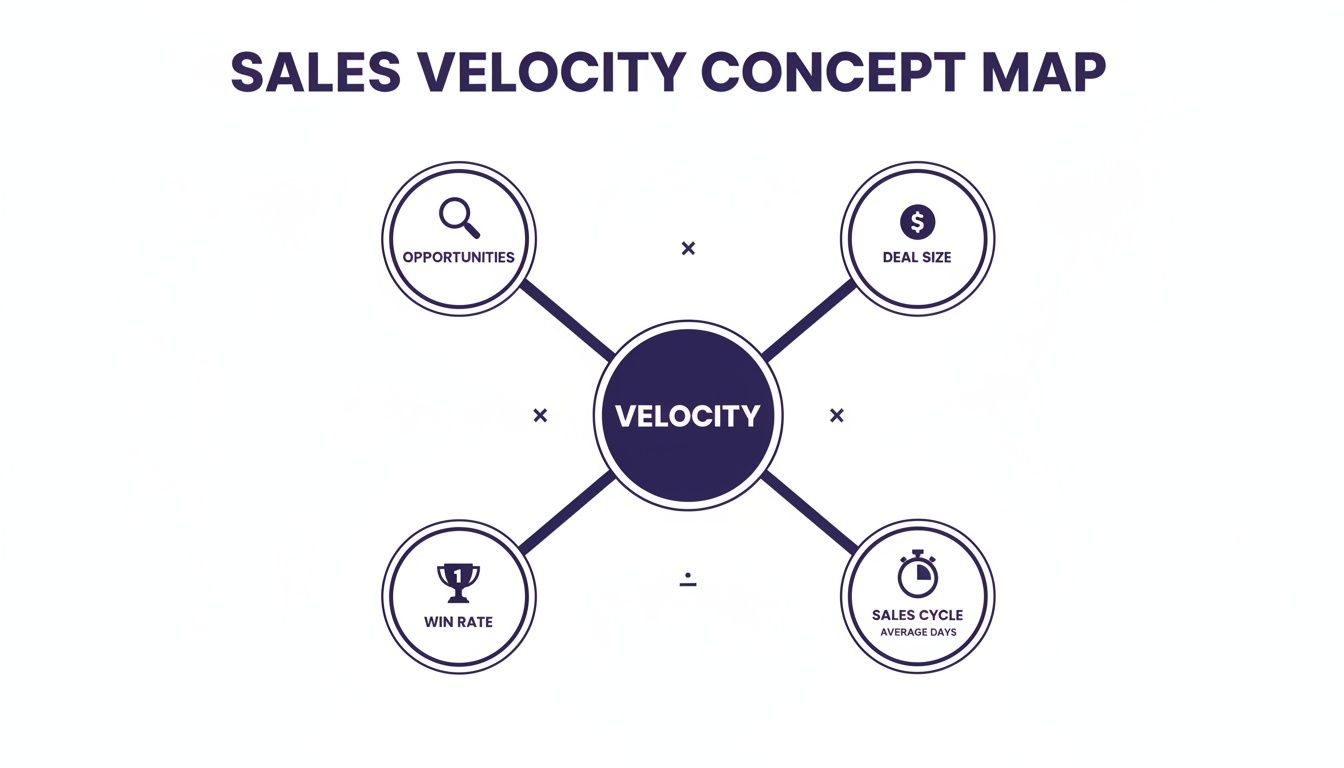
As you can see, a weakness in any single area slows the entire system down. Let's dig into each lever.
1. Opportunities
This is all about the top of your funnel—the total number of qualified leads in your pipeline. The keyword here is qualified.
Stuffing your pipeline with junk leads is a classic mistake. It actually hurts your velocity because those leads tank your win rate and drag out your sales cycle while your team chases ghosts.
A critical first step is building a sales pipeline that converts deals, because it forces you to get clear on what a real opportunity looks like. For us, an "opportunity" isn't someone who just downloaded a PDF; it's a founder who fits our ideal profile and has shown genuine interest.
2. Average Deal Value
Next up is the average dollar amount you get from each new customer. You find this by dividing your total revenue from new deals by the number of deals you closed.
This lever is incredibly powerful. Even a small bump here has a massive ripple effect.
For instance, if you can increase your average deal size by just 15%, you've grown revenue by 15% without needing a single extra lead. You can do this by upselling, cross-selling, or just targeting bigger companies.
3. Win Rate
Your win rate is the percentage of qualified opportunities that turn into paying customers. This is probably your most honest metric—it tells you how effective your sales process, messaging, and product-market fit really are.
Win Rate = (Number of Deals Won / Total Number of Opportunities) x 100
A low win rate is a huge red flag. It’s a sign that you're burning time and money on deals that were never going to close. If you want to dive deeper, we have a whole guide on https://www.dmpro.ai/blog/how-to-improve-sales-conversion-rate.
Boosting this number is about working smarter, not harder. Better lead qualification or a crisp follow-up cadence can make all the difference.
4. Sales Cycle Length
Finally, there’s the sales cycle—the average time it takes to get a deal across the finish line, measured in days. The clock starts the moment a lead becomes a qualified opportunity and stops when the contract is signed.
The shorter your sales cycle, the faster cash hits your bank. A long, drawn-out sales cycle can be a silent killer for a startup's cash flow.
To shorten it, you need to remove friction. This could mean automating follow-ups with a tool like DMpro so deals don't go cold, or setting clear next steps after every call. Every day you shave off this average directly boosts your sales velocity.
Components of Your Sales Velocity Engine
| Component | What It Measures | How to Improve It |
|---|---|---|
| Opportunities | The number of qualified leads in your pipeline. | Increase lead quality through better targeting and qualification. |
| Average Deal Value | The average size (in dollars) of a closed deal. | Upsell, cross-sell, and focus on higher-value customer segments. |
| Win Rate | The percentage of opportunities that become customers. | Refine your sales process, improve messaging, and qualify better. |
| Sales Cycle Length | The average time it takes to close a deal. | Remove friction, automate tasks, and streamline your process. |
By focusing on these four areas, you can systematically identify bottlenecks and make targeted improvements that have a real impact on how fast your company grows.
How to Calculate Your Sales Velocity With Real Examples
Okay, theory is great, but let's run the numbers. Seeing the sales velocity formula in action is where the lightbulb moments happen. It shows you what that final dollar-per-day figure truly means for your business.
We'll use the same simple formula for each example.
Sales Velocity = (Opportunities x Average Deal Value x Win Rate) / Sales Cycle Length
This little equation tells you how much revenue your pipeline is generating, day in and day out.
Example 1: The Bootstrapped SaaS
Imagine you're running a small SaaS startup. You're dealing with a high volume of smaller deals and have a good system for keeping the pipeline full.
Here's what your monthly numbers look like:
- Opportunities: 100 qualified leads
- Average Deal Value: $1,200 (annual contract)
- Win Rate: 25%
- Sales Cycle Length: 30 days
Now, let's plug those in.
(100 Opportunities x $1,200 x 0.25) / 30 Days = $1,000 per day
The takeaway: Your sales engine is churning out a steady $1,000 in new revenue every day. To grow, you might focus on bumping up your deal size with a new pricing tier or shortening the sales cycle.
Example 2: The Enterprise Software Company
Next, let's look at a company selling big-ticket software. Their numbers are a totally different beast—huge deal sizes, but painfully long sales cycles.
Here’s a look at their quarterly data:
- Opportunities: 15 qualified enterprise leads
- Average Deal Value: $250,000
- Win Rate: 15%
- Sales Cycle Length: 180 days
The math is pretty different.
(15 Opportunities x $250,000 x 0.15) / 180 Days = $3,125 per day
The takeaway: Even with a low win rate and a six-month sales cycle, their daily velocity is over $3,000. For a company like this, the biggest lever is the sales cycle. Shaving 30 days off would boost their velocity to nearly $3,750 per day.
Example 3: The B2B Service Agency
Finally, a B2B agency that provides marketing services. They get consistent leads from referrals but know their close rate could be better.
Here are their numbers over the last two months:
- Opportunities: 40 qualified projects
- Average Deal Value: $8,000
- Win Rate: 18%
- Sales Cycle Length: 60 days
Let's do the final calculation.
(40 Opportunities x $8,000 x 0.18) / 60 Days = $960 per day
The takeaway: Their velocity is just under $1,000 per day. The clear bottleneck is that 18% win rate. The fastest way to fix that is by improving lead quality. Implementing a smarter qualification process, like we cover in our guide on what is lead scoring, could easily bump that to 25%.
If they did that, their sales velocity would jump to $1,333 per day. That’s a nearly 40% increase just from improving one metric. This is why knowing your numbers is so powerful.
Understanding Sales Velocity Benchmarks
So, you've calculated your sales velocity. The first thing you're probably asking is, "Is this number any good?" That's where industry benchmarks come in. They give your number context, transforming it from a random figure into a meaningful metric.
Comparing your velocity isn’t about winning or losing. It's a reality check. But remember, the real goal isn't to hit some industry number; it's to consistently beat your own last record.
What Separates Good From Great
What does a top-tier sales engine actually look like? The difference between a median SaaS sales team and an elite one is often staggering, and it all comes down to optimizing the four components of sales velocity.
Industry data paints a very clear picture. According to benchmarks from Outreach, the best SaaS teams are playing a different game. They’re managing 60-80 qualified opportunities a month, with average deal sizes between $15,000-$25,000. Add in a solid 28% win rate and a quick 45-day sales cycle, and their velocity can top $11,000 per day.
Meanwhile, median teams might be handling 40 opportunities at $12,000, closing 18%, and taking 75 days to do it. The result? A sales velocity of just $2,200 per day. That’s a huge difference.
Your Most Important Benchmark Is Your Own
While looking at industry figures is a great way to orient yourself, the only benchmark that truly matters is your own past performance. Is your velocity higher this quarter than last? That’s the real win.
Think of it this way:
- Your Baseline: This is your current sales velocity.
- Your Goal: Aim for a steady 5-10% improvement each month or quarter.
- Your Strategy: Find your weakest link in the formula and pour your energy into it.
For example, if your average deal size is healthy but your sales cycle drags on, you've found your bottleneck. Even small, focused improvements will compound over time.
This is all tied to efficiency. A higher velocity means you're closing deals more profitably. This has a direct impact on other crucial metrics, as you can see in our guide on how to calculate SaaS customer acquisition cost. Top performers aren't just working harder—they're working smarter.
Proven Tactics to Increase Your Sales Velocity
Alright, knowing the formula is one thing, but using it to grow your business? That’s what really matters. Now we get to the fun part—pulling the four levers to see a real impact on your bottom line.
The key is to focus your energy where it will make the biggest difference. You don’t need to do everything at once. A small, focused improvement in just one area can create serious momentum.
Boost Opportunities with Automated Lead Generation
More qualified leads at the top of your funnel means more shots on goal. Simple. But as a founder, you don't have time to prospect all day. This is where automation becomes your secret weapon for scaling distribution without burning out.
For SaaS founders targeting other founders, Twitter is a goldmine. The challenge is sifting through the noise to find the right people and then starting conversations at scale. This is precisely the problem outreach automation was built to solve.
For example, a tool like DMpro can scan thousands of Twitter profiles 24/7, pinpointing founders who fit your ideal customer profile. It then kicks off personalized DMs based on their recent activity, filling your pipeline with warm conversations while you focus on building your product. You can learn more in our guide on https://www.dmpro.ai/blog/what-is-sales-automation. This approach lets you consistently add high-quality opportunities without the manual grind.
Increase Your Win Rate with Scalable Personalization
Your win rate is a direct reflection of how well you connect with prospects. Generic, one-size-fits-all pitches are a recipe for a low close rate. To win more deals, you need to show you’ve done your homework.
But "personalization" doesn't have to mean spending hours researching every lead. It's about finding smart, scalable ways to make your outreach feel one-to-one.
- Reference Recent Activity: Mention a recent post they shared on Twitter. It shows you're paying attention.
- Speak Their Language: Use industry-specific terms and talk about challenges unique to their role.
- Focus on a Single Pain Point: Instead of listing every feature, focus your initial message on solving one relevant problem.
The impact of personalization is huge. Highspot's analysis of 1,200 teams found that velocity improvements from $3,000 to $6,500 daily through content personalization lifted quarterly attainment from 78% to a staggering 105%.
This is another area where the right tool makes a difference. DMpro, for instance, can automatically reference a prospect's name and recent tweets in its outreach messages, giving you the power of personalization without the manual effort.
Raise Your Average Deal Value with Simple Frameworks
Increasing your average deal value is one of the most direct ways to boost revenue without needing more leads. You don't need a complex strategy; a few simple frameworks can do the trick.
The easiest place to start is with a tiered pricing model. Create clear "good, better, best" options that guide larger customers toward higher-value plans.
You should also train your team to listen for upsell opportunities during sales calls. If a prospect mentions a future need that a premium feature solves, make a note to introduce it. The goal isn't to be pushy—it's to be helpful by offering a more complete solution.
Shorten Your Sales Cycle by Removing Friction
A long sales cycle is often just a sign of friction. Every extra day it takes to close a deal is a day that cash isn't in your bank. The key to shortening your cycle is making it as easy as possible for your prospect to say "yes."
Start by mapping out every step in your sales process. Find the bottlenecks. Where do deals stall?
Here are a few common friction points and how to fix them:
- Slow Follow-ups: Manually tracking follow-ups is a surefire way to let deals fall through the cracks. Automate your follow-up sequences so no lead ever goes cold.
- Scheduling Headaches: The endless back-and-forth to find a meeting time kills momentum. Use a scheduling tool like Calendly.
- Contract Delays: Waiting for someone to print, sign, and scan a contract is a waste of time. Use an e-signature tool to get deals signed in minutes.
To put these ideas into action, check out some practical tools like these deal acceleration templates. By systematically removing these small friction points, you can significantly shorten your sales cycle.
Common Questions About Sales Velocity
Even after you get the hang of the formula, some practical questions always pop up. Let's tackle the most common questions I hear from other founders who are starting to track sales velocity.
This is all about turning theory into action and avoiding common traps.
How Often Should I Calculate My Sales Velocity?
This is a great question. For most SaaS businesses, calculating sales velocity on a monthly and quarterly basis is the sweet spot.
Monthly calculations are perfect for tracking short-term trends. Did that new Twitter outreach campaign move the needle? A monthly check-in will tell you.
Quarterly reviews give you a more stable, big-picture view. This longer timeframe smooths out weird fluctuations and is ideal for strategic planning. I'd advise against weekly calculations; the data is often too noisy.
Can I Improve Sales Velocity Without Hiring More People?
Absolutely. That’s the entire point of focusing on this metric. It’s a measure of efficiency, not just team size. This is great news for bootstrapped founders where every hire is a massive decision.
The goal is to make your existing process work smarter.
- Better Lead Quality: Focus on higher-quality leads. This alone boosts your win rate.
- Automation: Use tools to handle repetitive tasks. For example, using a tool like DMpro to automate lead generation on Twitter increases your opportunities without adding headcount.
- Process Refinements: Small tweaks like improving your sales script or tightening your follow-up sequence can dramatically shorten your sales cycle.
These are all high-leverage activities that increase velocity without increasing your payroll.
What Is the Biggest Mistake Founders Make With Sales Velocity?
The single biggest mistake is becoming obsessed with one component of the formula while ignoring the others. It’s a classic case of not seeing the forest for the trees.
For example, many founders get fixated on jamming the top of their funnel with leads (opportunities). But if they fail to properly qualify them, their win rate plummets and the sales cycle gets dragged out by dead-end conversations.
A balanced approach is always better. Small improvements across two or three variables will almost always have a greater impact than a huge effort to change just one.
Think of it as tuning an engine—you can’t just focus on the fuel intake and ignore the spark plugs.
My Sales Cycle Is Very Long. Can I Still Use Sales Velocity?
Yes, and for businesses with long sales cycles—like enterprise SaaS—this metric is arguably even more critical. When deals take six to twelve months to close, you can’t afford to wait until the end of the year to see if you’re on track.
Sales velocity becomes your early warning system.
It helps you measure progress when the finish line feels miles away. When your sales cycle is 180 days, even shaving off 20 days has a massive compounding effect. It allows you to see if your process improvements are working in near real-time, long before the cash hits the bank.
Ready to Hit the Accelerator?
<iframe width="100%" style="aspect-ratio: 16 / 9;" src="https://www.youtube.com/embed/gGD66B1x_FU" frameborder="0" allow="autoplay; encrypted-media" allowfullscreen></iframe>Knowing your sales velocity is one thing; actually doing something about it is where the real growth happens. We’ve walked through the four levers you can pull: opportunities, deal size, win rate, and how fast you can close.
Think of it this way: you now have the keys to your revenue engine. The next step is to get in the driver's seat.
Start small. Calculate your current velocity to see where you stand. Pinpoint which of the four levers is holding you back the most and pick one tactic to focus on. You don't need a massive overhaul overnight.
It's the steady, consistent tweaks that turn a clunky sales process into a finely-tuned machine—one that brings in revenue faster and more predictably.
If you’re tired of manually sending DMs every day, try DMpro.ai — it automates outreach and replies while you sleep.
Ready to Automate Your Twitter Outreach?
Start sending personalized DMs at scale and grow your business on autopilot.
Get Started Free