
What Is Lead Scoring and How Does It Work For Founders?
Learn what is lead scoring and how to build a simple model to prioritize high-value leads. Stop wasting time and start focusing on prospects ready to buy.
As a founder, your time is your most precious asset. You can't afford to waste it chasing leads who will never buy. Lead scoring is a simple system that helps you guard your time fiercely by ranking prospects based on how likely they are to actually become customers.
Think of it as a smart filter for your sales process. It stops you from chasing dead ends and makes sure your energy goes where it will actually make a difference—closing deals and growing your SaaS.
Stop Chasing Leads Who Will Never Buy
We've all been there—sending out a ton of DMs on Twitter or a blast of cold emails, only to get radio silence. It's not just frustrating; it’s a massive drain on resources you could be using to have real conversations with people who are actually interested in what you’re building.
It's time to move past the 'spray and pray' mindset and get targeted.

This is where lead scoring comes in. It's basically a point system for your prospects. Every time a potential customer takes a certain action (like replying to your DM on Twitter) or fits a specific profile (like being a SaaS founder), they earn points. The higher their score, the hotter the lead. Simple.
What Is Lead Scoring at Its Core?
At its heart, lead scoring is a way to prioritize leads so you know who's ready for a sales conversation. It works by adding up a few key data points to create a single, actionable score.
Here’s a quick breakdown of what goes into a typical lead scoring model.
| The Core Components of Lead Scoring | ||
|---|---|---|
| Component Type | What It Measures | Example Signal |
| Firmographic Data | How well the company fits your Ideal Customer Profile (ICP). | Company Size: 11-50 employees |
| Demographic Data | How well the individual contact fits your buyer persona. | Job Title: VP of Marketing |
| Behavioral Data | Actions a lead takes that signal active interest. | Visited your pricing page 3 times |
By assigning points to these attributes, you turn vague interest into a solid number. It makes it crystal clear who deserves your immediate attention and helps you move from guessing to knowing who to talk to next.
A good lead scoring system isn't about being complex; it's about being clear. It should give you a simple, at-a-glance view of your pipeline's health and tell you where to spend your next hour.
For a deeper dive into modern approaches, A Guide to Modern B2B SaaS Lead Scoring offers some great perspectives.
Of course, scoring is just one piece of the puzzle. You also need a solid process for lead qualification. You can learn more about how to https://www.dmpro.ai/blog/how-to-qualify-sales-leads here.
The Building Blocks of a Powerful Lead Score
So, how does this actually work in practice? It's not as complicated as it sounds. You’re just looking at each potential customer through a few different lenses to get a complete picture of who they are and how interested they might be.
Think of it like building a case for why you should spend your valuable time on one founder over another. Each piece of info adds to their score, helping you spot the real future customers among the crowd on platforms like Twitter.
The Four Pillars of Lead Scoring
To build a score that actually works, we need to blend different kinds of signals. The best scoring models are built on four key pillars that, together, tell a complete story about a lead's potential.
These pillars are:
- Fit (Demographics & Firmographics): Does this person or company look like your best customers? This is all about the static data—job title, industry, company size.
- Behavior (Implicit Interest): What actions are they taking that hint at interest? This includes things like visiting your pricing page or downloading a case study.
- Engagement (Explicit Interest): How are they interacting with you directly? This is gold on platforms like Twitter, where replies, DMs, or likes on your content are powerful buying signals.
- Recency (Timing): When did they do all this? Someone who engaged with your tweet this morning is a much hotter lead than someone who did the same thing six months ago.
Breaking lead scoring down this way makes it much easier to assign points. Fit tells you if they're a potential customer. Behavior, Engagement, and Recency tell you if they're a potential customer right now.
A lead with a great Fit score is a target. A lead with great Fit, Behavior, and Engagement scores is an opportunity. When you add Recency to the mix, that’s a conversation waiting to happen.
Fit Is Your Foundation
Everything starts with knowing who you're selling to. If a lead doesn't match your Ideal Customer Profile (ICP), then no amount of website visits or tweet replies will ever make them a good customer. That’s why Fit is the non-negotiable foundation of your entire model.
Before you can score for fit, you need a crystal-clear picture of your ideal buyer. Getting this right stops you from wasting time on people who will never convert, no matter how much they seem to like your content. If you need a refresher, we have a complete guide on how to identify your target audience that can help you nail this down.
By defining your ICP first, you make sure the rest of your scoring model is built on solid ground, pointing you toward the people who can actually buy your SaaS.
How to Build Your First Lead Scoring Model
Alright, let's get into the weeds. Building your first lead scoring model isn't rocket science. It's about being methodical and starting with what you already know about your best customers. The goal is to create a simple system that turns vague "interest" into a hard number you can act on.
The process kicks off with one make-or-break question: who are you really trying to sell to? If you can't answer that with total clarity, any scoring model you build will be on shaky ground. Before you assign a single point, you have to define your Ideal Customer Profile (ICP).
Start with Your Ideal Customer Profile
Think of your ICP as the blueprint for your entire lead scoring system. It’s a detailed description of the exact company and person who gets the most value from your product.
A great way to start is to think about your top five favorite customers right now. What do they all have in common?
Look for patterns in attributes like:
- Industry: Are they all in B2B SaaS, e-commerce, or another specific niche?
- Company Size: Do you find yourself working with startups of 10-50 employees or bigger enterprises?
- Job Title: Are you always talking to a Head of Growth, a CTO, or a fellow founder?
- Tech Stack: Do they use specific tools that make them a perfect fit for your solution?
Once you nail this down, you can start assigning points for Fit. For example, a "Founder" at a "B2B SaaS" company with "11-50 employees" might instantly get +25 points because they're a dead ringer for your ICP. Someone who doesn't match this profile gets zero points for fit, no matter how many of your tweets they like.
Assign Points to Actions and Behaviors
With your ICP defined, it's time to layer on points for actions that signal interest. This is where you track what people are actually doing. The trick is to assign different values based on how much intent an action really shows.
A simple way to look at it is to separate high-intent actions from low-intent ones. Someone who just liked your tweet is showing casual interest (+5 points). But someone who replied to your Twitter DM asking a question? That’s much stronger buying intent (+15 points).
This is where the three core pillars—Fit, Behavior, and Engagement—all come together to give you a complete picture of a lead.
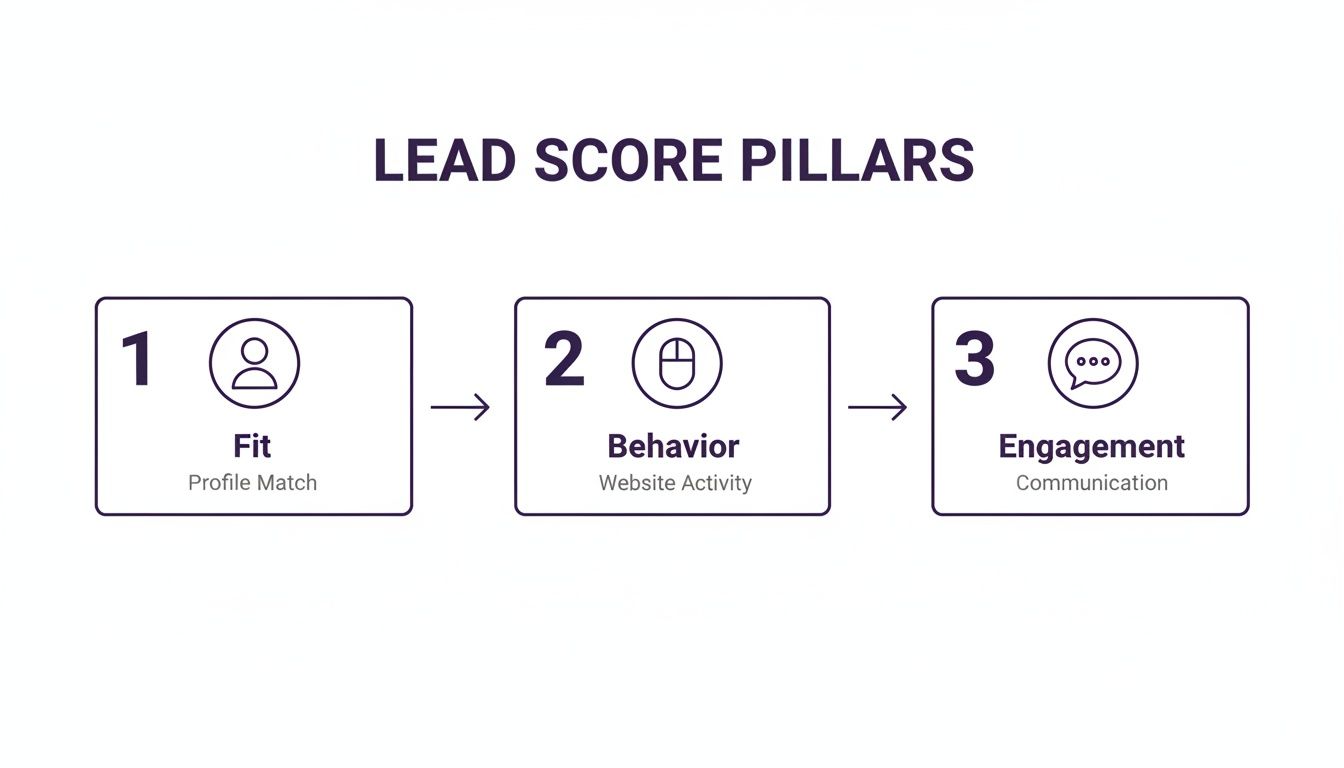
This method ensures you're evaluating leads from all angles, balancing who they are with what they do.
Your scoring model should be a living document. Start with your best guess based on past sales data. If you notice that leads who watch your demo video close at a higher rate, bump up the point value for that action.
A Sample Scoring Model in Action
To make this more concrete, here’s a simple scoring model for a hypothetical B2B SaaS company selling an outreach tool to other SaaS founders.
Sample Lead Scoring Model for SaaS Founders
| Data Category | Specific Signal or Attribute | Points Assigned |
|---|---|---|
| Fit | Job Title: "Founder" or "CEO" | +20 |
| Fit | Industry: "B2B SaaS" | +15 |
| Fit | Company Size: 10-50 | +10 |
| Behavior | Visited Pricing Page | +15 |
| Behavior | Requested a Demo | +25 |
| Behavior | Downloaded Case Study | +10 |
| Engagement | Replied to an X/Twitter DM | +15 |
| Engagement | Liked 3+ relevant tweets | +5 |
| Engagement | Mentioned a competitor | +10 |
This table is just a starting point. The real power comes from tweaking these values based on what actually leads to closed deals for your business.
Pulling all this data together, especially from a fast-moving platform like Twitter, can be a serious grind. This is where automation becomes your best friend. For example, a tool like DMpro offers automated lead scraping to pull this data without the manual headache. By getting the data collection on autopilot, you can focus your energy on refining your scores and actually reaching out to the right people.
Putting Your Lead Score Into Action
So you've built a slick scoring model. That's great, but a score is just a number until you actually do something with it. A high score doesn't pay the bills. The real magic happens when you use your scores to build a system that tells you exactly who to talk to right now.
This is the bridge between data and revenue. It’s how you stop manually digging through prospects and start having more conversations that actually lead somewhere.
Setting Your Lead Thresholds
First, you need to set clear thresholds. This is where you decide what score qualifies a lead as “hot,” “warm,” or “cold.” These aren't just labels; they're triggers for specific sales actions.
Think of it like a simple traffic light for your pipeline:
- Hot Leads (e.g., Score > 80): This is the green light. These are your A-players who tick all the boxes. They fit your ICP, have shown strong intent, and engaged recently. These folks get an immediate, personalized DM. No delays.
- Warm Leads (e.g., Score 50-79): The yellow light. They’re promising but might need more nurturing. Maybe they're a perfect fit but haven't shown those urgent buying signals yet. Add them to a light touch nurture sequence to warm them up.
- Cold Leads (e.g., Score < 50): The red light. These leads don't meet the criteria right now. Don't toss them out, but don't waste your prime selling time on them either. Keep them on a newsletter for the future.
Having these thresholds gives you crystal-clear rules of engagement. When a lead’s score hits 81, you know it’s go-time. No hesitation, no second-guessing.
Your thresholds transform lead scoring from a passive analytics tool into an active sales playbook. It tells you not just who to contact, but how and when.
Automating Your Outreach Triggers
Manually checking scores and deciding who to message is a surefire way to let great opportunities slip through the cracks. As a founder, you can't let a hot lead go cold just because you were stuck in meetings. This is where automation becomes your secret weapon for scaling distribution.
Instead of staring at a dashboard, you can set up simple workflows that fire off actions the moment a lead crosses a threshold. This is a game-changer for outreach on Twitter, where timing is everything.
For example, a tool like DMpro.ai can automate this process. You can create a rule that says: when any lead I'm tracking hits a score of 80 or more, automatically send them this personalized cold DM. This ensures you’re striking while the iron is hot, every single time. It’s how you scale your outreach without losing that critical personal touch. There are many fantastic lead generation automation tools out there that can help with this.
By connecting scores to automated actions, you're building a machine that surfaces and engages your best prospects 24/7. To make sure it's working, you have to track the right KPI lead generation. This closes the loop and helps you prove that your high-scoring leads are turning into revenue.
Common Lead Scoring Mistakes and How to Avoid Them
Building a lead scoring model is a massive step forward, but it's not a "set it and forget it" solution. Too many founders build a system, get excited, and then watch it slowly become useless because they fall into a few common traps.
The goal isn't just to build a model; it's to build one that stays sharp and actually helps you grow your SaaS. Let's look at the pitfalls to avoid.
Overcomplicating the Model
It’s tempting to create a system with fifty different rules, tracking every single action a lead can take. It feels like more data should lead to better results.
But more data doesn't always mean better scores. An overly complex model just creates noise, making it harder to spot the signals that truly matter. You end up with a system that’s confusing and impossible to maintain.
Start simple. Focus on the critical few indicators of intent. Did they visit your pricing page? Did they ask a specific question in your DMs on Twitter? These are high-value actions that deserve more weight than vanity metrics like a simple follow.
Forgetting to Use Negative Scores
Just as important as spotting the good fits is weeding out the bad ones. Negative scoring is your best tool for keeping the pipeline clean. It’s exactly what it sounds like: subtracting points for attributes or actions that signal a prospect is a terrible fit.
For example:
- A lead with a student email address? -10 points.
- Someone from an industry you don't serve? -15 points.
- A known competitor poking around your site? -50 points.
Using negative scores ensures your team isn't wasting precious time chasing leads who will never buy. It keeps your high-priority list reserved for genuinely qualified prospects.
Lead scoring isn't just about finding the winners; it's about systematically disqualifying the time-wasters so you can focus all your energy where it counts.
This is critical when you start automating outreach. You don't want an automated tool like DMpro.ai sending your best messages to an intern at a rival company. Negative scores are the guardrails that prevent that from happening.
To build a truly effective system, you need to combine different kinds of data. A recent study found that over half of companies (52.17%) now blend explicit data (like company size) with implicit behavioral data to get a much more accurate score. As these lead generation statistics show, this layered approach provides a far clearer picture of who's actually ready to talk.
Answering Your Top Lead Scoring Questions
<iframe width="100%" style="aspect-ratio: 16 / 9;" src="https://www.youtube.com/embed/kf3bf_GCzZw" frameborder="0" allow="autoplay; encrypted-media" allowfullscreen></iframe>Alright, even with the best plan, you're going to have questions. As founders, we don't have time for fluff—we just want straight answers so we can get back to building.
This section cuts to the chase, tackling the most common questions I hear from other SaaS founders.
How Often Should I Update My Lead Scoring Model?
Your lead scoring model isn't a "set it and forget it" deal. It's a living system that needs tuning. If you just leave it alone, it'll get stale as your market, product, and ideal customers all change.
A good rule of thumb is to review your model quarterly. That’s the sweet spot—enough time to gather real data, but not so long that things get out of sync.
During that review, look at your recent wins. Are your high-scoring leads consistently closing? Great. Are low-scoring leads converting? That’s a red flag. It means your model is missing a key buying signal. Think of it like tuning an engine; small, regular tweaks keep it running at peak performance.
What Are the Best Data Sources for a SaaS Founder?
It's easy to get lost in the sea of potential data points. My advice? Keep it simple and start where you're already spending your time. For most of us building in public, that means Twitter, our own website, and our email list.
Kick things off with these high-impact sources:
- On Twitter: Zero in on profile data and direct engagement. Look for keywords in their bio (like "SaaS founder"), check their follower count, and pay close attention to replies or DMs—those are strong signs of genuine interest.
- On your website: Track who is visiting your high-intent pages. Someone browsing your blog is one thing. Someone who keeps coming back to your pricing page is practically raising their hand.
- From your email list: Open rates and click-through rates are simple but powerful signals of who's actually leaning in.
Stitching these sources together gives you a solid view of a lead without needing a team of data scientists.
How Can I Start If I Have Very Little Data?
The classic chicken-and-egg problem for early-stage founders. Don't let it paralyze you. You don't need "big data" to start; you just need a starting hypothesis.
Begin by obsessing over your first 10-20 paying customers. Get on calls with them, study their journey, and hunt for the common threads.
What did they have in common? What specific actions did they take right before they decided to buy? These patterns are the foundation of your first scoring model.
Build your initial model based on what you find. It won't be perfect, but it gives you a baseline to test and improve as more data rolls in.
Should I Use Negative Scoring?
Yes. A thousand times, yes. Negative scoring is one of the most powerful ways to keep your pipeline clean and your focus sharp. It's how you proactively filter out all the noise.
Think of it as putting up guardrails. You assign negative points for traits that are clear signs of a bad fit. If a student or an employee from a competitor starts engaging, you can subtract points to automatically move them to the bottom of the list.
This is absolutely crucial if you're automating your Twitter outreach. A tool like DMpro.ai can send personalized messages at scale, but you only want it talking to real, qualified prospects. Negative scoring ensures your automated campaigns are laser-focused on people who can actually buy.
So, what's the big takeaway here?
Building a solid lead scoring system isn't just another task on your to-do list; it's one of the smartest moves a founder can make to scale distribution. It’s the difference between throwing darts in the dark and having a predictable way to grow your business.
When you start focusing your precious time on the people who are actually ready to talk, everything changes. You're not just boosting your win rate; you're building a sales process that can scale without falling apart. It's about spending less energy guessing and more time connecting.
Ultimately, this system tells you exactly who to talk to right now. It's all about working smarter, not harder, to find your next best customers.
If you’re tired of manually sending DMs every day, try DMpro — it automates outreach and replies while you sleep.
Ready to Automate Your Twitter Outreach?
Start sending personalized DMs at scale and grow your business on autopilot.
Get Started Free