
What Is a Sales Development Representative? A Founder's Guide to Building Your Sales Engine
What is a sales development representative? This founder's guide breaks down the SDR role, offers actionable insights, and shows you when to hire.
So, what exactly is a Sales Development Representative (SDR)? In simple terms, an SDR is a specialist on your sales team laser-focused on one mission: finding and qualifying potential customers.
They're on the front lines, starting conversations and figuring out if a prospect is a good fit for your SaaS before they ever talk to a closer. They are the engine of your sales pipeline.
The Engine of Your Sales Pipeline
For any founder, understanding the SDR role is key to unlocking predictable revenue. Think of them as the gatekeepers of your sales process. Their entire job is to make sure your closers—the Account Executives (AEs)—spend their time talking to people who can actually buy.
Imagine a busy restaurant. The SDR is the host at the front door. They greet people, see if they're a good fit for the menu, and guide the right patrons to a table. The AE is the server who takes their order. This separation of duties makes the whole operation incredibly efficient.
This process of finding and warming up potential customers is a crucial part of what’s known as outbound lead generation.
Why Founders Need to Understand This Role
The SDR role isn't just about smiling and dialing. It's a strategic, high-volume job that demands serious focus. They are the very first human touchpoint for many of your future customers.
The real magic of an SDR is their ability to turn a cold shoulder into a warm handshake. They transform passive interest into a real, sales-ready conversation.
Their work is a numbers game. An SDR makes dozens of touches a day—a mix of calls, emails, and social DMs—just to spark a few meaningful chats. That high volume is exactly why smart tools are no longer a luxury.
If your SDRs are prospecting on platforms like Twitter, manually sending hundreds of personalized DMs is a huge time-drain. This is where a tool like DMpro comes in. It automates that first touchpoint, so your team can focus on warm leads ready to talk, not waste time on cold outreach.
To give you a clearer picture, here’s a quick breakdown of what an SDR actually does day-to-day.
Core SDR Responsibilities for Founders
This table summarizes the key tasks an SDR handles to keep your sales pipeline full. It’s a systematic approach to creating opportunities from scratch.
| Responsibility | What It Means for Your Business |
|---|---|
| Prospecting & Research | They find and vet potential customers who match your ideal customer profile, ensuring you're talking to the right people. |
| Outreach | SDRs initiate contact through multi-channel sequences (email, phone, social), making the first impression for your brand. |
| Qualification | They ask the right questions to confirm a prospect has a need, the budget, and the authority to buy. No more wasted time for your AEs. |
| Booking Meetings | Their primary goal is to schedule a qualified discovery call or demo between the prospect and an Account Executive. |
| Pipeline Management | They meticulously track every interaction in a CRM, providing clean data and insights into what's working. |
In short, a great SDR team tees up high-quality at-bats for your closers, dramatically increasing the odds of turning a conversation into a customer.
What a High-Performing SDR Actually Does All Day
Ever wondered what a top Sales Development Representative really does every day? It’s not about blasting out generic emails. It's a highly structured process designed to consistently book qualified meetings.
A great SDR’s day is anything but random. They run a multi-channel playbook to connect with the right people at the right time. They aren’t just trying to hit a quota; they’re trying to start meaningful business conversations.
At its core, the SDR workflow is simple: find potential customers, qualify them, and then pass the opportunity to a closer.
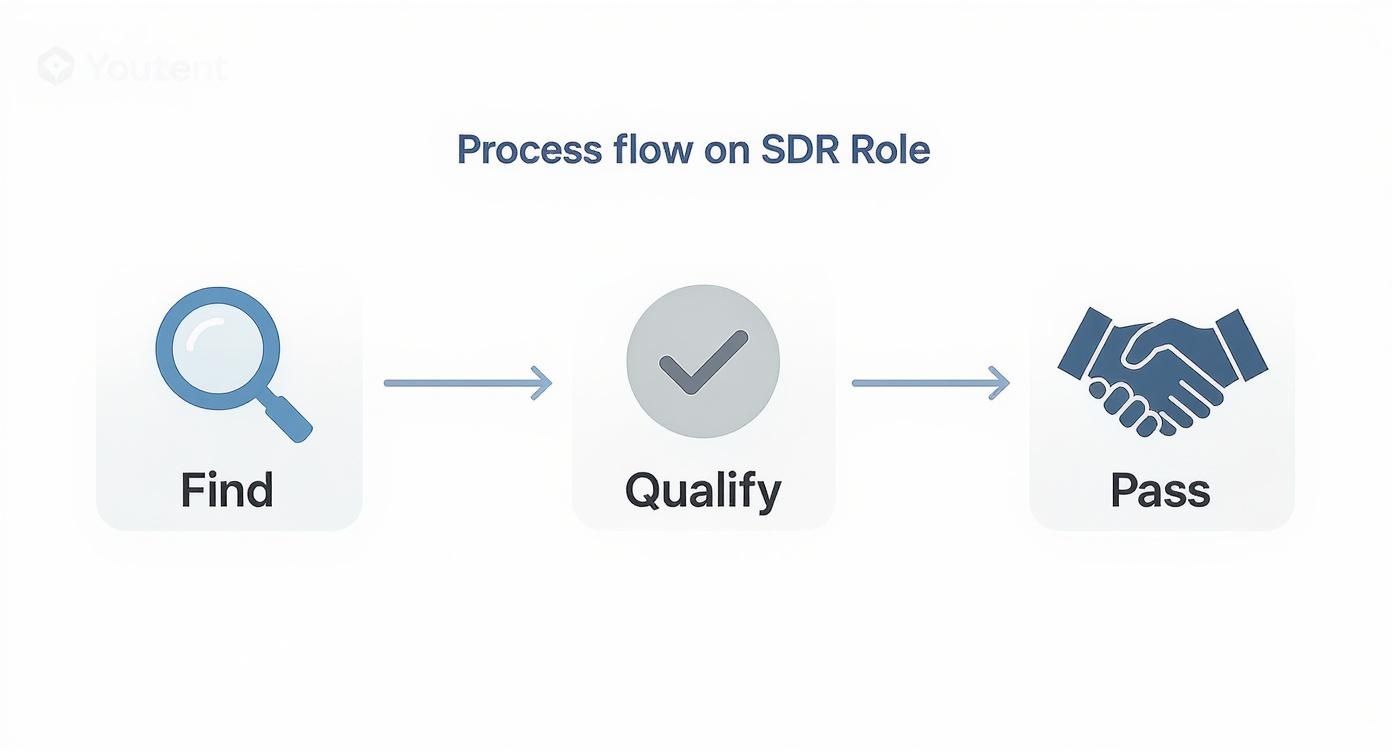
Think of the SDR as the ultimate filter. Their job is to make sure your closers (the Account Executives) only spend time with people who have a real problem you can solve.
Prospecting and Research
The day always kicks off with prospecting. This isn't just mindlessly scrolling through LinkedIn. It's about surgically identifying companies and contacts that match your Ideal Customer Profile (ICP).
They're hunting for buying signals—a new executive was hired, or someone on Twitter is complaining about a pain point your product solves. They build hyper-targeted lists to make every message feel personal.
Multi-Channel Outreach
Once they have a solid list, the outreach begins. This is where the grind—and the magic—happens. SDRs use a mix of channels to cut through the noise.
- Personalized Emails: A huge chunk of the day is spent writing compelling emails. Following cold email best practices is non-negotiable.
- Targeted DMs: Platforms like Twitter are goldmines for lead generation. Tools like DMpro can automate that first touchpoint, letting a single SDR manage hundreds of DMs without losing that personal feel.
- Strategic Calls: Cold calling isn't dead, it’s just smarter. Calls are now used to follow up on an email or to quickly qualify a high-value prospect.
Qualifying and Booking Meetings
The moment a prospect responds, the SDR’s role pivots from hunter to detective. Their job is now to qualify the lead. Using a series of smart questions, they dig into the prospect's challenges and goals.
They’re listening for key signals. Is there a real problem here? Does this person have the power to make a decision? If the answer is yes, the SDR’s final move is to book that crucial meeting for an Account Executive.
This is the end goal. An SDR’s success isn't measured by calls made, but by qualified meetings set. It takes discipline and the right tools. Speaking of which, we’ve broken down some of the best prospecting tools for sales in another guide.
2. SDR vs BDR vs Account Executive Explained
If you're building a SaaS sales team, you've run into the acronyms SDR, BDR, and AE. Getting these roles straight is crucial for building a machine that actually closes deals.
When you define these roles correctly, you prevent good leads from falling through the cracks and ensure your team is laser-focused on what they do best.

The easiest way to think about it is like a relay race. Each person has a specific job before passing the baton to the next.
Who's Who on a Modern Sales Team
Let's break down the three core roles you'll find in most high-growth SaaS companies.
-
Sales Development Representative (SDR): The Hunter. The SDR is your outbound specialist. They proactively reach out to cold prospects—people who likely haven't heard of you. Their entire job is to start conversations from scratch.
-
Business Development Representative (BDR): The Cultivator. In many organizations, the BDR handles all inbound interest. These are prospects who have already raised their hands by downloading a guide or filling out a form. The BDR's mission is to qualify this interest.
-
Account Executive (AE): The Closer. The AE is your rainmaker. They take the qualified meetings that SDRs and BDRs book and guide the prospect all the way to a signed contract. Their days are filled with demos, proposals, and closing deals.
The core takeaway is this: SDRs and BDRs create qualified opportunities. Account Executives close them. This division of labor is the secret sauce behind scalable SaaS distribution.
This specialization lets everyone master their part of the process.
To give you a clearer picture, here’s a simple table breaking down their differences.
SDR vs BDR vs Account Executive Key Differences
| Role | Primary Focus | Key Metric |
|---|---|---|
| Sales Development Representative (SDR) | Outbound Prospecting (Cold) | Meetings Booked or Qualified Pipeline |
| Business Development Representative (BDR) | Inbound Lead Qualification (Warm) | Sales Qualified Leads (SQLs) |
| Account Executive (AE) | Closing Deals | Revenue Generated or Quota Attainment |
As you can see, what success looks like for each role is completely different, which is exactly how it should be.
How Their Goals and Metrics Differ
The way you measure each role reflects their unique contribution. An SDR is measured by the number of qualified meetings they book from cold outreach. A BDR, meanwhile, is judged on the volume of inbound leads they qualify.
The AE has the most straightforward metric of all: revenue closed.
This structure is incredibly efficient. It ensures your most experienced—and expensive—salespeople (the AEs) spend their time doing what they do best: selling.
A huge piece of this puzzle is making sure the leads passed to the AE are actually ready. To dive deeper into that, check out our guide on how to qualify sales leads. Getting this right sets your entire team up for success.
Hiring Your First SDR: What to Look For
Bringing on your first Sales Development Representative is a make-or-break moment. You're hiring the engine of your sales pipeline. Get it right, and you're laying the foundation for serious growth.
So, what do you actually need in a great SDR? Let's cut through the fluff. The best SDRs are a unique blend of detective, writer, and psychologist. The traits they possess matter far more than years of experience.
The Non-Negotiable Traits
When you start interviewing, dig for the core attributes someone needs to thrive in a role built on rejection.
- Resilience: An SDR hears "no" constantly. They need the mental fortitude to shake off a bad call and dial the next number with the same energy.
- Coachability: The top performers are sponges. They want feedback and can put it into practice right away without getting defensive.
- Deep Curiosity: Great SDRs are naturally interested in how businesses work. This curiosity fuels them to ask insightful questions and uncover real problems.
- Meticulous Organization: This job is a numbers game. A successful SDR has to be a master of their CRM, follow-up sequences, and daily schedule.
The single most important skill isn't sales experience—it's an obsessive drive to get better. An SDR who listens back to their own call recordings is infinitely more valuable than a smooth-talker who thinks they know everything.
Finding the Right Fit for Your Stage
As a founder, it’s important to know that the SDR role is changing. SDR compensation, for instance, has been climbing. You can read more about these SDR compensation trends on Betts Recruiting.
This trend means you're looking for someone who doesn't just have the core traits but can also think strategically. They need to understand your ideal customer profile and have the instincts to spot opportunities on platforms like Twitter. To dive deeper into this crucial first step, check out our guide on how to identify your target audience.
Find someone who ticks these boxes, and you’re not just hiring an SDR—you’re building a pipeline-generating machine.
The Modern SDR: How Automation Scales Outreach
A great Sales Development Representative isn't just about hustle anymore; it's about working smarter. The best SDRs use technology to scale outreach without burning out. As founders, our job is to give them the right tools to win.
The old-school approach of manually dialing or copy-pasting emails is dead. Modern outreach is about automating repetitive tasks so your SDRs can focus on what they do best: building real connections.
From Manual Grind to Automated Scale
Imagine your SDR finds 100 perfect-fit leads on Twitter. Manually sending a personalized DM to each one is a massive time sink. This is where automation becomes a founder’s secret weapon.
A modern workflow flips this model. Instead of one-to-one manual outreach, your SDR uses tools to manage conversations at scale. This isn't about sending spam. It’s about using technology to execute a personalized strategy with speed.
The goal of automation isn't to replace your SDR. It’s to augment their skills, turning them from a prospector into a pilot who manages automated outreach campaigns.
For example, a tool like DMpro.ai is a game-changer for Twitter lead generation. Your SDR can define the ideal customer profile, and the system handles the initial outreach and follow-ups automatically. The SDR only steps in when a lead shows interest.
This is what a modern, automated outreach dashboard can look like, giving you a bird's-eye view of all your campaigns.

With a setup like this, a single SDR can manage the output of what would have taken three people to do manually just a few years ago.
The Real Impact of Smart Automation
When you bring in smart automation, you change the SDR's job for the better. Their focus shifts from low-value tasks to high-impact activities.
Here’s what that shift looks like:
- Less Time Prospecting: Automation handles the initial search and outreach, finding qualified leads around the clock.
- More Time Selling: SDRs spend their energy engaging warm leads and booking high-quality meetings.
- Better Data: Automated systems give you clear metrics on which messages and audiences are working.
This approach transforms the role from a manual grinder into a strategic operator. And that is how you scale your SaaS distribution efficiently.
Should a Founder Hire an SDR or Automate First?
As a founder, bringing on your first sales hire is a monumental step. It's a huge investment in salary, training, and management. But what if there's a smarter move to make first?
This leads to a question I see founders wrestle with all the time: Do you hire an SDR, or do you start with outreach automation?
<iframe width="100%" style="aspect-ratio: 16 / 9;" src="https://www.youtube.com/embed/lCrY8A0C83E" frameborder="0" allow="autoplay; encrypted-media" allowfullscreen></iframe>Hiring a human SDR gives you that irreplaceable personal touch. They can adapt on the fly, pick up on market feedback, and build real relationships.
The catch? It's expensive. You're also placing a massive bet on a single person to figure out your entire outbound strategy from scratch.
The Automation-First Approach
On the flip side, automation gives you a leaner way to see if your outreach strategy even has legs. A tool can run your campaigns 24/7 for a tiny fraction of a full-time salary. This is perfect for testing your messaging and zeroing in on your ideal customer.
For example, a tool like DMpro.ai can put your entire Twitter outreach on autopilot. You just tell it who to target and write your message sequences, and the system sends the DMs and follow-ups. All that time you save can be poured back into building your product.
This strategy lets you prove you have a viable market and a message that resonates before you hire someone to scale it.
The smartest play is usually a hybrid one. Start with automation to build a repeatable, data-backed process. Once you’ve proven what works, then hire an SDR to run and scale that proven system.
This isn't just a theory. A recent survey showed a telling trend: 36% of SaaS companies have shrunk their SDR teams. As detailed in an article about the great SDR downsizing at Saastr.com, many are moving toward leaner teams powered by AI and automation.
When you start with automation, you build the playbook first. Then, you hire a great SDR to run the plays, not to invent them from scratch. That's how you build a scalable sales engine from the start.
Turning Theory into a Sales Engine
Alright, so you know what a Sales Development Representative does. Now, let’s talk about building an outbound sales engine that works. The goal isn't just to be busy—it's to create a reliable system that brings in leads like clockwork.
Whether you hire an SDR or start with automation, the first step is the same. You have to get crystal clear on your ideal customer. Who are you trying to sell to? Where do they hang out online? What’s the one big problem that’s nagging at them?
Once you have a sharp picture of that person, you can craft a message that resonates. This isn't about listing product features. It’s about showing them you understand their world.
Putting Your Outreach Plan into Motion
You've got your target audience and your message. The last piece is just doing the work, consistently. This is where so many outreach efforts fail. You need a disciplined, repeatable process for reaching out and following up.
Think of it this way: your sales engine runs on three things—knowing your customer, having a clear message, and being relentlessly consistent. Nail those, and you’re building a foundation for predictable growth.
This is exactly where outreach automation can be a game-changer for a founder. Instead of sinking hours into manual prospecting on Twitter, you can build a system to do the grunt work. A tool like DMpro can handle those initial DMs and follow-ups, making sure your message consistently gets in front of the right people.
If you’re tired of manually sending DMs every day, try DMpro.ai — it automates outreach and replies while you sleep.
Ready to Automate Your Twitter Outreach?
Start sending personalized DMs at scale and grow your business on autopilot.
Get Started Free