
How to Identify Your Target Audience for SaaS Growth
A practical guide on how to identify target audience for your SaaS. Stop guessing and start using data-driven steps to find customers who will actually buy.
Let's get one thing straight: "everyone" is not your customer. Figuring out your target audience is about finding the specific group of people who are most likely to buy your SaaS.
It’s about digging into who they are, what they do, and what keeps them up at night. The goal is to build a detailed profile—an Ideal Customer Profile (ICP). This isn't just a marketing exercise. It’s the foundation for your product, marketing, and sales decisions.
Move Beyond Guesswork to Find Your Real Customers
Most founders start with a gut feeling. We build something we think is brilliant and assume customers will just show up. But hope isn't a strategy, and a vague customer profile will burn through your cash and energy fast.
Figuring out who you're actually selling to is the single most important thing you can do to scale. It’s the difference between shouting into an empty stadium and having a quiet, productive conversation with someone who's been waiting for your solution.
Casting a wide net is a classic rookie mistake. It leads to watered-down messaging, a marketing budget that evaporates, and a sales pipeline full of leads who were never going to buy.
This guide is your roadmap from a blurry idea of "our customer" to a razor-sharp ICP. A well-defined ICP is the lens for every business decision you make.
When you know exactly who you're talking to, everything else clicks into place. You’ll know:
- Where they hang out online (like Twitter or specific communities).
- The exact language to use in your cold outreach.
- Which product features solve their biggest headaches.
This process is the bedrock for your growth, especially for building outbound lead generation campaigns that actually work. A focused approach doesn't just save time and money; it builds the foundation for your entire go-to-market strategy.
Gathering Your Initial Customer Clues
Alright, let's get our hands dirty. This is where we stop guessing and start digging for real clues about who your ideal customers are. We're on an evidence hunt for the raw data that will point you in the right direction.
Don't worry, you don't need a PhD in data science. Just collect enough info to build your first solid, educated guess. We'll split this into two main types: hard numbers (quantitative) and human stories (qualitative).
This is all about shifting from a vague gut feeling to laser focus.
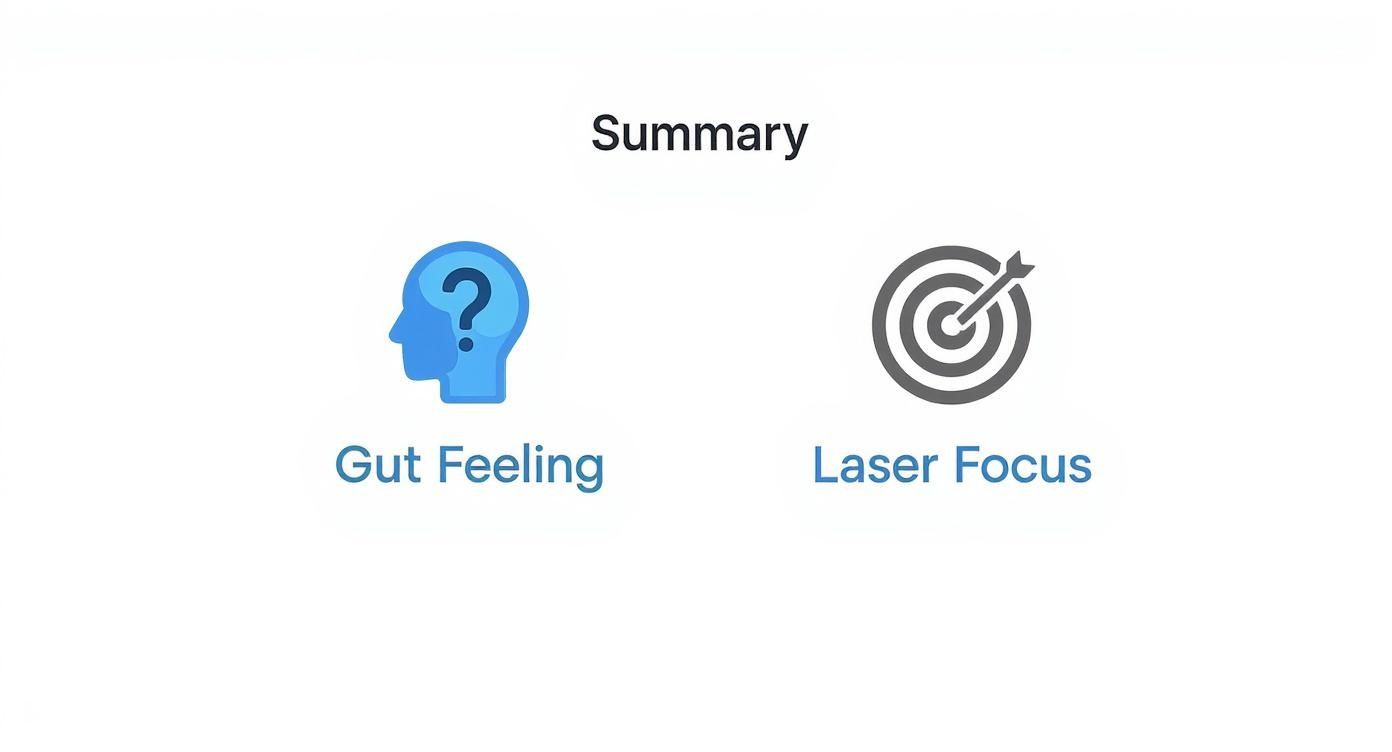
When you make that switch, all your effort is aimed at people who are most likely to care—and buy.
Digging Into the Numbers (Quantitative Data)
Quantitative data tells you the "what" and "who" by tracking actions and demographics. Even if you're starting from scratch, you probably have more of this data than you realize.
Here are a few treasure troves you can tap into right now:
- Your Existing User Base: Got a few early adopters? Perfect. Dive into your product analytics or CRM. Look them up on LinkedIn. What are their job titles? What size companies do they work for? This is ground zero for figuring out who already sees value in what you offer.
- Social Listening: People are talking about the problems you solve right now on platforms like Twitter. Use the advanced search to find conversations using keywords from your niche. You’ll find a goldmine of the exact language your audience uses.
- A Peek at the Competition: Who follows your competitors on Twitter and LinkedIn? This is a free, public list of people already interested in solutions like yours. It’s one of the quickest ways to find potential leads and is a core tactic for scaling SaaS distribution. Our guide on how to find clients online breaks it down.
Getting Insights From Real People (Qualitative Data)
Now for the fun part. Qualitative data gives you the "why" behind the numbers. Analytics show you what people do, but only a real conversation tells you why. This is where you uncover the insights that will make your messaging resonate.
The average person is juggling 6.8 different social media platforms. Their attention is fragmented. A genuine conversation cuts through the noise and helps you understand what truly motivates them.
Your first 10 customer conversations will teach you more than 100 hours of staring at spreadsheets. Seriously. Don't overthink this—just start talking to people.
A quick survey on a simple tool like Tally or Google Forms is a great starting point for casting a wider net.
But honestly, nothing beats a one-on-one chat. A 15-minute video call can reveal pain points that analytics will never catch. Learning how to conduct user interviews effectively is a skill that pays dividends forever.
Data Collection Methods At a Glance
Feeling a bit overwhelmed? Here’s a quick breakdown to help you pick the right method.
| Method | What You Get | Best For | Time Investment |
|---|---|---|---|
| Product/Web Analytics | Hard numbers on user behavior and demographics | Understanding your current user base | Low |
| Social Listening | Raw, unfiltered language and pain points | Early-stage idea validation and messaging | Low to Medium |
| Surveys | Scaled feedback on specific questions and preferences | Getting quick feedback from a larger group | Medium |
| 1-on-1 Interviews | Deep, nuanced insights into motivations and "why" | Building personas and finding product-market fit | High |
The best approach is a mix of both. Use quantitative data to spot trends, then use qualitative conversations to understand the stories behind those trends.
Building Your First Ideal Customer Profile
Okay, you've gathered the clues. Now it's time to turn that raw data into your single most important asset: your Ideal Customer Profile (ICP).
This isn't some fluffy persona that gets buried in a Google Drive folder. Think of your ICP as a practical, one-page blueprint. It’s the document that will guide every outreach message and product decision you make.
Forget the ridiculously detailed templates you've seen online. As a founder focused on growth, your first ICP needs to be lean and built for action. We're zeroing in on the details that directly impact lead generation and closing deals.

The goal is simple: get specific enough to confidently answer, "Where can I find 100 more people exactly like this?"
The Core Components of an Actionable ICP
Let's cut right to it. A truly useful ICP boils down to four key pillars. These are the exact inputs you'd plug into a tool like DMpro to find thousands of qualified prospects on Twitter, so getting them right is non-negotiable.
- Job Title & Role: Get specific. "Marketer" is useless. "Head of Growth" or "Content Marketing Manager" is much better because it tells you their function and authority.
- Company Details: This is about firmographics. What industry are they in (e.g., B2B SaaS, FinTech)? How big is the company (e.g., 10-50 employees)? This helps you find clusters of similar businesses.
- Their Primary Pain Points: This is pure gold. Use the exact words you heard in interviews. "Struggling to scale our content distribution" is infinitely more powerful than a generic "needs marketing help."
- Watering Holes: Where do they hang out online? Be specific. Is it #MarketingTwitter, the r/SaaS subreddit, or niche LinkedIn groups? This is where you’ll engage them.
Professional demographics are a huge piece of the puzzle. For example, a staggering 47.3% of LinkedIn's global user base is between 25-34 years old, a massive pool of ambitious, mid-career professionals. Knowing this helps you figure out where your target job titles are most likely to be active.
A Real-World Example in Action
Let's say you built a project management tool for small marketing teams. After digging into early user data and lurking on Twitter, your initial ICP might look like this:
Job Title: Marketing Manager or Head of Marketing Company Size: 10-50 employees, specifically in the B2B SaaS industry Pain Point: "Our current PM tool is too bloated for our small team; we spend more time managing the tool than doing the work." Watering Hole: Follows SaaS influencers like Jason Lemkin on Twitter, active in marketing-focused Slack communities.
See how practical that is? It’s not their life story. It’s a set of targeting criteria you can immediately use for lead generation.
With this profile, you're ready to start defining your Ideal Customer Profile (ICP) for lead generation and building targeted lists. Just remember, your ICP is a living document. You’ll constantly refine it as you get more feedback.
Validating Your Audience with Real-World Tests
So you've built an ICP on paper. It's a great start, but right now, it's just an educated guess. To really know if you're on to something, you have to test it in the wild.
For SaaS founders, there’s no better testing ground than X (what we all still call Twitter). Why? It's fast, direct, and transparent. You can get real feedback in hours, not weeks—exactly the speed you need when you're trying to find product-market fit and scale your distribution.

Let’s be clear: the goal here isn't to close deals. It’s to get proof that your assumptions are correct.
Running a Small-Scale Outreach Test on Twitter
This validation process doesn’t need to be some huge, complicated campaign. Simplicity is your best friend here. It’s the key to getting quick signals from the market. We're running a small experiment to see if your ICP resonates with real people.
Here’s a practical, founder-friendly approach:
- Find Your People: Use Twitter's advanced search to pinpoint 50-100 people who perfectly match your ICP. Look for specific job titles, keywords in their bios ("B2B SaaS" or "growth marketer"), and hashtags they use.
- Craft a Non-Salesy DM: This is critical. Your first message should not be a sales pitch. Offer genuine value, ask an insightful question, or reference a recent post. Your only goal is to start a conversation.
- Track Everything: Use a simple spreadsheet to log your results. Note who you messaged, who replied, and the sentiment of the reply. These are your first pieces of market feedback.
This hands-on process gives you a gut check that no amount of research can replicate. You'll learn quickly if your messaging is landing or falling flat.
Measuring What Truly Matters
As replies start trickling in, you need to know what you’re looking for. It’s easy to get discouraged by a low reply rate, but we’re focused on the quality of engagement.
The two metrics that matter most at this stage are:
- Reply Rate: What percentage of people responded? This tells you if your opening line is compelling enough to earn a response.
- Qualification Rate: Of those who replied, how many are actual potential customers who fit your ICP and have the problem you solve? This is the most crucial signal.
A high reply rate from unqualified people means your messaging is catchy but your targeting is off. A low reply rate from your target list means your targeting is right but your message isn't hitting home. Getting a handle on how to qualify these responses is a skill in itself; our guide on how to qualify sales leads can help.
A single, enthusiastic reply from a perfect-fit prospect is worth more than a dozen polite "no thank yous" from the wrong audience. This is about finding signal in the noise.
Traditionally, marketers leaned on demographic data. With social media now reaching 65.7% of the world's population, the pool is enormous. This massive reach is why a targeted approach is essential. You can learn more about how social media demographics shape modern marketing on GlobalTechStack.com.
For founders looking to scale this, doing it all by hand is a bottleneck. This is where a tool like DMpro shines. You can set up automated campaigns to test different audience segments or messaging angles on Twitter. Instead of spending your day buried in DMs, the automation handles the outreach while you focus on analyzing feedback and refining your ICP. It turns a manual task into a scalable validation engine.
Turning Feedback Into Your Roadmap
Those DMs you sent? They were the start of a conversation. Every reply—and even every non-reply—is valuable intel. The market is talking back, and listening is what separates the companies that win from those shouting into the void.
You've left theory behind and stepped into real-world data. Now, it’s time to dig in and figure out what the signals mean so you can adjust your ICP and outreach strategy. This is a continuous cycle: test, analyze, refine. This loop pulls you closer to product-market fit.
The Metrics That Actually Matter
Let's cut through the noise. Forget vanity metrics. When you’re validating an audience, only a handful of numbers tell you what's going on.
Here’s what to zero in on:
- Reply Rate: This is your first clue. If your reply rate is sinking below 10%, something's wrong. It could be your opening line, or you could be knocking on the wrong doors.
- Qualification Rate: Of the people who replied, how many are actually potential customers? A "qualified" reply comes from someone who fits your ICP and confirms they have the problem you solve. This number truly counts.
- Response Sentiment: What’s the vibe of the replies? Are people curious and asking questions, or are they brushing you off? The tone tells you a lot. Positive feedback from the wrong people means your ICP just needs to be more specific.
This whole process is about building a feedback loop. You put a hypothesis out there, see what comes back, and then tweak your approach.
Reading the Tea Leaves and Adjusting Your Course
Your data tells a story. A high reply rate full of unqualified leads? Your message is good, but your targeting is too broad. A low reply rate from what you thought were perfect prospects? Your targeting is right, but your message isn't hitting home.
The goal isn't a "yes" from everyone. It's a "tell me more" from the right people. That's the signal that you're onto something big.
This is where fine-tuning begins. Make small, calculated tweaks. If you targeted "Marketing Managers" and heard crickets, get more specific. Try "Marketing Managers at B2B SaaS companies with 10-50 employees." If your "save time" message fell flat, try talking about a more specific pain point, like "cutting down complexity in your project management."
Juggling this manually is tough. Once you start testing multiple audience segments, spreadsheets become a nightmare. An outreach automation tool like DMpro makes a massive difference. You can set up distinct campaigns for each hypothesis on Twitter and let the tool manage sending and tracking. Suddenly, you have clean, organized data, turning a chaotic effort into a structured experiment.
So, What Do You Do With All This Information?
<iframe width="100%" style="aspect-ratio: 16 / 9;" src="https://www.youtube.com/embed/3BNGMMc3Bgc" frameborder="0" allow="autoplay; encrypted-media" allowfullscreen></iframe>You've dug through the data, built your Ideal Customer Profile, and run a few tests. Now you have a solid, data-backed picture of who your customer is.
So, what's next?
This is where the rubber meets the road. That hard-earned insight is just theory until you translate it into your marketing and sales strategy. The goal is to make sure every single thing you do—from your website copy to the DMs you send—is perfectly tuned to the people who will actually buy from you.
Nailing the Message
Think of your refined ICP as a cheat sheet for writing copy that works. Every word you write, whether for a landing page or a cold DM on Twitter, should echo the exact pain points you uncovered in your research.
It’s all about using their language. If your ideal customers complain about “clunky workflows,” don’t sell them on “streamlined operational efficiency.” Speak their language, and they’ll feel like you’re reading their minds.
A great message doesn't just describe your product; it describes your customer's problem so well that they feel completely understood. That's how you build trust from day one.
Getting this right is the foundation for any scalable outreach. For a closer look, we've got a whole guide on B2B lead generation best practices that dives into the tactics.
Aligning Your Content and Outreach Efforts
With a validated ICP, you can finally stop guessing what content to create. Your audience’s biggest challenges become your content calendar. Are they struggling with manual outreach? Create content about automation. Are they trying to figure out SaaS distribution? Write about that.
This same logic applies directly to your outreach on platforms like Twitter. Your DMs can now be laser-focused on their specific role and industry. Instead of sending a generic pitch that gets ignored, you can send something hyper-relevant that begs for a response.
Here’s how to put your insights into practice:
- Landing Page Copy: Tweak your headlines to hit on the primary pain points of your validated audience.
- Content Marketing: Map out content that directly answers their most urgent questions.
- Outreach Campaigns: Segment your lists and write personalized DM templates that speak to the unique struggles of each group.
If you’re tired of manually sending DMs every day, a tool like DMpro.ai can automate your outreach and replies while you sleep, which is a game-changer for scaling your SaaS distribution.
Frequently Asked Questions
Figuring out your target audience always brings up questions. As a founder, it’s easy to get caught up in the "what ifs." Here are some quick, no-nonsense answers to common hurdles.
What If I Have Multiple Potential Audiences?
This is a good problem to have, but it's also a trap. Don't try to be everything to everyone right out of the gate.
Prioritize them. Which group feels the most pain that your product solves? Start there. Then, run small, separate validation tests for each audience. This is where automation really shines. With a tool like DMpro, you can create distinct outreach campaigns for each segment on Twitter and see the engagement metrics side-by-side. The data will show you which group is biting and where you should double down.
How Long Should I Test an Audience?
You need enough data, but you can't let a failing test drag on. As a founder, time is your most precious resource.
As a rule of thumb, aim for a sample size of 100-200 people in a target segment. Give it a couple of weeks. If you're getting radio silence or a bunch of "not for me" replies, that's your sign. It’s time to either re-work your messaging or pivot to the next audience. Don't get attached; speed and iteration are your best friends.
Where Do I Start If I Have No Customers Yet?
When you're at square one, focus completely on the problem, not the product. Your first job isn't selling; it's listening.
Your first ICP shouldn't be based on assumptions. It should be built from the unfiltered conversations already happening online. Don't invent pain points—go find them in the wild.
Find the digital hangouts where your ideal customers might be. Think specific subreddits, niche LinkedIn groups, or Twitter communities. Just lurk and listen. What are they complaining about? What solutions have they tried that didn't work? This is pure gold for building your first draft ICP, which you can then validate with targeted outreach.
If you’re tired of manually sending DMs every day, try DMpro.ai — it automates outreach and replies while you sleep.
Ready to Automate Your Twitter Outreach?
Start sending personalized DMs at scale and grow your business on autopilot.
Get started