
What Is Outbound Lead Generation Explained
What is outbound lead generation? This guide explains the core concepts, strategies, and tools SaaS founders need to start and scale their growth.
Let's get straight to it. Outbound lead generation is all about proactively starting conversations with people you've identified as ideal customers, instead of just waiting for them to stumble upon you.
Think of it this way: you could stand in the corner of a networking event hoping someone interesting walks up to you, or you could walk right up to the person you want to meet and introduce yourself. As founders, we don't have time to wait. Outbound is the second one.
What Is Outbound Lead Generation?
At its heart, outbound lead generation is about taking the initiative. You're not casting a wide net with content and hoping the right fish swim in—that's inbound marketing. Instead, you're grabbing a spear and targeting specific, high-value prospects. You decide who you want to talk to, and then you go talk to them.
This whole game has changed a lot over the years. Outbound used to mean endless cold calls and generic email blasts that everyone hated. Today, it’s a much smarter, data-driven strategy. It’s all about precision, personalization, and reaching people where they're already hanging out and talking shop, like on Twitter.
The Shift from Volume to Value
The old "spray and pray" method is officially dead. Modern outbound isn't about spamming as many people as possible. It's about making a relevant, timely connection with a handful of founders who have a problem you can genuinely solve.
The numbers don't lie. Old-school tactics just don't work anymore. For instance, cold calling conversion rates are now down to a painful 2%. This reality has forced a massive shift toward more thoughtful approaches that put personalization and multi-channel outreach front and center. You can read more about this strategic shift in B2B lead generation if you want to dig deeper.
The secret sauce is identifying the right people before you even think about reaching out. This is where modern tools and data come in. You’re no longer guessing; you’re building a hyper-targeted list of potential customers based on real signals.
Outbound vs Inbound Lead Generation At a Glance
So, what's the real difference between outbound and inbound? It boils down to who makes the first move. This table breaks it down quickly.
| Aspect | Outbound Lead Generation (Proactive) | Inbound Lead Generation (Reactive) |
|---|---|---|
| Initiator | You (the seller) start the conversation. | The lead (the buyer) starts the conversation. |
| Targeting | Highly specific and targeted. You choose who to contact. | Broad. You attract anyone interested in your content. |
| Speed | Fast. You can see results and get feedback almost immediately. | Slow. It takes time to build content and SEO authority. |
| Control | High. You control the volume and timing of your outreach. | Low. You depend on people finding you. |
| Example | Sending a personalized DM to a founder on Twitter. | A potential customer finds your blog post via Google. |
Both approaches have their place, of course. But for founders who need to build a sales pipeline now, outbound offers a direct and predictable path to getting conversations started.
Outbound: You reach out to a potential customer first. It’s proactive, direct, and gives you complete control over who you talk to and when.
Inbound: A potential customer finds you first, usually through your content, and then reaches out. It’s reactive, builds long-term brand authority, and attracts leads who are already looking for a solution.
Outbound allows you to test your messaging, get instant feedback from your target market, and land those critical first customers without waiting months for your blog to rank on Google. The first step is always finding the right people, which is why effective lead scraping tools are absolutely essential for building a solid outreach list from the get-go.
The Modern Outbound Playbook That Works
Alright, let's get into the nitty-gritty. A winning outbound campaign isn't about luck or some secret formula. It’s a system. And the modern system is all about being smart, targeted, and, most importantly, human.
It all boils down to one crucial question: who are you actually trying to reach?
Pinpoint Your Ideal Customer Profile
Before you even think about writing a message, you have to get crystal clear on who you're talking to. This is your Ideal Customer Profile (ICP). Don't just wing it. Who are the founders, marketers, or sales leaders who will genuinely benefit from what you offer?
Get specific. Think about details like:
- Industry: What specific SaaS niche are they in?
- Company Size: Is this a scrappy 5-person startup or a growing 100-person team?
- Role: Who signs the checks or makes the final call? The CTO? The Head of Growth?
- Pain Points: What’s the big, nagging problem you can solve for them?
Seriously, getting your ICP right is 90% of the battle. It’s the difference between shouting into the void and having a meaningful conversation with someone who actually wants to listen.
Build a Targeted List and Choose Your Channel
Once you know who to look for, the next step is figuring out where to find them.
Forget about scraping massive, generic lists. A small, carefully curated list of 100 perfect-fit prospects will outperform a random list of 10,000 contacts every single time. It's about quality, not quantity.
For SaaS founders, a platform like Twitter is a goldmine. It's a 24/7 digital conference where your ideal customers are talking shop, sharing their struggles, and actively looking for answers. You just have to show up.
This proactive approach is what sets outbound apart. You're not just waiting for people to find you; you're going to them.
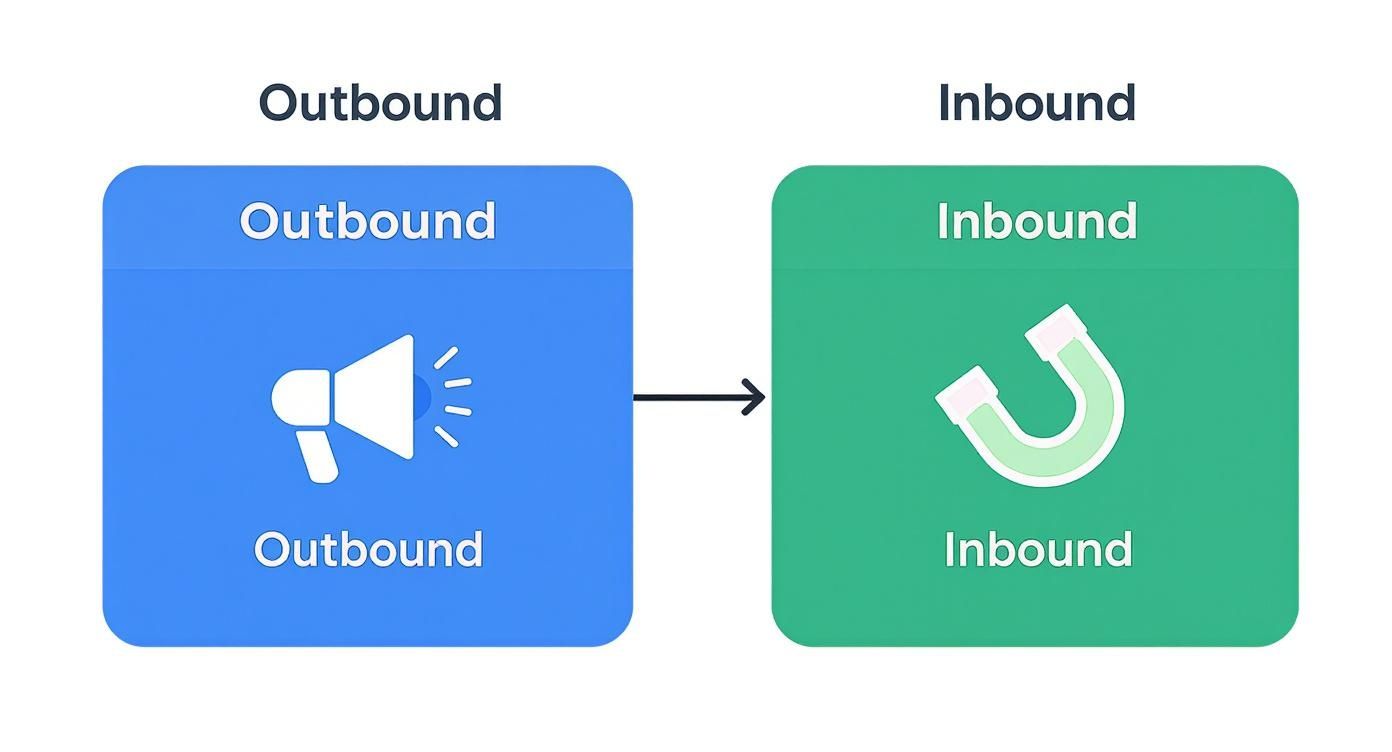
As you can see, outbound is all about broadcasting your message to a hand-picked audience. Inbound, on the other hand, is about creating a magnetic presence that draws people in.
Craft a Message That Connects
Now for the fun part: the outreach. Your goal here isn't to make a sale in the first DM. It's simply to start a conversation.
Generic, copy-paste templates are a one-way ticket to the ignore pile. Your message has to be short, relevant, and personal.
The best cold outreach doesn't feel cold at all. It feels like a helpful introduction from someone who understands your world and might have a solution to a problem you're actively thinking about.
Mention something specific. A recent tweet they posted, a company announcement, a shared connection—anything that shows you've done your homework. This is where tools that offer AI personalization can be a game-changer, helping you create unique openers at scale without sounding like a robot.
Finally, don't be shy about following up. People are busy. Your first message might get buried. A polite nudge a few days later shows you’re persistent and can double or triple your response rates. Keep it casual, helpful, and focused on them.
Why Outbound Is a Superpower for SaaS Founders
<iframe width="100%" style="aspect-ratio: 16 / 9;" src="https://www.youtube.com/embed/dZt0U4xQx6c" frameborder="0" allow="autoplay; encrypted-media" allowfullscreen></iframe>So, is all this talk about outbound lead generation actually worth the effort? For SaaS founders, the answer is a hard yes. While inbound marketing is a fantastic long-term play, outbound is your secret weapon for getting traction and building momentum right now.
Think of it this way: inbound is like setting up a beautiful storefront and waiting for curious customers to wander in. Outbound is like being a personal shopper who goes directly to your dream clients and shows them exactly what they’ve been looking for. It's proactive, it's fast, and it puts you squarely in the driver's seat.
Gain Speed and Predictable Growth
The single biggest advantage of outbound is speed. You simply don’t have to wait months for your blog posts to rank or for your content to magically go viral. You can start having real conversations with potential customers this week. That’s a game-changer when you're trying to validate a new idea or land your first ten paying users.
And because you control the volume, your pipeline becomes predictable. Need more meetings this month? Ramp up your outreach. Want to test a new feature? Reach out to a specific segment for instant feedback. This level of control is pure gold in the early days when every single conversation matters. This is a core reason why SaaS founders use outbound lead generation to get off the ground.
Get Direct and Honest Market Feedback
Here's a secret: outbound isn't just about making sales. It's one of the fastest, most effective forms of market research you can do. Every reply, every objection, and every question is a direct line into the mind of your ideal customer.
Outbound gives you raw, unfiltered feedback that you can use to refine your product, tighten your messaging, and find your product-market fit faster than any other method.
You get to hear their exact pain points, in their own words. This feedback loop is an absolute superpower. It helps you build a product people actually want to buy, not just one you think they need. You stop guessing what resonates and start getting real-time data from every conversation.
Target Your Ideal Customers with Precision
Finally, outbound lets you be incredibly specific. You can hand-pick the exact companies and individuals who are a perfect match for your software. This kind of laser-focused targeting means you’re not wasting precious time and resources talking to people who were never going to buy anyway.
This thoughtful approach really pays off. For example, personalized outreach emails get response rates 32.7% higher than generic blasts. By using a mix of channels—like email, social DMs, and calls—you can meet prospects where they already are. When done right, outbound continues to deliver a strong ROI. By concentrating your efforts, you give every single message the highest possible chance of starting a valuable conversation.
How to Automate Your Twitter Outreach
Let's be honest: manually sending hundreds of DMs is a soul-crushing task for any founder. It's the kind of repetitive work that drains your energy and keeps you from focusing on what actually moves the needle—talking to qualified leads and closing deals.
This is where smart outreach automation comes in, acting as your secret weapon for scaling SaaS distribution.
Scaling your outreach on Twitter doesn’t mean you have to sacrifice the personal touch. In fact, the right tools are built to scale personalization, letting you connect with more of the right people without coming across as a spam bot. The whole point is to offload the grunt work so you can handle the high-value conversations.
Turning Your Twitter Account Into a Lead Machine
The real breakthrough happens when you transform your Twitter account into a lead generation engine that works around the clock. Modern tools can handle the entire top-of-funnel process, from digging up prospects to kicking off that first conversation.
This is precisely what a platform like DMpro.ai was designed for. Here’s a peek at how it helps SaaS founders with Twitter lead generation:
- It scans for relevant tweets and profiles based on keywords you care about (think "looking for an SEO tool" or "need a new CRM").
- It then sends a personalized opening DM that actually references the person's recent activity, so it feels natural.
- It can even manage initial replies to help filter for people who are genuinely interested.
This layer of automation lets you consistently fill your sales pipeline without being chained to your screen all day. Instead of spending hours hunting down profiles and typing out messages, you only get involved when a lead is warm and ready to chat.
Here's a quick look at how a simple dashboard lets you manage multiple campaigns at once.
As you can see, you can set up highly targeted campaigns that automatically engage with users who match your ideal customer profile. It’s the perfect blend of scale and precision.
Smart Automation That Still Feels Human
The trick is to use automation for the tasks a machine does best. A machine is brilliant at finding hundreds of people who tweeted "looking for a new CRM" and sending them a perfectly tailored opening line. You, the human, are brilliant at taking that initial spark and nurturing it into a real business relationship.
By automating that first touchpoint, you free up your time to focus on strategy, building relationships, and actually closing deals. It's all about working smarter, not just harder.
Think of it like having a virtual assistant who handles all the initial prospecting. You only need to step in when a conversation shows genuine potential. If you're looking for a step-by-step walkthrough, we have a detailed guide on how to send automated Twitter DMs that still feel personal and get replies.
This approach transforms outbound from a manual grind into a predictable, scalable system for growth.
Common Outbound Mistakes and How to Avoid Them
We’ve all been there—hitting 'send' on a generic, cringey message and immediately wishing we could take it back. Outbound lead generation is a powerful tool, but it's also incredibly easy to get wrong. Let's walk through the common pitfalls so you can skip the trial-and-error phase and get straight to the results.
The biggest mistake? The classic "spray and pray" approach. This is where you blast the same robotic message to hundreds of people, just hoping something sticks. It’s lazy, it’s ineffective, and it’s the fastest way to get your account flagged or just plain ignored. You’re not building relationships; you’re just creating noise.
Going In Without a Clear Target
Another huge trap is not having a laser-focused Ideal Customer Profile (ICP). When you're messaging "anyone who might be interested," you’re really messaging no one at all. Vague targeting leads to vague messaging, which gets you exactly zero replies. You just end up wasting your time on people who were never going to be a good fit to begin with.
So instead, get hyper-specific. What's their job title? What industry are they in? More importantly, what specific problem are they dealing with right now? The sharper your focus, the more personal and relevant your outreach can be.
The Fix: Treat every message like a one-on-one conversation, not a mass broadcast. Take 60 seconds to do your homework. Mention a recent tweet they posted, a company milestone, or a shared interest. This tiny bit of effort shows you see them as a person, not just another name on a spreadsheet.
Giving Up After One Try
So you sent a great, personalized message and got… crickets. It’s easy to get discouraged and assume they aren't interested. But the reality is, people are busy. Your perfectly crafted message probably got buried under a mountain of other notifications.
Not following up is one of the biggest missed opportunities in outbound. Seriously. A single, polite follow-up a few days later can often double or even triple your response rate. Persistence is key, as long as it’s respectful and not pushy. A simple, "Hey, just wanted to gently bump this up in your inbox" can work wonders.
This is especially true as outbound evolves. While older data shows outbound marketing averages a 1.7% close rate compared to inbound's 14.6%, that gap closes dramatically when outreach is smart, personal, and persistent. Modern outbound isn’t dead; it just requires a much better strategy than the outdated methods most people are still using. You can discover more insights about lead generation stats to see how things are shifting.
Automating these follow-ups with a tool like DMpro.ai ensures you never drop the ball. It helps you keep the conversation going without having to manually track every single DM, turning persistence into a system.
Launching Your First Twitter Outbound Campaign
Alright, enough with the theory. Let's get your hands dirty and move from learning about outbound lead generation to actually doing it. This is a simple, three-step framework to get your very first outbound campaign on Twitter off the ground today.
The goal isn't perfection; it's action. We're going to start small, get some feedback, and build momentum from there. Think of this as your playbook for getting started immediately, without getting stuck in the weeds.
Step 1: Define Your Target
Before you even think about writing a message, you have to know exactly who you're talking to. "SaaS founders" isn't good enough. You need to get specific and create a mini-persona just for this first campaign.
- Who are they? Get granular. For instance, "Early-stage B2B SaaS founders with 1-10 employees."
- What are they talking about? Pinpoint the keywords and topics they're tweeting about, like "MRR," "churn," or "product-market fit."
- Where do they hang out? They’re active on Twitter, probably sharing their build-in-public journey.
Getting this level of clarity makes every other step ten times easier. Your entire campaign really hinges on how well you nail this first step.
Step 2: Craft Your Message
Your first DM has one job: to start a conversation. It's not a sales pitch. It needs to be short, casual, and focused on them, not you.
Here’s a simple, non-salesy template you can adapt:
"Hey [Name], saw your tweet about [specific topic]. Really resonated with what you said about [their pain point]. Curious, how are you currently handling [related challenge]?"
Why does this work? It’s personal, it shows you actually paid attention, and it ends with an open-ended question that makes it easy for them to reply. No hard selling, just genuine curiosity.
Step 3: Set Up Your System
Finally, you need a simple way to manage your outreach and keep track of who you've talked to. Don't go overboard with a complex CRM right away. For your first 50-100 prospects, a basic spreadsheet is all you need.
Your system should track a few key things:
- Prospect Name: Who you contacted.
- Date Sent: When the first message went out.
- Follow-Up Date: A reminder for when to check in again.
- Status: A simple tag like Replied, Not Interested, or Meeting Booked.
Of course, tracking even a small list by hand can quickly become a huge time sink. This is where tools come in. You can streamline all these steps with an automation platform, which makes it much easier to launch and manage your outreach without getting buried in spreadsheets and calendar reminders.
If you’re tired of manually sending DMs every day, try DMpro.ai — it automates outreach and replies while you sleep.
Ready to Automate Your Twitter Outreach?
Start sending personalized DMs at scale and grow your business on autopilot.
Get Started Free