
SDR Outsourcing: Costs, Trade-offs and When It Fits
By DMpro team
SDR outsourcing explained in plain English: what it costs, how it works, what to measure and when it makes sense for your sales team.
Your calendar for next quarter looks thin, and you're already stretched across product releases, customer onboarding, and investor updates. You know outbound drives SaaS distribution, yet finding time to research prospects, write cold emails, and send daily X messages feels impossible. So you start looking at SDR outsourcing as the fastest way to fill the top of the funnel.
Most founders treat that decision as a simple cost cut compared to a full-time hire. That framing leads to bad contracts and calendars full of prospects who never had budget or intent to buy. Outsourced sales development works only when you treat it as a pipeline-quality decision.
Getting that decision right comes down to three practical checks: normalizing the fee shapes agencies quote, tightening compliance and qualification rules before launch, and auditing downstream revenue metrics instead of celebrating booked meetings.
What SDR Outsourcing Means in Plain Terms
Say a SaaS founder needs qualified demos next quarter, has a clear product and pricing, and lacks the bandwidth to recruit, train, and manage a new sales rep. SDR outsourcing solves that capacity gap by hiring an external team to find target accounts, write and send outbound messages, handle replies, qualify interest, and book meetings on your behalf while your internal team closes the deals.
It is like renting a fully staffed commercial kitchen instead of building one from scratch. The outside crew handles prep, cooking, and cleanup, while you still own the menu, the ingredients, and the relationship with every customer who walks in.

What an Outsourced Team Actually Runs
Before signing any scope of work, it helps to separate daily outbound tasks from closing work. If you're still defining the core role, reviewing what a sales development representative handles day to day makes it easier to see which duties you're handing off. Most external providers bundle six operational pieces:
- Prospect research: Building targeted lists of decision-makers and verifying contact details across email, phone, and social channels.
- Outbound messaging: Drafting sequences, cold DMs, and follow-up cadences matched to your buyer personas.
- Cold calling: Dialing prospects directly to break through crowded inboxes and social feeds.
- Reply qualification: Screening responses against your fit criteria so your closers don't waste hours on tire-kickers.
- Appointment setting: Booking confirmed slots straight onto your sales team's calendar.
- Campaign reporting: Tracking outreach volume, response rates, and meeting outcomes each week.
To make sense of how agencies price these deliverables, Big Moves Marketing breaks down cost per qualified meeting explained, which gives useful context when reviewing proposals.
How Big the Market Really Is
External sales development has grown well past temporary staffing. According to the GII Research SDR service market global forecast, one estimate values the global outsourced SDR services market at approximately $2.27 billion in 2026, projected to reach $3.84 billion by 2032 at a 9.06% compound annual growth rate. The same report notes a separate estimate placing the broader SDR-as-a-service category at $1.60 billion in 2025, rising to $1.76 billion in 2026 and projected to hit $3.16 billion by 2032 (10.19% CAGR).
Those figures differ because "SDR outsourcing," "SDR as a service," and broader "sales outsourcing" don't cover identical activities. Compare market numbers only when geographic coverage, base years, and included services match.
If your bottleneck is execution capacity, outsourcing is a real candidate. If your bottleneck is an unproven offer or messy pricing, an outside team won't fix it.
What an Outsourced SDR Costs Next to a Hire
Comparing an agency retainer directly to an employee's base salary distorts the math. You have to look at the full cost of recruiting, ramping, managing, and replacing an in-house rep.
The Bridge Group's 2025 SDR benchmark, which surveyed 351 B2B companies and is cited in the Research and Markets outsourced SDR services report, puts median SDR on-target earnings at $80,000 (roughly $55,000 in base pay and $25,000 in variable compensation). The hidden drag sits in the operational figures alongside that paycheck: an average ramp time of 3.0 months before a rep hits expected productivity, median annual attrition of 40%, and an average tenure of just 1.9 years.
When a rep leaves before year two, you pay recruiting and onboarding costs all over again while your pipeline stalls. Outsourcing doesn't magically erase those realities, because someone still has to train and retain reps, yet it transfers the recruiting and replacement burden to a specialist vendor.
| Option | Cost basis | Ramp time | Turnover risk | Management load |
|---|---|---|---|---|
| In-house SDR | About $80,000 median on-target earnings ($55,000 base, $25,000 variable), plus tooling and management time | 3.0 months average before expected productivity | 40% median annual attrition and 1.9 years average tenure | High: recruit, train, coach and replace |
| Outsourced SDR service | Contract fee: monthly retainer, price per booked meeting, or price per accepted opportunity | Contract-dependent: ask how long onboarding to your offer takes before meetings start | Shifted to the provider; confirm replacement and notice terms in the contract | Medium: provider runs daily execution, your team reviews and accepts meetings |
| Software-assisted outreach run by your team | Software subscription plus your team's time | Days to set up; your team's writing and review time sets the pace | Stays with your team | Medium to high: your team writes targeting and reviews replies |
How to Normalize the Three Fee Shapes
Outsourced providers usually quote in one of three ways: a flat monthly retainer, a price per booked meeting, or a price per accepted opportunity paired with a performance component. Each model puts risk in a different corner. A flat retainer shifts slow-month risk onto you, while pure pay-per-meeting pushes reps to book anyone with a pulse just to trigger an invoice.
To compare proposals fairly, normalize every quote into one unit before you negotiate. Add the vendor's full fee and your team's internal review hours, then divide that total by the sales-accepted meetings you realistically expect in month three, not month one. Pairing that math with a clear view of your lead generation cost per lead keeps you from mispricing early ramp friction.
If you're also weighing software agents alongside human callers, Salesmotion's guide on AI prospecting agents vs human reps lays out where automated prospecting helps and where human judgment still matters.
Five Lines for Your Pre-Proposal Cost Sheet
Build a one-page spreadsheet with these five lines before you ask any agency for pricing:
- Direct vendor fee: Monthly retainer, setup charges, data credits, or per-meeting rates across a full quarter.
- Internal management hours: Founder or sales leader time spent reviewing scripts, coaching calls, and auditing leads each week.
- Closer time on rejected calls: Hours your account executives lose when unqualified prospects slip onto the calendar.
- Tooling and channel expenses: Extra CRM seats, sending domains, or social outreach accounts required outside the retainer.
- Exit and replacement terms: Written answers on what happens when your team rejects a meeting, whether replacement meetings are included, and how much notice you need to pause.
Contract Terms and Compliance to Check First
Most buyers assume heavier AI personalization automatically lifts reply rates. In practice, automated outreach creates a sharper double edge. As the Coherent Market Insights sales development outsourcing analysis points out, AI-generated messages can improve relevance while amplifying inaccurate inferences, clumsy product claims, or uneven treatment across regions.
That risk intensifies fast if you sell internationally. European markets carry much stricter expectations around privacy, consent, documentation, language localization, and local outreach norms, and cross-border data processing introduces extra governance obligations. Treating compliance as a checkbox on a sales deck leaves your brand exposed when an agency cuts corners.
Accountability test: Ask every provider who bears responsibility when automated personalization breaks a local privacy rule or platform policy, and demand to see documented proof that their controls actually run.
Non-Negotiable Contract Clauses
Copy these eight requirements straight into your redlines before signing any statement of work:
- Permitted data sources: Name the exact enrichment tools and public sources the provider can pull contact records from.
- Lawful-use basis: Document the legal basis for contacting prospects in every target region, especially across European countries.
- Retention and deletion rules: Specify how long the vendor holds your prospect records and how fast they purge data after cancellation.
- Human review thresholds: Define which AI-drafted sequences require a human editor before sending so bad inferences never reach buyers.
- Language-quality standards: Set clear expectations for native fluency and localized phrasing when running multi-country campaigns.
- Opt-out handling: Require immediate suppression across all channels and shared blocklists whenever a prospect asks not to be contacted.
- Data export rights: Guarantee that your lead lists, notes, and sequence learnings export cleanly to your CRM when the contract ends.
- Platform-policy shifts: State who absorbs workflow adjustments and downtime when email providers or social networks tighten enforcement.
Building solid outreach compliance monitoring into your weekly cadence ensures these clauses stay enforced after kickoff instead of sitting in a drawer.
Channel Safeguards and X Outreach Checks
Separate operational safeguards from guarantees. Variable sending delays, warm-up routines, and daily volume caps reduce risk, yet no vendor or software tool can promise total immunity from account restrictions. Even with sending limits, delays, and account controls active, X can still restrict or suspend accounts that trip its filters.
Channel mechanics matter just as much as legal compliance. According to X's public-to-private conversation documentation, moving a prospect from the timeline into Direct Messages only works if the recipient has "Receive Direct Messages from Anyone" turned on, and a deep link inside a post uses 22 characters of the 280-character limit through t.co unless attached via a media upload. Meanwhile, X's platform update on usage restrictions states that its limits specifically target bots, scraping public X data to build AI models, and manipulating conversations, warning that enforcement can throttle usage.
Before signing, send this final vetting checklist to three shortlisted providers:
- Proof of controls: Request sample audit logs, a written message-review workflow, and a clause allowing you to pause any campaign immediately.
- X account hygiene: If they run X outreach, ask which accounts they'll send from, how those accounts were warmed up, and what reply or block threshold triggers an automatic pause.
- Peer references: Ask for two current client references in your revenue range, not just enterprise logos.
- Daily execution clarity: Request a sample campaign brief, the exact name of the rep doing the daily work, and their written policy when your team rejects a meeting.
How to Set Up an Outsourced SDR Engagement
Good agencies still fail when founders hand over a website link and walk away for a month. Launching an outsourced program requires tight upfront setup and fast feedback during the first two weeks.
Seven Steps From Kickoff to Week Four
Follow this sequence to avoid the traps that sink most early pilots.
-
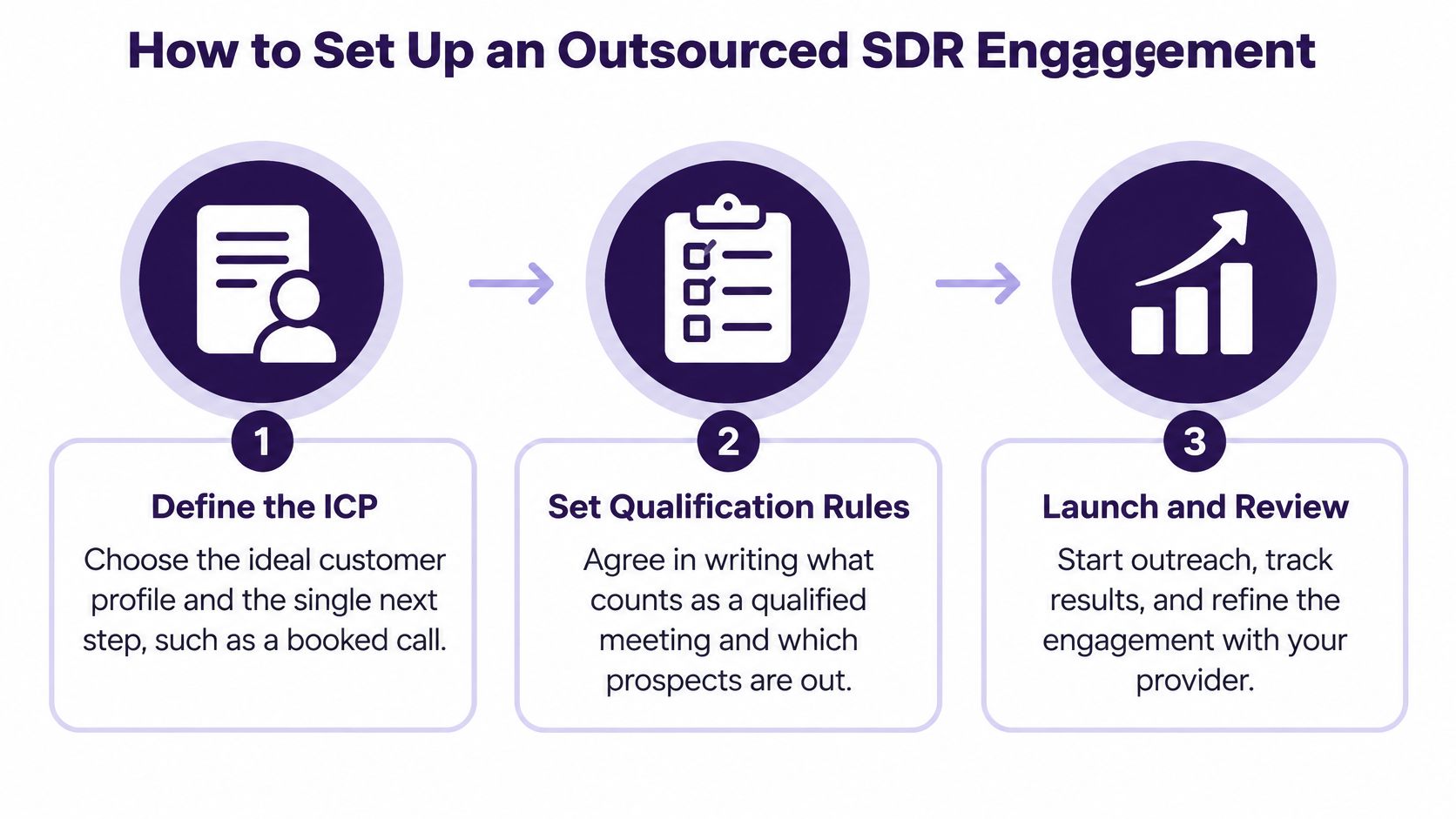
Pin down your ICP and one clear next step. Narrow your list to the exact titles, company sizes, and pain signals that convert, and pick a single conversion goal such as a 20-minute discovery call. Broad targeting ("any B2B SaaS founder") is the fastest way to burn through budget with irrelevant replies.
-
Put qualification rules in writing before a single message goes out. List the exact criteria that make a meeting qualified, the disqualifiers that void a booking, and the handoff notes the rep must log in your CRM. Skip verbal agreements here; vague qualification rules create ugly billing disputes by week three.
-
Hand over real objections, proof points, and multi-touch context. Share call recordings, common buyer pushback, and customer outcomes so outreach sounds like your team instead of a generic template. Don't rely on one isolated pitch, either. In X's B2B campaign analysis across 10 accounts and 751 campaigns, users exposed to a business message four times were 335% more likely to click the business's Tweet link than users exposed once (at the 95% confidence level), so plan spaced follow-ups and useful public engagement rather than copy-pasting the same cold ask.
-
Constrain the ask inside your scripts. Open-ended questions ("want to chat about growth?") force busy buyers to think too hard and ignore you. Take a cue from X's Direct Message setup documentation, which caps native conversation buttons at four routed paths and quick-reply lists at 20 choices for API partners: keep your outbound next step explicit and tight, asking whether a prospect wants a quick demo, pricing details, a short teardown, or no further outreach.
-
Run a 30-day pilot with a fixed budget and weekly review. Lock the calendar for a 30-minute weekly audit covering reply sentiment, bounce or block rates, and objection themes. Without a standing review date, messaging mistakes compound across hundreds of prospects.
-
Assign one internal owner with a 48-hour SLA. Someone on your team must accept or reject every booked meeting within two working days and leave concrete notes on why a lead missed the mark. Slow internal feedback is the single most common reason outsourced pilots stall.
-
Calibrate for two weeks before scaling volume, then judge at day 30. Keep daily sending low during weeks one and two while you read actual prospect replies and sharpen the list. Scaling volume before you see clean reply patterns only amplifies bad targeting, and your day-30 decision should hinge on pipeline quality rather than raw calendar fills.
What a Healthy Pilot Looks Like at Week Four
By the end of week four, a working engagement won't look chaotic. You should see a steady reply rate, booked meetings your reps consistently accept, and a short written log of targeting and script tweaks for month two.
If you're still arguing over what counts as a valid prospect at day 30, pause the campaign and fix the brief before paying for another month.
Metrics That Show Real Pipeline, Not Just Meetings
Judging an outsourced SDR program by total meetings booked is a trap. When an agency gets paid or praised purely on calendar volume, reps naturally chase the easiest people to book: junior employees, polite browsers, or companies outside your target budget. Every low-fit meeting steals selling time from your closers and still produces zero revenue.

Why Small Teams Need Cohort Auditing
The adoption gap makes disciplined measurement even more urgent for lean SaaS companies. According to memoryBlue's 2026 State of Sales Development report, only 11% of SDR organizations use outsourced SDRs, yet adoption is three times higher among companies below $10 million in revenue. Smaller teams have the thinnest internal RevOps capacity to audit agency claims, which makes it easy for hidden costs like poor qualification and messy handoffs to go unnoticed.
Instead of reading vanity activity reports after you pay the invoice, run a cohort-based measurement plan. Tag every prospect the vendor touches by launch month, track internal sales acceptance, and measure actual pipeline created at 30, 60, and 90 days against an internal baseline from your own outbound. Pairing these checkpoints with sales rep productivity metrics shows whether outside outreach outperforms what your team generates in-house.
| Metric | What it shows | When to check |
|---|---|---|
| Qualified meeting definition | Whether each meeting meets criteria agreed before launch | Before launch |
| Sales-accepted opportunities | Share of meetings your reps accept as real | Weekly, then at 30 days |
| Pipeline created after 30, 60 and 90 days | Whether outreach produces lasting pipeline | 30, 60 and 90 days |
| Opportunity-to-close conversion | Whether pipeline turns into revenue | After first closes |
| Customer acquisition cost | Total spend, provider fees included, divided by won customers | Quarterly |
| Revenue per 1,000 prospects | Quality of the prospect list, not only its size | Quarterly |
How to Read the Numbers Without Getting Spun
Watch the relationship between booking volume and acceptance rate. A rising meeting count paired with falling sales acceptance means the targeting or qualification is broken, not that you need more sending volume. Pushing the agency to send twice as many messages will only flood your closers with worse calls.
Keep an eye on the financial denominator, too. Divide your all-in spend (retainers, setup fees, data costs, and internal review hours) by actual closed-won customers each quarter to see real customer acquisition cost, and track revenue per 1,000 prospects to see whether the agency is burning through your total addressable market.
Ask every agency for its written definition of a qualified meeting, and refuse any contract that bills on booked meetings without an explicit internal acceptance rule.
That acceptance clause belongs inside the contract and your day-30 review, never buried as a footnote in a monthly slide deck.
When Outsourcing Fits and What to Do This Week
Three founder scenarios make the boundary clear. A SaaS founder with a proven buyer profile, a repeatable pitch, and no SDR hire yet can use outsourcing to generate testable pipeline inside a single quarter. A boutique consultancy running long, consultative sales cycles gets weak results from outside reps who can't absorb subtle product feedback on live calls. And a lean team with nobody free to coach the vendor ends up buying calendar slots that never convert.

| Situation | Verdict | Reason |
|---|---|---|
| Need pipeline fast and no SDR hire yet | Good fit | Skips the multi-month ramp of a new hire |
| Clear ideal customer profile and repeatable pitch | Good fit | Easier to brief the provider and measure results |
| Team with high turnover risk | Good fit | Provider handles replacement and onboarding |
| Consultative sale with long cycles | Poor fit | Outside reps cannot absorb deep product feedback |
| No internal owner to coach the provider | Poor fit | Unreviewed meetings rarely convert |
| Offer or pricing still unproven | Delay | Outreach amplifies a weak message rather than revealing it |
The Decision Rule and Three Steps for This Week
Here's the plain filter: outsource when execution capacity is your bottleneck, you can name one internal owner to review meetings, and you have a measurable qualification rule; wait if your core offer or pricing is still unproven.
If you fit the green rows above, take three concrete actions before Friday:
- Build your five-line cost sheet: Map direct fees, internal review time, and expected month-three accepted meetings so you can normalize every quote.
- Draft your qualified-meeting definition: Write down the exact company traits, buyer roles, and disqualifiers your sales team will enforce.
- Send the compliance and vetting checklist to two providers: Ask for references, sample briefs, and their exact rejected-meeting policy in writing before booking a second sales call.
The Middle Path for Founders Who Want Control
Not every SaaS team needs a traditional calling agency. If you already write sharp messages, know your buyers on X, and want to keep human qualification in-house, software-assisted outreach gives you speed without handing away your voice or your prospect data.
That's why we built two distinct paths at DMpro depending on how much execution you want to keep in-house. If you want hands-off execution similar to an outsourced SDR pod on X, our Custom done-for-you service handles account setup and warm-up, done-for-you targeting and lead sourcing, outreach scripts written for your offer, campaign management and optimization, and ongoing reporting with a dedicated strategist (you apply for free so we can scope custom pricing together). If you prefer to run campaigns yourself while keeping full control over targeting and replies, our paid subscription plans run automated X outreach 24/7, with plan details and starting pricing available directly on our site.
If you're tired of manually sending cold DMs every day or debating whether an agency retainer will produce qualified pipeline, take a look at DMpro. You can automate X prospect discovery, personalized cold DMs, and follow-ups 24/7 on a self-managed plan, or apply for our done-for-you service when you want a dedicated strategist running execution end to end. Start automating your cold outreach while you sleep and keep your team focused on closing real buyers.
Put your outreach plan into practice
Find relevant leads on X (Twitter), personalize your messages, and manage the replies in DMpro.
Get started