
The Sales Rep Productivity Metrics That Actually Matter
Stop tracking vanity metrics. Discover the sales rep productivity metrics that reveal what's working and how to build a predictable revenue engine.
As founders, we're obsessed with metrics. But when it comes to sales, we often track the wrong things. We look at calls made or emails sent and wonder why revenue isn't moving.
The truth is, most sales rep productivity metrics are just noise. They measure busy work, not impact. To really scale, you need to focus on the handful of numbers that directly connect a sales rep's time to the money in your bank account.
Moving Beyond Busywork to Better Metrics

Let's be honest, a lot of us get sales productivity wrong at first. We fixate on vanity metrics—things like 'dials per day' or 'DMs sent'—and then scratch our heads when the pipeline is bone dry.
Those activity numbers feel good. They look like work is getting done. But they often just lead to a burnt-out team and mediocre results.
Real productivity isn't about how many things your team does; it's about how many of those things actually lead to closed deals. We're building a scalable sales engine here, not just a busy one.
Leading vs. Lagging Indicators
First, you need to understand the two types of metrics that will guide your strategy.
-
Leading Indicators: Think of these as your crystal ball. They are the forward-looking activities that predict future success. They're inputs, like the number of qualified conversations you start on Twitter each week or the reply rate to your outreach. You can directly control these.
-
Lagging Indicators: These are your report card. They look backward and tell you what already happened. They're outputs, like 'monthly recurring revenue' or 'total deals closed'. They confirm if your strategy worked, but it's too late to change them.
A smart founder watches both. You use leading indicators to influence your lagging indicators. Want to increase closed deals (lagging)? You have to improve a leading metric, like the number of qualified meetings you book.
Truly improving sales productivity means you stop yelling "sell more!" and start looking at the data to find and fix the real bottlenecks in your process.
Vanity Metrics vs. Impactful Metrics
It's easy to fall into the trap of tracking metrics that look impressive on a dashboard but don't actually signal business health. Here’s a quick breakdown.
| Vanity Metric (What Most Track) | Impactful Metric (What You Should Track) | Why It Matters |
|---|---|---|
| DMs/Emails Sent | Positive Reply Rate | Shows your messaging resonates, not just that you’re spamming. |
| Follower Count | Engagement Rate (Replies, DMs initiated) | An engaged audience is a potential customer base. A big, silent one is just a number. |
| Total Leads Generated | Marketing Qualified Leads (MQLs) or Sales Qualified Leads (SQLs) | Quality over quantity. This metric tracks leads that actually fit your ideal customer profile. |
| Calls Made | Meetings Booked | Dialing is easy; getting a qualified prospect to commit their time is what counts. |
Focusing on the right side of this table is how you build a predictable revenue engine. The metrics on the left just create a culture of being busy, not a culture of closing.
This guide will walk you through the handful of metrics that actually matter for scaling a modern SaaS business, especially if you're using channels like Twitter for lead gen. If you want to dive deeper, we've put together a full guide on how to improve sales productivity. Let's get to it.
The One Metric That Unlocks More Revenue
If you only track one metric, make it this one: Time Spent Selling. Forget everything else for a moment. The single biggest lever you can pull is to get your reps spending more time in actual, meaningful sales conversations.
Think of it like a factory. If your assembly line is only running 30% of the time—with the other 70% spent on maintenance and paperwork—you have a massive problem. Your sales team works the same way.
When reps are buried in non-selling tasks, their ability to generate revenue is crippled before they even start their day.
The Great Time Robbery
So where does all that time go? It’s death by a thousand cuts. These are the usual suspects killing your team’s productivity:
- Manual Prospecting: Hours spent scrolling through Twitter, LinkedIn, and websites to find a few decent leads.
- Data Entry: The soul-crushing task of updating the CRM and logging activities.
- Internal Meetings: Endless syncs that pull reps away from talking to actual customers.
- Clunky Tools: Juggling multiple platforms that don’t talk to each other.
These activities are the silent killers of your sales pipeline. They feel productive, but they're just administrative overhead that keeps your reps from doing their one true job: selling.
Research backs this up. Salesforce’s State of Sales reports show reps now spend only about 30% of their week in real selling conversations. Digging deeper into these sales productivity statistics reveals that top-performing organizations see their reps actively selling nearly 50% more than reps at lower-performing companies.
This isn’t just an efficiency problem; it’s a direct cap on your growth. Every hour a rep spends on admin is an hour they could have spent booking a demo.
How Automation Reclaims Selling Time
The solution isn't to ask your reps to work harder. It's to be ruthless in cutting out non-selling tasks. This is where automation becomes a founder’s best friend, especially for outreach.
Take lead generation on Twitter. A rep could easily burn half their day manually searching for relevant accounts, finding the right person, and crafting a semi-personalized DM.
Now, imagine an automated approach. A tool like DMpro can run that entire process on its own. It finds ideal customer profiles and sends out hyper-personalized DMs at scale.
This one change can free up 2-3 hours per day for each rep. That’s an extra 10-15 hours a week they can now spend on handling warm replies, booking meetings, and closing deals. This is exactly how you improve your sales velocity and accelerating revenue.
By automating the grunt work, you let your reps focus their talent where it matters most—on the human conversations that move deals forward.
Connecting Daily Activity to Annual Revenue
It's easy to get caught up in the daily whirlwind of sending DMs and updating the CRM. But all that activity is just noise if it doesn't lead to revenue.
How do you draw a straight line from what your reps do every day to the money hitting your bank account?
The secret is to work backward from your revenue goal. For most SaaS startups, that North Star metric is Annual Recurring Revenue (ARR) per Rep. It’s the ultimate report card on a rep’s efficiency and impact.
Setting the Right Revenue Target
So, what's a good number to shoot for? As a general rule, a healthy B2B SaaS team often targets somewhere between $500,000 to $1,000,000 in ARR per rep. This is one of the most critical KPIs for spotting your A-players and setting achievable goals. You can find more insights on tracking these kinds of sales KPIs from our friends at Outdoo.ai.
Once you have your ARR target, you can reverse-engineer your entire sales motion to figure out the daily and weekly activities required to hit it.
Working Backward from Your ARR Goal
Let's make this real. Imagine your target is $750,000 ARR per rep. How many personalized Twitter DMs does a rep need to send to make that happen? We can map it out.
The table below breaks down how to connect those small daily activities on Twitter to a big annual revenue goal.
Sample ARR Per Rep Calculation
| Metric | Target Value | Calculation/Note |
|---|---|---|
| Annual Revenue Goal | $750,000 | The ultimate lagging indicator we're aiming for. |
| Average Deal Size (ACV) | $15,000 | The average annual contract value of a new customer. |
| Deals Needed per Year | 50 | $750,000 (Goal) / $15,000 (ACV) |
| Deals Needed per Month | ~4 | 50 Deals / 12 Months |
| Win Rate | 20% | Percentage of qualified meetings that turn into closed deals. |
| Meetings Needed | 20 per month | 4 Deals / 20% Win Rate |
| Meeting Booked Rate | 25% | Percentage of positive replies that convert to a booked meeting. |
| Positive Replies Needed | 80 per month | 20 Meetings / 25% Meeting Booked Rate |
| DM Reply Rate | 30% | Percentage of initial DMs that get a positive response. |
| DMs Sent per Month | ~267 per month | 80 Replies / 30% Reply Rate (This is your key leading indicator) |
And just like that, the intimidating $750k goal becomes a clear, manageable target: send around 267 high-quality, personalized DMs per month. That's the mission.
Freeing Up Reps to Focus on Revenue
When you look at that math, one thing becomes crystal clear: the top of the funnel—finding people and sending those first DMs—is a massive time-suck. It pulls reps away from the work that actually closes deals.
This is all about shifting a rep's focus from low-value tasks to high-impact selling activities.
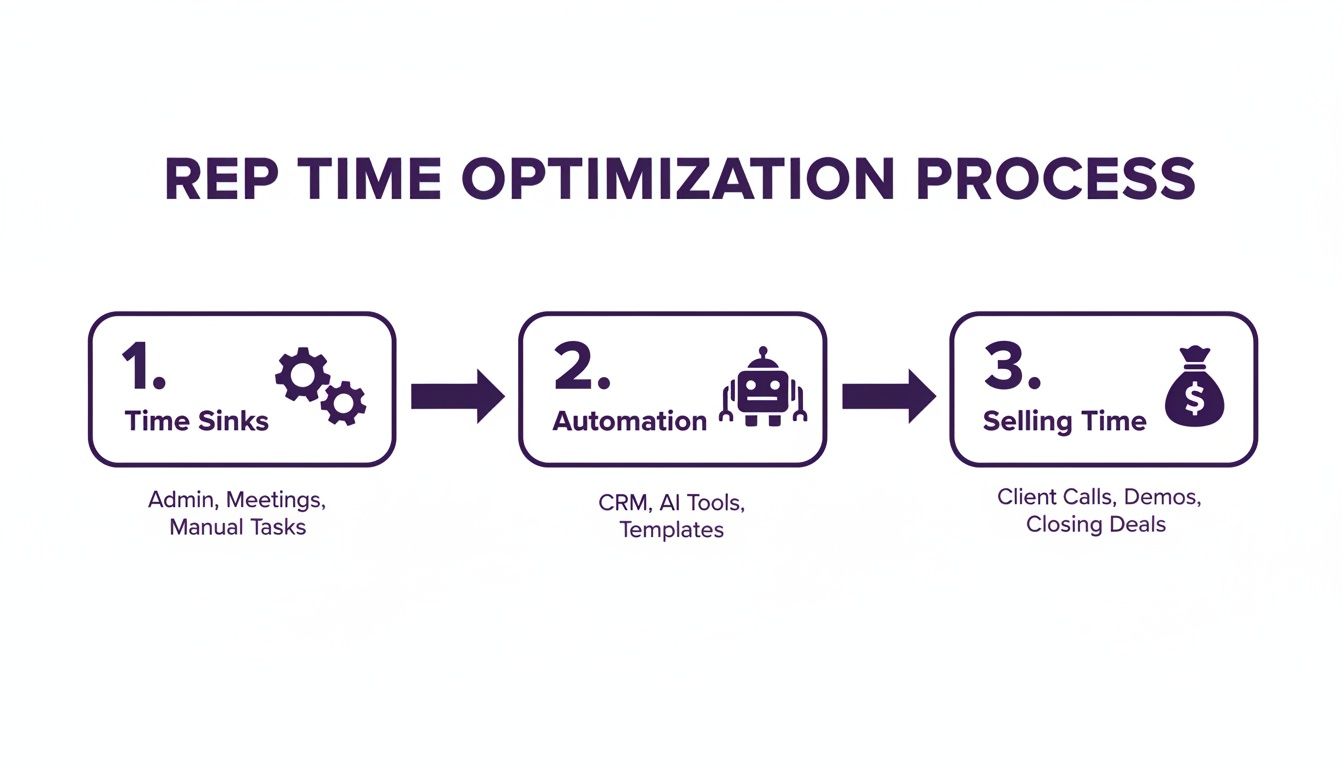
This is where a platform like DMpro.ai becomes a game-changer for automating outreach on Twitter. It handles the lead sourcing and initial DM sending, so your reps start their day with a list of warm, interested replies.
Instead of getting bogged down in manual prospecting, they can pour all their energy into turning replies into meetings, and meetings into closed deals. It's the most direct way to increase their pipeline value.
How to Predict Your Future Pipeline
<iframe width="100%" style="aspect-ratio: 16 / 9;" src="https://www.youtube.com/embed/4y6fUC56KPw" frameborder="0" allow="autoplay; encrypted-media" allowfullscreen></iframe>That 'revenue closed' report you get at the end of the month? It’s like looking in the rearview mirror. It tells you where you’ve been, but it does nothing to help you see the road ahead.
You can't steer your business by looking backward. You need a dashboard of leading indicators—metrics that give you a sneak peek into what’s going to happen next month.
This is the critical shift from reacting to your pipeline to proactively building it. It’s all about focusing on the inputs you can control today to shape the revenue you see tomorrow.
The Metrics That Foretell Your Future
For any modern outreach strategy, especially on platforms like Twitter, your leading indicators boil down to the quality of your outreach.
Here are the crucial ones to track:
-
Qualified Conversations Started per Week: This isn't just about the number of DMs you blast out. It’s about how many messages spark a real, two-way conversation with someone who fits your ideal customer profile.
-
Response Rate: This is your most powerful leading indicator. It’s the percentage of your initial messages that get a reply. A high response rate is a direct signal that your targeting and messaging are hitting the mark.
-
Meeting Booked Rate: Of all the positive replies you get, what percentage turn into a booked demo? This tells you how well your reps convert initial interest into a solid next step.
These three metrics create a powerful funnel. If you can get them right, your closed revenue will almost always take care of itself.
Your Response Rate Is Your Compass
Let's zoom in on response rate, because it’s the canary in your coal mine. A low response rate (anything under 15%) is an early warning that something is broken at the top of your funnel—usually your targeting or messaging.
On the flip side, a high response rate means you’re onto something big. You’re reaching the right people with a message that resonates.
This is where automation tools become so valuable. For example, when you’re running campaigns with a tool like DMpro, you can see the response rates for different message templates in real-time.
Imagine one message gets a 10% response rate, and another gets a 35% response rate. That’s a direct, actionable insight. You can kill the loser and double down on the winner, instantly boosting your pipeline without guesswork. As you improve these numbers, it also helps to understand what lead scoring is and how to spot your most engaged prospects early.
By focusing on these leading sales rep productivity metrics, you’re no longer just a passenger. You’re in the driver’s seat, making small adjustments that have a massive impact on your future pipeline.
Using AI to Redefine Sales Productivity
The whole game of sales is changing, and AI is at the heart of it. As founders, we're always hunting for an edge—a way to get more done without just throwing more people at the problem.
AI hands your team back its most precious asset: time. It takes over repetitive tasks like scraping for leads and writing the same outreach message a hundred times.
But the real power here isn't just about speed. It's about doing things better, at a scale that was previously impossible.
From Manual Grind to Intelligent Outreach
Picture a standard outreach campaign on Twitter. A sales rep has to manually dig through profiles, find a clever hook, and then write a personalized first line. It works, but it’s a slog. A great rep might manage 10-15 truly custom messages in an hour.
Now, bring in an AI-powered system. It can sift through thousands of profiles in minutes, scan a prospect's recent activity, and instantly draft a personalized opening line that actually makes sense.
This changes how we measure productivity. We're no longer just counting messages sent per day. The new standard is high-quality, personalized messages sent per hour. This lets a small team make a huge impact.
The Tangible Impact of AI on Sales Metrics
This isn't just an idea; the numbers back it up. Recent studies found that 81% of sales reps spend less time on busywork because of AI. On average, AI gives reps back about two hours every day. That's 10 hours a week of selling time recovered, per person. Crucially, somewhere between 63% and 69% of buyers are now responding to this kind of smart, personalized outreach.
This is exactly where a tool like DMpro.ai comes in. It automates that entire top-of-funnel grind on Twitter. Your team just tells the AI what an ideal customer looks like, and it takes over—finding the right people and starting conversations with personalized DMs that get replies. This directly juices up your leading indicators like Response Rate and Qualified Conversations Started.
The goal of AI isn't to replace your reps. It’s to clone their best skills—their intuition for a good lead, their ability to personalize—and apply them at a scale no human ever could.
This shifts your sales process from a manual chore into a scalable engine. Reps can finally focus their energy on what they do best: nurturing warm leads and closing deals. For a deeper dive, check out our guide on the best AI tools for sales prospecting or explore the best AI sales assistant software.
Building Your Simple Sales Dashboard
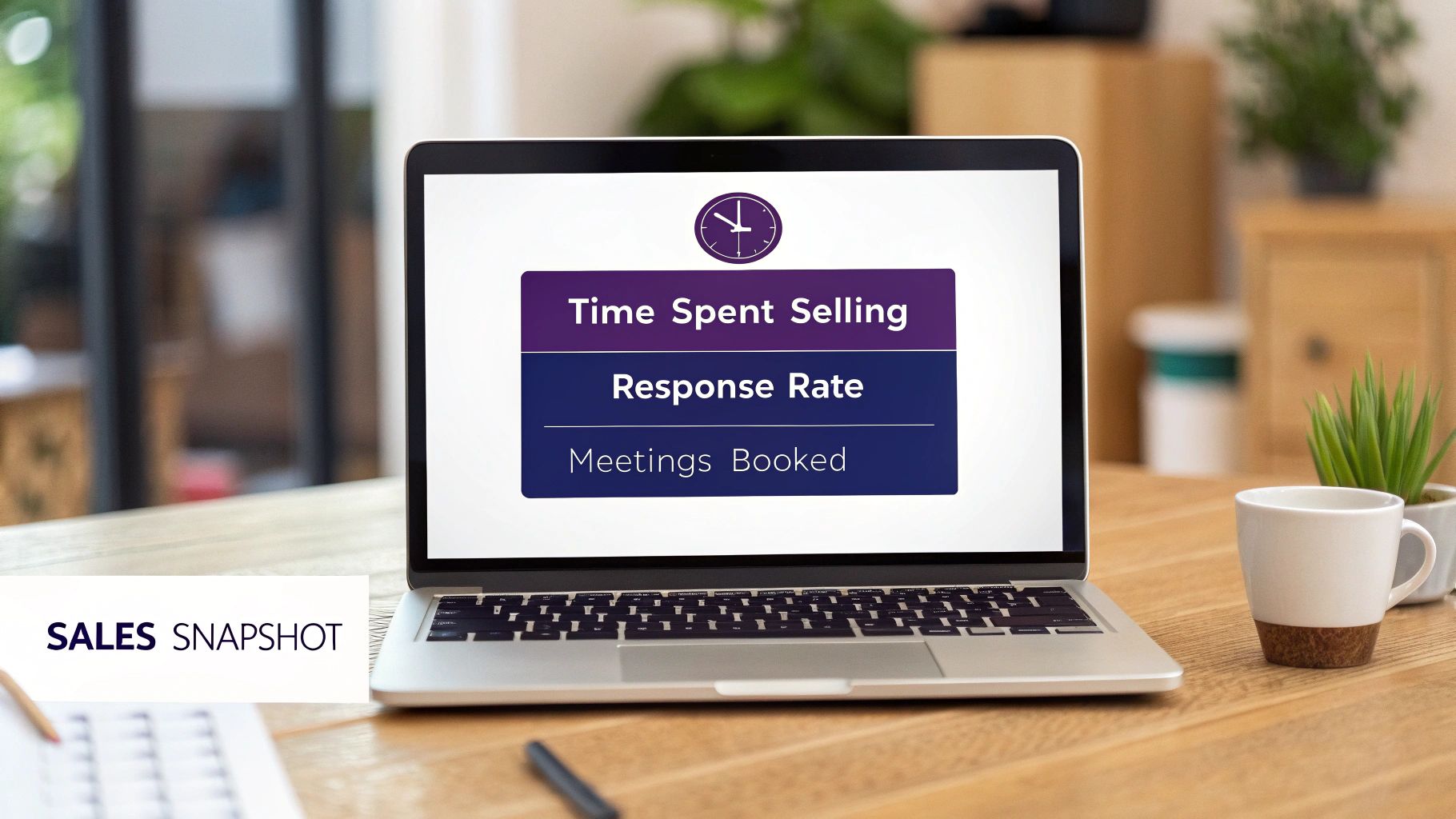
All the theory in the world is useless if you can't put it into practice. As a founder, you need a straightforward way to see what’s working without drowning in data.
Forget those overwhelming, 30-metric monstrosities. We're talking about a simple, weekly snapshot that tells you the health of your sales engine at a glance. The point isn't to micromanage; it's to give your team clarity.
This dashboard will only track a handful of the most vital sales rep productivity metrics.
Your Founder-Friendly Dashboard Template
A good dashboard should be a balanced scorecard, showing you past performance and future potential. To get that complete picture, we need to track a mix of lagging and leading indicators.
Here’s the simple formula:
- Lagging Indicators (The Results): Track 1-2 of these to understand what happened.
- Leading Indicators (The Predictors): Track 3-4 of these to see what’s coming.
This blend ensures you're not just driving by looking in the rearview mirror. You're using real-time activity to predict where you'll be next quarter.
The Vital Few Metrics to Track
Alright, let's get specific. These are the core metrics that should have a permanent home on your dashboard.
Lagging Indicators (Pick 1-2):
- ARR per Rep: This is your ultimate North Star. It cuts through the noise and tells you if a rep’s effort is actually turning into revenue.
- Win Rate: This is all about closing effectiveness. The formula is just (Deals Won / Total Opportunities).
Leading Indicators (Pick 3-4):
- Time Spent Selling: This is probably your biggest lever for growth. The best way to track it is a simple time audit for one week. The goal is to slash admin tasks and maximize customer-facing time.
- Positive Reply Rate (from DMs): If you're running outreach on Twitter, this is gold. It’s calculated as (Positive Replies / Total DMs Sent). A high rate means your targeting and messaging are on point. If you’re using a tool like DMpro, this metric gets tracked automatically.
- Meetings Booked per Week: This is the bridge between a warm reply and a real sales opportunity. It's a simple count of how many qualified first calls a rep gets on the calendar.
Your dashboard shouldn't be a tool for judgment. Think of it as a compass. When a metric is off, the question isn't "Why did you fail?" It should be "What's the bottleneck, and how can we clear it together?"
This handful of metrics is all you need to start. It tells a clear story: Are we talking to the right people? Is our message landing? Are those conversations turning into pipeline? And is that pipeline turning into money?
If you’re tired of manually sending DMs every day, try DMpro.ai—it automates outreach and replies while you sleep.
Frequently Asked Questions
Putting a new metrics system into practice always brings up a few questions. Here are some of the most common ones I get from other founders.
What Is the First Metric a New Founder Should Track?
If you track only one thing, make it Qualified Meetings Booked per Week.
It’s simple, direct, and cuts straight to what matters. This metric forces you to focus on the quality of your outreach right from the start, not just on how busy your reps seem. Are you getting into real sales conversations with people who can actually buy? That's the only question that counts in the early days.
How Can I Measure Time Spent Selling Without Complex Software?
You don't need a fancy tool. Ask your reps to keep a simple time log for one full week. It’s old-school, but it’s incredibly effective.
Just create a few basic categories:
- Prospecting (manual searches, list building)
- Outreach (writing DMs and emails)
- Selling (live calls, demos, follow-ups)
- Admin (updating the CRM, internal notes)
- Internal Meetings
The results are almost always eye-opening. You'll quickly see the biggest time-drains, and manual prospecting is often the first thing begging to be automated.
My Team Is High on Activity but Low on Results. What Do I Fix First?
This is a classic symptom of a targeting or messaging problem. Your team is either talking to the wrong people or saying the wrong things.
Start by digging into your Response Rate, especially on direct channels like Twitter. If that number is below 15-20%, it's a clear signal your message isn't connecting. A/B test your opening lines, your value props, and your calls to action.
If the response rate is high but meetings are still low, it means reps are getting bites but struggling to turn that initial interest into a solid next step.
If you’re tired of manually sending DMs every day, try DMpro.ai — it automates outreach and replies while you sleep.
Ready to Automate Your Twitter Outreach?
Start sending personalized DMs at scale and grow your business on autopilot.
Get Started Free