
Understanding Lead Generation Cost Per Lead for Founders
Learn how to calculate, benchmark, and reduce your lead generation cost per lead. Get actionable strategies for SaaS founders to scale efficiently.
Ever wonder what it really costs to get a new lead in the door? As a founder, you're constantly juggling numbers, but this one is critical: your Cost Per Lead (CPL). It's the total price tag for every person who raises their hand and shows interest in what you're building.
Think of it as the fuel gauge for your growth engine. A low CPL means you're running efficiently, getting great mileage from your marketing spend. A high CPL? That's a sign you're burning cash just to get a little bit of traction.
What Is Cost Per Lead and Why It Matters for Growth

As a founder, you have a million metrics you could track. But CPL isn't just fluffy marketing-speak; it's a hard number that directly reflects the health and scalability of your SaaS.
CPL tells you exactly how much you're shelling out for each sign-up, inquiry, or demo request. It cuts through the noise and answers one critical question: "Is our marketing spend actually working?"
If you don't have a firm grip on your CPL, you're flying blind. You might be pouring money into different channels, but you'll have no idea which ones are bringing in good prospects and which are just a money pit.
Your North Star for Scaling
Knowing your CPL isn't just an academic exercise—it's the key to smart, sustainable growth. Here’s why it’s so important for scaling distribution:
- Smarter Budgeting: It shines a light on which channels are goldmines and which are drains. You can confidently double down on what’s working, especially high-leverage channels like Twitter outreach.
- Predicting Profitability: Your CPL is a direct input into your Customer Acquisition Cost (CAC). A lower CPL gives you much more margin to convert those leads into paying customers.
- Measuring What Matters: It lets you see the real-world impact of your campaigns. Did that new ad copy actually lower your CPL? Did tweaking your outreach sequence move the needle?
Founder's Takeaway: A low Cost Per Lead isn’t just about saving a few bucks. It’s about building a predictable, scalable growth engine that doesn’t require massive, risky ad budgets to keep running.
For many SaaS founders, traditional channels like paid ads send CPL soaring. This is why many are shifting to direct, high-leverage approaches like automated outreach on Twitter. Our guide on what is lead generation in sales is a great place to start building these pipelines.
Ultimately, mastering your CPL gives you control. It turns lead generation from a game of chance into a system you can rely on to fill your pipeline.
How to Calculate Your Cost Per Lead Accurately
Alright, let's run the numbers. Figuring out your cost per lead is probably easier than you think, and it all comes down to one simple formula.
Here’s the basic formula:
Cost Per Lead (CPL) = Total Marketing & Sales Spend / Total New Leads Acquired
This simple calculation gives you one powerful number that acts as a health check for your lead generation. It’s the starting point for making much smarter decisions about where you put your budget.
What Actually Goes into the Calculation
The formula is straightforward, but the devil is in the details. To get a CPL you can trust, you have to be meticulous about what you count as a "cost" and a "lead."
1. Total Marketing & Sales Spend
This is way more than just your ad budget. For a true CPL, you need to add up all the expenses that went into generating leads over a certain time frame.
Think about everything involved:
- Ad Spend: The cash you're dropping on platforms like Google Ads, LinkedIn, or Twitter.
- Tool Subscriptions: Those recurring fees for your CRM, outreach automation tools like DMpro, and any other software in your marketing and sales stack.
- Salaries: A portion of the salaries for team members working directly on lead generation.
- Freelancer & Agency Costs: Any money paid out to content creators, designers, or agencies.
2. Total New Leads Acquired
This number is totally dependent on what your business considers a "lead." Is it a contact form fill? A free trial sign-up? A booked demo? Whatever you decide, the key is to be consistent.
To make sure your calculation is built on solid ground, you need flawless tracking. Using techniques like these 8 Essential UTM Parameter Best Practices for Flawless Tracking is a non-negotiable step for accurately tying every lead back to its source.
A Real-World SaaS Example
Let's make this tangible. Imagine your SaaS startup spent $5,000 on marketing and sales efforts last month. That total includes ad spend, software subscriptions, and part of a marketing manager's salary. In that same month, you brought in 100 new leads (people who signed up for a demo).
Here’s the math:
$5,000 (Total Spend) / 100 (New Leads) = $50 CPL
Your Cost Per Lead for the month was $50. Boom. You now have a baseline. Next month, you could experiment with a new channel, like automating your outreach on Twitter with a tool like DMpro, and see if you can drive that number down.
What's a Good Cost Per Lead, Anyway? Industry and Channel Benchmarks
So you've figured out your CPL. Now the big question: Is that number any good?
The honest answer is, it depends. A "good" cost per lead isn't a universal figure; it's completely relative to your industry and the marketing channels you're using.
Comparing your CPL to a SaaS company in a totally different space is a classic apples-to-oranges problem. Some industries are just more competitive, which naturally pushes costs up.
The math itself is simple. It all comes down to how much you spend versus how many leads you get.
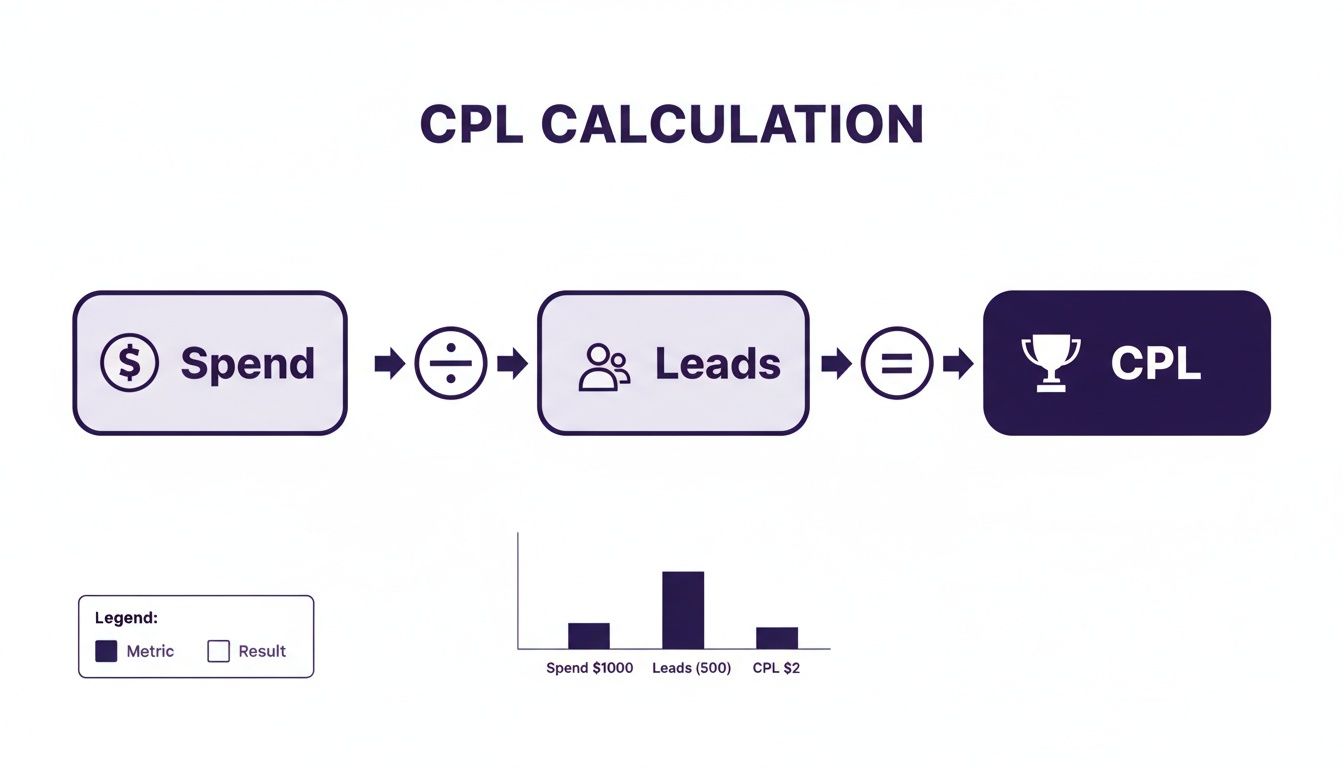
This is a great reminder that lowering your CPL means one of two things: spend less to get the same number of leads, or get more leads without increasing your spend.
How CPL Varies by Industry
The cost of a lead can be wildly different from one industry to the next. For instance, a lead in higher education can cost a staggering $982, while the legal sector hovers around $649.
Even in the B2B tech world, the numbers are high. Fintech companies pay an average of $452 per lead. These numbers make it clear why just pouring money into ads isn't a winning strategy for most founders.
How Marketing Channels Impact Your CPL
Where you choose to spend your time and money has a massive effect on your cost per lead. Some channels are just inherently more expensive than others.
Average Cost Per Lead by Channel
| Channel | Average CPL (B2B) | Best For |
|---|---|---|
| Trade Shows & Events | $811 | High-value networking, enterprise deals |
| Referral Marketing | $73 | Warm, high-trust leads from existing customers |
| Paid Search (PPC) | $110 - $200+ | High-intent buyers actively searching for solutions |
| Content Marketing | $92 | Building long-term authority and organic traffic |
| SEO | $70 | Attracting consistent, low-cost organic leads over time |
| Social Media | $80 | Brand building and top-of-funnel engagement |
| Direct Outreach | $50 - $150 | Hyper-targeted prospecting and relationship building |
Old-school methods like trade shows can run you over $800 for a single lead—a price that’s out of reach for most startups. Even paid search gets expensive fast. You can get a feel for this by checking out Google Ads industry benchmarks.
This is exactly why direct outreach, especially on platforms like Twitter, has become a game-changer for scaling SaaS distribution. It lets you skip the bidding wars and connect directly with your ideal customers.
With an outreach automation tool like DMpro, you can find and start conversations with hundreds of targeted leads on Twitter every day. By automating the prospecting and personalizing messages at scale, you generate quality conversations for a fraction of what you'd pay on traditional ad channels.
The Key Factors That Influence Your CPL
Your Cost Per Lead isn’t a random number. It's the direct result of a handful of key drivers you can control. Let's break down what they are so you can start pulling the right levers.
Your Industry and Target Audience
The biggest factor is who you're selling to. If you’re in a hyper-competitive space like fintech, you’re naturally going to pay more to get someone's attention. More competition means more noise.
The seniority of your target audience also matters. A lead for a C-suite executive will almost always cost more than one for a marketing manager. Decision-makers are harder to reach.
The Channels You Use
Not all lead generation channels are created equal. The average B2B cost per lead has been climbing, but that hides massive differences between channels. Events can cost $811 per lead, while other channels are far more efficient. You can explore more of these lead generation statistics to see the gap.
For founders scaling distribution, this is critical. Relying on expensive channels like paid search is a quick way to burn through runway. This is why channels like direct outreach on Twitter, especially when automated, are so powerful—they offer a direct line to prospects without the high price tag.
Messaging and Offer Quality
How you talk to prospects directly impacts how many respond. A generic message gets ignored, driving your CPL sky-high because you’re paying for outreach that produces zero results.
Personalization is your secret weapon. A message that references a prospect's recent tweet is infinitely more effective. This is where tools like DMpro can change your CPL. By automating hyper-personalized DMs at scale, you boost your response rate, which means more leads from the same effort. That’s how you lower your cost per lead.
Finally, lead quality plays a huge role. If you’re generating tons of cheap but unqualified leads, your real CPL is much higher. Implementing a system to define and score leads helps you focus on quality. If you want to dive deeper, we have a guide on what is lead scoring.
Actionable Strategies to Lower Your Lead Generation Cost
Alright, let’s get into the practical moves you can make right now to lower your lead generation cost per lead without sacrificing quality. As a founder, you don’t have time for strategies that don’t move the needle.
These tactics are all about working smarter. They're designed to help you spend less money and effort to get more of the right conversations started.
Nail Your Ideal Customer Profile
This sounds basic, but it's crucial. A fuzzy Ideal Customer Profile (ICP) is the fastest way to waste money talking to the wrong people. Get laser-focused on who you're really trying to reach.
A rock-solid ICP acts like a GPS for your outreach. It tells you exactly where to find your future customers on platforms like Twitter, what their pain points are, and how to talk to them in a way that resonates.
Ditch Manual Prospecting for Automation
One of the biggest drains on your resources is manual outreach. Spending hours every day scrolling through Twitter, hunting for prospects, and copy-pasting DMs is a recipe for a sky-high CPL. Your time is your most valuable asset.
This is where automation becomes a total game-changer for scaling SaaS distribution. Instead of burning hours on manual work, the right tool can do the heavy lifting for you.
For example, a platform like DMpro uses AI to scan thousands of profiles on Twitter, identifying hundreds of hyper-targeted leads that fit your ICP every single day. It then engages them with personalized messages, turning a slow, manual grind into a 24/7 lead generation engine.
Personalize Your Outreach at Scale
Personalization is a must. Cold outreach reply rates often hover around a dismal 5.1%, mostly because the messages are generic and self-serving. To break through, you have to show you've done your homework.
Look for tools that can automate personalization based on a prospect's recent activity, bio, or interests. A simple message like, "Hey [Name], loved your recent tweet on [Topic]..." is infinitely more powerful than a generic template. This boosts reply rates, which directly lowers your CPL. For more inspiration, check out our guide on SaaS lead generation strategies that work.
Focus on Low-CPL Channels
Not all channels are created equal. While the average B2B CPL can be a staggering $391.80, channels like social media and email are far more cost-effective. Recent stats show Facebook ads averaging $27.66 per lead and email at $53. You can find more of these insights about 2026 lead gen stats on snov.io.
By automating outreach on a high-leverage platform like Twitter, it's possible to see response rates of 25-40%. That's almost unheard of in traditional cold outreach and allows you to build a steady stream of high-quality leads for a fraction of what you'd spend on paid ads.
Your Founder's Playbook for CPL Management
<iframe width="100%" style="aspect-ratio: 16 / 9;" src="https://www.youtube.com/embed/QGDevkDWaHQ" frameborder="0" allow="autoplay; encrypted-media" allowfullscreen></iframe>Let’s pull this all together. Getting a handle on your cost per lead isn't about getting lost in spreadsheets. It's about building a simple, repeatable system that works.
Think of this as your playbook for creating a predictable pipeline that doesn't drain your bank account. Stop thinking about "buying leads" and start thinking about "investing in a scalable growth engine."
Your real goal isn't just to make a number go down. It's to build a process that consistently brings you high-quality conversations.
Your CPL Management Checklist
Ready to start? Here’s a straightforward checklist to get you moving.
- Set a Target CPL: Use the benchmarks we covered to pick a realistic starting CPL. Make sure it lines up with your industry and average deal size.
- Track Everything: You can't improve what you don't measure. Set up a simple way to track your marketing spend and where every lead comes from.
- Focus on One Channel: Don't try to be everywhere at once. Pick one channel with high potential—like automated outreach on Twitter—and get really good at it first.
- Automate the Grind: Use tools to take care of the repetitive stuff like finding prospects and sending that first message. This frees you up to talk to prospects and close deals.
When you automate your outreach, you take a time-consuming task and turn it into a fixed, low-cost system that runs on its own.
If you’re tired of manually sending DMs every day, try DMpro.ai — it automates outreach and replies while you sleep.
Frequently Asked Questions
As a founder, you're always trying to cut through the noise. When it comes to metrics like cost per lead, a few questions come up over and over. Let's get you some straight answers.
What Is the Difference Between CPL and CAC?
This is a big one, and it's easy to get them mixed up.
Think of it this way: CPL (Cost Per Lead) is what you pay for a potential customer to raise their hand. They're interested.
CAC (Customer Acquisition Cost) is the full cost of getting an actual paying customer. This includes all the marketing and sales costs that went into turning that interested lead into someone who pulls out their credit card.
Your CAC will always be higher than your CPL because not every lead becomes a customer. The game isn't just about getting a low CPL; it's about getting a low CPL for high-quality leads that actually convert.
Key Takeaway: A low CPL with leads that never convert is just a vanity metric. The real win is a low CPL that translates into a low CAC.
How Often Should I Review My CPL?
For a fast-moving SaaS, checking your CPL monthly is the sweet spot.
This gives you enough time to see real trends and measure the impact of your experiments without getting bogged down by daily noise. If you check it too often, you'll drive yourself crazy.
The most important thing is consistency—make CPL a regular part of your monthly growth meetings.
Is Automated Outreach on Twitter Really Cheaper Than Paid Ads?
Yes, by a long shot. The reason is simple.
With paid ads, you're in a constant bidding war. You pay for every click, and your costs can skyrocket overnight. It's unpredictable and expensive.
Outreach automation tools like DMpro flip the script. Your main cost is a flat subscription fee. The software then works around the clock, engaging hundreds of laser-targeted prospects for you every day. Because these DMs are direct and personal, the response rates are often fantastic—we consistently see 25-40%.
You end up with a steady stream of qualified conversations for a predictable price. This creates a much lower and more stable cost per lead than you'll ever get from ads. You're building an outreach engine, not just renting eyeballs.
If you’re tired of manually sending DMs every day, try DMpro.ai — it automates outreach and replies while you sleep.
Ready to Automate Your Twitter Outreach?
Start sending personalized DMs at scale and grow your business on autopilot.
Get Started Free