
Lead Generation Agency: What It Does and How to Hire One
By DMpro team
A lead generation agency runs prospecting, outreach and reporting for you. Here is what they do, what they cost and how to judge a fit.
Agencies sell conversations, but the deal goes to whoever answers first. An analysis of 1.25 million leads across 42 U.S. companies found that firms attempting contact within one hour were nearly seven times more likely to qualify a lead than firms that waited an extra hour, and more than 60 times more likely than firms that waited at least 24 hours, as Callingly's review of speed-to-lead research sets out.
That finding reframes the hiring decision. You aren't buying a list of names. You're buying a system that reaches the right person while their intent is still live, and that does it inside the rules of the platform it runs on. I judge every agency on two things before price ever comes up: qualified pipeline it can prove, and whether it can show a reason to contact every prospect it messaged.
The rest of this piece is the working version of that judgement: what a lead generation agency does, four ways to buy the work, the consent checks to run before a dollar goes out, and the arithmetic that tells you whether the fee earns its place.
What a Lead Generation Agency Actually Does
A lead generation agency finds people who might buy, starts conversations, qualifies whoever answers, and hands your team contacts who are ready to talk. Four jobs sit inside that sentence: finding prospects, deciding who fits, reaching out, and reporting what happened.

The category is big enough that most founders meet it long before they've written down a buyer definition. One market estimate valued global lead generation services at roughly $4.1 billion in 2022 and projected $9.9 billion by 2028, a compound annual growth rate of 17.5%, according to Stealth Agents' lead-generation outsourcing research. The same estimate found that business-process-outsourcing delivery, meaning agencies, contact centers and virtual assistants, made up 58% of total market revenue.
That 58% is the part worth sitting with. Most of the money in this category pays for people doing work, not software being licensed. Companies buy capacity: prospect research, qualification, messaging and campaign execution that nobody in-house has the time or the process discipline for. A founder who spends three mornings a week on cold DMs doesn't have a strategy problem. They have a capacity problem, and outsourcing is the usual fix.
Three things founders actually buy
Read "lead generation agency" loosely and you'll end up comparing four different products as if they were one. A people-run service takes the whole job and reports back. A managed campaign service sets up and runs your outreach for you. A tool you operate yourself gives your team the workflow and leaves execution with you. Same words on the invoice, completely different amounts of control.
Price isn't the first question either. When a campaign underperforms, the cause is usually upstream of the channel: no buyer definition, no weekly owner, no follow-up. A useful read is fixing a stalled B2B sales pipeline, which works through where deals get stuck before you spend money on more outreach.
Service Models Compared Side by Side
Start with the shape of each option rather than the pitch deck. The table below strips out the marketing language and leaves who does the work, how you're billed, who it suits and where it breaks.
| Model | Who runs the daily work | How you pay | Best fit | Main risk |
|---|---|---|---|---|
| Full-service agency | Agency team handles targeting, outreach and reporting | Monthly retainer or per-lead fee | Companies with no internal sales operations | Less control over messaging and lead quality |
| Managed campaign service | Vendor sets up and runs your campaigns | Monthly fee scoped to the work | Founders who want outcomes without hiring staff | Dependence on the vendor's process |
| Software you run yourself | Your team runs the workflow with the tool | Fixed monthly subscription | Teams with someone who owns outreach | Results depend on your own execution |
| Freelancer or consultant | One person handles part of prospecting | Hourly or project fee | Small, specific projects | Limited capacity and key-person risk |
Full-service agency. The agency owns targeting, outreach and reporting, usually on a monthly retainer or a per-lead fee. It suits a company with no internal sales operations at all. The risk is message drift: copy you'd never approve goes out under your name, and lead quality slips while the weekly report still looks healthy.
Managed campaign service. The vendor builds and runs campaigns on your behalf for a monthly fee scoped to the work. It fits a founder who wants outcomes without hiring a team. The dependency is real. Process knowledge sits with them, and leaving the service means rebuilding the machine from scratch.
Software you run yourself. Your team runs the workflow inside the tool for a fixed monthly subscription. Control is the highest of the four and the fixed cost the lowest. Results track how well someone on your side owns the work every single week, and how outsourcing SDR work compares with keeping it in-house is worth reading before you pick a side.
Freelancer or consultant. One person handles one slice, billed hourly or by project. Good for a defined job such as rewriting message copy or building a first list. Capacity is capped by one calendar, and if they leave, the work leaves with them.
Per-lead pricing deserves its own warning. It pays the vendor for volume, so qualification loosens as the contract matures, and the cheapest lead is usually the one nobody wanted. If you're weighing that model, especially in local verticals, the pay per lead for local services breakdown explains how the economics work from the seller's side of the deal.
We sit in the bottom two rows. Two self-managed subscriptions handle the do-it-yourself path: Pro for a handful of X accounts and smaller lists, Agency for unlimited accounts, higher daily sending and much larger storage. The third option is our custom managed plan, where our team runs account setup and warm-up, done-for-you targeting and lead sourcing, outreach scripts written for your offer, campaign management and optimization, and reporting with a dedicated strategist. The subscriptions carry fixed monthly prices. The managed plan is scoped to your needs, so the number moves with the work.
Rule of thumb: choose by who will own outreach every week, not by price alone. A cheap tool with no owner produces nothing, and an expensive agency with a vague brief produces the same.
Consent and Platform Rules to Check First
One rule decides whether the rest of your campaign survives contact with the platform. X's automation rules prohibit sending unsolicited direct messages in bulk or through automation, and automated DMs are allowed only when the recipient has requested contact or clearly indicated on X that they want to hear from you, such as by sending a DM first, per X's automation rules.
A profile that matches your keyword is a reason to look closer. It isn't permission to send.
Plenty of agencies skip that distinction. They build a list from keyword searches and followers, load it into a sequence, and let volume do the talking. It works until an account gets flagged, an angry recipient reports the message, or a client asks for proof of consent and nobody can produce it.
The checks to run before the first automated message
- A real opt-in signal for every prospect. An inbound DM, an explicit request, a conversation the prospect started.
- An opt-out inside every message, honored the same day. No queue, no "we'll process it next week".
- Contact frequency that respects the person. One conversation, not five accounts pushing identical copy.
- Rate limits treated as hard edges. Never exceed them, never route around them.
- Data minimization with a record. Keep only what you need, and log who was contacted, when and why.
- Escalation to a human for sensitive or ambiguous conversations, before a template answers for you.
The developer side of the same policy is stricter than most agencies expect. Services that send DMs must obtain explicit consent before automated messages, honor opt-outs immediately, avoid bulk or aggressive actions, avoid posting identical or substantially similar content across multiple accounts, and never exceed or circumvent rate limits, per X's developer terms.
Our lead collection only touches publicly available information and respects X's rate limits when scraping. Reply-triggered branching and account monitoring are the controls we give you for volume. They help you stay inside consent-based conversations and they are not a guarantee against a platform restriction. On multi-account work, a weekly account compliance monitoring review catches the pattern before enforcement does: rising send volume, repeated copy, an opt-out that never got actioned.
Two questions to ask any agency before signing: can you prove each prospect was eligible to receive this message, and what happens in the ten minutes after someone opts out?
The Work Agencies Do From Targeting to Reporting
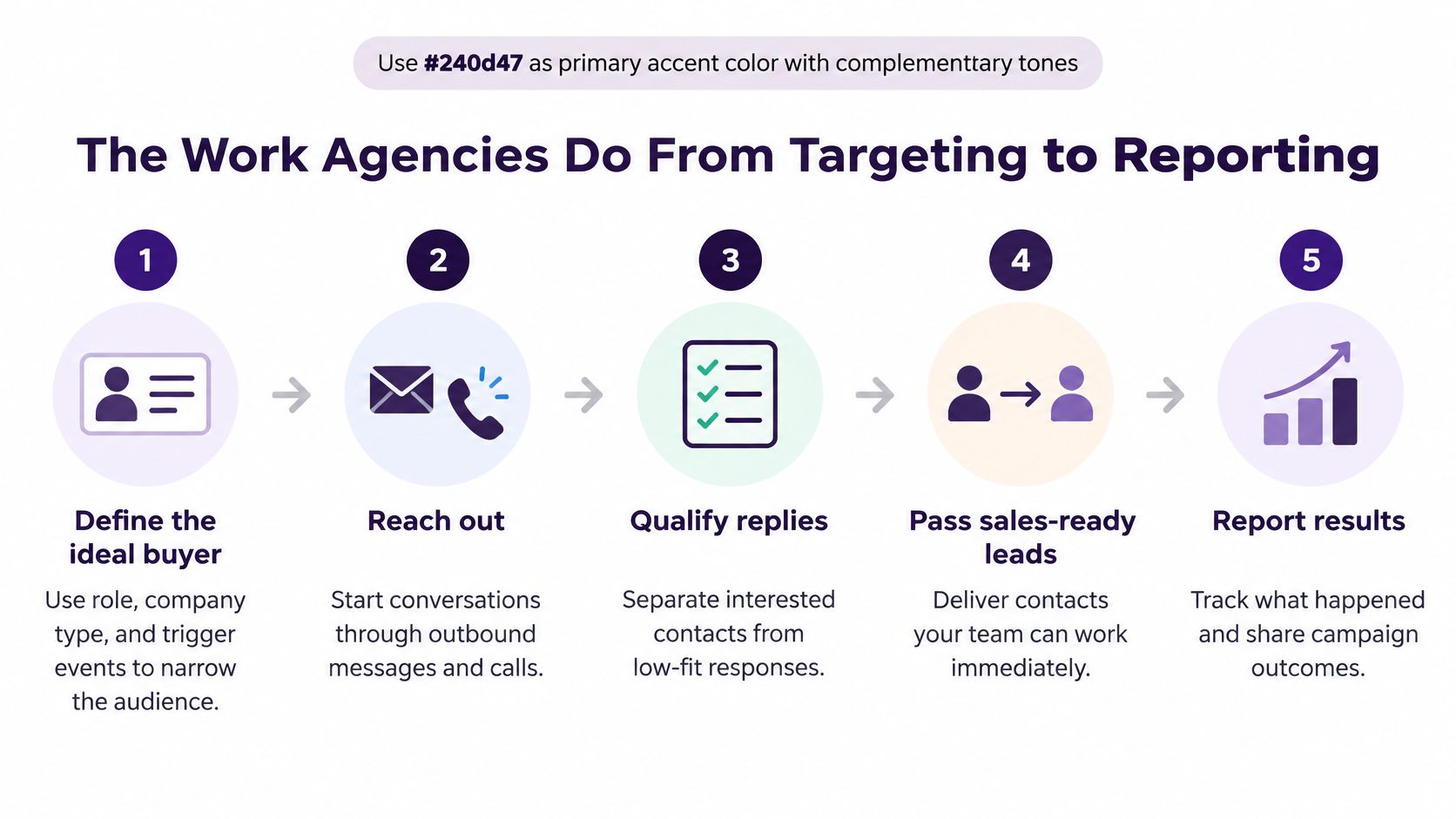
Ask an agency to walk you through a live campaign and the simplicity disappears. The work runs through seven stages, and each one fails in a way you can predict before signing.
- Define the ideal buyer. Role, company type, and trigger events such as a funding round, a hiring post or a product launch. Vague criteria like "founders who want growth" produce a list that replies politely and never buys. The common failure is targeting anyone who could theoretically use you.
- Source prospects where intent shows up. Followers of accounts adjacent to your category, active communities, keyword-matched conversations, replies to relevant tweets, and a CSV of names you already know. Content still carries much of this work: 85% of B2B marketers use content to generate sales leads, against 60% of B2C marketers, per compiled lead-generation survey data from WPForms. The failure is buying a scraped list and calling it sourcing.
- Qualify with filters before anyone writes a word. Bio terms, location, account age, profile image, website presence. A list of twenty thousand names is raw material until those filters cut it down. The failure is skipping them because the audience "looks right".
- Write openers that use something real. A line from a recent post, a detail from the prospect's website, a problem their role owns. First-name insertion adds almost nothing: an analysis of 338 million cadence emails reported by Salesloft found sellers who personalized at least 75% of messages generated about three replies per 100 sends, against about one per 100 for sellers who personalized none. The failure is a template that could go to anyone.
- Build the sequence with waits, follow-ups and branches. The branches matter more than the copy. A sequence that changes when someone replies reads like a conversation. The failure is a fixed script that keeps firing after the prospect already answered, which reads like a robot and burns the lead.
- Sort replies and hand warm ones over fast. Interested, not now, wrong person, hostile. Speed decides this stage, because a warm reply cools by the hour. The failure is a shared inbox where an interested prospect waits two days for a human.
- Report in terms the next campaign can use. Messages sent, reply rates, response categories, meetings booked, broken out by audience and opener. The failure is a summary that proves activity while hiding which targeting choice produced it.
Use those seven failures as a vetting checklist. Ask a prospective agency how it handles each stage, and a vague answer at any step tells you where the retainer leaks.
Inside DMpro, a campaign combines three things: sending accounts, a lead audience and a workflow. The audience works as a reusable group you can collect into, filter and run again on a different offer, so stages two and three compound instead of restarting each month.
Nothing in this workflow creates permission by itself. Finding someone through followers, replies or a keyword match gives you a reason to qualify them. Permission to message them has to come from somewhere else.
Judging Whether the Leads Are Worth Paying For
Ask an agency how it reports and you'll hear contacts collected, messages sent, reply rate, meetings booked. Every one of those measures activity. None of them tells you whether the work produced revenue.
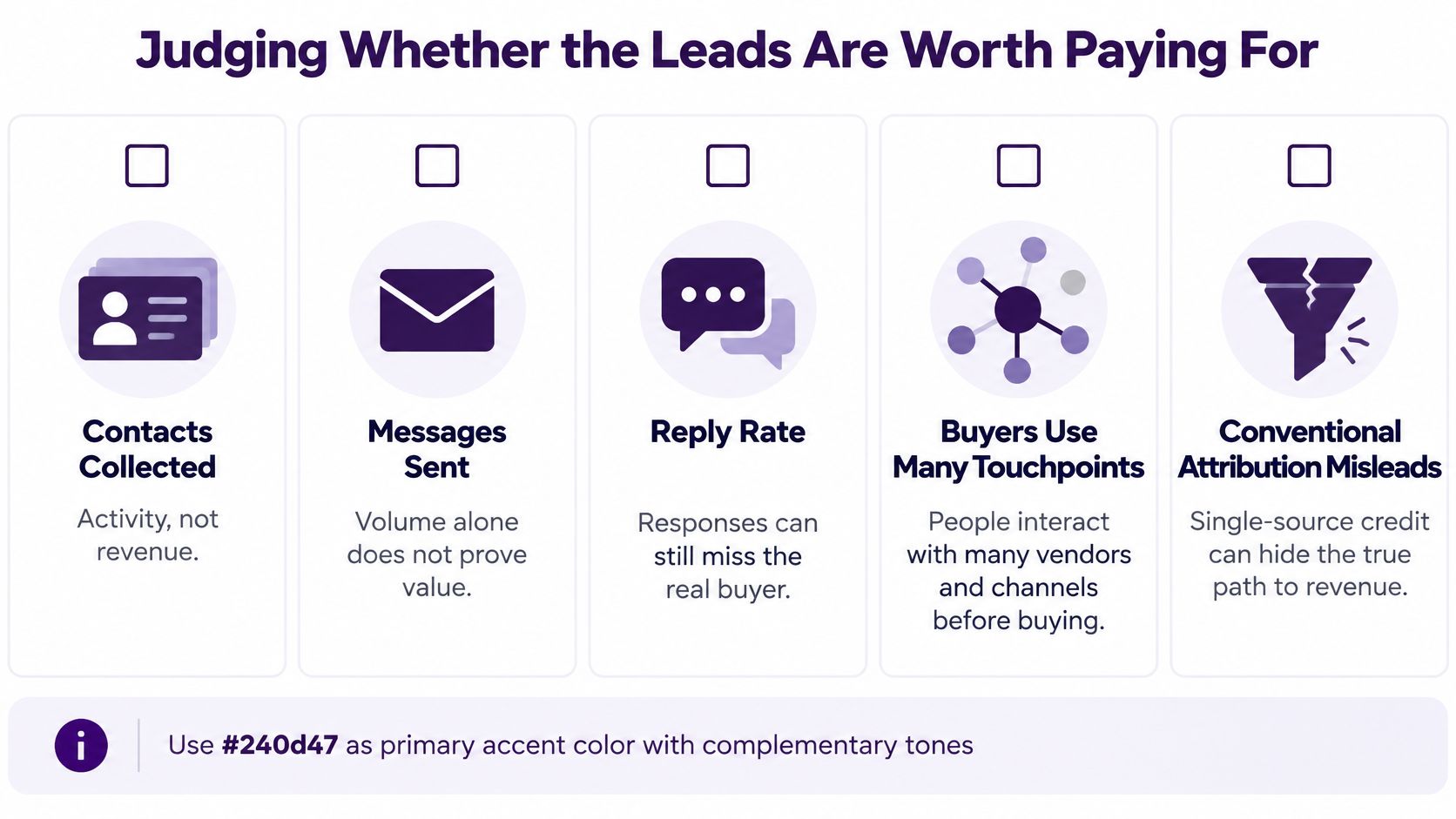
The buying side feels the same gap. 31% of demand-generation respondents planned to shift from lead volume and MQL generation toward higher-quality leads, while only 20% ranked lead quality as their top priority, per the 2025 demand generation benchmark survey. The same survey found six in ten B2B marketers track pipeline generated, which leaves four in ten who don't.
Attribution makes it worse. Buying groups meet many vendors across many channels, most of it digital and anonymous, so a single form fill or first click rarely explains the deal. An agency can hand you a dashboard full of green arrows and still have no idea which contact turned into revenue.
The measurement contract to agree before launch
- Written qualification criteria, one sentence per lead type, signed by both sides.
- Source and campaign IDs on every lead, so attribution survives the CRM import.
- Reply categories defined in advance, not invented inside the monthly report.
- Opportunity stages and disqualification reasons tracked, not collapsed into "not a fit".
- Sales-accepted-lead rate, pipeline created, win rate and sales cycle length, reported by cohort.
- One operational number, the median time from a lead's reply to a human answer, because a fast reply to a live conversation is the only part of the funnel you fully control.
How to run a 30-day pilot that settles it
A pilot beats a proposal every time. Fix the number of leads, score them against the agreed criteria at the end of the month, and treat the sales-accepted rate as the headline result. Ask for the reply classifications alongside it so you can see how the agency decided what counted as interest, and check that its definitions match the lead qualification process your sales team already uses.
Decide the pass mark before the pilot starts, in writing. If a meeting is worth a certain amount to your business, say so, multiply it by the meetings you expect, and agree that number as the threshold. A result argued after the fact is not a result.
A Worked Cost Example for a Small SaaS Team
Take a three-person SaaS team that wants roughly 300 qualified conversations a month and is choosing between running outreach itself and hiring a managed service. The self-run options buy the following.
| Option | Monthly price | Accounts and daily messages | Lead storage |
|---|---|---|---|
| Self-run Pro plan | $69 | 5 accounts at 25 messages per account per day | 5,000 leads |
| Self-run Agency plan | $199 | Unlimited accounts at 35 messages per account per day | 100,000 leads |
| Custom managed service | Quote-based | Set by the scope agreed in your proposal | Set by the scope agreed in your proposal |
Run the ceiling math before you run the campaign. Pro allows five accounts at 25 messages each, which caps you at about 125 messages a day, or roughly 2,750 over 22 working days. Agency removes the account cap and lifts each account to 35 per day, so the ceiling grows with the number of accounts you're willing to warm, monitor and keep distinct from one another.
X adds a boundary the plans sit under. The platform limits accounts to 500 Direct Messages sent per day, per X's Help Center limits page. That figure is well above both plan limits, and it becomes binding once you run many accounts or push follow-ups into the same day as a first touch.
Treat every one of these numbers as a ceiling, not a promise. X restrictions and account settings can lower the effective rate, and our safeguards add delays and sending limits on top of the plan figures. Nothing in the software can guarantee the platform will allow a given sending rate.
The cost per meeting method
Divide the monthly cost by the number of qualified meetings the campaign books, not the ones you hoped for. At $199 a month, ten meetings puts you near $20 a meeting. Two meetings puts you near $100, and at that spread the problem is targeting, not the tool. Compare the result with what one closed customer is worth to you. This same division, applied to cost per lead benchmarks, tells you whether the funnel is improving or just getting louder.
Do the identical calculation on any managed proposal you receive. Take the quoted monthly fee, ask how many qualified meetings the scope supports, and divide. If the vendor won't commit to a meeting number, use the low end of what they'll verbally promise and see whether the number still clears what a meeting is worth to you.
Decide Whether an Agency Fits Before You Sign
Three questions settle it faster than any call. Does someone on your side have time to own outreach for at least six months? Can you define a qualified lead in one sentence? Does your expected cost per meeting stay below what a meeting is worth to you?
If you have no owner and a budget for a retainer, hire a full-service or managed agency and accept the loss of control as the price of speed. If you have an owner and clear criteria, start with software you run yourself and keep the money. If you have neither, fix your offer and your target list first. No agency rescues a weak offer, and the retainer will prove it slowly.
Nothing to write down is where most of this goes wrong, and the buyer's guide to outsourced sales development is a useful second opinion on how agency structures differ on ramp time, cost and control. Then get practical:
- Write the buyer criteria in a shared doc, one sentence, with exclusions named.
- Pick one pilot segment instead of the whole market.
- Agree the measurement contract in writing before any message goes out.
- Request the scope and pricing as a document, including who owns what weekly.
- Set a 30-day checkpoint with the decision defined in advance.
If you're going the self-run route, the setup is straightforward: sign up, connect your X account through our secure browser extension, create a first campaign and start generating leads.
If you're tired of manually sending DMs every day, try DMpro. It automates outreach and replies while you sleep, with reply-triggered branches, lead groups you can reuse and reporting that shows which conversations moved. Start on a self-managed plan, or have our team run the campaign for you under the managed service.
Put your outreach plan into practice
Find relevant leads on X (Twitter), personalize your messages, and manage the replies in DMpro.
Get started