
What is sales automation? A Practical Guide for Founders
Discover what is sales automation and how it streamlines outreach, boosts lead capture, and scales your SaaS sales with practical examples.
Think of sales automation as your own personal growth assistant. It’s a smart system designed to take over the repetitive, time-consuming parts of your sales process, like finding leads and sending DMs, so you can stop doing them manually.
This assistant works 24/7 to find prospects, send personalized outreach, and keep track of who’s interested. All this happens in the background, freeing you up to focus on what really matters: talking to hot leads and closing deals.
What Is Sales Automation In Simple Terms
As a founder, your time is everything. Every minute you spend manually digging for leads on Twitter, sending one-off DMs, or updating a spreadsheet is a minute you're not spending on product, strategy, or talking to a user who's ready to pay.
That's the exact problem sales automation solves. It's not about replacing you or making your outreach robotic. It's about amplifying your efforts so you can scale your SaaS distribution without hiring a huge team.
Imagine setting up a system that automatically spots potential customers on Twitter who are talking about a problem your SaaS solves. Instead of you spending hours sending a personalized DM to each one, the system can kick off dozens of those conversations for you—even while you sleep.
Why It Matters For Founders
The whole point is to build a predictable engine for growth without burning yourself out. This is especially true for early-stage SaaS companies where consistent outreach is a lifeline. By automating the top of your funnel, you create a steady, reliable stream of new conversations. For a deeper look at this process, check out our guide on what is outbound lead generation.
Sales automation isn't just a "nice-to-have" tool for big companies anymore. It’s a core part of the modern founder's toolkit, especially for scaling SaaS distribution efficiently. The numbers back this up: the global sales automation market is expected to reach $16 billion by 2025, and analysts predict that 80% of B2B sales interactions will happen in digital channels.
Automation isn't about being less human; it's about being more human where it counts. It handles the robotic tasks so you can focus on genuine connection, strategy, and closing deals that move the needle.
For founders, this means you can compete with much larger teams by working smarter, not just harder. It’s how you can turn a manual, time-draining chore like Twitter outreach into a powerful, automated lead generation channel that works for you 24/7.
Manual Versus Automated Sales Tasks
To see the difference in action, let’s compare some common manual sales tasks with their automated counterparts. The contrast shows just how much time and effort you can reclaim.
| Manual Task | Automated Solution | Founder Benefit |
|---|---|---|
| Finding Leads | The system automatically scans Twitter for keywords, job titles, and buying signals. | Saves dozens of hours a week and delivers a constant flow of relevant prospects. |
| Initial Outreach | A personalized DM sequence is sent automatically to new leads at the best time. | Ensures no lead is ever missed and that every first touchpoint is consistent and timely. |
| Following Up | Smart follow-up DMs are triggered if a prospect doesn't reply after a set time. | Prevents leads from falling through the cracks and dramatically increases response rates. |
| Lead Scoring | The system scores leads based on their engagement (clicks, replies, profile data). | You can instantly see who your hottest leads are and prioritize your time effectively. |
| Scheduling Meetings | An integrated calendar link is sent after a positive reply, letting leads book a time instantly. | Eliminates the back-and-forth of scheduling and gets interested prospects on a call faster. |
As the table shows, it's not about just doing things faster. It's about creating a smarter, more reliable sales process that gives you back the time you need to focus on growth.
The Building Blocks Of A Sales Automation System
A good sales automation system isn't a single tool you just switch on. It’s more like an engine, with several key parts working together to move your SaaS forward. Once you understand these building blocks, you'll see exactly how to apply automation to your own sales process.
At its core, sales automation is built on core web automation principles that help you create repeatable, efficient workflows. It's all about saving you time while generating predictable results. Let's break down the three most critical parts.
Automated Lead Capture
This is the very top of your funnel. Automated lead capture is all about automatically finding and grabbing information on potential customers, so you're not stuck doing it manually. Think of it as casting a smart, self-operating net.
Instead of losing hours scrolling through Twitter, you can put systems in place to find prospects for you.
- Social Media Monitoring: The system can automatically flag users on Twitter who post about a specific problem your software solves.
- Website Forms: When someone fills out a "Request a Demo" form, their info is instantly added to your CRM and tagged for follow-up.
- List Building Tools: These tools can find contacts based on criteria like job title or company size, then feed them right into your outreach campaigns.
This first step is crucial. It ensures you have a steady stream of new people to talk to, which is the lifeblood of any growing SaaS.
Intelligent Outreach Automation
Okay, you've got the leads. Now you need to start conversations. This is where most founders get stuck, sending the same DM over and over. Outreach automation handles that initial contact and all the follow-ups, letting you engage prospects at scale without losing that personal touch.
This isn't about sending generic blasts. Modern outreach is much smarter.
For instance, you can create highly targeted campaigns for different audience segments. A tool like DMpro is perfect for this on Twitter, allowing you to automatically send personalized DMs to prospects based on their bio or recent activity. You can see exactly how to build these workflows in our guide to campaign automation.
The goal of outreach automation is simple: Start more high-quality conversations in less time. It's about making sure every qualified lead gets a timely, relevant message without you having to hit "send" every single time.
This diagram really drives home how these components give founders back their most valuable resources: time, energy, and the capacity to close deals.
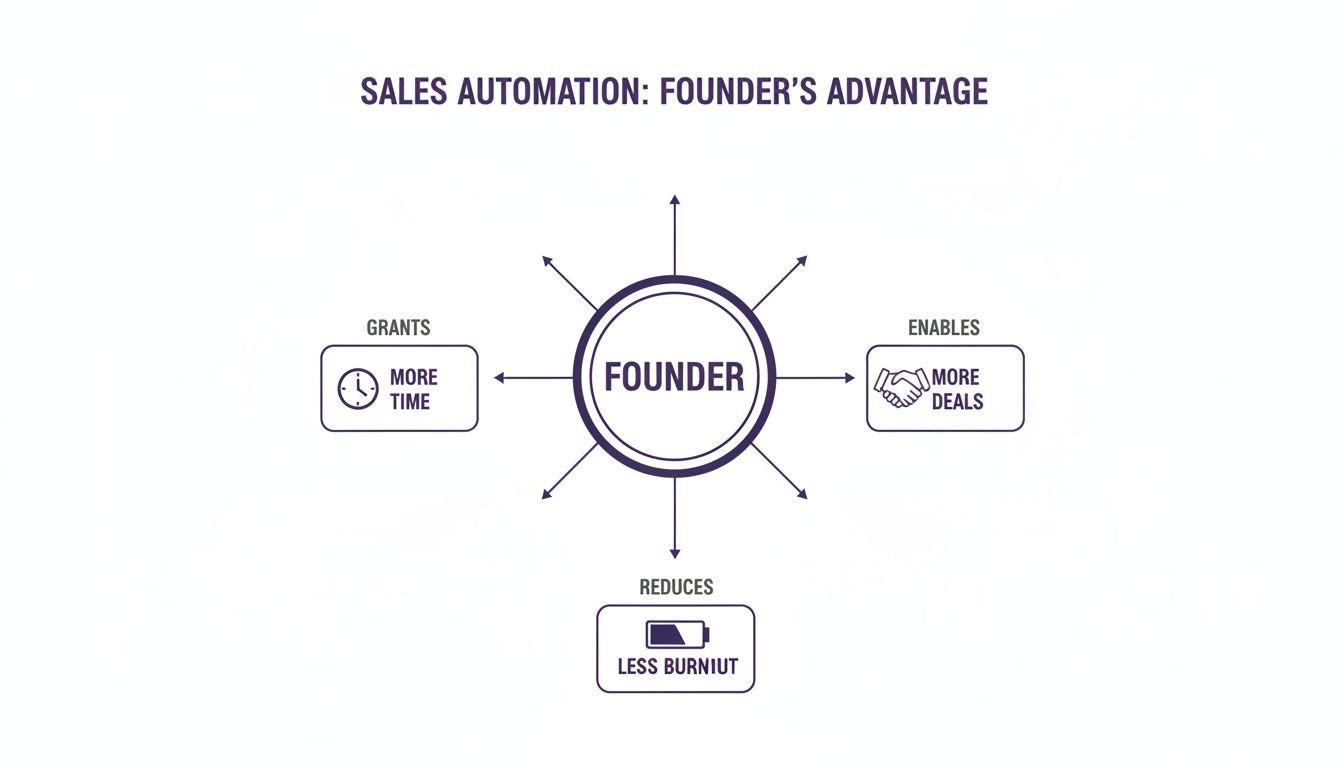
By automating the top of the funnel, founders can reclaim their days, focus on closing, and finally ditch the burnout that comes from all that manual grinding.
Performance Analytics
The final piece of the puzzle is knowing what’s actually working. After all, you can’t improve what you don’t measure. Performance analytics automatically tracks the results of your outreach, giving you a clear, honest look at your sales process.
This means you can see open rates, reply rates, and conversion rates without having to manually tally numbers in a spreadsheet. This data helps you make smarter decisions. Which DM templates are getting the best responses? Which lead sources are a waste of time?
It closes the loop, turning your sales efforts from guesswork into a data-driven science.
Automating Lead Generation On Twitter
Let's get practical. Most SaaS founders are on Twitter, but they’re using it the hard way. They're stuck in a time-consuming grind of endless scrolling, searching for conversations, and sending DMs one by one.
What if you could flip that script and turn Twitter into a predictable, automated lead machine?
This is exactly what sales automation was made for. Instead of hoping you stumble into the right conversation, you can set up a system that finds high-intent prospects and starts those conversations for you. All while you’re busy building your product.
When you do this right, Twitter stops being just another social channel and becomes a scalable part of your SaaS distribution funnel.
Finding The Right People To Target
First things first: you need to find who you’re talking to. Searching manually is slow and you're bound to miss people. Automation lets you cast a much wider and more precise net. You can build systems to automatically find users based on specific, high-intent signals.
What kind of signals are we talking about?
- Keyword Searches: Automatically find people tweeting "anyone know a good tool for..." or "struggling with [pain point]."
- Follower Targeting: Engage with the followers of your direct competitors or influential accounts in your niche. These are people already interested in solutions like yours.
- Bio Keywords: Pinpoint prospects based on their job titles in their Twitter bio, like "SaaS Founder," "Head of Growth," or "Marketing Director."
This automated discovery process gives you a constantly refreshed list of warm leads, easily saving you dozens of hours a week.
Launching Automated Outreach Campaigns
Once you’ve got your list of prospects, it’s time for outreach. This is where the manual grind really crushes founders. Trying to send dozens of personalized DMs every single day just isn't sustainable. This is where a tool built for this exact purpose, like DMpro, becomes a game-changer.
Instead of hitting "send" over and over, you can create an automated DM sequence. We dive deep into the mechanics of this in our guide to automated direct messages on Twitter. The trick is to make your messages feel authentic and human, even though a system is sending them.
The real power here isn't just sending messages; it's the ability to test and measure your approach. Automation provides the data you need to see which messages get replies and which ones fall flat, allowing you to constantly improve your outreach.
The system can automatically find users talking about relevant topics and initiate a personalized conversation, effectively building your sales pipeline in the background.
By automating this entire workflow—from finding the right people to making that first touchpoint—you create a consistent and predictable lead generation channel that works for you 24/7. This frees you up to handle replies from interested leads and close deals.
The Real-World Benefits Of Automation
<iframe width="100%" style="aspect-ratio: 16 / 9;" src="https://www.youtube.com/embed/rSsGgv_uYI0" frameborder="0" allow="autoplay; encrypted-media" allowfullscreen></iframe>So, what’s the actual payoff here? We've covered what sales automation is, but let's get down to the numbers that really matter to a founder. The benefits are tangible improvements to your time, your pipeline, and your bottom line.
Think about it founder-to-founder. Your most valuable asset is your time. Every hour you spend on manual, repetitive tasks is an hour you can't spend talking to customers, refining your product, or building high-level partnerships. This is where automation delivers its first and most immediate return.
Reclaiming Your Time
The first thing you’ll notice is how much time automation hands back to you. Instead of carving out hours a day to hunt for leads on Twitter and send DMs, you can shrink that entire workflow into a 30-minute setup.
By automating just the top of their sales funnel, many founders reclaim 10-15 hours per week. That’s an extra day and a half you can pour back into the parts of the business that only you can drive forward. It’s the difference between being a busy operator and an effective CEO.
The goal isn't just to work faster; it's to free up your mindshare. When you're not bogged down in repetitive outreach, you have the mental space to think bigger and focus on long-term strategy instead of just surviving the week.
This reclaimed time is what allows you to scale your SaaS distribution. It’s how a one-person SaaS can compete with teams ten times its size.
Impacting Key SaaS Metrics
Beyond just saving time, automation directly boosts the metrics that define your SaaS company's health. In sales, especially when you're trying to get a new product off the ground, speed is everything.
Faster lead response times create a huge advantage. An automated system can engage a prospect on Twitter within minutes of them showing interest—not hours or days later. This speed creates a powerful ripple effect:
- Higher Conversion Rates: Engaging leads while their interest is peaked dramatically increases the odds of getting a reply and booking a demo.
- Improved Pipeline Velocity: You move prospects through your funnel more quickly, shortening the sales cycle from the first touch to a closed deal.
- Increased ARR: A more efficient funnel means more deals closed per month, which translates directly to higher annual recurring revenue.
The data backs this up. Sales teams that embrace automation see a significant productivity jump. In fact, studies show sales automation can lead to a 14.5% average increase in productivity. They also see higher lead qualification rates, simply because they can respond faster. You can find more sales automation statistics and their impact on revenue to see the full picture.
Ultimately, sales automation isn't just a convenience—it's a critical growth engine for scaling your distribution without burning out.
How To Build Your First Automation Workflow
Getting started with sales automation can feel overwhelming. But as a founder, the best way to begin is to ignore the complexity. Just find one simple, repetitive task to automate.
Think of it this way: you wouldn't try to build an entire car engine on your first day. You'd start by learning how to change the oil. The same principle applies here. Focus on the single biggest time-drain in your day, get a quick win, and build momentum from there.

Here’s a simple, headache-free roadmap to get your first workflow up and running.
Identify Your Biggest Bottleneck
First, what's the one repetitive task that makes you want to pull your hair out? Is it spending hours scrolling through Twitter to find a few decent leads? Or is it copy-pasting the same intro DM a hundred times?
Pinpoint that one activity. For many SaaS founders, cold DM outreach on Twitter is the perfect candidate. It’s high-volume, follows a predictable pattern, and directly feeds your pipeline. That's your starting point.
Choose The Right Tool For The Job
Once you’ve found your bottleneck, find a tool designed to solve that specific problem. Don't get sidetracked by massive, all-in-one platforms. You need simplicity and a straight line to results.
When you're picking your first tool, look for these three things:
- Ease of Use: Can you launch a campaign in under an hour?
- Scalability: Will it grow with you?
- Direct Impact: Does it actually solve your problem and help you find more customers?
This is where a specialized tool shines. For automating outreach on Twitter, a platform like DMpro.ai is built for exactly that. It's focused, so you can get your first campaign live and see leads coming in almost immediately. If you need a hand, our quick start guide can walk you through it.
The best first tool isn't the one with the most features; it's the one that delivers the fastest win. Getting that initial taste of success is what will motivate you to explore more advanced automation.
Start Small, Then Iterate
Now it's time to launch your first, tiny campaign. Don't overthink it. Target a small, specific group of people with a simple, two-step message sequence. The goal isn't perfection—it's just to get the machine running.
Once it’s live, watch what happens. Are people replying? What’s your open rate? Use that early feedback to make small adjustments. Maybe you can tweak the first message or refine your targeting. This cycle of launching, learning, and improving is how you build a powerful automation engine over time. For those interested in taking this further, understanding concepts like agentic workflows and AI automation can open up even more sophisticated possibilities.
By following this simple three-step process, you can sidestep the overwhelm and start getting the benefits of sales automation right away.
10 Common Sales Automation Mistakes to Avoid (And How to Fix Them)
Jumping into sales automation is exciting, but it’s easy to get it wrong. As founders, we’re wired to move fast, but a little caution here can save you from alienating the very prospects you’re trying to connect with.
Think of automation as a powerful amplifier—it can amplify great outreach, but it can also amplify sloppy, impersonal messages.
The biggest trap is treating automation like a "set it and forget it" system. It's not. The goal is to handle the repetitive parts so you can be more human where it actually matters. Let's walk through some common mistakes I’ve seen founders make.
Sounding Like a Robot
This is the number one killer of outreach campaigns. If your DMs are generic and impersonal, they’ll get ignored. Nobody wants to talk to a robot. Remember, the goal is to scale conversations, not to broadcast spammy ads.
The fix is simple: personalization at scale. Don’t just blast the same message to everyone. Use personalization tokens to include a prospect's name, company, or something specific you noticed about them. For example, tools like DMpro.ai are designed for this, letting you create message templates that dynamically pull in details for each person.
A message that says, "Hey [FirstName], loved your recent post about [Topic]" will always outperform a generic "Hello."
A good rule of thumb: If you wouldn't say it in a real-life conversation, don't automate it. Keep your tone genuine, helpful, and focused on starting a real dialogue.
Forgetting to Monitor Performance
Another classic pitfall is launching a campaign and never looking back. If you aren't tracking your results, you're flying blind. You have no idea what’s working, what's failing, or why.
You need to treat your automation like a science experiment. Keep a close eye on these key metrics:
- Open/View Rates: Are people even looking at your messages?
- Reply Rates: How many people are engaging in a conversation?
- Conversion Rates: How many replies are turning into qualified leads or demos?
Check these numbers weekly. If your reply rate is low, it’s a clear sign your messaging isn't landing. Tweak your copy, adjust your targeting, and test a new angle. Continuous iteration is the secret to building a high-performing automation engine that drives SaaS growth.
To give you a head start, here’s a quick reference guide to help you sidestep the most common mistakes.
Automation Pitfalls And Practical Solutions
| Common Pitfall | Why It Happens | How to Fix It |
|---|---|---|
| Over-automating follow-ups | Enthusiasm leads to creating long, aggressive sequences that annoy prospects. | Cap follow-ups at a reasonable number (3-5). Use different channels and always add value. Sometimes, a simple "Just checking in" is enough. |
| Using a "salesy" tone | The focus is on pitching the product instead of helping the person. | Shift your mindset from "selling" to "helping." Ask questions, offer insights, and focus on their problems, not your solution. |
| Ignoring negative replies | Treating "not interested" or "unsubscribe" replies as failures and ignoring them. | See these as valuable feedback. Acknowledge them politely, remove the person from your list, and use the feedback to refine your targeting. |
| Poor lead data | Using outdated or inaccurate lists, leading to bounced messages and targeting the wrong people. | Invest in good data sources or clean your lists regularly. A smaller, high-quality list is always better than a massive, messy one. |
Learning from these common stumbles will help you build an automation strategy that feels helpful and human, not robotic and intrusive.
What to Do Next with Sales Automation
So, where do you go from here? Hopefully, you now see that sales automation isn't some complex system for giant corporations. It's about finding clever ways to offload repetitive tasks so you can get back to focusing on strategy and building genuine connections.
The trick is to start small. Don't try to automate your entire sales funnel in one weekend. Instead, find one major bottleneck that’s slowing you down. For most SaaS founders, that's manually finding leads and sending DMs on Twitter. Find a tool built to solve that one specific headache. That first small win will give you the momentum you need.
When you automate the right pieces of your outreach, you free yourself up to be the founder your company needs. You get back precious time and the mental energy to think bigger, connect with your most valuable prospects, and do what you do best: close deals.
Amplify, Don't Replace
Remember, the point of this isn't to replace the human element of sales. It's to amplify it. Good automation handles the grunt work at the top of the funnel, which in turn creates more chances for you to have the meaningful conversations that actually drive SaaS growth.
Take what you've learned here, pick that one frustrating task that's been nagging at you, and find a way to automate it today. Your future self will thank you for it.
The most successful founders don't just work harder; they build systems that work for them. Sales automation is one of the most powerful systems you can build to create predictable, scalable growth for your SaaS.
If you’re tired of manually sending DMs every day, try DMpro.ai — it automates outreach and replies while you sleep.
Ready to Automate Your Twitter Outreach?
Start sending personalized DMs at scale and grow your business on autopilot.
Get Started Free