
A Founder's Guide: How to Improve Your Sales Conversion Rate
Discover how to improve sales conversion rate with practical, proven tactics that help founders boost revenue and conversions.
Before you can improve your sales conversion rate, you have to answer a simple question: what does "good" actually look like for your business?
It's all about setting realistic benchmarks based on where your leads come from, not chasing vanity metrics from some industry report.
A founder selling high-ticket SaaS might be thrilled with a 2% conversion rate. Another founder selling a low-cost tool might need 5% just to keep the lights on. It’s all relative.
What Is a Good Sales Conversion Rate, Anyway?
Every founder asks this question. The honest answer? There's no magic number.
"Good" is completely contextual. Comparing your early-stage startup to a massive public company is pointless. You're playing different games.
A lead from a warm Twitter DM, where you've already built some rapport, is a world away from a cold click on a paid ad. They show up with different levels of intent and trust. Trying to apply one benchmark across your entire funnel is a recipe for frustration.
Setting Realistic Benchmarks
Instead of getting lost in broad industry stats, let's focus on what actually moves the needle. A great starting point is understanding how your different channels perform.
Cross-industry studies show an average conversion rate of around 2.9%, but the real insight is in the details. Paid search often converts higher than organic search. This tells you that not all traffic is created equal.
The trick is to slice your conversion data by its source. That’s how you get a clear picture of what’s working and what’s a waste of money.
As a founder, your job isn't to hit some universal benchmark. It’s to understand your own numbers so deeply that you can systematically improve them, channel by channel.
This approach helps you spend smarter. Once you know which channels bring in the best leads, you can double down. To really get a handle on this, check out our guide on how to calculate and optimize your https://www.dmpro.ai/blog/saas-customer-acquisition-cost.
Here's a quick look at average conversion rates from different channels to help set realistic expectations.
Conversion Rate Benchmarks by Traffic Source
| Traffic Source | Average Conversion Rate | Founder's Takeaway |
|---|---|---|
| Organic Search | 2.7% | High-intent traffic, but takes time to build. Focus on long-tail keywords. |
| Paid Search (PPC) | 3.2% | Great for targeting specific intent, but can be costly. Monitor ROAS closely. |
| Referral (e.g., Guest Posts) | 4.0% | Often brings in highly qualified leads due to pre-established trust. |
| Email Marketing | 2.5% | Nurtured leads convert well. The key is segmentation and personalization. |
| Social Media (Organic) | 1.2% | More for brand building, but direct outreach on Twitter can yield high-quality leads. |
Remember, these are just starting points. The real value comes from tracking your own performance and finding opportunities.
Why Your Business Model Changes Everything
The price and complexity of your SaaS product are massive variables. A cheap, self-serve tool is a volume game. A high-ticket enterprise solution is all about quality over quantity.
-
Product-Led Growth (PLG): If you’re running a free trial or freemium model, your visitor-to-signup rate is a key metric. A 5% rate here could be fantastic. The real moment of truth, though, is the trial-to-paid conversion rate.
-
Sales-Led Growth: For businesses built on demos and sales calls, the conversion from lead to qualified meeting matters most. Hitting a 10% conversion rate on high-intent leads could be a huge win for a B2B SaaS with a high average contract value (ACV).
Ultimately, you need to focus on the metrics that directly tie back to revenue. Establish a baseline for your business. Once that's set, the real work begins.
For a deeper dive, explore these comprehensive strategies to improve your sales conversion rate and start closing more deals.
How to Find the Leaks in Your Sales Funnel
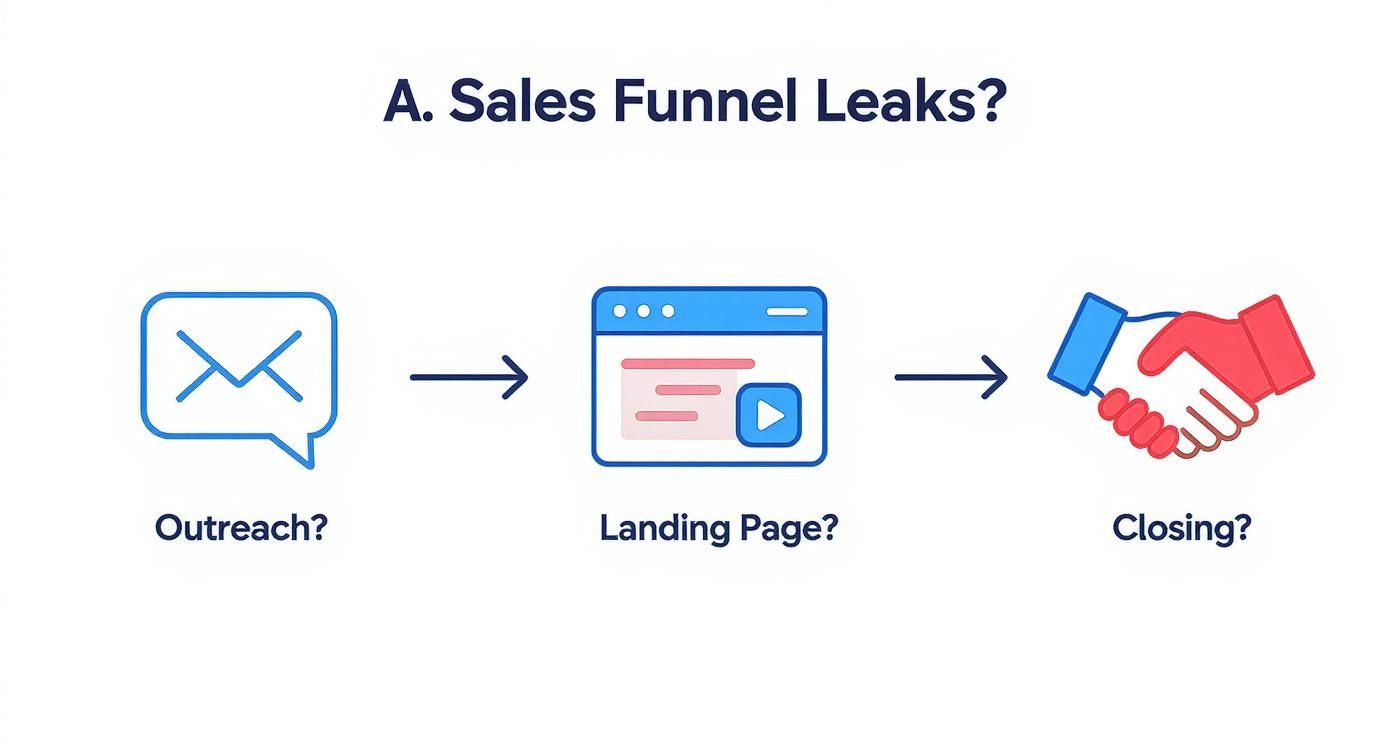
A low conversion rate is never just one problem. Think of it like a leaky pipe—the issue isn't the puddle, but the hidden crack. Your job is to play detective and find that crack.
This is about asking simple questions about your customer's journey. Is your initial Twitter outreach falling flat? Are people bouncing from your landing page? Or is the drop-off happening between the demo and the close?
Each stage of your funnel has potential leaks. Finding them is the first step to plugging them for good.
Auditing Your Top-of-Funnel Outreach
Your outreach is the first handshake. If it's weak, no one sticks around. This is especially true on a noisy platform like Twitter, where you have seconds to grab attention.
Ask yourself a few honest questions:
- Is your targeting too broad? If you're messaging everyone, you're resonating with no one.
- Is your message instantly valuable? A cold DM that just pitches your SaaS is spam. A message that offers a specific insight is how you start a relationship.
- Are you tracking engagement? You need to know your reply rates and how many replies turn into meetings.
This is where a little automation goes a long way. When sending hundreds of DMs, manual tracking is a nightmare. A tool like DMpro helps you run campaigns at scale and see exactly which messages get replies. By looking at the analytics, you can spot weak links in your outreach and fix them fast.
Pinpointing Landing Page Friction
Once someone clicks, your landing page takes over. This is often the biggest leak in a founder's funnel. You did all the hard work to get them there, only to lose them on a confusing page.
The worldwide average eCommerce conversion rate sits between 2.5% and 3%, but this swings wildly by industry. For instance, food and beverage converts at about 6.11%, while luxury goods hover closer to 1.19%. The key takeaway? Every click is precious. You can find more eCommerce benchmarks on Red Stag Fulfillment.
Your landing page has one job: to turn a visitor's interest into action. Everything else is a distraction that’s costing you money.
Start a simple audit by asking these questions:
- Is the headline crystal clear? Does it state what problem you solve?
- Is the call-to-action (CTA) obvious? Is it a single, compelling action?
- Is there enough social proof? Testimonials, logos, and case studies build instant trust.
Simple tools like heatmaps can show you where people are clicking and where they're getting stuck. You don't need a massive budget; you just need to be observant.
Diagnosing Your Mid-to-Bottom Funnel
So, you got the click and the lead. Awesome. But the leaks don't stop there. The journey from a qualified lead to a paying customer is where many SaaS startups bleed revenue.
This stage is all about the human element.
- Lead Qualification: Are you talking to the right people? A tight process ensures you aren't wasting time on tire-kickers.
- Demo and Follow-up: Is your demo a generic product tour, or is it a tailored solution? And how quickly are you following up?
- Closing: Is your pricing clear? Is the onboarding straightforward? Any friction here can kill a deal.
To get a clear view of your funnel's health, it helps to use tools with detailed metrics. For instance, the analytics and reporting features in modern outreach platforms can track leads from their first contact to conversion.
By breaking your funnel into these three areas—Outreach, Landing Page, and Closing—you can stop feeling overwhelmed and start tackling specific, fixable problems.
Mastering Outreach That Actually Converts
Let's be honest: most cold outreach is awful. We’ve been taught to blast templates and play a numbers game, but that's a fast track to getting ignored.
If you want to improve your conversion rate at the top of the funnel, you have to flip the script. Stop selling and start helping.
For SaaS founders, there's no better place to do this than on Twitter. It's a massive public database where your ideal customers are openly talking about their problems. Your job is to listen and then join the conversation in a genuinely useful way.
The Art of the Value-First DM
Here’s the golden rule for sliding into someone’s DMs: lead with value, not a pitch. Nobody wants a message from a stranger asking for a demo.
Your only goal is to start a real conversation. Find a recent tweet where a potential customer mentioned a problem your product solves. Then, craft a short, simple message that does one of these things:
- Share a quick insight: "Hey [Name], saw your tweet about struggling with [problem]. A few founders I know found that [new angle] really helped. Just a thought!"
- Offer a helpful resource: "Hey [Name], noticed you’re digging into [topic]. I found this killer article on it. Thought you might find it useful."
- Ask a smart question: "Hey [Name], your post on [topic] was spot-on. Curious—how are you currently handling [specific challenge]?"
See what's missing? Zero mention of your product. You're just being a helpful expert. This simple shift builds rapport and boosts your reply rate, which is the first micro-conversion you need to nail.
A breakdown at any stage—outreach, landing page, or closing—can kill your conversion rates before they have a chance.
Scaling Personalization with Smart Automation
"That’s great," you’re thinking, "but I can't manually research hundreds of people!" You're right. Trying to do this by hand is the fastest way to burn out.
This is where smart automation comes in. The point isn’t to automate the entire conversation—that’s how you sound like a robot. The goal is to automate the top-of-funnel grunt work so you can spend your time in warm conversations.
The best automation doesn't replace the human touch; it amplifies it. It handles repetitive tasks, freeing you up to build relationships.
A tool like DMpro.ai was built for this. You can set it up to scan thousands of Twitter profiles for keywords in their bios or recent tweets. Then, use personalized snippets in your messages to reference their name or activity, making each DM feel unique.
Suddenly, your workflow is transformed. Instead of hunting for leads and writing DMs from scratch, you're loading a proven message into the system. It makes the initial contact at scale, and you only jump in when someone replies.
For founders who want to build a real engine for growth, understanding the fundamentals of what is outbound lead generation is the perfect place to start.
This approach gives you the scale of automation with the high conversion rates of personal interaction. You’re no longer sending cold DMs; you’re joining conversations the machine has already teed up for you.
Turning Your Landing Page into a Conversion Machine
You can have the most dialed-in outreach on the planet, but it's all for nothing if your landing page immediately loses people. That's a massive, expensive leak. Your landing page is the final handshake that turns a curious visitor into a qualified lead.
All the hard work you put into warming up prospects on Twitter leads to this single moment. Don't waste it.
Nail the Essentials First
Before you start obsessing over button colors, make sure you have the fundamentals locked down. A high-converting page almost always gets these three things right.
- A Powerful Headline: Your headline has one job: grab your ideal customer and say, "I understand your exact problem." It needs to speak directly to their pain.
- Visible Social Proof: Your prospects are skeptical. Show them they're in good company with testimonials, case studies, and logos of clients they’ll recognize.
- A Single, Clear Call-to-Action (CTA): Decide on the one thing you want them to do—sign up, start a trial, book a demo—and make that CTA impossible to miss.
As you work on optimizing your landing pages, remember that overall website conversion rate improvements often come from a combination of tactics. You can explore more proven tactics to boost your website conversion rate.
Dissect Your Offer
Sometimes the page isn't the problem; it's the offer. Is what you're asking for truly compelling?
For instance, we once changed a CTA from "Request a Demo" to "Start Your Free Trial." The first one sounds like a sales call. The second sounds like a risk-free chance to explore. The result was a big jump in sign-ups.
The best offers remove friction. Ask yourself what your prospect really wants, not just what you want to sell them.
Think about the perceived value. Adding a small bonus, like a free setup guide or a quick strategy call, can sometimes be enough to nudge a hesitant lead over the edge.
Simple A/B Tests Anyone Can Run
You don't need a team of developers to start improving your page. A/B testing is just a fancy way of saying "try something new and see if it works better."
Here are a few ideas to get you started:
- Test Your Headline: Pit a benefit-driven headline against a feature-focused one.
- Experiment with CTA Text: Try "Get Started" vs. "Start My Free Trial."
- Reduce Form Fields: Can you get away with just an email? Every extra field is another reason for someone to give up.
The goal is to eliminate every piece of friction standing between a visitor and them becoming a lead.
This is especially true for B2B SaaS founders. Historical data shows the average B2B eCommerce conversion rate is around 1.8%, a bit lower than B2C. That gap highlights the more complex buying cycles in B2B. But by using strong personalization, some B2B companies have pushed their conversion rates past 11%.
This is where connecting your outreach to your landing page becomes critical. For example, the AI personalization features in an outreach tool can prime a lead with specific language that you then echo on the landing page they visit, creating a seamless journey.
Scaling Your SaaS Distribution with Automation
https://www.youtube.com/embed/JSA2oezQWOU
So, you’ve plugged the leaks, dialed in your outreach, and optimized your landing page. You finally have a process that works.
Now comes the real challenge: scaling it without having to clone yourself.
Manual outreach is essential when you're starting out. It's how you get raw feedback and figure out what messages connect. But let's be honest, it’s not a long-term growth strategy. You can't build a seven-figure business by sending a few dozen DMs every day.
To really move the needle, you need a repeatable system. This is the moment you graduate from doing things that don't scale to building an engine that does the heavy lifting for you.
Moving from Manual Effort to Automated Systems
Making the jump from manual to automated can feel daunting. We’re so used to having our hands on every single interaction.
But that’s the wrong way to look at it.
Good automation doesn't erase the human touch; it amplifies it. It’s about letting technology handle the tedious, top-of-funnel work so you can pour your energy into the high-value conversations that close deals.
Think about what eats up most of your time right now:
- Scrolling Twitter to find qualified leads.
- Crafting and sending that first personalized DM, over and over.
- Remembering to follow up with everyone.
- Sifting through replies to find the warm leads.
These steps are all crucial, but they're also repetitive. This is prime territory for smart automation.
How Smart Automation Works in Practice
Let’s get practical. Imagine you've nailed that perfect value-first DM. Instead of spending your day in a copy-paste haze, you can plug that proven message into a tool like DMpro.ai.
You define your ideal customer—job titles, keywords in their bio, or topics they’ve recently tweeted about.
Then, you let the system go to work. It scans thousands of profiles, finds the best matches, and sends your personalized message on autopilot. It can even use smart snippets to pull in a person’s name or reference a recent tweet, so each message feels unique.
The goal of automation isn't to fool people. It's to efficiently kickstart so many genuine conversations that you can spend your day talking to qualified, interested leads instead of prospecting.
The system can do the initial sorting, flagging the most engaged leads so you know where to focus. Your daily routine is transformed. Instead of a grind, you’re just dropping into warm conversations that are already teed up.
Building a Predictable Lead Generation Machine
This is how you build a predictable pipeline. You start to see patterns. You know that for every 1,000 automated DMs sent, you can expect a certain number of positive replies. Those replies turn into demos, which turn into new customers.
Finally, you can actually forecast growth with some confidence.
This approach also lets you test and iterate at a speed that’s impossible manually. Want to try a new message? Spin up a new campaign and get data from hundreds of leads in a single day, not a month. This rapid feedback loop helps you constantly refine your conversion rates.
By automating the top of your funnel, you buy back your most valuable asset: your time. You can stop being a full-time sales rep and get back to being a founder.
Bringing It All Together: Your Go-Forward Plan
We've walked through the entire process, from setting benchmarks to smart automation. The main takeaway is this: fixing your sales conversion rate is never about finding a single silver bullet.
It's about making a series of small, intentional improvements that add up over time. The best way to start? Find the single biggest leak in your sales funnel right now and pour all your energy into fixing that one thing first.
Your real objective is to build a reliable, repeatable system that turns prospects into happy customers, predictably. That means constantly testing, refining your offer, and using the right tech to handle the manual tasks.
This is how you get off the revenue roller coaster. By taking a systematic approach, you stop guessing and start building a true growth engine for your business.
Common Questions We Hear
When founders are trying to dial in their conversion rates, the same questions tend to pop up. Here are a few we hear all the time.
What’s a "Good" Conversion Rate for a New SaaS?
It's tempting to look for a magic number, but it really varies. A healthy visitor-to-trial conversion rate for a new SaaS usually lands somewhere between 2% and 5%.
The metric I'd pay even closer attention to is your trial-to-paid conversion rate. For a product-led company, you want to see this north of 15%. If you're running a more hands-on, sales-led motion, it should be even higher.
Our advice: Don't get hung up on industry benchmarks. The most important thing is that your numbers are improving month-over-month.
How Long Should a Test Run Before I Call It?
This comes down to your traffic. To get data you can trust from a landing page test, you need enough volume. A good rule of thumb is to aim for at least 100 conversions for each variation you're testing.
If you don't have a ton of traffic, you'll need to be patient. Let your test run for a minimum of two to four weeks to smooth out any random spikes in traffic. The biggest mistake is calling a test after just a few days.
Will Automation Make My Brand Feel Less Human?
It’s a valid concern. The answer is yes—if you do it wrong. Bad automation feels robotic. Smart automation is about getting repetitive tasks off your plate so you can focus on what matters.
Think of it this way: use a tool like DMpro.ai to start conversations at scale using personalized snippets. It handles the initial heavy lifting. The second a real prospect shows interest, a human needs to step in.
The goal isn't to replace real connection; it's to free up your team to be more personal with the people who are actually ready to talk.
If you’re tired of manually sending DMs every day, try DMpro.ai — it automates outreach and replies while you sleep. Get started with DMpro.ai.
Ready to Automate Your Twitter Outreach?
Start sending personalized DMs at scale and grow your business on autopilot.
Get Started Free