
What Is Cold Outreach and How to Use It for SaaS Growth
Learn what is cold outreach and how to leverage email, LinkedIn, and Twitter to connect with customers and scale your SaaS business effectively.
Let's be real, the term "cold outreach" sounds a bit... spammy. But it's not about blasting a random list and hoping something sticks.
What Is Cold Outreach Really

Think of it less like an old-school cold call and more like walking up to the right person at a conference. You've done your homework, you know they're a good fit for your SaaS, and you're starting a conversation you genuinely believe will be valuable for them.
It’s the art of reaching out to someone who doesn't know you yet but probably should.
For founders, especially in the early days, this is your direct line to growth. It's how you get your first 10 or 100 users, validate your idea, and get raw, unfiltered feedback without waiting for inbound to kick in. This direct approach is a key part of any solid outbound lead generation playbook.
The goal isn't a day-one sale. It’s about starting a meaningful conversation, showing you understand their world, and earning the right to their time.
Today, these conversations happen across a few key channels, each with its own vibe.
Cold Outreach Channels At A Glance
To help you decide where to focus your energy, here’s a quick breakdown of the most popular platforms for SaaS founders.
| Channel | Best For | Key Challenge | Success Tip |
|---|---|---|---|
| Sending detailed proposals or information to decision-makers in more traditional industries. | Getting past spam filters and cutting through a crowded inbox. | Hyper-personalize the first line to show you've done your research. | |
| Connecting directly with professionals based on their job title, industry, or company. | Crafting a connection request that doesn't feel like a generic sales pitch. | Engage with their content before sending a connection request. | |
| X (Twitter) | Building public rapport and engaging in real-time conversations with tech-savvy audiences. | Needing to build some credibility publicly before sliding into the DMs. | Be part of the conversation—reply, add value, and then send a DM. |
Understanding these nuances is crucial. A message that works on LinkedIn will fall flat on X. The trick is to meet potential customers where they already hang out and speak their language.
Why Cold Outreach Is a Founder's Superpower
<iframe width="100%" style="aspect-ratio: 16 / 9;" src="https://www.youtube.com/embed/Nklil7730rI" frameborder="0" allow="autoplay; encrypted-media" allowfullscreen></iframe>In a world drowning in digital ads, why should a busy founder bother with cold outreach? Simple. While everyone else is waiting for leads to find them, you get to go straight to the source. It’s all about taking control.
Unlike content marketing, which can take months to show results, cold outreach puts you in the driver’s seat. You decide exactly who you talk to and when. That’s a massive advantage when you need to land your first customers or get quick feedback on a new feature.
This direct line to potential customers is also your best source for raw, unfiltered product feedback. A handful of targeted conversations will tell you more than a thousand survey responses ever could.
Go Straight To Your Ideal Customer
The real beauty of cold outreach is its precision. Instead of casting a wide net with ads and hoping the right people swim by, you can pinpoint your perfect audience from day one. If you’re not sure who that is, our guide on how to identify your target audience can help.
This focused approach lets you build a high-quality sales pipeline without a huge marketing budget. You're not paying for clicks; you're investing your time in genuine conversations with people who could become your biggest fans.
For an early-stage founder, every conversation is an opportunity to learn, sell, or build a relationship. Cold outreach gives you an unlimited supply of those conversations.
When you're ready to scale these conversations, especially on a platform like Twitter, smart automation is a game-changer. For example, a tool like DMpro helps find and engage hundreds of qualified leads, turning a manual grind into a consistent SaaS distribution channel.
The 3 Pillars of Effective Outreach
Cold outreach isn't a numbers game; it’s a craft. When done right, it builds a predictable pipeline. When done wrong, you get ignored or marked as spam.
So what separates a welcome message from one that gets instantly deleted? It comes down to three things: precise targeting, genuine personalization, and delivering immediate value. This strategy starts way before you write a single message.
Pillar 1: Precise Targeting
First things first: you have to know who you’re talking to. This is the most critical pillar. Without a rock-solid Ideal Customer Profile (ICP), you’re just shouting into the void.
Go beyond basic demographics. Understand their specific pain points, their goals, and even the tools they’re already using. For a deep dive into identifying your target audience, this is a fantastic resource.
Pillar 2: Genuine Personalization
Once you know your audience, prove you’ve done your homework. Personalization is so much more than dropping a {{first_name}} tag into a template. That’s the bare minimum.
Genuine personalization shows you respect their time and see them as a person, not just a lead.
Real personalization isn’t about you—it’s about them. It’s the difference between saying, “I have a great product,” and “I saw your recent post on scaling SaaS and thought of a solution for the bottleneck you mentioned.”
Mention a recent tweet, a comment they made on LinkedIn, or a new company initiative. This is where tools that help with outreach automation, like DMpro, really shine on Twitter. They help you find those relevant conversations and engage authentically, even at scale.
Pillar 3: Delivering Immediate Value
The final pillar answers the one question every prospect has: "What's in it for me?" Your message has to offer something of immediate value. Don't just list your product's features. Frame everything around solving their specific problem.
Your goal is to be helpful, not just to sell. Offer a quick insight, share a useful resource, or make a relevant observation. When your message gives them something valuable, you earn the right to ask for their time in return.
Executing Cold Outreach on Key Channels
Knowing the theory is one thing, but putting it into practice is what lands customers. Let's dig into how cold outreach works on the three most important channels for SaaS founders: email, LinkedIn, and Twitter. Each has its own etiquette.
The success of any campaign boils down to three core pillars: Targeting, Personalization, and Value. Get these right, and you'll see a massive difference.
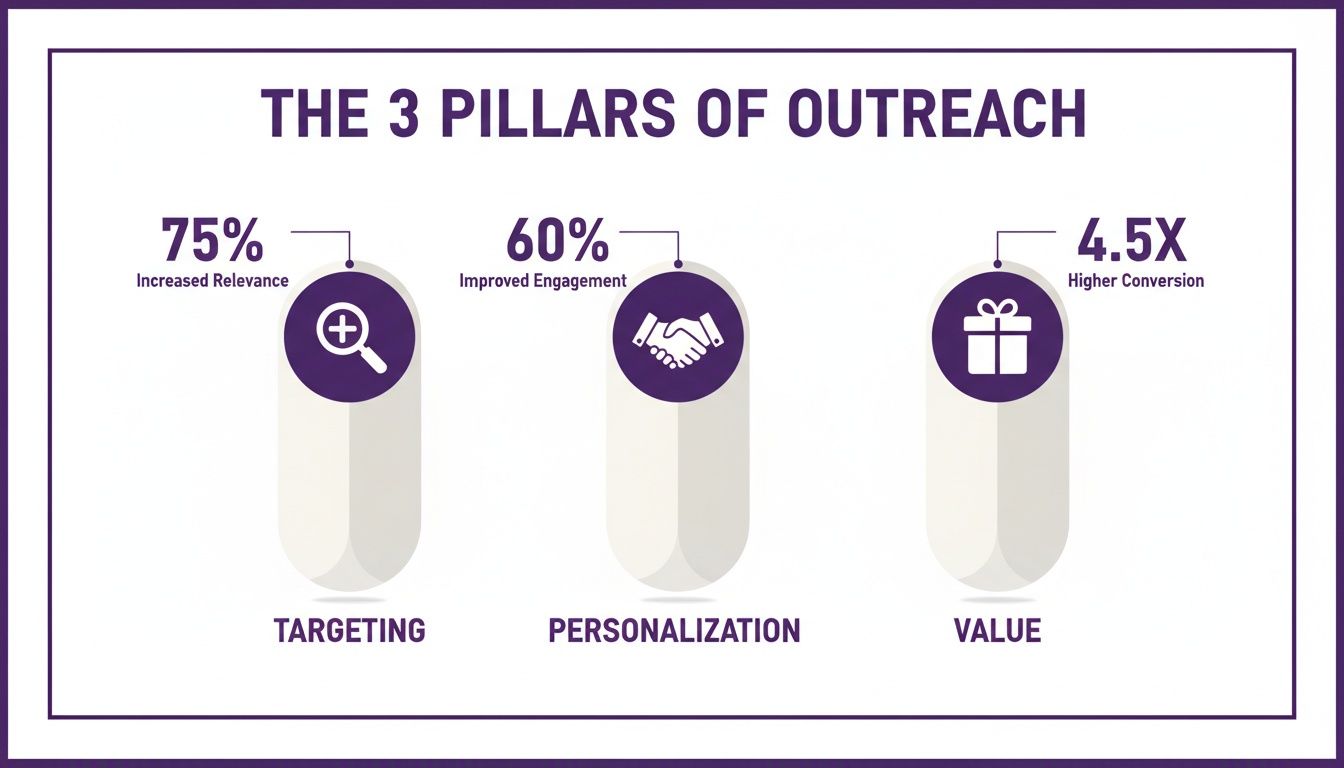
As you can see, these aren't just fluffy concepts. They are the levers that directly drive better engagement and higher conversion rates.
Mastering Cold Email
Email is still the workhorse of B2B outreach, but you're fighting for attention in a crowded inbox. Your subject line is your one shot. Keep it short, personal, and curious—please, no more "Quick Question."
The email itself needs to be scannable. Think "read on a phone in 30 seconds." Your only job is to get a reply, not to pitch your entire life story. End with a simple, clear call-to-action.
Despite the noise, email is incredibly effective. While average open rates can hit around 40%, the real gold is in the replies. Campaigns focusing on a prospect's specific challenges get response rates 20-30% higher than generic blasts. A message built around value always wins.
Connecting on LinkedIn
On LinkedIn, context is king. Sending a blank "I'd like to connect" request is a wasted opportunity. Your connection message needs to immediately tell them why you’re reaching out to them.
A great approach is to reference a shared connection or comment on a recent post they shared.
"Hey [Name], saw your post on scaling engineering teams and loved your point about documentation. Been thinking a lot about that in my own work. Would love to connect."
This little bit of effort shows you've done your homework and you're not just spamming. It frames you as a peer, not a pest.
Building Relationships on X (Twitter)
X is the most casual and fast-moving of the bunch. A cold DM from a total stranger can feel jarring. The smart play here is to warm them up first by engaging with their content publicly.
Drop thoughtful replies to their tweets—more than just "great point!" Actually add to the conversation. After a few genuine interactions, sliding into their DMs feels like a natural next step. For a complete playbook, check out our guide on effective messaging on Twitter.
This is where smart outreach automation can be a founder's secret weapon. A tool like DMpro helps you find the right conversations on Twitter and send personalized DMs at a scale you could never manage manually, freeing you up to focus on closing.
Common Cold Outreach Mistakes to Avoid
Done poorly, cold outreach is worse than doing nothing at all. A bad first impression doesn't just lose a sale; it can burn a bridge and tarnish your brand's reputation. As founders, we have to make every interaction count.
The biggest rookie mistake? Sending a novel. No one has time to read a wall of text from a stranger. Keep your message brutally short and focused on one idea. If you can’t say it in three sentences, you haven’t refined your pitch enough.
Another classic error is leaning on generic templates that scream "I'm a robot." Personalization is table stakes now, and it goes far beyond just slotting in their first name.
From Bad to Worse
Here are a few other common pitfalls to sidestep:
- No Clear Ask: Your message must have a clear, low-friction call-to-action. "Book a demo" is a huge commitment. "Mind if I send over a one-pager?" is much easier to say yes to.
- Giving Up Too Soon: The magic is in the follow-up. Most positive replies come after the second or third touchpoint.
- Ignoring Negative Signals: If someone isn't interested, respect their time and move on. Pestering them only hurts your credibility.
Getting the follow-up right is crucial. While the success rate for a single cold call can hover around a humbling 2-3%, a persistent, multi-channel approach changes the game. Layering calls with email and social DMs can spike appointments by over 180%.
It's powerful proof that a thoughtful strategy is everything. You can dig deeper into these cold calling stats on Martal.ca.
How to Scale Outreach Without Sounding Like a Robot

So, you’ve figured out the perfect message—it’s hitting the mark and getting replies. Now comes the real challenge: how do you go from sending 10 DMs a day to 100 without losing that personal touch? This is the key to scaling SaaS distribution.
This is where smart outreach automation comes in. The idea isn't to replace your voice with a machine's, but to amplify it. Let technology handle the repetitive work so you can spend your time where it counts: building actual relationships.
Using Automation the Smart Way
Think of automation as a system that does the heavy lifting. It can find the right people and send that first message, leaving you to jump into high-value conversations. This approach works especially well for Twitter lead generation.
A tool like DMpro, for instance, is built for exactly this. It can pinpoint thousands of relevant leads by analyzing their tweets and bios, then schedule personalized messages that still feel like they came from you. We dive deeper into this in our guide to lead generation automation tools.
The key is to see automation as a lever for your authenticity, not a replacement for it. Let it handle the who and the when, so you can focus on the why and the how in your replies.
Maintaining the Human Element
To scale up and still sound like a person, your system needs to be built around personalization triggers. Good automation uses specific data points to make every message feel unique.
Here’s how you can pull it off:
- Reference Recent Activity: Set up automated messages that mention a prospect's recent tweet or a specific keyword they used.
- Segment Your Lists: Don’t send the same message to everyone. Create highly targeted campaigns for different types of customers.
- Take Over Conversations: As soon as a lead replies, the automation should stop. That’s your cue to step in and have a real conversation.
A solid lead capture automation guide is another critical piece of the puzzle for efficient growth. At the end of the day, scaling is all about creating a repeatable process that keeps human connection at its core.
If you’re tired of manually sending DMs every day, try DMpro.ai — it automates outreach and replies while you sleep.
Ready to Automate Your Twitter Outreach?
Start sending personalized DMs at scale and grow your business on autopilot.
Get Started Free