
What Is Account-Based Marketing? A Founder's Guide to Landing Big Deals
What is account-based marketing? Learn how B2B founders use ABM to target and win high-value clients with simple, actionable steps and real-world examples.
Forget casting a huge net and hoping for the best. Account-Based Marketing (ABM) flips the script. Instead of chasing thousands of small leads, you hand-pick a list of your dream clients and build a specific game plan to win each one.
Think of it as the difference between a generic billboard and a personal invitation to a private dinner for your top ten prospects. It's a focused, high-leverage strategy for founders who want to land game-changing clients.
Flipping The Funnel: What Is Account-Based Marketing?
We all know the traditional sales funnel. It starts wide with tons of leads and narrows down to a few actual customers. This model, which drives most inbound and outbound lead generation, is a volume game. You attract a massive audience and hope a tiny fraction buys.
ABM works in reverse. You start by identifying the customers you really want.
First, you pinpoint your ideal, high-value target accounts. Then, you build a completely customized marketing and sales plan to engage the key decision-makers inside those specific companies. The focus isn't on the number of leads, but on the quality and precision of your outreach.
The Spear Vs. The Net
A great way to think about this is fishing. Traditional marketing is like casting a wide net. You'll catch some good fish, but you'll also haul in a lot of junk you have to toss back.
Account-Based Marketing is like spearfishing. You identify the exact prize fish you want, take careful aim, and concentrate all your energy on that single, high-value target. It's a focused, deliberate strategy that cuts out the waste.
This shift from a broad "spray and pray" approach to a hyper-targeted one is no longer a niche trend. By 2025, an estimated 70% of marketers have an active ABM program. This is a fundamental move toward treating individual accounts as their own unique markets.
ABM Vs. Traditional Marketing: A Quick Comparison
Account-Based Marketing is built to help you land those big, game-changing clients. To win, you need to master specific strategies to generate business leads that fit this targeted model.
This table breaks down the core differences.
| Aspect | Traditional Marketing (The Wide Net) | Account-Based Marketing (The Spear) |
|---|---|---|
| Focus | Individuals and leads | Specific companies and key contacts within them |
| Goal | Generate a high volume of leads | Build deep relationships with a select few high-value accounts |
| Process | Attract, then qualify | Identify, then engage with personalized outreach |
| Sales & Marketing | Often operate in separate silos | Tightly aligned and collaborate on a unified strategy |
| Key Metric | Cost Per Lead (CPL) | Revenue generated from target accounts |
As you can see, the entire philosophy is different. While traditional marketing chases leads, ABM focuses on building meaningful relationships that lead directly to revenue.
Why ABM Is a Game-Changer for SaaS Founders
<iframe width="100%" style="aspect-ratio: 16 / 9;" src="https://www.youtube.com/embed/Jx0muHw5NUY" frameborder="0" allow="autoplay; encrypted-media" allowfullscreen></iframe>So, why should a busy founder care about ABM? The short answer: it delivers real results without the noise and waste of traditional marketing. It’s a smarter way to grow, focusing your limited resources where they’ll actually have an impact.
Instead of burning cash on ads that reach thousands of people who will never buy, ABM helps you concentrate your budget only on the prospects who are a perfect fit. For an early-stage founder where every dollar counts, that precision is a lifesaver.
Eliminate Wasted Marketing Spend
Let's be honest, traditional marketing feels like a numbers game with terrible odds. You spend a fortune to attract a huge audience, knowing that 99% of them will never become customers. That just bloats your customer acquisition cost and makes growth feel random.
ABM flips that model on its head by targeting only your ideal-fit accounts from day one.
With ABM, you’re not trying to boil the ocean. You’re making a cup of tea for a few people you know are thirsty. Every piece of content, every ad, and every outreach message is created for a specific, high-value audience.
This focus does wonders for your ROI. All the resources that would have been wasted on unqualified leads are now invested in building real relationships with companies that can actually move your revenue needle. For a deeper dive, check out our guide on how to calculate and optimize your SaaS customer acquisition cost.
Shorten Your Sales Cycle
In B2B SaaS, deals often get stuck because you’ve only convinced one person in a company. But the average enterprise buying decision now involves 14 or more stakeholders. If you’re not engaging the entire buying committee, your deal will probably stall.
ABM tackles this problem head-on. It helps you orchestrate a coordinated campaign that targets everyone involved—from the end-user to the C-level executive. When you get buy-in from multiple decision-makers at the same time, you remove internal roadblocks and speed up the journey from first contact to a closed deal.
Boost Deal Size and Customer Lifetime Value
Because ABM is so hyper-personalized, it naturally builds stronger relationships. You stop being just another vendor and become a trusted partner who genuinely understands their challenges. That deep connection builds trust, which almost always translates into larger initial contracts and a higher customer lifetime value (LTV).
Here’s a quick breakdown of how that works:
- Deeper Discovery: Your research uncovers more opportunities for upselling and cross-selling right from the start.
- Stronger Relationships: High-value accounts that feel understood are more likely to stick around, which directly reduces churn.
- Better Fit: You’re selling to companies that have a real need for your solution, leading to greater customer success and more brand advocates.
Align Your Sales and Marketing Teams
One of the biggest benefits of ABM is that it forces your sales and marketing teams to finally get on the same page. They stop operating in separate silos and start working as a single, unified revenue engine.
Marketing is no longer just tossing leads over the wall. Instead, both teams collaborate to identify target accounts, craft personalized messaging, and coordinate outreach. For example, marketing might warm up an account with targeted content on social media right before sales follows up with a direct message.
This is where tools like DMpro.ai can be incredibly helpful. It can automate personalized DM sequences on X (formerly Twitter), making sure every key stakeholder gets a relevant, timely message. This alignment creates a seamless experience for the buyer and makes your internal team incredibly efficient.
Choosing Your ABM Strategy
Account-Based Marketing isn't a rigid, one-size-fits-all playbook. It's a toolkit with different tools for different jobs. The right approach comes down to your resources, goals, and the value of the accounts you're chasing. As a founder, you don’t want to bring a sledgehammer to a job that needs a scalpel.
There are three main flavors of ABM, each with its own level of intensity and personalization. Understanding them is key to building a strategy that actually works for your business.
One-to-One ABM: The VIP Treatment
This is the most focused and resource-heavy form of ABM. With the One-to-One approach, you treat a single, high-value account as its own market. Every piece of communication, every ad, and every outreach message is built from the ground up, just for them.
Imagine you’re trying to land a whale. You'd dig into their key executives, read quarterly reports, and create content that speaks directly to a specific challenge you know they're facing. This isn't about sending a template; it’s about building a deep, consultative relationship.
- Best for: A tiny number of strategic, high-revenue accounts (think 1-10 companies).
- Effort Level: Extremely high. This requires deep research and completely bespoke campaigns.
- Example: Creating a custom-branded comic book for the CEO of your dream client that references their recent company wins and their favorite superhero.
This approach is incredibly powerful but doesn't scale. It’s for those moments when landing just one account could change your company's trajectory.
One-to-Few ABM: The Small Group Approach
The One-to-Few model is a fantastic middle ground and often the best starting point for SaaS founders. Instead of focusing on individual companies, you group a small cluster of similar accounts—usually 5 to 15—that share common ground, like being in the same industry or facing similar challenges.
You then create tailored campaigns that are highly relevant to that specific group. The personalization is still deep, but you're applying it to a cluster. For instance, you could run a campaign targeting VPs of Engineering at Series B fintech startups, who are all likely wrestling with similar scaling issues.
This strategy lets you balance personalization with efficiency. Your message is still worlds away from a generic marketing blast. The first step is always to precisely identify your target audience so you can create those meaningful clusters.
One-to-Many ABM: Personalized Outreach at Scale
Finally, there's the One-to-Many approach. This model uses technology to apply ABM principles on a much larger scale, often targeting hundreds of accounts at once. The magic here is using data and automation to deliver personalized experiences without all the manual effort.
This is where you identify a broader list of good-fit companies and use tools to automate targeted outreach. You might segment your list by industry and send automated DMs on X that reference a common pain point for that vertical.
For example, you could use a tool like DMpro.ai to engage hundreds of target accounts on X at the same time. By using smart variables like
{companyName}and{painPoint}, your outreach feels personal and relevant, but the execution is automated. This lets you start conversations at scale.
This strategy is perfect for founders who have nailed their Ideal Customer Profile (ICP) and want to scale their SaaS distribution efficiently. It blends the precision of ABM with the reach needed for consistent pipeline growth.
Your Step-by-Step ABM Implementation Framework
Okay, you get the what and the why. Now it’s time for the how. Theory is one thing, but a solid, step-by-step framework is what turns ideas into revenue. This isn't some complex enterprise playbook; it's a practical guide for getting your first ABM campaign off the ground.
Think of it like building a custom piece of furniture. You'd sketch a blueprint, pick the right wood, and measure twice before cutting. ABM works the same way.
Step 1: Identify Your Ideal Accounts
First things first: know exactly who you're going after. This is more than a basic buyer persona. We're talking about defining your Ideal Customer Profile (ICP), which is a crystal-clear picture of the company you want as a customer.
Get granular here. What industry are they in? How many employees? What tech stack are they using? A rock-solid ICP is the foundation of your entire ABM strategy. Once you have it nailed down, you can build a target account list filled with companies that fit perfectly.
Step 2: Research and Map Your Accounts
With your target list ready, it’s time to play detective. The goal is to understand these companies inside and out. Who are the key players? What are their biggest headaches? What are they talking about online?
Platforms like LinkedIn and especially X (formerly Twitter) are goldmines for this. You can quickly find decision-makers, see the challenges they’re posting about, and catch up on company news. This intel is the difference between a generic message and a warm, relevant conversation starter.
The point of this research isn't just to collect names. It's to find a hook—a genuine reason to reach out that proves you’ve done your homework and understand their world.
You should try to identify the whole buying committee, which usually includes:
- The Champion: The person who will fight for your solution internally.
- The Influencer: Team leads or tech experts whose opinions carry weight.
- The Decision-Maker: The exec who holds the purse strings.
- The Blocker: Someone (often in finance or IT) who might raise objections.
Step 3: Craft Hyper-Personalized Messaging
Now you can start writing your outreach. Take all those juicy details from your research and craft messages that speak directly to the goals and pain points of each person you’re targeting. This is about true personalization, not just a modified template.
Mention a project they recently launched, a post they shared on X, or an industry trend impacting their specific role. The more you can prove your message is for them, the better your odds of getting a reply.
Step 4: Choose Your Channels and Execute
ABM is a multi-channel, multi-touch game. You can't just fire off a single email and hope for the best. You need to run a coordinated campaign across different platforms to stay on their radar.
A simple, effective sequence might look like this:
- Engage on Social: Start by liking and commenting on a key stakeholder's posts on X or LinkedIn.
- Send a Personalized DM: A week later, slide into their DMs, referencing your earlier engagement and their work.
- Follow Up with Email: Switch to email with a more detailed pitch that connects to their needs.
- Run Targeted Ads: Serve ads to the entire company to build brand recognition with the rest of the team.
This multi-pronged approach helps your message cut through the noise.
The infographic below shows the three main ABM models—One-to-One, One-to-Few, and One-to-Many—which you can choose from depending on your campaign’s goals.
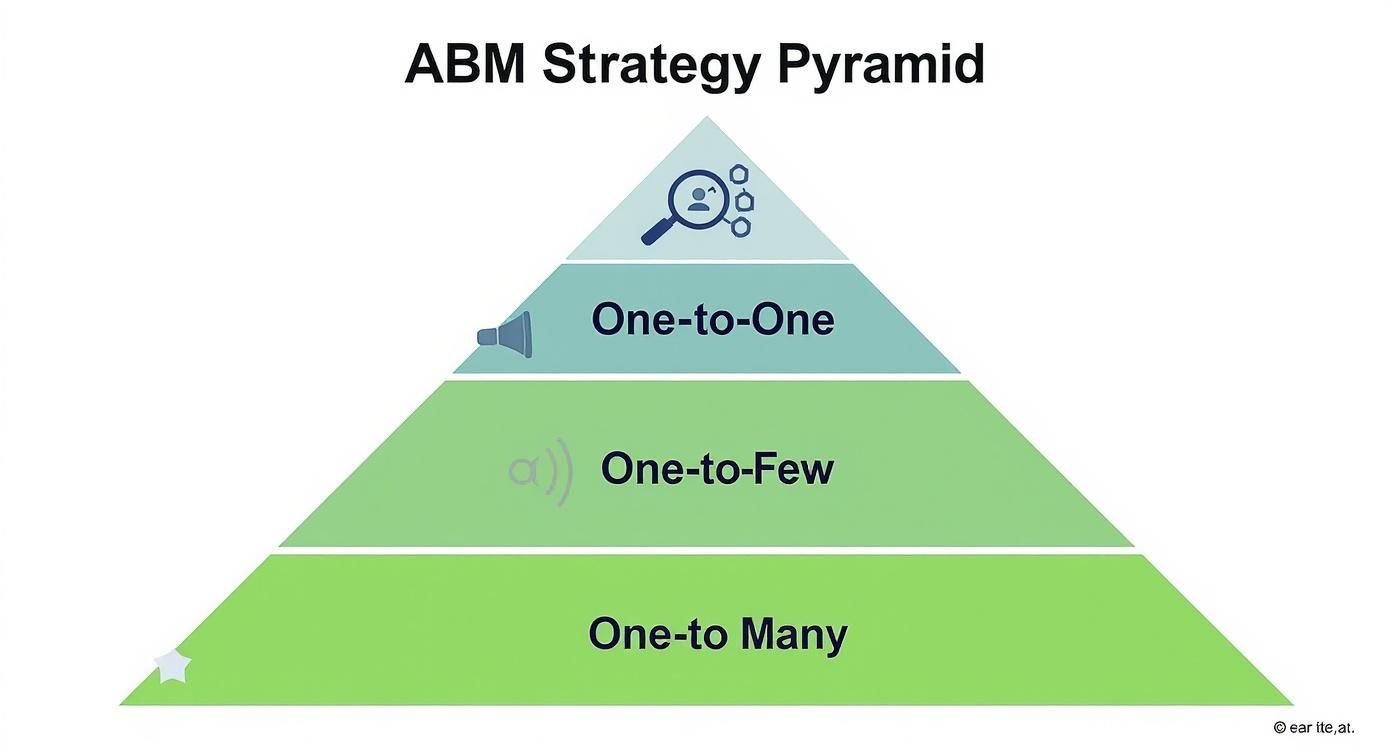
The pyramid shows that as you move from hyper-focused one-to-one campaigns to broader one-to-many outreach, your tactics naturally have to scale up.
For anyone trying to scale their outreach on X, manually managing hundreds of these sequences is a nightmare. This is where a little automation can be a lifesaver. A tool like DMpro.ai can run these personalized DM campaigns for you, engaging the right people at the right time so you can focus on strategy and closing deals.
Step 5: Measure, Analyze, and Optimize
Finally, no campaign is done until you measure the results. With ABM, you can forget about vanity metrics like clicks and impressions. You need to focus on what actually moves the needle: engagement within your target accounts.
Keep an eye on metrics like:
- Account Engagement Score: How many people at a target company are interacting with your stuff?
- Pipeline Velocity: How fast are accounts moving from first touch to a qualified sales opportunity?
- Win Rate: What percentage of your target accounts are you closing?
Use this data to figure out what’s working. Maybe your DMs on X are crushing it, but your emails are being ignored. If so, double down on X and tweak your email approach. This constant cycle of doing, measuring, and refining is the secret to long-term ABM success.
Real-World ABM Campaign Examples You Can Use
Theory is great, but seeing how ABM works in the real world is what really matters. A good template can save you from weeks of trial and error. Let’s walk through a couple of practical ABM campaigns you can adapt for your own SaaS.
Think of these less as rigid instructions and more as proven playbooks to get you moving quickly.
The One-to-Few Campaign Playbook
This strategy is your go-to when you have a small, well-defined group of dream clients. It strikes a perfect balance between deep personalization and efficiency, making it a fantastic starting point for most founders.
The Goal: Book meetings with VPs of Engineering at 15 high-growth B2B tech companies.
The Strategy: A coordinated, multi-channel campaign that shows you've done your homework.
Here’s a potential four-week game plan:
-
Week 1: Research and Warm-Up: First, identify the key VPs and a few other influential engineers at each of the 15 companies. Follow them on X (formerly Twitter) and LinkedIn. For a few days, just listen. What are they talking about? What are their companies celebrating? This intel is gold.
-
Week 2: Create Personalized Content: Build a simple, custom landing page just for this group. The headline could be something like, "For B2B Tech Leaders Facing Scaling Pains." On that page, embed a quick video where you speak directly to their challenges, using some of the specific language you picked up in your research.
-
Week 3: Multi-Channel Outreach: Now it's time to make contact. Send a highly personalized DM on X or LinkedIn that mentions something specific—a recent company achievement or a post they shared. Keep it short, genuine, and valuable. Skip the hard pitch. Try something like: "Hey {firstName}, congrats on the team's latest product launch! As you scale, many VPs tell me they hit roadblocks with [specific problem]. This custom guide might be useful." Then, link to your landing page.
-
Week 4: Targeted Ads and Follow-Up: Use LinkedIn ads to get your content in front of everyone at those 15 companies, reinforcing your message. For anyone who engaged but didn't book a call, follow up. The idea is to be persistent but never annoying, offering a little more value with every touch.
This kind of focused effort immediately sets you apart from the noise. It shows you’re a serious partner, not just another spammer.
The One-to-Many Campaign Playbook
So, what happens when your list of good-fit accounts gets bigger? A manual One-to-Few approach won't scale—you'd spend your entire day sending DMs. This is where you can apply ABM principles with the help of smart automation.
The point of One-to-Many isn't to be generic; it's to automate personalization. You’re using technology to kickstart hundreds of relevant conversations that would be impossible to manage by hand.
The Goal: Start conversations with key decision-makers at 200 target SaaS companies.
The Strategy: Use an automated outreach tool to send personalized DMs on X at scale.
This is where a tool like DMpro.ai becomes your secret weapon. Instead of grinding out manual outreach, you can set up a campaign that does the heavy lifting for you.
Here’s your scaled-up playbook:
- Build Your List: First things first, identify the 200 companies that perfectly match your Ideal Customer Profile.
- Define Your Outreach: Craft a few DM templates using personalization variables. A simple but effective opener can work wonders: “Hi {firstName}, saw you're at {companyName}. We help SaaS companies like yours tackle [common pain point]. Wondering if this is a priority for you right now?”
- Launch Your Campaign: Inside DMpro, you plug in your list, set your criteria, and hit "launch." The AI gets to work finding the right people at your target accounts and sending your personalized messages automatically.
- Engage with Replies: The automation handles the initial outreach, which frees you up to do what you do best: have real conversations with the people who express interest.
This approach lets you maintain a steady pipeline of high-quality leads without getting buried in the tedious, manual work. It's the perfect way to blend the sharp targeting of ABM with the scale you need for predictable growth.
If you’re tired of manually sending DMs every day, try DMpro.ai — it automates outreach and replies while you sleep.
How to Measure ABM Success
When you’re running an Account-Based Marketing play, your old marketing dashboard becomes almost useless. Forget about tracking impressions and clicks—those are vanity metrics. They might look impressive, but they don't tell you if you're any closer to signing that whale client you’ve been chasing.
In ABM, success isn't about casting a wide net. It’s about how deep you can go with a hand-picked list of accounts. Getting three key people from one target company to engage with your content is a massive victory, even if your overall website traffic barely moved. It’s all about quality over quantity.
Look Beyond Clicks and Impressions
The metrics that matter in ABM are the ones that show real ROI and what’s actually bringing in revenue. It's time to stop obsessing over surface-level numbers and start tracking what signals real progress with the accounts you care about.
Here are the core KPIs you should be laser-focused on:
- Account Engagement: This is your true north. Are people from your target companies opening your emails? Replying to your DMs on X? Visiting your case study pages? If engagement from within an account is climbing, you’re on the right track.
- Pipeline Velocity: How fast are target accounts moving from that first touch to a real sales opportunity? If your ABM efforts are working, you should see this timeline shrink. You're getting to the right conversations faster.
- Average Deal Size: Pull the numbers. Compare the average contract value from your ABM accounts to your non-ABM accounts. A solid campaign should result in bigger deals because you're building stronger relationships.
- Win Rate: This is the bottom line. What percentage of your target accounts are you actually signing? A high win rate is the ultimate proof that your focused, personalized approach is working.
Connecting Metrics to Real Business Goals
Tracking these KPIs isn't just an exercise in data entry. It’s about understanding the story your numbers are telling. If you have high account engagement but your pipeline velocity is sluggish, it could be a sign that your content is hitting the mark but you’re not reaching the key decision-makers yet.
A classic mistake is to measure ABM with a traditional marketing lens. A single, meaningful conversation with a VP at a target account is worth more than a thousand anonymous website visits. Your reporting needs to reflect that.
By zeroing in on these specific KPIs, you get a clear view of what’s actually working. You can confidently put more resources into the channels and messages that drive genuine engagement. This is how ABM stops being a buzzword and becomes a predictable revenue engine for your SaaS.
Common Questions About Account-Based Marketing
As a founder, I know that diving into a new strategy always kicks up a lot of questions. Let's tackle some of the most common ones that pop up when you're first exploring Account-Based Marketing. My goal here is to give you clear, straightforward answers.
When Should I Use ABM Instead of Inbound Marketing?
This is a big one. Think of it like this: ABM is your best bet when you're selling a high-value product to a specific type of company, especially one with a complicated buying process. If your deals are large and you have to get buy-in from multiple people, the laser-focused approach of ABM is built for that exact scenario.
Inbound marketing, on the other hand, is perfect when your product has a much wider audience and a quicker sales cycle. If you're spearfishing for whales, you use ABM. If you’re casting a wide net for lots of smaller fish, you stick with inbound.
Is ABM Only for Enterprises with Big Budgets?
Not at all. That’s one of the biggest myths out there. The core ideas of ABM—focus and personalization—are actually a huge advantage for startups where every dollar and minute counts. As a founder, you can run an incredibly effective "One-to-Few" campaign targeting 10-20 dream clients on a shoestring budget.
The secret is being smart with your resources. A little creativity and hustle can take you a long way. Plus, today's automation tools make it possible to scale your personalized outreach without needing a massive team or budget.
How Can I Use X for My ABM Strategy?
X (what we all used to call Twitter) is a goldmine for ABM, particularly for research and making that first contact. You can quickly pinpoint the key players at your target companies and get a genuine sense of what they care about just by observing what they post and interact with.
This isn't about sending a cold, generic DM. It's about finding an authentic reason to start a conversation. Mentioning a recent post they made or a new company milestone makes your outreach feel relevant and human, not like more spam.
This is where a tool like DMpro.ai really shines. It helps you automate that initial outreach on X, letting you kick off hundreds of warm, personalized conversations at scale. That frees you up to focus your energy on the important part: building real relationships with the people who respond.
Time to Automate Your Outreach
Putting an Account-Based Marketing strategy into motion is one thing; keeping it going is another. The reality is, consistent, personalized outreach is a huge time sink. Manually tracking and sending follow-ups to dozens of key accounts is a recipe for burnout.
This is exactly where the right tools come into play. They handle the repetitive legwork, freeing you up to focus on the big-picture strategy and relationship-building that truly matters.
Exploring different lead generation automation tools can be a game-changer, showing you how to scale your efforts without losing that personal touch. Of course, sending messages is only half the battle. You also have to make sure they get seen, which is why it's critical to optimize email deliverability and ensure your communications land in the inbox.
Getting this combination right—smart automation paired with solid technical practices—is the secret to making your ABM engine hum.
If you’re tired of manually sending DMs every day, try DMpro.ai — it automates outreach and replies while you sleep.
Ready to Automate Your Twitter Outreach?
Start sending personalized DMs at scale and grow your business on autopilot.
Get Started Free