
A Founder's Guide on How to Improve Sales Productivity
Learn how to improve sales productivity with practical advice on process, automation, and team optimization. A founder-to-founder guide to scaling revenue.
Improving sales productivity isn't about working longer hours. It's about working smarter—clearing out the junk that wastes time and focusing on the actions that actually close deals.
As a founder, you're constantly looking for leverage. Let's dig into how to find it in your sales process, particularly when it comes to scaling your SaaS distribution through channels like Twitter.
Find and Fix Your Broken Sales Process
It’s easy to get caught up in the daily grind and mistake raw activity for real progress. Your team might be hammering out hundreds of DMs or emails, but if the pipeline is stagnant, something is fundamentally wrong.
Before you can build a high-performance sales machine, you have to take an honest look at what's holding you back. This isn't about blaming anyone; it’s a deep diagnostic to find the friction points that silently kill deals and drain your team's energy.
Pinpoint the Productivity Leaks
So, where is the process bleeding? Often, it’s in the messy handoffs and hidden inefficiencies. A hot lead from Twitter goes cold because it took two days to get to a sales rep. An AE spends three hours manually logging data instead of prepping for a crucial demo. These "small" leaks add up fast.
Your first job is to identify exactly where these bottlenecks are. Start by asking some tough questions:
- Where are deals getting stuck? Pull up your funnel. Is there a specific stage where prospects just disappear? That could signal a problem with your follow-up cadence or your core messaging.
- How much time are reps actually selling? Talk to your team. You might be shocked to find they spend less than a third of their day in conversations with prospects. The rest gets eaten by admin work and hunting for the right sales collateral.
- Are marketing and sales on the same page? Misalignment is a silent killer of productivity. If marketing is tossing unqualified leads over the fence, your sales team is forced to waste its time sifting through noise. If this sounds familiar, check out our guide on how to qualify sales leads to get that process dialed in.
Run a Quick and Powerful Audit
You don’t need an expensive consultant to find these issues. A simple, focused audit can uncover the biggest problems fast. Grab a whiteboard and map out every single step a lead takes, from their first click to a signed deal.
As you trace this journey, hunt for friction. Where do manual handoffs happen? Where are reps left guessing what to do next? This map will make the weak spots obvious.
Common Sales Productivity Bottlenecks and Their Symptoms
| Bottleneck | Common Symptoms | First Step to Fix |
|---|---|---|
| Poor Lead Qualification | Low conversion rates, reps complain about lead quality, sales cycles end in "no decision." | Redefine your Ideal Customer Profile (ICP) and create a scoring model with marketing. |
| Inefficient Handoffs | Leads go cold between marketing and sales, reps have to re-ask for basic info. | Implement an automated handoff process in your CRM with clear Service Level Agreements (SLAs). |
| Manual Admin Tasks | Reps spend hours on data entry, logging calls, and updating the CRM instead of selling. | Audit your sales tech stack for automation opportunities (e.g., call logging, email sequencing). |
| Lack of Clear Process | Inconsistent follow-up, reps "doing their own thing," long ramp-up time for new hires. | Document a standardized sales playbook with clear cadences, scripts, and templates. |
| Disorganized Content | Reps waste time searching for case studies, proposals, or one-pagers. | Create a centralized, searchable content library (a sales enablement tool or a shared drive). |
This audit gives you a clear, data-backed picture of what needs fixing. Maybe your reps are building custom proposals from scratch every single time—a task screaming for a template.
Once you’ve identified these core issues, you can stop plugging leaks and start designing a system that actually drives results.
Redesign Your Sales Workflow for Speed and Impact
Once you’ve found the cracks in your sales process, it's time to rebuild. An effective workflow turns random activity into predictable revenue. It's the playbook that tells your team exactly what to do next, freeing them to do what they do best: sell.
The goal here is a repeatable system where every action has a clear purpose. This means getting surgical about who you talk to, making handoffs buttery smooth, and designing outreach cadences that feel human—especially on a platform like Twitter, where authenticity is everything.
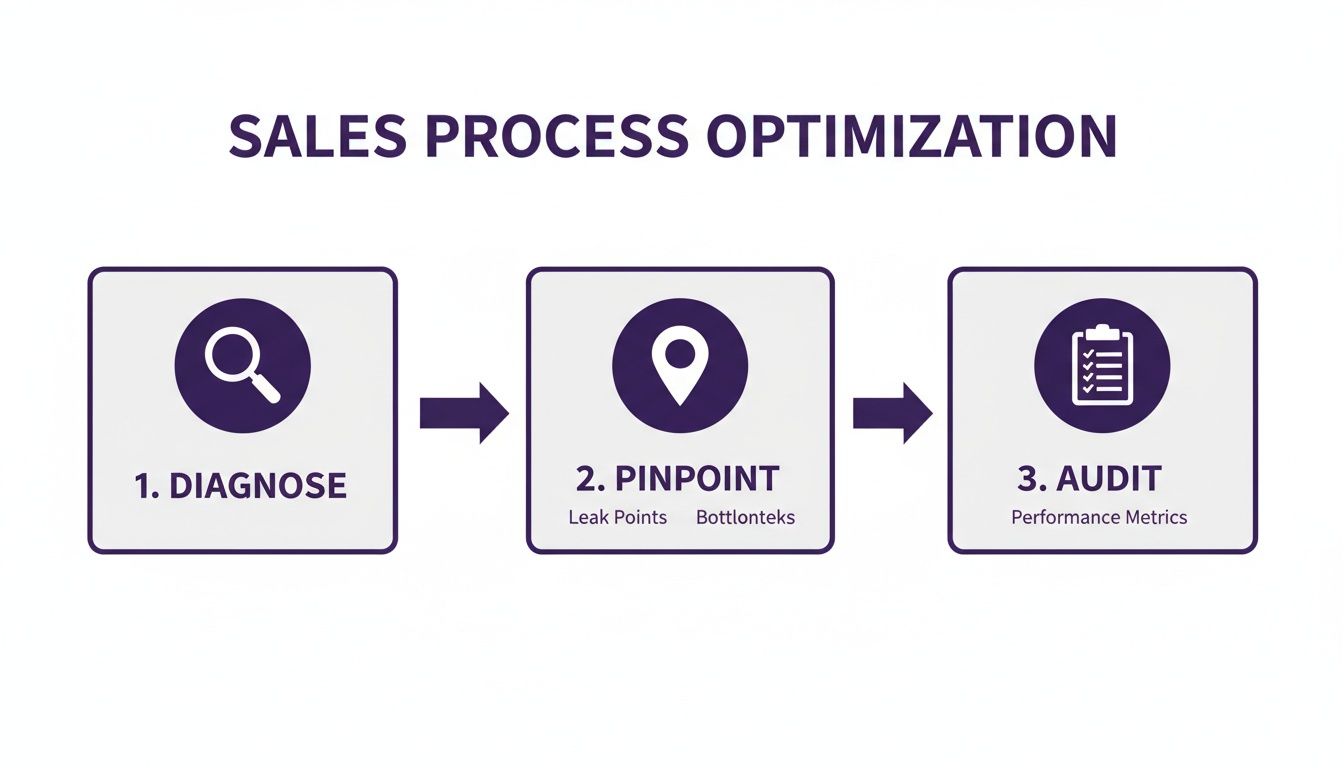
This simple framework keeps you honest. It forces you to solve the right problems in the right order, so you're not wasting time on tweaks that don't move the needle.
Build a Ruthless Qualification Framework
I’ve seen it a hundred times: the single biggest time-waster for sales reps is chasing prospects who were never going to buy.
The fix? A simple, strict lead qualification framework. This is about defining the absolute, non-negotiable criteria a prospect must meet to be worth your team’s time.
Start with your Ideal Customer Profile (ICP). What are the must-have firmographics (company size, industry) and behavioral signals (visited pricing page, downloaded an e-book)?
Define what a "sales-qualified lead" (SQL) looks like and get both marketing and sales to sign off on it. This simple alignment stops reps from wasting cycles on tire-kickers and focuses all their energy on leads with real intent.
Create Seamless Handoffs
One of the most common places deals go to die is in the dead space between marketing, SDRs, and AEs. A hot lead comes in, but by the time it gets routed, the initial spark is gone. You have to make these handoffs instant and frictionless.
Your sales process should feel like a relay race, not a game of hot potato.
Set up automation in your CRM to route leads to the correct rep immediately. Even more important, establish clear Service Level Agreements (SLAs). For example, an SDR must contact a new MQL within 15 minutes. This creates real accountability.
Craft Sales Cadences That Actually Work
A sales cadence is your sequence of touchpoints—emails, calls, social DMs—designed to get a prospect’s attention. The problem is, most of them are robotic and generic. A productive cadence needs structure but also flexibility for personalization.
This is especially true on platforms like Twitter, where a copy-paste DM gets ignored 100% of the time. Instead of just blasting links, your cadence needs to add value at every step.
- Touchpoint 1 (Twitter DM): Don't pitch. Reference a recent tweet and ask an insightful question.
- Touchpoint 2 (Email): Follow up on the DM, sharing a relevant resource.
- Touchpoint 3 (Twitter Like/Reply): Engage with another post to stay on their radar.
- Touchpoint 4 (Email): Now you can make a direct ask for a brief chat.
Building sequences like this ensures your team is persistent without being annoying. Tools like DMpro can help automate that initial Twitter outreach, using AI to personalize DMs based on a prospect's bio or recent activity. This kicks off the cadence with a warm, relevant touchpoint. For a deeper dive, our guide on sales cadence best practices is a great blueprint.
A solid process removes friction and builds momentum. It’s the operating system for your sales team.
Embrace Automation Without Losing the Human Touch
As a founder, trying to scale sales by just hiring more people is a recipe for burning cash. The real leverage comes from letting technology handle the grunt work, freeing up your team to focus on what matters: building relationships and closing deals.
This is where smart automation comes in. I'm not talking about robotic emails. I'm talking about taking repetitive tasks off your team's plate—like data entry, lead routing, and manual follow-ups.

The trick is to use automation to create more opportunities for genuine connection, not to fake it.
Automate Tasks, Not Relationships
The biggest mistake I see founders make is trying to automate an entire conversation. That never works. The goal should be to automate the start of the conversation and the admin headaches that come with it.
Think about all the non-selling activities that drain your team's day. A rep might spend hours hunting for contacts, logging notes in the CRM, or sending the same follow-up email for the tenth time. Each one is a prime candidate for automation.
This isn't just a nice idea; it gets results. Companies that automate smartly see productivity and revenue climb. If you want to dig into the data, check out the benefits of an AI sales assistant.
High-Impact Automation Opportunities for SaaS Founders
| Task | Why Automate It | Recommended Tool Type |
|---|---|---|
| Lead Qualification | Manually sifting through leads is slow and prone to error. Automation scores leads so reps only talk to the best fits. | Marketing Automation or CRM with lead scoring |
| Initial Outreach (e.g., DMs) | Sending personalized DMs one by one is a huge time sink. Automation can handle the initial message so reps jump in when there's interest. | DM Automation Tool (like DMpro.ai) |
| Meeting Scheduling | The endless back-and-forth to find a time to meet is a productivity killer. A scheduling link lets prospects book instantly. | Calendar Scheduling Tool |
| CRM Data Entry | Reps hate logging calls and updating contacts. Automating this ensures your CRM data is accurate and saves hours each week. | CRM with automation rules or sales engagement platforms |
| Follow-up Sequences | Remembering to follow up with dozens of prospects is impossible. Automated sequences ensure no lead falls through the cracks. | Sales Engagement Platform |
Automating these repetitive tasks is how you build a scalable sales engine without losing that human element.
Personalizing Outreach at Scale
So what does this look like if you're trying to scale on Twitter? Manually sending hundreds of DMs a day is a fast-track to burnout. It's also inefficient.
This is where a specialized tool becomes your secret weapon. Instead of a rep spending their morning personalizing and sending DMs, a tool like DMpro.ai can run targeted campaigns 24/7.
It finds prospects based on their bio or keywords, then sends a personalized opening message. The moment someone replies, the automation stops, and your rep jumps into a warm, qualified conversation.
The core idea is simple: let robots do the robotic work. This frees up your humans to handle the nuanced, strategic parts of the sales process that close deals.
Setting Up Your First Automated Campaign
Let's walk through an example. Imagine you want to connect with marketing managers at B2B SaaS companies on Twitter.
- Define Your Target: First, you set up your ICP in the tool, targeting keywords like "Marketing Manager" or hashtags like
#SaaS. - Craft Your Message: Next, you write a few different opening messages that provide value, like, "Saw your post about lead gen. Ever tried using automated DMs to start conversations on Twitter?"
- Launch and Monitor: You hit 'go,' and the tool starts messaging relevant profiles. Your rep isn't sending; they're just watching for replies and jumping in to talk to people who express interest.
Suddenly, one rep can manage the outreach of five, but they're only spending time on conversations that have a real shot. This is the modern playbook for scaling your SaaS distribution.
Get Your Team and Tech Stack Right
The right people and tools are rocket fuel for a productive sales engine. But just throwing software or more hires at a problem rarely fixes it. To really move the needle, you need a smart approach to structuring your team and a lean, powerful tech stack.
Even if your "team" is just you and one other person, defining clear roles is non-negotiable. Who owns prospecting? Who handles demos? Without clear lanes, you’ll step on each other's toes, and tasks will slip through the cracks.
Defining Roles for Maximum Output
Clarity kills friction. When your team is small, people might wear multiple hats, but the functions need to be distinct.
- Lead Generation: This person lives at the top of the funnel. Their entire world is identifying and engaging potential customers on channels like Twitter.
- Qualification & Demos: This role takes that initial spark and turns it into a real sales opportunity. They dig into a prospect's pain and show how your product solves it.
- Closing & Account Management: This person gets the contract signed and ensures the customer succeeds, paving the way for renewals and upsells.
This simple division of labor ensures each stage of the buyer's journey gets the specialized attention it needs.
Building a Lean and Powerful Tech Stack
Next up: your technology. It's easy to get distracted by shiny new tools, only to end up with a bloated, expensive mess of software. Your goal should be a lean, integrated stack where every tool serves a vital purpose.
You don’t need a dozen platforms. You just need a few core tools that talk to each other. Exploring the best AI tools for sales is a great starting point for finding tech that can automate key tasks and boost efficiency without adding clutter.
The best tech stack isn't the one with the most logos; it's the one that feels invisible.
Your stack needs a central nervous system—usually your CRM. From there, you add specialized tools that solve specific bottlenecks. For instance, if your team is burning hours manually prospecting and sending DMs on Twitter, that's a perfect use case for an automation tool.
A platform like DMpro.ai can take over that entire top-of-funnel motion. It finds your ideal prospects, sends personalized outreach, and tees up warm conversations for your sales reps. This single tool solves a massive time sink, freeing up your team to focus on strategy instead of endless manual clicks.
We're Building a Culture of Constant Improvement, Not Just a Process
Fixing your sales process and getting the right tech gives you an immediate bump. But that's a one-time fix. The real, sustainable gains come from building a team that is obsessed with getting better, day in and day out.
Improving sales isn't a project you check off a list. It's a cultural shift. It’s about creating an environment where everyone is on the lookout for those small, 1% improvements that add up over time.
This isn't about mandatory training sessions everyone forgets a week later. It's about a living system of learning and tweaking. The goal is simple: your team should be smarter and more efficient this quarter than they were last quarter.
Let Your Team Teach Each Other
Your best training assets are already on your payroll. The rep with the highest response rates on their Twitter DMs has clearly cracked a code. Your job is to bottle that magic and share it with everyone else.
Peer-to-peer coaching shines here. It’s real, relevant, and comes from someone in the trenches.
- Host a "Weekly Wins" Call: Carve out 15 minutes for reps to share a specific win and exactly how they did it. What was the DM opener? Get granular.
- Break Down the "Call of the Week": Let the team vote on the best recorded call. Have the rep who ran it walk everyone through their thought process.
- Create a Shared Template Library: When a rep writes a DM script that crushes it, add it to a shared library where the whole team can use and adapt it.
This creates a powerful feedback loop and helps everyone level up.
A/B Test Everything (It's Easier Than You Think)
The fastest way to figure out what works is to test it. The only rule is to be systematic and change just one variable at a time.
Your outreach is the perfect laboratory. Every message you send is a chance to learn something.
Treat your sales process like a product—it should always be in beta.
Here are some easy A/B tests you can start this week:
- Twitter DM Openers: Test a question-based opener ("Saw your post on X, have you considered Y?") against a value-based one ("Your post on X was great, here's a resource...").
- Email Subject Lines: Pit a direct subject line ("Idea to improve sales productivity") against a more personalized one ("Quick question about [Company Name]").
- Call to Action: Compare a "hard" CTA ("Are you free for a call?") with a "soft" CTA ("Is this something you're interested in?").
Tools built for modern outreach make this easy. For example, a platform like DMpro lets you set up two different DM templates within the same campaign. The system automatically splits the outreach, so you can see which message gets more replies without any manual tracking.
Build a Simple Productivity Dashboard
You can't improve what you don't measure. A simple spreadsheet is more than enough to get started.
This dashboard should be a focused snapshot of a few key metrics that directly reflect your team's productivity.
| Metric | Rep 1 | Rep 2 | Team Avg | Goal | Trend (WoW) |
|---|---|---|---|---|---|
| Activities | |||||
| New Conversations Started | 45 | 52 | 48.5 | 50 | ▲ 5% |
| Demos Booked | 5 | 7 | 6 | 6 | ▼ 2% |
| Efficiency Ratios | |||||
| Conversation-to-Demo Rate | 11.1% | 13.5% | 12.3% | 12% | ▲ 1.5% |
| Outcomes | |||||
| Deals Closed | 1 | 2 | 1.5 | 2 | ▬ |
Reviewing this weekly will immediately highlight who's crushing it and whether your process changes are moving the needle. It turns "productivity" from a fuzzy concept into a hard number you can manage.
Putting These Productivity Tips into Action
<iframe width="100%" style="aspect-ratio: 16 / 9;" src="https://www.youtube.com/embed/MKoH_-W1Nn4" frameborder="0" allow="autoplay; encrypted-media" allowfullscreen></iframe>We’ve covered a lot of ground, but ideas are one thing; execution is another. The real challenge is turning theory into results without getting overwhelmed.
The secret? Don't try to fix everything at once.
Instead, pick just one bottleneck you uncovered during your audit. Make that your sole focus for the next 30 days. This laser-focused approach is how you build real, sustainable momentum.
Maybe your focus is building an automated follow-up sequence so prospects stop slipping through the cracks. Or perhaps it's scaling your Twitter outreach.
Small, consistent wins are the foundation of a high-performing sales machine.
If your biggest time-suck is manual outreach—especially on a high-value channel like Twitter—then finding the right tool is your fastest path to a quick win. This is how you start to seriously scale your SaaS distribution without hiring more reps.
Got Questions? Let's Talk Strategy
It's a great sign that you have questions. It means you're thinking about how to build a smarter sales engine. Here are some of the most common questions I get from other founders.
For a Small Team, What's the One Thing That Moves the Needle Most?
Hands down, it's ruthless focus. For a small team, your most valuable resource isn't your budget; it's your time. The biggest productivity killer is spending that precious time on leads who were never going to buy.
Get obsessive about lead qualification. Create a simple scoring system based on real-world indicators like company size, industry, or specific engagement signals (like their activity on Twitter). This prevents your team from chasing dead-end deals for weeks.
How Do I Automate Sales Without My Team Sounding Like Robots?
This is a classic fear, but the solution is simple: automate tasks, not relationships. The goal of automation isn't to replace human interaction but to get to it faster.
Use tools for repetitive, top-of-funnel work—initial outreach, gentle follow-ups, data entry. But always design the process to hand off to a human as soon as a real conversation starts. Ensure your automated outreach uses deep personalization. Reference a recent post or a shared connection. Tools like DMpro.ai are built for this, letting you scale that initial touchpoint while keeping it personal.
Is My CRM All I Need to Boost Sales Productivity?
A CRM is your system of record. It’s essential, but on its own, it’s passive. It's a database, not an engine. Real productivity gains come from the tools and processes you integrate with it.
Think of your CRM as a warehouse. It holds your data, but you still need the forklifts (your automation and outreach tools) to actually move things and make sales happen.
Your CRM is perfect for tracking deals, but it won't automate your outreach on Twitter or fill your pipeline. It needs to be paired with specialized tools that do the heavy lifting.
How Often Should We Revisit and Tweak Our Sales Process?
In the early days, pretty frequently. I recommend a quick glance at your key sales dashboard daily. Hold a more formal review of your core metrics weekly with the team.
Then, once a quarter, block out time for a deep-dive analysis. Look at what worked and what didn't. Based on that review, pick one or two small experiments to run for the next 90 days. Continuous, iterative improvement always wins.
If you’re tired of manually sending DMs every day, try DMpro.ai — it automates outreach and replies while you sleep.
Ready to Automate Your Twitter Outreach?
Start sending personalized DMs at scale and grow your business on autopilot.
Get Started Free