
7 Lead Generation for Recruiters That Work in 2026
Lead generation for recruiters: seven practical strategies to find hiring companies, source candidates, and start better conversations in 2026.
Job boards can fill your inbox without filling your roles. In Gem's recruiting benchmarks analysis, job boards and company marketing generated approximately 90% of applications but only about half of hires.
Your problem isn't a shortage of people. It's finding the right people at the right moment, spread across candidate databases, X threads, job postings, and hiring-manager inboxes.
There's another complication: lead generation for recruiters serves two different pipelines. A candidate interested in a role isn't the same as an employer willing to sign an agency agreement. Buying software without separating those goals leaves you with plenty of contacts and no clear next step.
Start by deciding who you need, what signals make them relevant, and who owns the reply. Then build a lead routing workflow so an interested prospect reaches the right recruiter instead of sitting in another spreadsheet.
These seven options are grouped by where the lead comes from: X communities and candidate pools, live hiring signals, client-side outreach, and outsourced prospecting. Choose the source before you choose the subscription.
1. DMpro
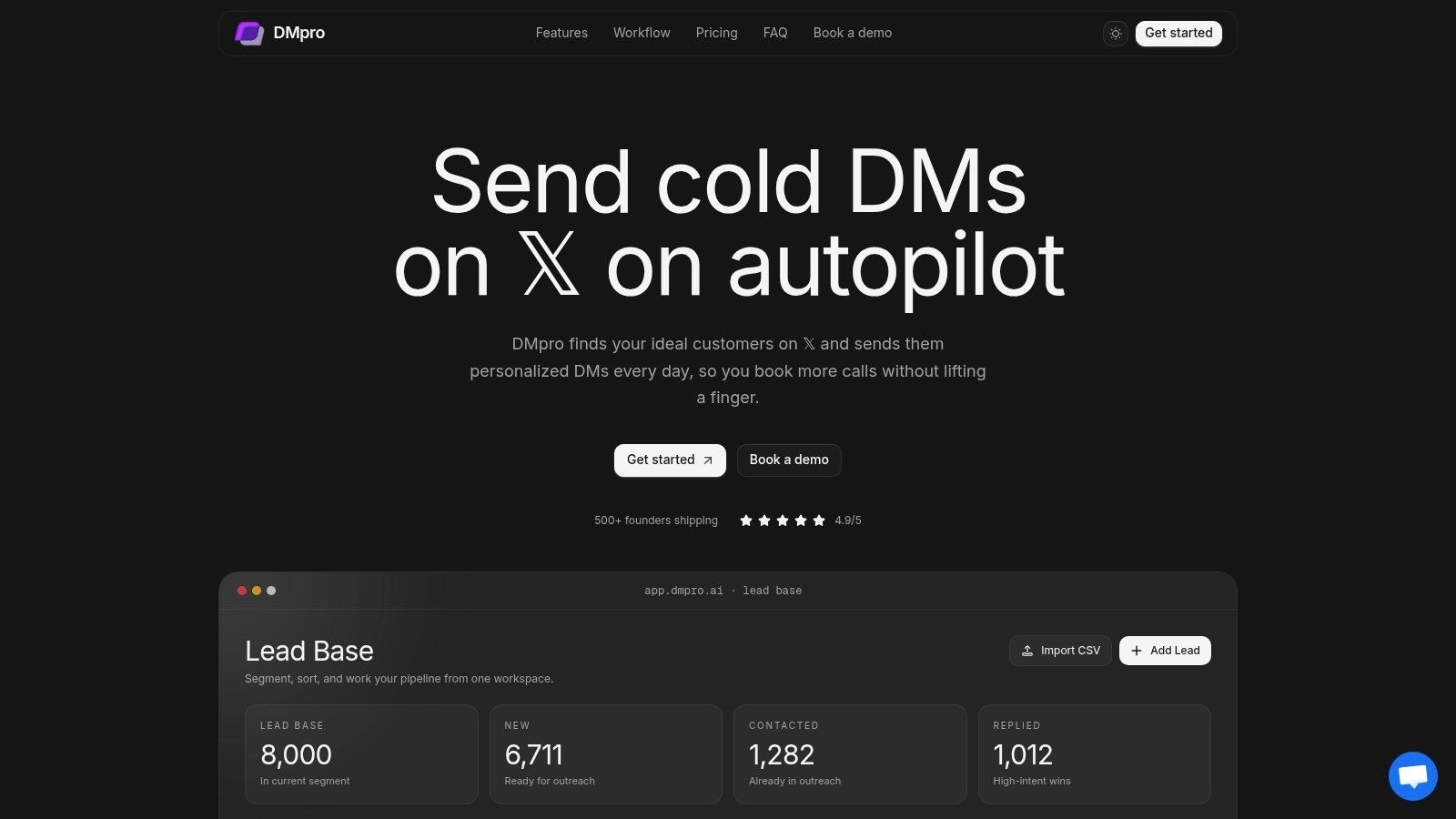
Best for X-based prospect discovery and permission-aware outreach. Our recruiter workflow fits recruiters whose candidates or potential clients already discuss their work on X, formerly Twitter.
We combine discovery, lead management, personalized messaging, and analytics in one workspace. You can collect followers, community members, tweet repliers, keyword-matched conversations, and bio-search matches, or import usernames through CSV, with scrapes pulling up to 20,000 leads per run.
Start in Leads → Find leads, choose a relevant audience, set a modest lead limit, and review the filters before collecting. Scraping engagers, meaning the likers and commenters on a post, tends to produce warmer replies than pulling a cold follower list. Collection runs in the background once the search starts, and afterward you can filter by included or excluded bio terms, location, account age, profile image, and website. Groups become reusable campaign audiences, while statuses such as New, Contacted, and Replied keep prospecting organized.
What you get and what to verify
Our visual campaign builder supports waiting periods, follow-ups, and branches that change based on whether a recipient replies. AI personalization draws on profile details, recent posts, and website context rather than only inserting a first name, while analytics report sends, queued messages, reply rates, and response categories. For qualification, you set a Core fit criterion before scoring; new setups leave automatic assessment off, so you review the scoring yourself before trusting it.
The DMpro website lists Pro at $69/month with five X accounts, 500 monthly AI credits, and storage for 5,000 leads, and Agency at $199/month with unlimited accounts, 2,000 monthly AI credits, and storage for 100,000 leads. Both include unlimited scraping, onboarding, and priority support, with daily per-account sending caps of 25 on Pro and 35 on Agency. X restrictions and account settings can reduce actual sending rates below those caps.
- Main advantage: Discovery, segmentation, AI qualification, personalized sequences, and reporting sit together instead of requiring separate handoffs.
- Main constraint: AI credits and lead storage depend on the plan, so heavy scrapers should check the 5,000-lead ceiling on Pro before committing.
- Managed option: Our custom-priced service includes account setup and warm-up, targeting, sourcing, scripts, optimization, reporting, and a dedicated strategist.
Permission comes first: A relevant profile is a research lead. Treat it that way until the person invites contact.
X's automation rules prohibit unsolicited bulk or automated DMs. Recipients must have requested contact or clearly indicated they want it, and you must offer an easy opt-out and honor it promptly.
Use public conversations to establish relevance and permission before any automated message goes out. A keyword match or a follow tells you someone is worth researching; the consent has to come separately.
2. SAFRO
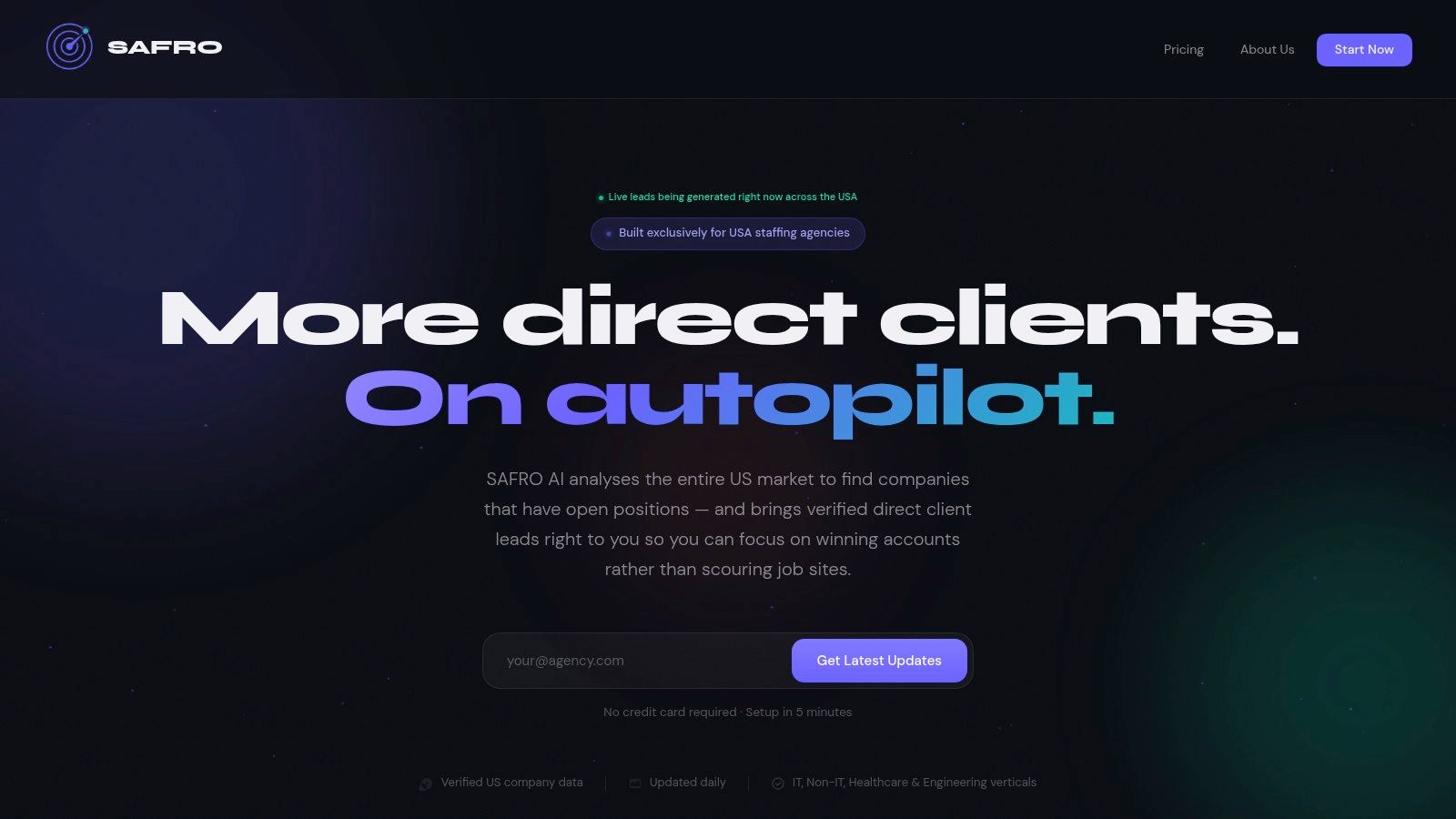
SAFRO belongs in the employer-client pipeline, not the candidate pipeline. SAFRO is built for US staffing agencies that want to identify hiring companies and reach relevant decision-makers.
Its appeal is the connection between hiring activity and contact discovery. Rather than buying a broad company list, you can narrow prospects using open positions, hiring volume, industry, technology stacks, and funding rounds.
Say you place technical contractors for growing software businesses. Filter for the right stack and geography, inspect the hiring activity, then approach the person responsible for that function with a specific staffing question.
Where it earns a closer look
- Useful context: Hiring signals give recruiters a reason to investigate an account before contacting it.
- Connected workflow: Decision-maker details and LinkedIn profiles sit alongside prospect research, with lead analytics and CRM/ATS export or sync options including Bullhorn, Staffpilot, and JobDiva.
- Important limitation: Accuracy and time-saving claims are vendor claims, not independent performance findings.
Before paying, request a sample from your actual niche. Check whether the contacts still work at those companies, whether the vacancies remain active, and whether the supposed decision-maker can engage an outside staffing supplier.
SAFRO doesn't publish pricing on its site, so request a written quote that covers coverage, costs, integration behavior, and how the provider handles stale records.
Compared with outsourced lead generation, this approach suits an agency that wants to retain prospect selection and sales conversations internally. It won't fix an unclear offer or persuade an employer that only hires directly.
3. Scowter
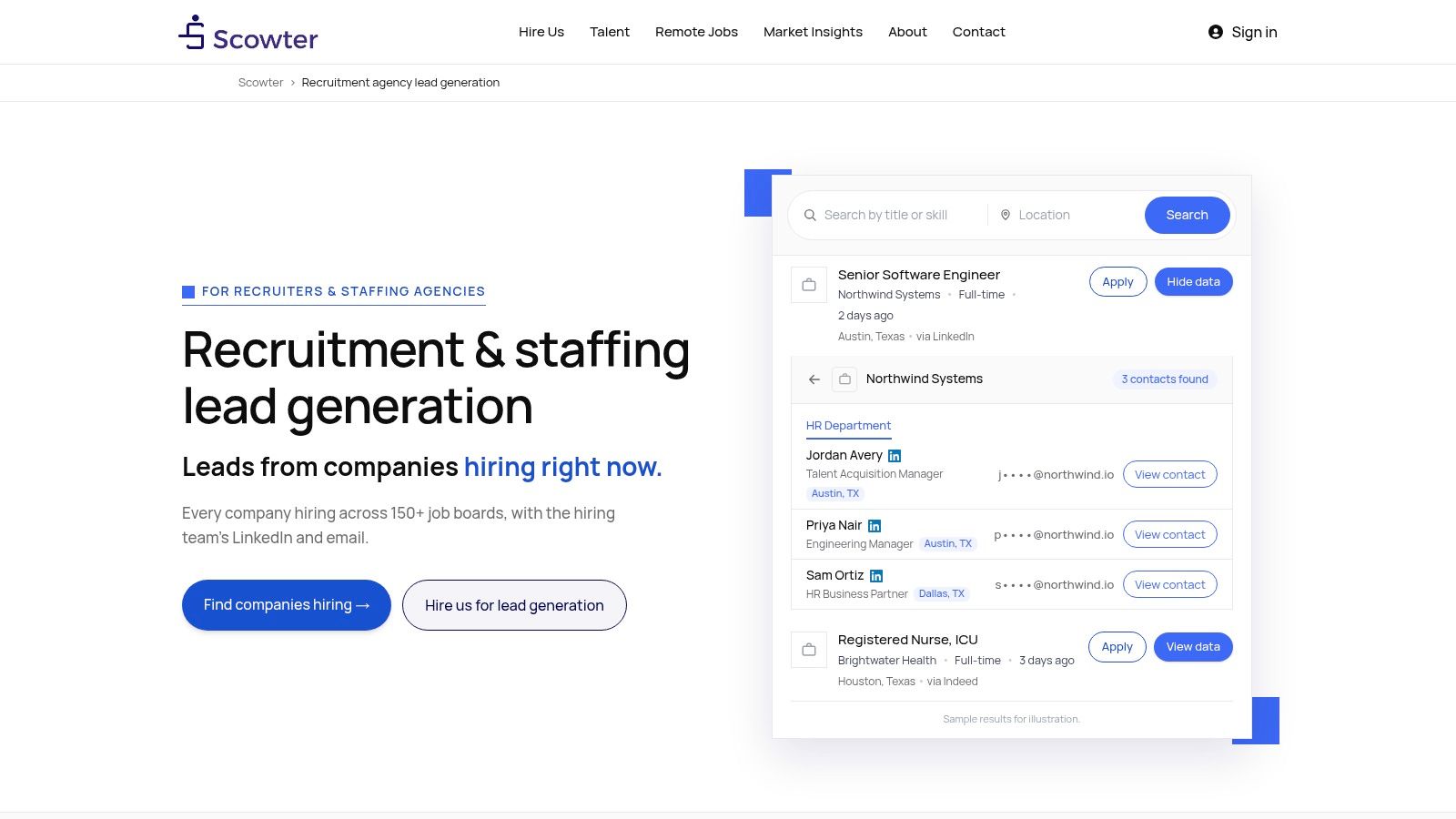
Say you've got a strong candidate and need to find employers hiring for that exact background. Scowter combines live job-led employer discovery with a candidate pool, making it relevant when you work both sides of the recruitment desk.
According to Scowter's recruitment-agency page, it aggregates postings from more than 150 job boards and offers free job search with payment to reveal contacts. Filters include role, seniority, country, city, and work type, with hiring-manager or talent-team work emails and direct phone details.
The platform also includes candidates it describes as pre-vetted. Treat that label as a starting point: your screening still needs to establish availability, expectations, work eligibility, and role fit.
A live vacancy proves that a company advertised a role. It doesn't prove that the company wants agency help.
Check freshness before buying contacts
A Pin analysis of recruiting outreach found candidates replied 11.31% of the time for roles less than 30 days old, versus 8.43% for roles older than 90 days. That finding concerns candidate outreach, not agency sales, but it reinforces the need to verify that the role behind a campaign is still current.
- Best use: Find employers with a concrete requirement that matches your specialization.
- Trade-off: Job-led prospects are visible to competing recruiters, and advertised demand isn't purchasing intent.
- Before paying: Check contact-reveal costs, target-US coverage, posting freshness, and what pre-vetting includes.
Open the employer's careers page before reaching out. Ask about the hiring challenge rather than assuming the posting is an invitation to pitch.
4. Agency Leads
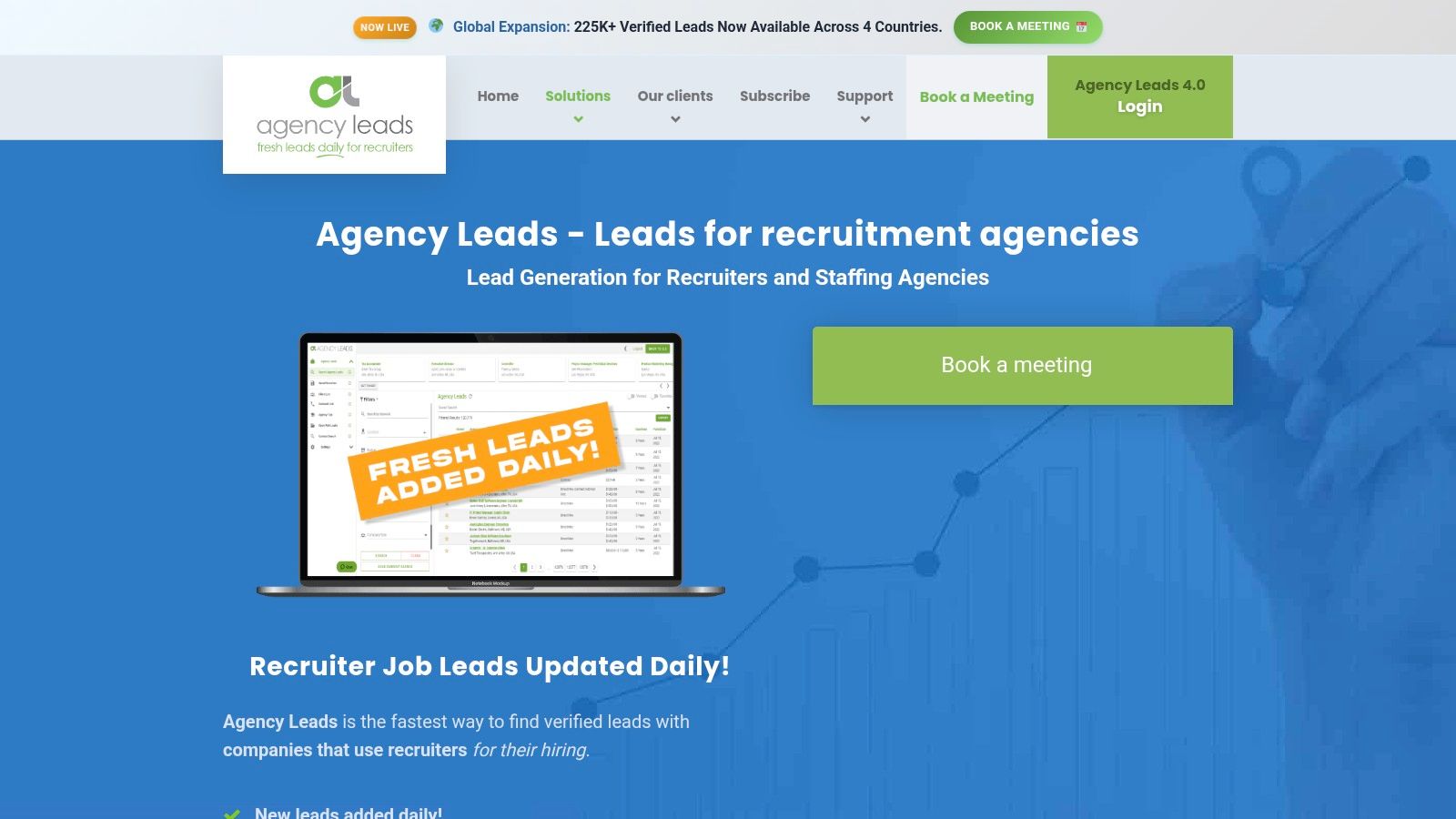
Agency Leads attempts to answer a more useful question than who's hiring: who already uses recruitment agencies? Its provider describes the listings as verified leads from companies that use recruitment or staffing suppliers.
Agency Leads advertises more than 225,000 verified recruitment leads, with new additions daily and new-lead notifications. Records include job details, posting dates, salary information, company context, and hiring-manager contacts.
That extra context can help you avoid a generic introduction. You can connect your outreach to the role's requirements, location, and compensation rather than announcing that your agency exists.
Assess the verification, not just the database
The useful distinction is agency use, but the verification method matters. During a demo, ask what evidence supports that label, when it was checked, and whether it applies to the company generally or the specific hiring team.
- Advantages: Searchable records, lead tracking, CRM export, live support, and one-on-one training support day-to-day prospecting.
- Coverage consideration: The provider offers demos and has a US presence, but your niche still needs a sample-based review.
- Limitations: Pricing wasn't clearly stated on the reviewed page, and public-posting-led coverage may be thin in discreet search markets.
For remote staffing agencies, check whether remote means globally distributed or restricted to an employer's approved hiring locations. That distinction changes which candidates you can credibly offer.
This is a targeted version of lead generation for agencies, not a replacement for account qualification. Previous agency use doesn't guarantee an open supplier list, budget, or a willingness to change partners.
5. Leedo
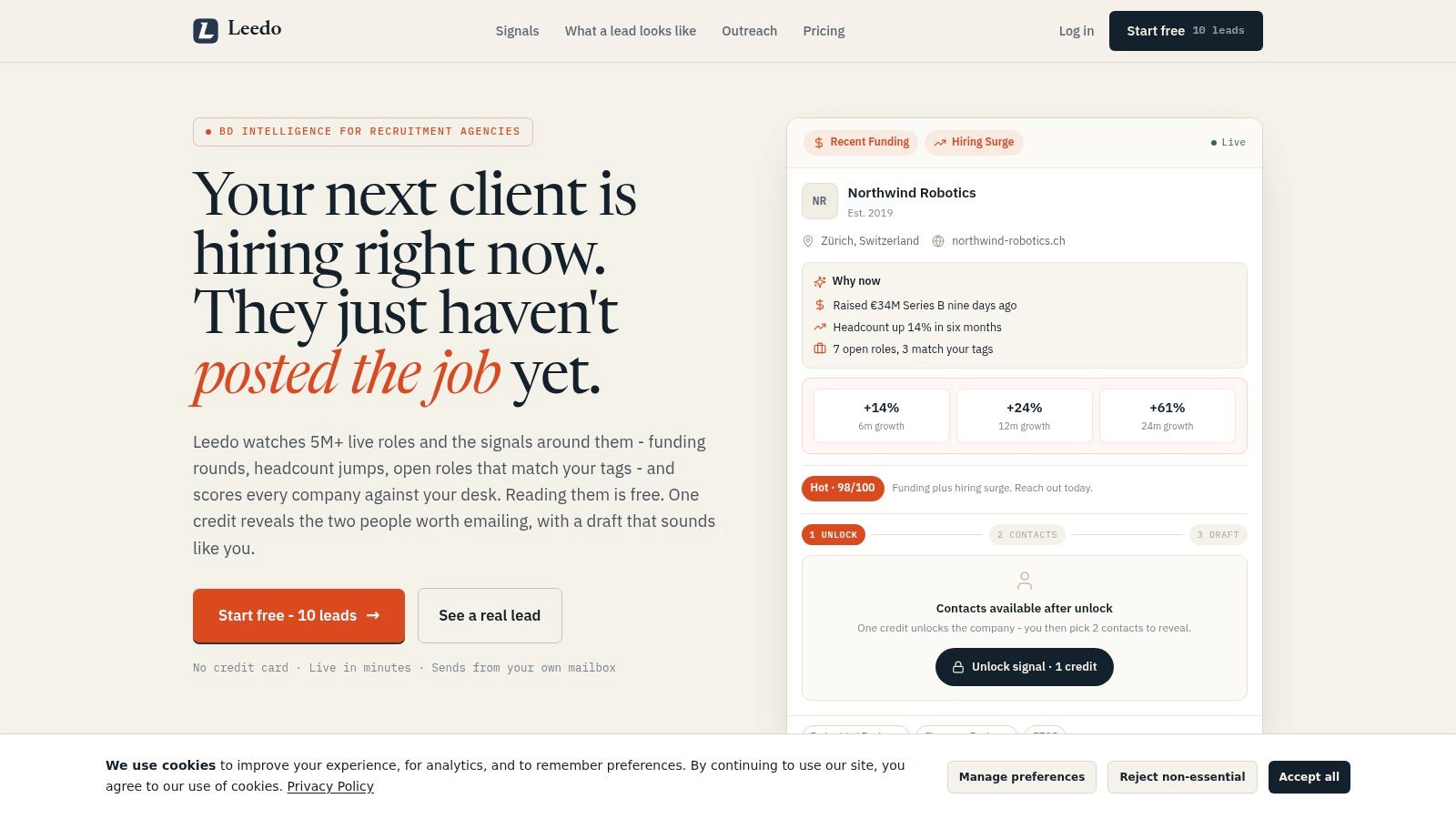
Choose Leedo when the missing piece is a repeatable client-side outreach workflow. It targets recruitment agencies, executive search firms, and independent recruiters who want discovery, enrichment, and email follow-up together.
Leedo finds hiring-manager and talent-acquisition contacts by role, industry, and geography, and advertises a seven-day trial with 10 credits and no credit card required. It enriches contacts with business emails and LinkedIn profiles, then supports personalized drafts and follow-ups through Gmail or Outlook.
Its prospecting signals include funding, headcount growth, leadership changes, and hiring patterns. Those signals are useful for choosing accounts to investigate, but they don't establish a confirmed recruitment budget.
Keep a human on the first message
iHire's 2025 employer survey found that 68.6% of employers using recruitment AI used it to compose candidate messages. That's a candidate-communication finding, not evidence of Leedo's performance, but it highlights a practical starting point for automation: drafting rather than unchecked decision-making.
Use the draft to save preparation time. Review every claim about the company, remove unsupported assumptions, and make the request easy to answer.
- Strength: Agency-specific discovery, enrichment, outreach drafts, and follow-up tracking reduce handoffs.
- Constraint: Credit allowances may limit your usable prospect volume, and independent customer-review evidence was limited in the material reviewed.
- Before paying: Test contact accuracy, credit consumption, Gmail or Outlook behavior, and how campaigns stop after replies.
Track qualified replies and real hiring discussions alongside opens. A prospect who corrects an inaccurate assumption has replied, but that doesn't make the campaign successful.
6. Leads10
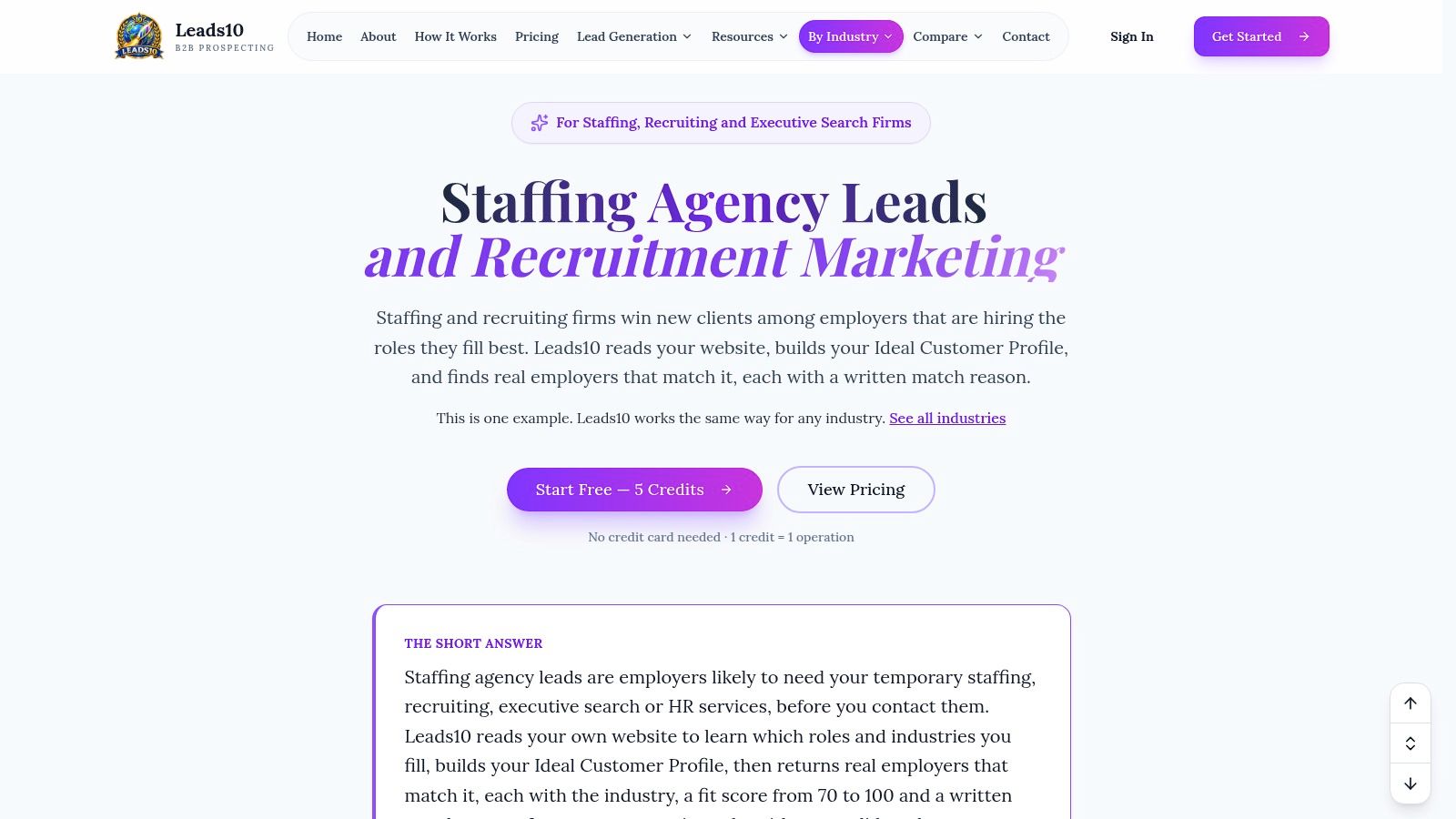
A specialist agency doesn't need every employer in its market. It needs employers whose hiring problems match the roles it can fill.
Leads10 emphasizes that match rather than raw list size. Leads10's staffing-agency service targets employer prospects and supplies company details, including industry, website, and LinkedIn page, alongside an apparent pain point, match rationale, and fit score.
That makes it closer to customized prospect research than a generic contact directory. It may suit a specialist recruiter who can evaluate a short account list but doesn't have time to assemble all the background.
Buying rule: A fit score is useful only when you can inspect the reasons behind it.
Separate evidence from interpretation
A company's industry and advertised vacancies are observable facts. A claim that its hiring team is struggling or needs an agency is an interpretation unless someone has confirmed it.
Ask for a sample that separates those categories. A useful lead qualification process should make the evidence visible so your salesperson can decide whether the proposed angle is credible.
- Upside: Niche-based selection and company context can support more relevant preparation.
- Unclear scope: Pricing, lead volume, and the delivery model weren't sufficiently clear on the reviewed page.
- Before paying: Establish whether you're buying prospect data, campaign execution, or booked meetings, and inspect the research and verification process.
Independent user-feedback evidence was also limited in the material reviewed. I'd favor a clearly defined pilot with agreed acceptance criteria over a commitment based on an attractive fit score.
7. LeadWeft
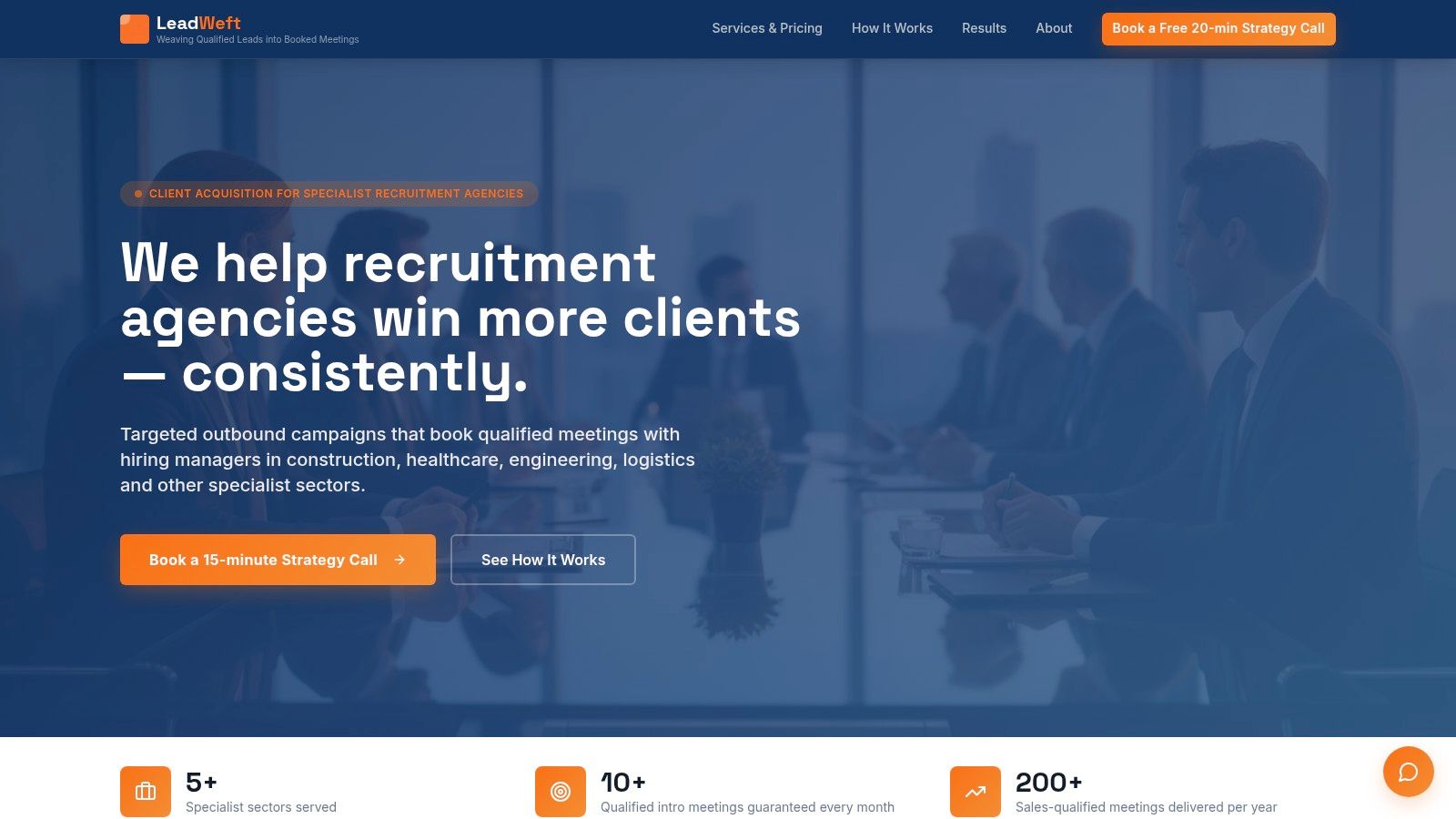
LeadWeft is outsourced business development rather than a self-serve database. LeadWeft says it identifies actively hiring employers, builds decision-maker lists, runs cold-email campaigns, and aims to book qualified introductory meetings for specialist recruitment agencies.
That changes what you're buying. Instead of paying for access and doing the prospecting yourself, you're delegating research and campaign execution.
It may suit an agency whose recruiters can run discovery calls but struggle to maintain consistent outbound activity. It's less attractive if your positioning is still unsettled, because an external team will need a clear answer to who you help and why.
Define a qualified meeting before launch
- Account fit: Agree on industries, locations, company profiles, and exclusions before list building starts.
- Buyer fit: Specify which hiring managers, business leaders, or talent contacts count as relevant.
- Meeting intent: Distinguish willingness to discuss recruitment support from willingness to accept a calendar invitation.
- Handoff: Require the outreach history, stated hiring need, objections, and next-step context.
The advantage is reduced internal execution work. The trade-off is that results still depend on targeting, offer quality, contact accuracy, and campaign management.
Pricing and specific guarantees weren't available in the reviewed page content. Confirm the commercial terms, account ownership, reporting access, and treatment of unsuitable or missed meetings before signing.
Recruiters still have to follow up, qualify the opportunity, discuss terms, and win the agreement. A booked introduction is useful progress, but it isn't a signed recruitment brief.
How the seven options compare at a glance
| Item | Best For | Main Channel | Public Pricing | Free Option |
|---|---|---|---|---|
| DMpro | X prospecting and automated outreach | X direct messages | From $69/month | Free outreach and profile-analysis tools |
| SAFRO | US staffing agencies targeting employers with hiring signals | Lead database and CRM/ATS integrations | Not publicly available | Not specified |
| Scowter | Recruiters prospecting companies with live job postings | Job-board leads and contact reveals | Contact-reveal pricing not specified | Free job search |
| Agency Leads | Recruiters seeking companies that use staffing agencies | Verified job-led prospect database | Not clearly stated | Demo available |
| Leedo | Recruiters seeking hiring-manager contacts and outreach support | Email outreach via Gmail or Outlook | Not specified | 7-day trial with 10 credits |
| Leads10 | Specialist staffing and recruiting firms seeking tailored prospects | Researched employer leads | Not clearly stated | Not specified |
| LeadWeft | Recruitment agencies outsourcing client acquisition | Cold email and booked meetings | Not publicly available | Not specified |
Start With One Channel and Let the Replies Decide
Pick the channel where your candidates or clients already spend time, run it for two weeks, and track replies rather than sends. Treat that as an initial operating test, not enough time to judge placement revenue or a long sales cycle.
Keep candidate and employer campaigns separate. A candidate campaign should produce suitable conversations about a current role; an employer campaign should uncover a hiring need and willingness to discuss outside support.
Measure what happens after the reply
- Positive intent: Did the person express relevant interest, or merely acknowledge your message?
- Qualification: Do the role, timing, geography, and commercial expectations fit?
- Progression: Did the conversation reach a screen, discovery call, or agreed next step?
- Experience: Did anyone opt out, receive an irrelevant follow-up, or wait too long for an update?
Communication after initial interest deserves attention. Bullhorn's talent-trends report found 71% of surveyed candidates wanted recruiter contact at least weekly, while 56% reported receiving it. Agree on a useful cadence with each candidate instead of assuming another automated touch is always welcome.
For X outreach, don't confuse a platform ceiling with a sensible campaign target. X's consumer limits documentation lists a 500-message daily DM limit, but consent rules, account settings, and other restrictions still apply.
Choose the smallest setup that covers your current bottleneck. Use a hiring-signal database when you need relevant employers, an outreach workflow when follow-up is inconsistent, and an outsourced service when execution capacity is the problem.
If conversations are already arriving but nobody owns qualification or scheduling, you might hire appointment setters rather than add another prospecting subscription. Assign ownership before increasing volume.
Then double down on the source producing relevant conversations. Better targeting and prompt human replies are more useful than a larger queue of messages nobody wants.
DMpro brings X prospect discovery, contextual message personalization, follow-up workflows, and response tracking into one workspace. If you're tired of manually managing DMs, visit DMpro to try automating cold-DM workflows where recipients have explicitly requested contact, while keeping recruiters in charge of qualification and replies.
Ready to Automate Your Twitter Outreach?
Start sending personalized DMs at scale and grow your business on autopilot.
Get started