
Outsourced Lead Generation: Models, Risks and How to Choose
Learn how outsourced lead generation works, the main service models, risks to watch and how to choose a provider that books real conversations.
You're building product all week, then spending Sunday night sending DMs on X and chasing replies from Tuesday. Some prospects get a fast answer. Most get silence because you were shipping a fix. That's the exact point where outsourced lead generation starts to look attractive, and also where founders make sloppy deals.
Don't judge a provider by lead counts or messages sent. Judge them by speed to first contact, human review, and qualified conversations. Volume without those three controls just gives you a bigger unworked list.
Outsourced Lead Generation Models Compared
Outsourced lead generation means paying an outside team or platform to find prospects, start conversations, and hand over qualified leads, so your team doesn't build that engine in-house. You keep the close. They fill the top of the funnel.
Outsourced Lead Generation Models at a Glance
| Model | What the provider does | Who sends the messages | How it is usually priced |
|---|---|---|---|
| Done-for-you appointment setting | Finds prospects, starts conversations and books meetings | Provider, using scripts you approve | Per meeting or monthly retainer |
| Managed campaign service | Runs targeting, sourcing, messaging, follow-up and reporting | Provider, within your approved targets | Monthly retainer plus setup fee |
| Software plus your team | Sets up lists, sequences and reporting in a tool you operate | Your team | Subscription or per seat |
| Lead list or data supply | Supplies contact lists or profiles only | Your team | Per lead or per list |
Done-for-you appointment setting is the fullest handover. The provider books meetings and you show up to sell.
Managed campaign service sits one step back. The provider runs targeting, messaging, and reporting while you approve direction and take qualified replies.
Software plus your team keeps your voice in the messages. You operate the tool, the provider helps with setup, and a platform like DMpro fits here when you want control. Its custom service, by contrast, is a managed model.
Lead list or data supply is the lightest option. You buy contacts only and own every message, follow-up, and mistake.
If you're still mapping where prospects come from, compare your lead generation channels before you pick a model. It's also worth reading lead generation outsourcing advice from H2 for another view on how agencies structure this work.
Practical rule: The more of the sales conversation a provider owns, the more control you must write into the contract.
Pick the model that matches your bottleneck, not the one with the biggest promise.
Why Teams Outsource and What They Gain
Say a SaaS founder gets twelve trial sign-ups a week and has no time to follow up. She can close when she gets a call. She just can't prospect, personalize, and chase replies every day. Outsourcing fixes that specific gap.
Three Gains That Actually Matter
- Capacity: Prospecting continues while you build product, run support, or take sales calls. You don't lose a week every time you ship.
- Skill: A specialist already knows list building, message testing, and objection handling. You're renting repetition you'd take months to learn.
- Cost control: A variable monthly fee turns a hiring decision into a test. You can stop a pilot faster than you can unwind a bad hire.
This isn't only an enterprise habit. In a 2024 survey of 151 lead-generation and sales professionals, 62.25% had outsourced outbound marketing operations during the preceding year and 68.21% considered outsourcing lead generation useful. The same survey found 63.58% operated with a monthly budget below $10,000 for lead generation and sales-meeting activity.
Read those numbers as directional. It's a professional-opinion sample, not a census of all businesses. Still, it confirms smaller teams with tight budgets already buy this help for research, list building, messaging, qualification, and appointment setting.
Before you sign, run a three-question test. Is your problem volume, speed, or message quality? Outsourcing fixes volume and speed well. If your message is weak, a provider will just send a weak message faster.
How Outsourced Lead Generation Works Step by Step
A clean process protects your account and your time. If a provider can't walk you through these steps in order, don't hire them.
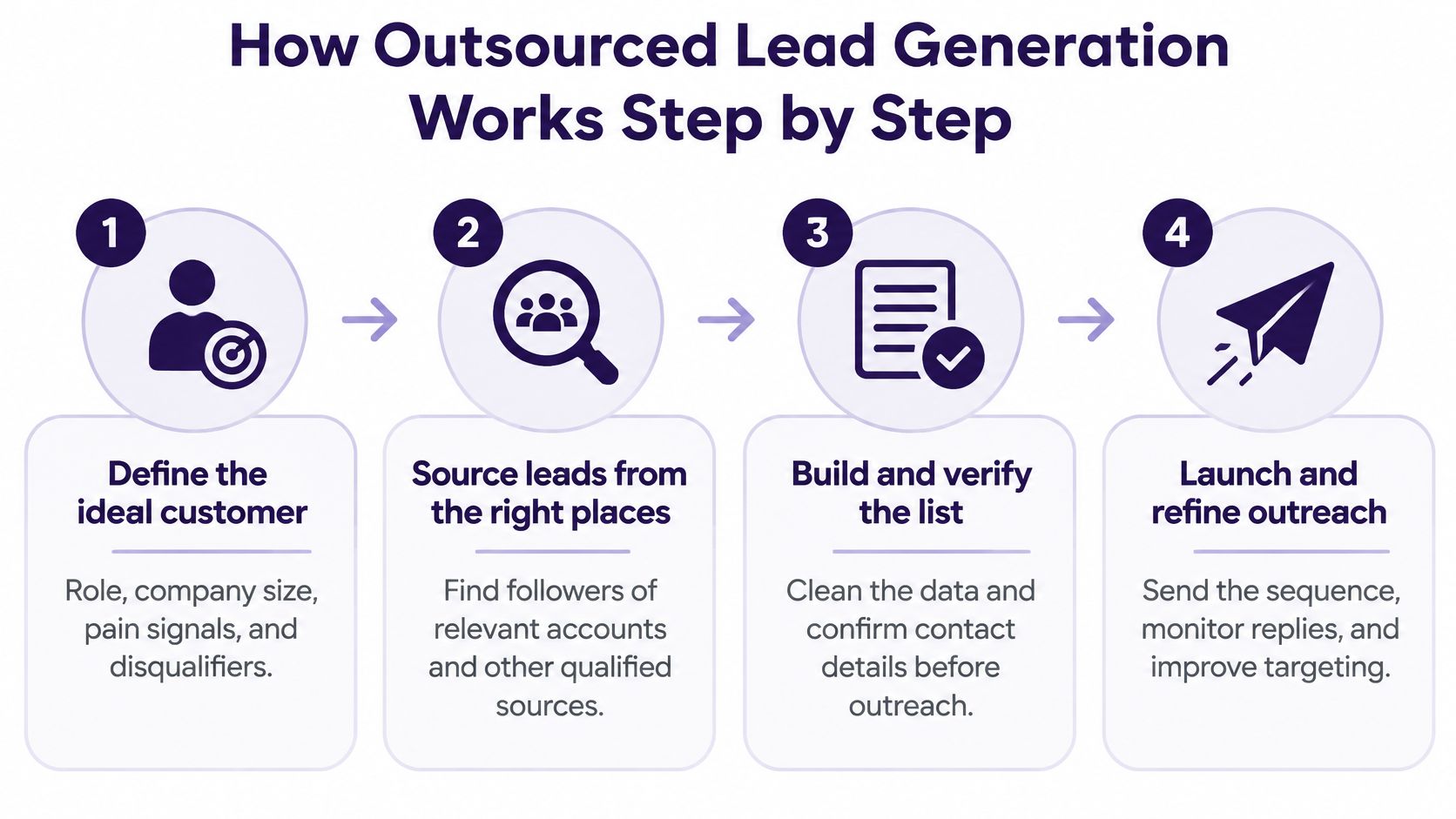
The Seven Steps
-
Define the ideal customer. Write role, company size, pain signals, and disqualifiers. This stops a provider padding results with easy, wrong-fit replies. The common slip is a vague brief like founders who need marketing.
-
Source leads from the right places. Pull from followers of relevant accounts, communities, keyword conversations, and engaged users. Start with a modest first batch to test fit. Scraping a huge list before you test the message wastes your best prospects.
-
Qualify and score before any message goes out. Check each lead against your criteria and prioritize by activity and relevance. Lead scoring helps, because a hot lead deserves a direct ask and a cold lead deserves a lighter touch or a skip.
-
Write first messages with real context. Reference a recent post, a company detail, or a stated problem. A first name swap isn't personalization. Review a sample batch yourself before launch.
-
Send through controlled sequences. Use delays, daily limits, and a stop rule when someone says no. Campaigns should branch after a reply instead of blindly continuing follow-ups.
-
Route replies by intent. Positive answers go straight to a human on your team. A "not right now" reply moves to a long-tail nurture branch, not into another pushy follow-up tomorrow.
-
Hand off and log everything. Qualified conversations land on your calendar with context attached. Every outcome goes into one shared record, tracked by status such as New, Contacted, and Replied, so you can segment and sort your pipeline from one workspace.
A healthy first two weeks looks boring. Small test batch, replies reviewed daily, one message change based on results.
If week one is all volume and no review, the provider is optimizing for their report, not your pipeline. Slow them down.
Speed and Measurement Targets to Set Up Front
Set targets before you sign, not after the first invoice. Speed is the first one, because a late first touch kills interest you already earned.
A Harvard Business Review audit of 2,241 U.S. companies found only 37% responded to web-generated leads within one hour, the average response time among companies that replied within 30 days was 42 hours, and 23% never responded. In a separate analysis in that summary, contacting a lead within one hour made qualification nearly seven times more likely than waiting an additional hour.
The MIT/InsideSales lead-response study summarized by Plura found contacting a lead within five minutes produced approximately 100 times higher contact odds and 21 times higher qualification odds than waiting 30 minutes, across more than 15,000 leads and six companies. Those studies come from inbound contexts, so use them as direction for X outreach, not exact benchmarks.
Provider Scorecard Metrics and Targets
| Metric | What it shows | Target or benchmark |
|---|---|---|
| Time to first touch | Speed from lead capture to first message | Under 1 hour |
| Contact rate within SLA | Share of leads reached inside the agreed window | Record a 30-day baseline, then write the agreed number into the contract |
| Reply rate by audience source | Response from each audience type, kept separate | Record a 30-day baseline per source, then set a source level target |
| Positive reply rate | Share of replies showing real interest | Record a 30-day baseline, then write the agreed number into the contract |
| Qualified conversation rate | Replies that pass your qualification criteria | Record a 30-day baseline, then write the agreed number into the contract |
| Booked meeting rate | Qualified conversations that become meetings | Record a 30-day baseline, then write the agreed number into the contract |
Measure the full funnel. Sourced lead to message delivered, delivered to reply, reply to qualified conversation, and qualified conversation to booked meeting. Split results by audience source, so followers, communities, keyword conversations, replies, bios, and imported lists are compared separately.
Use solid lead generation metrics in the contract, including routing coverage and escalation rules. Volume alone tells you nothing about sales capacity.
Risks to Check Before You Hand Over Outreach
Handing over outreach hands over your account and your reputation. Check three risk areas before anyone sends in your name.

Platform Rules on X
X's automation rules prohibit unsolicited bulk or automated direct messages, and automated DMs are allowed only when recipients have requested contact or clearly indicated on X that they want to be contacted, such as by messaging the sender first. Spam or abusive automation can lead to search filtering or suspension. Ask a provider, which prospects have signaled interest?
X's published limits set a limit of 500 direct messages per account per day across web, mobile, phone, and API activity, and limits can be temporarily reduced during heavy usage. Treat that ceiling as a danger line, not a daily quota. Ask what cap they'll set well below it, and what delays and monitoring they use.
Message Quality and AI Accountability
X's authenticity policy identifies identical or nearly identical direct messages as duplicative spam and prohibits bulk, aggressive, high-volume unsolicited DMs. If a provider only swaps first names, you're buying spam risk.
AI adds a second problem. In Gartner's survey of B2B buyers, 45% of B2B buyers used generative AI during a recent purchase, 69% preferred to validate AI-generated insights with a sales representative, and 51% said they were more likely to encounter misleading information from GenAI.
So ask directly. Who is accountable when AI research misstates a prospect or invents a detail? Put compliance monitoring and human review for high-value accounts in writing.
Three red flags end the conversation for me. Guaranteed reply rates, no account-safety controls, and no way to see which messages a human approved.
Require these safeguards in writing:
- Evidence-based personalization: Every claim in a message traces to a profile, post, or website detail you can check.
- Clear escalation: Positive or sensitive replies go to a named human fast.
- Separate reporting: AI-generated activity is reported apart from human-approved activity.
How to Choose a Provider Without Getting Burned
Start with one job. If you can't name it in one sentence, you're not ready to buy.
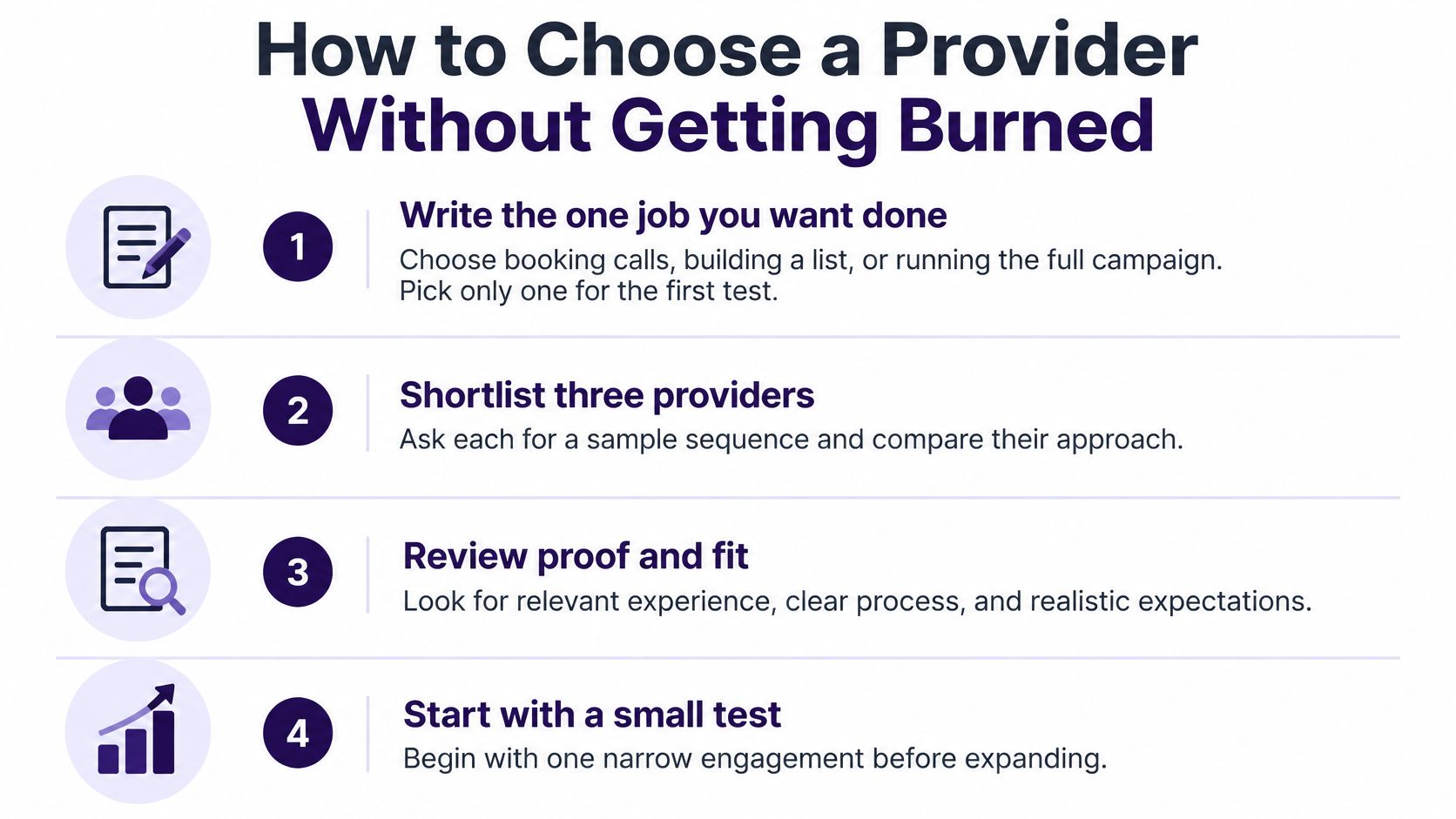
Six Steps in Order
-
Write the one job you want done. Booking calls, building a list, or running the full campaign. Pick only one for the first test.
-
Shortlist three providers. Ask each for a sample sequence built for your audience, not a generic template. If you want to compare pricing structures, review performance-based lead generation options alongside retainer quotes so you can see what you're paying for.
-
Check what the provider controls. Targeting, message approval, sending limits, and reply routing. You approve targets and scripts. They operate inside those lines.
-
Ask how readiness is shown. We are direct about this in our own platform. An active campaign status does not mean every lead can be sent immediately. Campaign details show readiness and per-lead progress, including sent messages, contacted leads, replies, and the state of each lead. Demand that level of visibility from any provider.
-
Ask for funnel-level reporting. Split by audience source, not only messages sent. Also ask how a rejected lead is handled and who reviews it.
-
Run a 30-day pilot. Capped budget, clear cancel clause, and contract terms you read before signing.
Never agree to a per-lead fee without written qualification criteria. A fee per lead rewards volume, not conversations.
Provider Checklist for Scoring Candidates
| Criterion | What to check | Pass signal |
|---|---|---|
| Scope | Booking calls, list building or full campaign | One named job written into the contract |
| Human approval | Who signs off each message and target | A named reviewer and visible approval records |
| Account safety | Sending caps, delays and duplicate-message checks | Caps set well below 500 DMs per account per day |
| Reporting | Funnel stages, split by audience source | Weekly report that includes time to first touch |
| Pilot terms | Length, budget cap and cancel clause | 30 days, capped budget and written exit terms |
Score each candidate against the same five rows. The cheapest provider who fails account safety is the most expensive one you'll hire.
Decide Whether Outsourcing Fits Your Outreach
Here's my verdict. If your bottleneck is capacity and you can name a clear ideal customer, outsource one defined slice first, one channel or one segment, for 30 days. If your bottleneck is message quality or you have no clear offer, fix that before paying anyone.
Do three things this week. First, write your scorecard with time to first touch, contact rate within the SLA, reply rate, positive reply rate, and qualified meeting rate. Second, shortlist two models that fit your situation. Third, send the checklist to two providers and request a pilot on terms that match it.
If you want a managed route, a proper done-for-you service should include account setup and warm-up, done-for-you targeting and lead sourcing, outreach scripts written for you, campaign management and optimization, and reporting with a dedicated strategist. If you want to keep the work in-house, DMpro's software handles lead collection, message generation, campaigns, and reply analytics in your own voice.
If you're tired of sending cold DMs by hand every day, try DMpro.ai. It automates outreach and replies while you sleep.
Ready to test outsourced lead generation without handing over control of your voice or your account? Try DMpro to automate your X cold DMs, personalize each message with real prospect context, and track replies through to qualified conversations.
Ready to Automate Your Twitter Outreach?
Start sending personalized DMs at scale and grow your business on autopilot.
Get started