
How to Find Clients Online: A Founder's Guide to Scaling SaaS
Tired of guessing how to find clients online? This guide breaks down actionable strategies for targeting, outreach, and scaling your client acquisition.
Finding clients online isn't about some secret formula. It comes down to two simple things: knowing exactly who you're selling to and mastering one place where they hang out. Forget trying to be everywhere at once. The real win for founders like us is in going deep, building a repeatable system, and then using the right tools to scale what works.
This playbook will walk you through exactly how to do that, focusing on Twitter (X) as a goldmine for SaaS leads.
Pinpoint Exactly Who Your Ideal Clients Are
Before you write a single cold DM, you have to know who you're looking for. I mean really know them. So many founders just scratch the surface with vague demographics like job titles or company size. That's a huge mistake, and it leads to generic messaging that gets ignored.
The real magic is in creating a laser-focused Ideal Customer Profile (ICP). This isn't just about what they do; it's about who they are. It’s about understanding the person on the other side of the screen so well that your outreach feels like a conversation they were already having in their head.
Go Deeper Than Demographics
Start by digging into the psychographics—the actual beliefs, frustrations, and goals that drive these people every day. You're not just selling to a "VP of Sales at a Series A SaaS company." You're selling to a human who is probably stressed about hitting their quarterly number, struggling to train a young sales team, and absolutely sick of a weak pipeline.
To get to this level of detail, ask yourself these kinds of questions:
- What are their biggest daily headaches? What tasks do they dread? What problems literally keep them up at night?
- What does a "win" look like for them? Are they gunning for a promotion, trying to lock down the next funding round, or just trying to make their work life a little less chaotic?
- Where do they actually spend their time online? For SaaS founders, this is often Twitter. Who do they follow? What newsletters are in their inbox?
This isn’t about guesswork. It’s about listening. Go hang out where your ideal customers are. Read their posts, see what questions they're asking, and—this is key—pay attention to the exact words they use to talk about their challenges.
Key Takeaway: Your goal is to build an ICP that feels like a real person. When you know their specific pain points and the language they use to describe them, your outreach will hit completely differently.
Find Their Digital Watering Holes
Once you have a crystal-clear picture of your ICP, the next move is to figure out where they gather online. For most B2B SaaS businesses, the action is happening on platforms like LinkedIn and especially Twitter (X). Stop thinking of these as just social networks and start seeing them for what they are: massive, searchable databases of your potential clients.
For example, you can find SaaS founders on Twitter who need distribution help by searching for phrases like "struggling with lead gen" or "how to scale GTM." You can pinpoint people who follow specific industry influencers or use certain keywords in their bio.
This is where automation gives you a massive edge. A tool like DMpro can scan thousands of Twitter profiles using your criteria, surfacing hyper-relevant leads who are actively talking about the problems you solve.
By focusing your energy on these high-signal spots, you stop shouting into the void and start having real conversations with people who are actually ready to listen. That's the foundation of any SaaS distribution strategy that actually works.
Choose Your Acquisition Channel Wisely
Once you know who you’re looking for, the next question is where to find them. This is where so many founders get it wrong. They try to be everywhere at once—posting on Instagram, writing blog posts, and running ads. The result? Burnout and a ton of wasted effort.
Instead of trying to conquer the entire internet, your job is to pick one primary channel and master it. Just one. Ask yourself: where does my ideal SaaS customer actually spend their time? For most of us, that’s almost always Twitter (X) or LinkedIn.
These platforms are massive, searchable databases of your ideal clients. The most direct way to connect with them is through smart, strategic cold DMs. It’s the fastest path from finding a lead to starting a real conversation.
The Power of Going Direct
Why start with DMs on Twitter? Simple: you get feedback almost instantly. You don’t have to wait months for an SEO strategy to kick in or burn through thousands on ads just hoping for a return. You can find a potential client, send a thoughtful message, and get a reply—sometimes within the hour.
This direct approach is a game-changer for scaling SaaS distribution. It lets you:
- Test your messaging fast. Find out what pain points and value propositions actually land with your audience.
- Build real relationships. You’re not just a brand waiting to be discovered; you're proactively starting conversations with the right people.
- Generate leads with little to no budget. Your main investment here is time, not a huge ad spend.
Think of it this way: content marketing is like setting up a storefront and hoping people wander in. Direct outreach on Twitter is like walking into a high-value networking event, knowing exactly who you want to talk to, and introducing yourself. You can get done in a day what might take weeks or months with other methods.
Short-Term Wins vs. The Long Game
Of course, direct outreach isn't the only way to find clients. It’s crucial to understand the whole playing field, as every channel has trade-offs in speed, cost, and effort. Some tactics pay off quickly, while others are a long-term investment.
For instance, a deep dive into digital acquisition costs shows a clear split between short-term tactics like paid ads and long-term plays like SEO. Pay-Per-Click (PPC) campaigns can bring in leads almost immediately, but they come at a high average Customer Acquisition Cost (CAC) of around $802. On the other hand, SEO has a lower average CAC of $647 but can take over nine months just to start showing results.
For a founder who needs clients now, waiting nearly a year for the phone to ring just isn't an option.
Founder-to-Founder Tip: Don't get distracted by what works for huge companies with massive budgets. Focus on the channels that give you the most direct line to your ideal customer with the resources you have today. For most of us, that means mastering direct outreach on Twitter first.
How to Pick Your One Channel
To pick your primary channel, go back to your customer research. The goal is to find the platform with the highest concentration of your ideal clients who are actively engaging in conversations you can join.
This is where you can use tools to your advantage. For example, using smart lead scraping features in DMpro can help you scan thousands of profiles on Twitter to find users who match your specific criteria, confirming it’s a goldmine for your SaaS niche.
Not all channels are created equal, and your choice depends entirely on who you're trying to reach. Here’s a quick breakdown to help you compare the most common options.
Comparing Client Acquisition Channels
| Channel | Best For | Typical Speed | Resource Cost |
|---|---|---|---|
| Twitter DMs | Quick, direct conversations with tech-savvy founders, marketers, and creators. | Very Fast (Hours-Days) | Low (Time) |
| LinkedIn Outreach | Connecting with corporate decision-makers and professionals in specific industries. | Fast (Days-Weeks) | Low (Time) |
| SEO/Blogging | Building long-term authority and attracting inbound leads over time. | Very Slow (6-12+ Months) | High (Time &/or Money) |
| Paid Ads | Generating a high volume of leads quickly, if you have a validated offer and budget. | Very Fast (Hours-Days) | Very High (Money) |
| Niche Marketplaces | Finding clients with immediate project needs, like on Upwork or industry job boards. | Fast (Days-Weeks) | Medium (Platform Fees) |
The key takeaway? Start with one. If your ideal SaaS clients are all over Twitter, commit to it. Learn the platform's culture, engage in conversations, and build a repeatable system for outreach there. Once that channel is reliably bringing in clients, you can think about expanding. But not a moment sooner.
Crafting Cold DMs That Actually Get Replies
So, you’ve picked your channel—let's say it's Twitter—and now the real work begins. This is where most founders stumble. They treat DMs like a numbers game, blasting out generic, self-serving pitches that land them on ignore or get them marked as spam.
A bad cold DM feels like an ad. A great one feels like the start of a genuine conversation.
The difference isn't complicated. It’s about shifting your mindset from "pitching" to "helping." Your goal isn't to land a sale in that first message. It’s just to get a reply and open a dialogue. That's it. You do that by proving you’ve done a tiny bit of homework.
Forget the long, feature-dumping paragraphs. Your prospect is busy. A great cold DM is short, direct, and all about them.
Personalization Beyond a Name Tag
Everyone knows how to use a [First Name] tag. That’s not real personalization; it’s the bare minimum. True personalization is about showing you see them as an individual, not just another lead in a spreadsheet. It’s about finding a specific, relevant hook that makes your message feel like it was written just for them.
This doesn't mean you need to spend 30 minutes researching every single person. That’s not scalable. Instead, it’s about finding scalable signals you can quickly identify.
Here are a few hooks that work like a charm on Twitter:
- A recent post: "Loved your thread on scaling SaaS distribution. The point you made about channel saturation really hit home."
- A company milestone: "Saw you just closed your Series A—congrats! Scaling the GTM team must be a top priority right now."
- A shared interest: "Noticed from your bio you’re into indie hacking. Always great to connect with fellow builders."
- A question they asked: "Saw your post asking for advice on improving lead quality. It’s a challenge I see a lot of founders facing."
These small touches show you’re paying attention and immediately separate you from 90% of generic outreach. This is where tools with AI-driven personalization are a game-changer. For instance, a platform like DMpro can automatically reference a prospect's recent tweet or a keyword in their bio, helping you achieve this level of detail at scale. You can find out more about how AI personalization works to make every message feel unique.
The Anatomy of a High-Converting DM
A winning DM has three simple parts: the hook, the value proposition, and the call-to-action (CTA). Let's look at a bad example versus a good one for a founder selling a social media scheduling tool.
The Bad DM (Self-Focused):
"Hey [Name], I’m the founder of [Tool]. We help businesses automate their social media with features like AI scheduling and analytics. Can I show you a demo next week?"
This message is all about the sender. It lists features, asks for a meeting, and provides zero value upfront. It will almost certainly be ignored.
The Good DM (Prospect-Focused):
"Hey [Name], saw your tweet about how much time you spend on content distribution. I help founders like you get 5+ hours back a week by automating that process. Curious how you're tackling it now?"
See the difference? This one starts with their problem (the hook), connects it to a tangible outcome (the value prop), and ends with a low-friction question (the CTA). It's not asking for a sale; it's asking for a conversation.
Key Takeaway: Lead with their pain, not your product. Frame your solution as the bridge from their current frustration to their desired outcome. Always end with an open-ended question to make replying easy.
Choosing Your Outreach Channel
While the principles of good outreach are universal, the channel you choose significantly impacts your potential returns. Some channels deliver results quickly, while others are a slower burn.
This chart compares the Return on Investment (ROI) for two common acquisition channels, PPC and SEO, illustrating the trade-off between speed and long-term value.
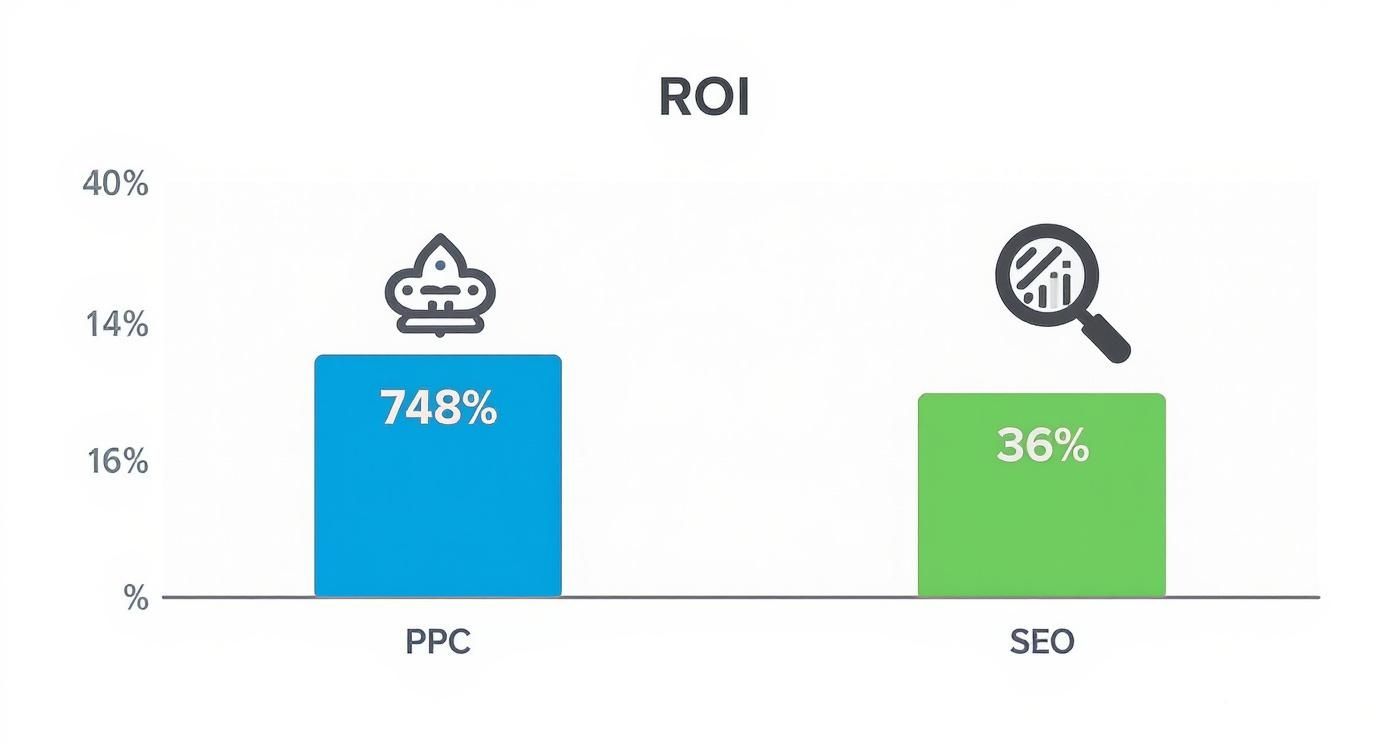
The data clearly shows that while PPC offers an impressive short-term ROI, SEO is a long-term play with more modest but sustained returns. For SaaS founders needing immediate traction, direct channels like Twitter DMs offer a similar speed-to-value as PPC but with a much lower initial cost, making it the ideal starting point for scaling distribution.
If you’re tired of manually sending DMs every day, try DMpro.ai — it automates outreach and replies while you sleep.
Automate Your Outreach (Without Sounding Like a Robot)
<iframe width="100%" style="aspect-ratio: 16 / 9;" src="https://www.youtube.com/embed/ud30-w-Wt48" frameborder="0" allow="autoplay; encrypted-media" allowfullscreen></iframe>Let's be honest. Manually hunting for leads on Twitter, digging into each one, writing a personalized DM, and then keeping track of follow-ups... it's a soul-crushing time sink. As a founder, your time is your most valuable asset. Burning hours every day on repetitive outreach is a direct flight to burnout.
This is where outreach automation comes in. And I know what you’re thinking—spammy, generic bots that just annoy people and hurt your brand. That's the old way.
Smart automation today is completely different. It’s about taking the robotic, repetitive tasks off your plate so you can focus on the human parts: building real relationships and actually closing deals. The goal isn't to remove yourself from the conversation; it's to get you into more of the right conversations, faster.
The New Age of Smart Outreach
The game has totally changed. In 2025, AI and automation are at the core of scaling SaaS distribution. AI-powered tools can now sift through mountains of data to figure out what customers need, personalize messages at scale, and automate interactions to make the whole process incredibly efficient. For instance, predictive analytics can help you zero in on potential clients with startling accuracy, which naturally leads to better conversion rates. You can find more insights on these customer acquisition trends over at synapticincorporated.com.
What does this mean for you? It means you can finally automate the most tedious parts of finding new clients without sacrificing quality.
Imagine a system that works for you 24/7, even while you're asleep. A system that:
- Scans Twitter for new leads who fit your ideal customer profile perfectly.
- Picks up on high-intent signals, like someone asking for recommendations or complaining about a specific problem you solve.
- Sends them an initial, personalized DM that directly references their situation.
- Handles the follow-ups automatically, so a warm lead never slips through the cracks.
This isn't some far-off fantasy. It's exactly what platforms like DMpro were built for. By setting up the right rules and triggers, you can build a consistent, scalable outreach engine that practically runs itself. This frees you up to focus on strategy, product, and having high-value conversations with the qualified leads the system brings to your door.
How to Automate Without Losing the Human Touch
Here’s the secret: you automate the actions, not the personality. Your outreach should always feel like it’s coming from a real person who actually did their homework.
I call this "scalable personalization." It goes way beyond just inserting a [First Name]. Modern tools can pull in dynamic details that make each message feel unique. This could be a nod to a prospect's recent tweet, a keyword from their bio, or even a shared interest.
For example, with a tool like DMpro, you can craft a message template that automatically customizes itself for every single person based on what they're doing on Twitter.
Here's how that might look: You set up a campaign targeting SaaS founders who are talking about "churn." The system spots a tweet saying, "Our churn rate is killing us this quarter." Your automated first DM could be:
"Hey [Name], saw your tweet about churn. It’s a tough problem. I help founders cut churn by [your value prop]. Curious what you’ve tried so far?"
That message is automated, but it's also timely, relevant, and personal. It proves you're paying attention and immediately positions you as a helpful expert, not a spammer. To really get into the nuts and bolts, check out our complete guide on how to send automated Twitter DMs that feel authentic.
When you blend the power of automation with the nuance of real human interaction, you create a system that's both efficient and incredibly effective. This is how you stop trading your time for leads and start building a predictable client acquisition machine for your SaaS.
If you’re tired of manually sending DMs every day, try DMpro.ai—it automates outreach and replies while you sleep.
Track Your Progress and Scale What Works
Running an outreach campaign without tracking your numbers is like driving blind. You might be busy, but you have no clue if you're actually getting anywhere. If you want to scale your SaaS distribution in a predictable, repeatable way, you have to measure what you're doing.
It’s a simple truth in business: you can't scale what you don't measure.
This isn’t about getting lost in a sea of complicated analytics. It's about zeroing in on the handful of metrics that tell you the real story. Tracking these numbers is how you stop guessing and start making smart decisions that lead directly to more clients.
The Metrics That Really Matter
Forget about vanity metrics like profile views or impressions. They might feel good, but they don't pay the bills. For direct outreach on Twitter, there are only a few numbers you need to live and breathe.
Here’s what you should be tracking from day one:
- Reply Rate: This is your first and most important checkpoint. What percentage of people are actually responding to your message? If your reply rate is consistently below 10%, something is broken. It's a clear sign your targeting is off or your opening line is falling flat.
- Positive Reply Rate: Not all replies are good news. This metric cuts through the noise of "no thanks" messages and shows you how many people are genuinely interested in talking. This is your true signal for message-market fit.
- Meetings Booked Rate: This is where the rubber meets the road. Of those positive conversations, how many are turning into actual sales calls or demos? This number tells you how effective you are at converting interest into a tangible next step.
Founder-to-Founder Tip: Don't overcomplicate this at the start. A simple spreadsheet will do. For every 100 DMs you send, log the replies, positive replies, and meetings booked. You'll quickly spot the patterns of what's working and what's a waste of time.
Calculating Your Customer Acquisition Cost
Beyond the immediate campaign stats, you have to understand the money side of things. The single most important figure here is your Customer Acquisition Cost (CAC). Put simply: how much are you spending to land one new client?
Knowing your CAC is crucial for sustainable growth. The cost of getting customers online is soaring. One analysis found that the average CAC for e-commerce is projected to hit $70 to $78 in 2025, a jump of 40% in just two years. This trend shows why running efficient, measurable outreach isn't a luxury; it's a necessity. You can read more about these rising acquisition costs on Loyalty Lion.
Calculating your CAC for direct outreach is pretty straightforward:
(Your Time's Hourly Rate x Hours Spent on Outreach) + Cost of Tools = Total Cost
Total Cost / Number of New Clients = Your CAC
Let’s say you value your time at $100/hour, you spend 10 hours a month on this, and use a tool that costs $50/month. Your total cost is $1,050. If that effort brings in 3 new clients, your CAC is $350.
Using Data to Scale Smartly
Once you have these core numbers, you can start optimizing.
If you see one message template gets a 25% reply rate while another barely scrapes by with 5%, you know exactly which horse to back. You kill the loser and double down on the winner. This is how you build a scalable system.
This is also where a dedicated platform quickly becomes a no-brainer. A spreadsheet is great for getting started, but a tool like DMpro gives you a live dashboard to see what's happening in real-time. You can spot the winning campaigns instantly, allowing you to pour your budget into what's actually working.
You can explore how to track your outreach with detailed analytics and reporting to make this process even easier.
This data-driven approach turns client acquisition from a guessing game into a science. You stop throwing spaghetti at the wall and start building a predictable, repeatable engine for growth.
If you’re tired of manually sending DMs every day, try DMpro.ai — it automates outreach and replies while you sleep.
Answering Your Top Questions
When you're a founder trying to get clients online, you're hit with a firehose of advice. It's tough to know what actually works. I get asked the same questions over and over, so let's cut through the noise with some straight answers from one founder to another.
How Many DMs Should I Actually Send a Day?
Look, there’s no magic number, but here’s a solid rule of thumb: consistency beats intensity.
Start with a goal of 20-30 highly personalized DMs a day. The key word there is personalized. You will get infinitely better results from 20 well-researched messages than you will from blasting out 200 generic, copy-and-paste templates. I've seen it time and time again.
The real aim here is to build a process you can stick with. Once you figure out what's resonating and your messaging is dialed in, you can start scaling up. This is where a tool like DMpro.ai comes in, letting you manage a higher volume of personalized outreach so you can focus on the conversations that matter.
Keep an eye on your reply rates. If you’re getting good, positive responses, that’s your green light to gradually increase the daily sends.
What's the Single Biggest Mistake People Make with Cold Outreach?
Easy. Making it all about you.
Your prospect doesn't care about your product's feature list in the first message. They care about their own problems. The most effective outreach shows you understand their world and their frustrations.
Instead of opening with, "We sell an advanced tool that does X, Y, and Z," flip the script. Try something that shows you've done your homework: "Noticed you're dealing with [their specific problem]. I help founders like you solve that by [the benefit you provide]."
Founder-to-Founder Advice: Lead with their pain point, not your pitch. Your first message has one job: start a conversation. Always end with a simple, open-ended question to make it easy for them to reply.
How Long Should I Follow Up if I Don't Hear Back?
A polite, persistent follow-up strategy is non-negotiable. Seriously, some of my best clients came from the second or third message, not the first.
A good baseline is to send 2-3 follow-ups, spaced about 3-5 days apart.
Each follow-up should bring something new to the table. Share a relevant article, a quick case study snippet, or a helpful tip related to their problem. Your goal is to be professionally persistent, not annoying. If you've sent 3-4 messages over a couple of weeks and hear nothing but crickets, it’s probably time to move on.
Is It Better to Focus on One Channel or Be Everywhere?
When you’re just starting out, trying to be everywhere is a recipe for burnout. It's far more effective to master one channel where you know your ideal clients hang out. For a lot of us in B2B and SaaS, that’s going to be LinkedIn or Twitter (X).
Go deep on that single platform. Learn its quirks, build a real presence, and create a system for generating leads that you can measure and repeat.
Once that one channel is a reliable, predictable source of new business, then you can think about expanding to a second one. Master one before you move on to the next.
Tired of the daily grind of sending DMs? Give DMpro.ai a look—it can automate your outreach and even handle initial replies, so you don't have to.
Ready to Scale Your Client Acquisition?
Finding clients online isn't some secret art—it's a system. When you nail down exactly who you're trying to reach, pick the right channel (like Twitter), and master a personalized outreach process, you create a pipeline that brings in leads like clockwork. The trick is to start with a manageable plan, measure what's working, and then use automation to scale.
That’s how you stop chasing leads and start building a real growth engine for your SaaS. It's about putting a machine in place that consistently delivers high-quality prospects, freeing you up to focus on what truly matters: running your company and amazing the clients you've already won.
If you’re tired of manually sending DMs every day, try DMpro.ai — it automates outreach and replies while you sleep.
Ready to Automate Your Twitter Outreach?
Start sending personalized DMs at scale and grow your business on autopilot.
Get started