
How to Get Sponsorships: A Founder's Step-by-Step Guide
Learn how to get sponsorships by finding fitting brands, pitching measurable results, reaching out on X, and following up without spam.
You've been meaning to land a sponsor for months. You've sent a handful of DMs to brands you like, got one "not right now" and a lot of silence, and then watched an account with half your followers announce a partnership on a Tuesday.
That gap usually isn't about size. It's about whether the marketing lead at that brand can tell, in about twenty seconds, that your audience is their buyer and that you've thought about how they'll measure the result. Most pitches fail on one of those two things, often both.
Here's the process I'd run starting this week: find five brands that fit, build a one-page offer, price it from cost and value rather than follower count, reach out inside X's rules, follow up like a professional, and put the terms in writing before anyone records anything.
Finding Sponsors That Fit Your Audience
Most sponsorship requests die because the brand's buyer and the creator's audience don't overlap, and nothing in the message proves they do. Reach gets blamed. Fit is the actual cause.
Before you write a word, describe your audience the way a media buyer would: job role, industry, company size, geography, buying authority, and how often they engage with you. "Freelancers who invoice in three currencies" is a buying audience. "People interested in business" is not.
Then build a list of ten to twenty brands whose customer-acquisition or awareness goals touch that group. Public clues do most of the work: a product launching this quarter, a job ad for a growth marketer, a move into a new country, a sponsored post from another creator in your space.
Research on how sponsors evaluate properties puts positioning and image compatibility at the top, above raw reach. The sponsor's brand, product and target audience have to line up with the property's audience and image, according to this review of sponsorship decision criteria. A 4,000-follower account writing about invoicing for freelancers beats a 50,000-follower lifestyle account for an accounting SaaS deal, because the freelancers are the buyers.
| Criterion | Strong Signal | Weak Signal |
|---|---|---|
| Audience overlap | Followers match the sponsor's buyer role and industry | Large follower count with mixed, unrelated interests |
| Marketing objective | Recent posts about launches, hiring or entering a new market | No visible growth goal, only generic brand posts |
| Recent sponsorship activity | Sponsored posts or event partnerships in the last six months | No sign of any paid partnerships |
| Budget plausibility | Company size and funding support the deal you have in mind | Proposed deal far above what the company's stage supports |
| Decision-maker access | A named marketing lead or founder you can reach | Only a generic contact form or support inbox |
Rank every brand against those five rows, keep the best five, and write one sentence for each explaining why it fits and which of their objectives you'd support. If you can't write that sentence, drop the brand.
For the outreach side seen from a creator's perspective, the SuperX guide to pitching brands is worth reading before you draft anything.
The filter that kills bad prospects: if you can't name the person whose job depends on reaching your audience, you don't have a prospect yet.
Follower counts also lie in both directions. Auditing who follows you, by role and interest rather than volume, changes which brands make the shortlist; this Twitter followers analysis guide shows how to read those signals from profiles instead of guessing. And remember that a follow or a reply isn't intent. Someone following an account or replying to a post has not told you they want your offer, so check the profile and the evidence before you message.
Building a One-Page Pitch That Shows Results
A pitch is one page. A media kit answers "who are you". The pitch answers "what do I get, and how will we know it worked". Sponsors are explicitly worried about that second question: only 37% of sponsors say they can effectively measure sponsorship ROI, while 30% name lead quality as the most important ROI metric, per this sponsorship ROI research for organizers. Lead with measurement and you're already ahead of most of the inbox.
Here's the order that works.
- Name their objective in the first line. Not your story, their goal: launching in Germany, filling a webinar, getting 50 demo requests this quarter. The rest of the page should serve that one sentence, because a sponsor reading ten pitches is scanning for relevance, not biography.
- Show audience evidence from the last 90 days. Role mix, geography, interests, average engagement, and one line on why those people buy. A screenshot of a chart beats an adjective, and a 90-day window beats lifetime totals because it reflects who's there now.
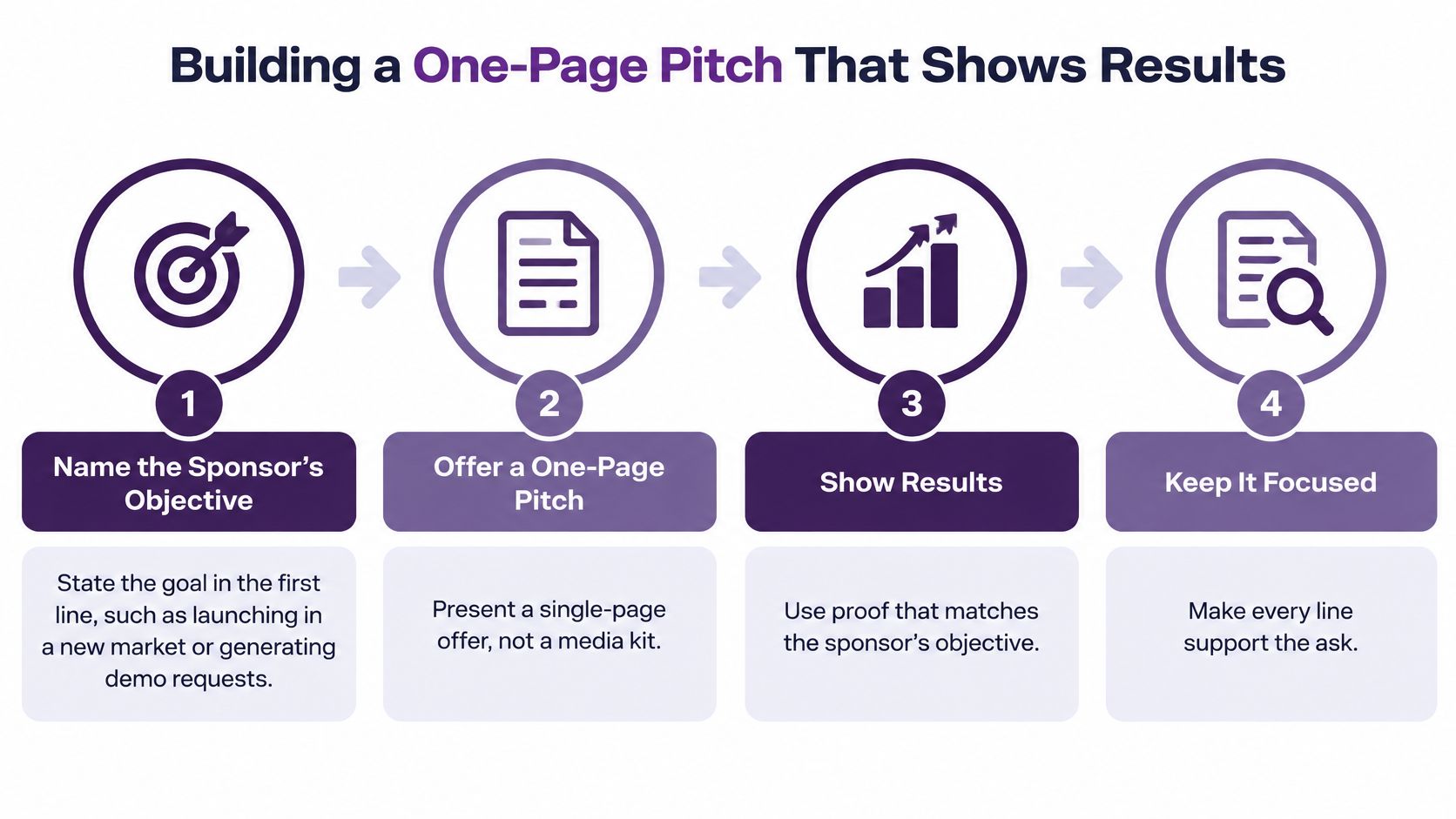
- Offer two or three deliverables tied to that objective. A tutorial thread, a dedicated newsletter mention, a tracked promo code, a live Q&A. Two strong assets beat six vague ones, and every asset should map back to line one.
- Attach a measurement plan. Baseline, target, owner and reporting date for each deliverable. Define what counts as a qualified lead before the campaign starts, otherwise you'll argue about it later at exactly the wrong moment.
- Propose a small paid pilot. Thirty days, a fixed price, one metric. It's the lowest-risk way for a sponsor who has never worked with you to say yes without a formal budget review.
Show the math in the page itself. A $1,500 pilot that produces 25 qualified leads costs $60 per qualified lead, and that single number lets the sponsor compare you against their own targets instead of guessing. Promising impressions alone invites skepticism; three reports at 30, 60 and 90 days with the agreed metrics and one recommendation for next steps builds the case for renewal.
Impressions have their place, but you should know what they're measuring before you quote them; this breakdown of impressions on Twitter explains the difference between a view and a real reader.
If a sponsor can't understand your offer and its success metric in two sentences, the page isn't finished.
How Much to Ask for Your First Sponsorship
Price from three inputs, not from follower count. Follower-based pricing is the reason small, high-intent audiences get underpriced and large, vague ones get overpriced.
- Your cost to produce. Hours the deliverables take multiplied by your hourly rate, plus editing, tools, or a designer. This is your floor and you should never quote below it.
- The value the sponsor receives. Take the pilot price and divide it by the qualified leads you're confident you can deliver. If the result is above what the sponsor already pays per lead elsewhere, the deal is too expensive no matter how good the content is.
- A premium for usage rights. Paid-ad reuse, a longer duration, wider geography, and whitelisting all let the brand buy more than one post, so they belong on a separate line. The Clipatra breakdown of sponsorships and verified-view bonuses is a useful reference for how rights and performance bonuses stack on top of a base fee.
- A fixed-price pilot with an end date. Defined metric, defined window, defined deliverable. Risk drops for both sides.
- Ask early who approves the budget and what range they've set. You'll either calibrate the offer or learn the deal never fit their allocation.
Don't undercut to win a yes. A low first rate becomes the anchor for every renewal conversation, and you'll spend two years climbing back to a fair number.
Making First Contact on X Without Spamming
One rule comes before any message. X's automation policy prohibits unsolicited Direct Messages sent in bulk or automatically. Automated DMs are permitted only when the recipient asked for contact or clearly indicated on X that they want to be contacted, for example by messaging you first, and only when you offer an easy opt-out and honor it promptly. Treat that as part of your sales process, because a restriction on your account ends the channel you were counting on.
Here's a message sequence that fits inside the rules.
Warm up first. Engage with the brand's recent posts for a few days so your name isn't unfamiliar. Reply to one or two, not twelve. Flooding their mentions reads as noise, not interest.
Send about 80 words. Name their current campaign, launch, or the market they're entering, then give one specific idea. Short messages get read on a phone between meetings, which is where your message will land.
Ask one question. "Are you optimizing for signups or awareness this quarter?" That single line tells you whether to pitch a tracked code or a content series, and it turns a pitch into a conversation.
Share the one-page pitch only after they reply. Sending it in message one puts a document in front of someone who hasn't decided to care yet. If you want the mechanical side of DMs handled properly, this walkthrough on how to send a DM on Twitter covers the practical details.
X also caps activity: a platform-wide limit of 500 Direct Messages per day, which can drop under heavy use and applies across web, mobile and API activity, per X's account limits documentation. That's a ceiling, not a target. A newsletter writer who sends 15 personal messages a day and spends the afternoon answering replies will hold more real conversations than someone firing 200 templated pings and getting flagged.
If you want a single place to keep the sponsor list, the follow-up queue and the reply log, that's the kind of workflow DMpro is built for. Use it for people who've engaged with you, and keep every opt-out working.
<iframe width="100%" style="aspect-ratio: 16 / 9;" src="https://www.youtube.com/embed/cLDuDEe4MHA" frameborder="0" allow="autoplay; encrypted-media" allowfullscreen></iframe>Following Up Without Losing the Lead
Most deals are lost between message one and message three, not in the pitch. A fixed cadence keeps the conversation alive without making you the person who sends a ninth "just bumping this".
| Day | Message | Purpose |
|---|---|---|
| Day 0 | Initial message with one specific idea | Start a conversation |
| Day 4 | Short bump with one new proof point | Remind without repeating the pitch |
| Day 10 | Offer a fixed-price 30-day pilot | Lower the commitment |
| Day 14 | Closing question asking for a clear yes, no or later | Get a real signal |
Each message has to add something the last one didn't. The day-four bump isn't a nudge, it's new information: a result from a recent campaign, a subscriber number that moved, a piece of content that performed. If you have nothing new, wait a few days until you do.
The pilot offer at day ten does the heavy lifting. Fixed price, 30 days, one metric, an end date. It's a smaller decision than a partnership, and a sponsor who's on the fence can usually approve it without a review cycle.
The close that works: ask for a yes, a no, or a date. "Should I circle back in Q3, or is this not a fit?" gets an answer far more often than an open-ended "let me know".
Whatever they say, log it. A no-reply goes on a three-month hold so you aren't re-pitching the same person in a fortnight. A "later" needs a specific month in the calendar, not a vague promise. A yes needs three reporting dates booked before the campaign starts, and each report should carry the agreed metrics plus one recommendation on what to do next.
The habit that makes all of this manageable is a shared spreadsheet with four columns: contact, last message date, next date, status. Anything else and you'll lose track of who you've already approached.
Protecting Your Deal With Disclosure and Terms
Disclosure is part of the deal, not an afterthought. The FTC's influencer disclosure guide defines a material connection as payment, free or discounted products, employment, personal relationships, or other benefits, and says the disclosure should appear with the endorsement itself. You can't assume your followers already know.
A preflight check before anything goes live:
- Disclose in the asset itself. In the video, the thread, the caption. Not only in a pinned comment.
- Use plain words. "Paid partnership with X" reads clearly; vague labels and hashtag-only hints don't.
- Repeat it when content is reused. A clip that runs as a paid ad needs its own disclosure.
- Keep records. What was promised, what was delivered, when the brand approved it.
Then get the commercial terms in writing.
| Term | What to Define | Why It Matters |
|---|---|---|
| Base production fee | Price for creating the content | Pays for the work you actually do |
| Usage rights | Where and how the brand can reuse your content | Paid-ad reuse is worth a higher rate |
| Exclusivity | Which competitors you cannot work with, and for how long | Limits your other deals |
| Revisions | Number of revision rounds included | Prevents open-ended edits |
| Geographic scope | Countries where the content can run | Matters for international brands |
| Duration | Start and end dates for each usage right | Stops content running indefinitely |
The reason to split base fee from usage rights is simple. A brand that wants your video in paid ads for six months is buying media inventory, not one post, and the rate has to reflect that. Working with international brands also means checking the advertising and consumer-protection rules in each market they operate in. A clean contract template helps here; this overview of contract terms covers the clauses creators most often leave out. Clear disclosure and tidy terms make you look like a lower-risk partner, which is a sales advantage.
Fixing Stalled Deals and Launching Your First Pitch
Start with the symptom, not the whole pitch. Most stalled deals need one change, not a rewrite.
| Symptom | Likely Cause | Fix |
|---|---|---|
| No reply after the first message | Pitch opens with your stats, not their goal | Rewrite the opening around their current objective |
| Sponsor says the audience is wrong | Audience described as broad, not role-specific | Narrow to one segment and show the breakdown |
| Brand asks only about impressions | Measurement not defined in the offer | Propose qualified clicks or leads with a baseline |
| Deal stalls after a pilot | No results report or renewal recommendation | Send a 30, 60 and 90-day report with a next-step recommendation |
| Account warned or restricted | Bulk or unsolicited automated DMs | Stop automation, message only engaged users and honor every opt-out |
Find the row that matches your situation, rerun the fit criteria from the first section to see which one failed, apply that single fix, and wait for the next follow-up date before judging it.
Then run the three-day start. Day one: score your top 15 brands against the five criteria and keep the best five. Day two: write a one-page pitch with one objective, two or three deliverables, a measurement plan and a pilot offer. Day three: send the first personal message to your top two brands and put the follow-up dates in your calendar. Sponsors set budgets yearly or quarterly, so a message that lands before the planning window is worth more than a perfect one that arrives after it.
Before you send, ask yourself which metric the sponsor will check at day 30. If you can't answer that in one sentence, the pitch isn't ready.
DMpro is built for the part after the pitch: it finds prospects from conversations and engaged followers, personalizes messages from profile and post context, and runs follow-up sequences that branch when someone replies. If manual outreach is eating your afternoons, visit DMpro and set up a small campaign on people who have already engaged with you, then spend your time on the conversations that close.
Ready to Automate Your Twitter Outreach?
Start sending personalized DMs at scale and grow your business on autopilot.
Get started