
What Is Lead Generation in Sales? A Founder's Guide
Discover what is lead generation in sales. This founder's guide explains the funnel, inbound vs. outbound, and how to build a scalable sales pipeline.
Lead generation. You've heard the term, but what does it actually mean for a founder?
Think of it as the very first step in making a sale. It’s the process of finding and attracting people who might be interested in what you're building. This isn't just another marketing task—it's the engine that powers your growth.
What Is Lead Generation in Sales, Really?

At its core, lead generation is about starting conversations. It's the system you build to turn strangers into potential customers who are genuinely interested in your SaaS, agency, or coaching program.
Imagine you're fishing. You wouldn't just throw a line into any random pond. Lead generation is about knowing which pond has your ideal customers, using the right bait (your offer), and then casting your line.
A strong lead generation strategy is what separates founders who scale from those who constantly wonder where their next customer will come from. It's the key to a predictable sales pipeline.
Why It Matters More Than Ever
For founders, getting this right isn't just a "nice to have." It's essential for survival. Without a consistent stream of new leads, your pipeline eventually runs dry. You end up scrambling for business instead of scaling with confidence.
The data says it all. A massive 91% of marketers see lead generation as their most important goal. Why? Because without it, there are no sales.
The Role of Modern Tools
The good news? Lead generation has gotten a lot smarter. Thanks to automation and AI, the days of manually digging for prospects are numbered, especially on platforms like Twitter.
- Automated Prospecting: Instead of spending hours searching, tools can sift through thousands of Twitter profiles to find people who fit your ideal customer profile.
- Personalized Outreach: AI helps you write messages that actually connect, maybe by referencing a recent tweet or a shared interest. It helps you start a real conversation, not just a sales pitch.
- Scalable Systems: You can move beyond one-off campaigns and build a true lead-generating machine that brings in opportunities around the clock.
To see just how much AI is changing the game, it's worth checking out resources on AI Lead Generators. This shift lets you put your energy where it counts: talking to warm prospects and closing deals.
Choosing Your Approach: Inbound vs. Outbound
So, how do you actually find these leads? It comes down to two main strategies: inbound and outbound.
It’s easy to think of them as opposites, but that’s a mistake. They’re just different tools in your founder toolkit, each with its own time and place.
Inbound lead generation is about attraction. You create useful content—blog posts, SEO guides, or helpful Twitter threads—that naturally pulls potential customers to you. They find you because you're answering a question they're already asking.
Outbound lead generation, on the other hand, is proactive. This is where you go out and start the conversations yourself. Think cold emails, direct messages on Twitter, or hyper-targeted ads. Instead of waiting for people to find you, you go straight to them.
The Inbound Method: The Slow Burn
Inbound is the long game. It’s like planting an orchard. You do the hard work upfront—creating great content and building your online presence—and over time, it grows into a consistent source of leads.
The biggest upside is that inbound leads are usually "warmer." They've already seen your content and view you as a credible expert, so the sales conversation is often much easier.
- Pros: Builds long-term assets, attracts high-intent leads, positions you as an authority.
- Cons: It's slow to start, requires consistent effort, and initial results can feel unpredictable.
A great example is a SaaS company writing the ultimate guide to solving a niche problem. Someone finds it on Google, downloads the guide, and becomes a lead.
The Outbound Method: The Fast Track
Outbound is all about speed and control. It’s for when you need to spark conversations right now. This approach puts you in the driver's seat, letting you decide exactly who you talk to and when.
For most new SaaS companies, agencies, or coaches, this is the most direct path to revenue. You can build a list of your ideal customers on Twitter and start conversations the same day. The trick is making your outreach personal and valuable, not spammy.
To go a bit deeper, check out our guide on what is outbound lead generation.
Outbound isn’t about blasting a generic message to thousands. It’s about surgical precision—finding the right person, at the right time, with the right conversation starter.
This is where smart automation becomes a founder's best friend. For instance, tools like DMpro.ai can find prospects on Twitter who fit your ideal customer profile, then send personalized DMs that feel relevant because they are. It gives you the scale of outbound with the personal touch needed to get a reply.
Inbound vs Outbound: A Quick Comparison
So, which path is right for you? It depends on your goals, resources, and timeline. This table breaks down the key differences.
| Attribute | Inbound Lead Generation | Outbound Lead Generation |
|---|---|---|
| Pace | Slow and steady (long-term) | Fast and immediate (short-term) |
| Control | Less control over who finds you | High control over who you target |
| Cost | "Free" but high time investment | Can be costly (tools, ads, time) |
| Lead Quality | Generally warmer, higher intent | Colder, requires more nurturing |
| Key Channels | SEO, blogging, social media | Cold email, DMs, cold calling, ads |
| Best For | Building brand authority, sustainable growth | Quick revenue, market validation |
Ultimately, the best founders don't choose one or the other—they blend both. You might start with outbound to get cash flowing, then reinvest those profits into a long-term inbound strategy.
How the Lead Generation Funnel Actually Works
The lead generation funnel isn't just marketing jargon; it's a map of your customer's journey from stranger to paying customer. For any founder, mastering this map is non-negotiable.
It's the difference between guessing and making smart, data-backed decisions. You can see exactly where your process is winning and, more importantly, where it’s breaking down.
The Three Core Stages
At its heart, the funnel has three simple stages.
-
Top of Funnel (TOFU): Awareness. This is your first impression. Someone sees one of your tweets, finds a blog post, or hears your name. The goal here isn't a hard sell. It's about grabbing the attention of the right people and making them aware you have a solution.
-
Middle of Funnel (MOFU): Nurturing. Okay, they know you exist. Now what? They're weighing their options. Your job is to build trust and show you know your stuff. This is where case studies, webinars, or in-depth guides come in.
-
Bottom of Funnel (BOFU): Decision. This is crunch time. The prospect is ready to buy, and you need to make it easy for them to choose you. Think demos, free trials, or strategy calls—anything that gets them over the finish line.
The Metrics That Matter
Understanding the stages is great, but the numbers tell the real story.
First, you have Marketing Qualified Leads (MQLs). These are people who’ve shown interest—they downloaded an ebook or followed you on Twitter—but aren't ready for a sales pitch yet. Want to go deeper? Check out our guide on what is a marketing qualified lead.
Then come the Sales Qualified Leads (SQLs). These are the leads your sales team should be focused on. An SQL has shown direct buying intent, like requesting a demo or asking for pricing.
Your goal is to efficiently turn MQLs into SQLs. The ratio between these two numbers tells you a lot about the quality of your leads and the effectiveness of your nurturing process.
Finally, keep a close eye on your Conversion Rate at each stage and your overall Cost Per Lead (CPL). These metrics show you exactly where your funnel is leaking and how much you're spending to acquire each prospect.
Scaling Outbound on Twitter with AI
<iframe width="100%" style="aspect-ratio: 16 / 9;" src="https://www.youtube.com/embed/CrdmNs0JCKM" frameborder="0" allow="autoplay; encrypted-media" allowfullscreen></iframe>As a founder, your time is your most valuable asset. But let's be honest, manual outbound prospecting on Twitter is a massive time-suck. Scrolling profiles, crafting DMs, and tracking follow-ups is a full-time job.
You can't manually scale meaningful conversations. With AI, however, you can automate the grunt work without sounding like a robot. This isn’t about spam. It's about building a system that hunts for leads 24/7, pinpoints your ideal customers, and kicks off relevant conversations while you're busy building your product.
From Manual Grind to Automated Pipeline
Think about what you’re likely doing now: searching keywords in bios, digging through follower lists, and guessing who might be a good fit. It’s slow and inefficient.
AI flips the script. It lets you operate at a scale that's not humanly possible. A tool like DMpro.ai, for example, can sift through thousands of profiles in minutes, finding prospects based on their bio, recent tweets, and interests. It then crafts and sends personalized DMs that reference a prospect's recent activity, making your outreach feel timely and genuine.
Suddenly, you're not just another random message in their inbox.
The data backs this up. Businesses using AI for lead gen have seen a 50% increase in sales-ready leads and have slashed customer acquisition costs by up to 60%. Automation is a serious multiplier.
This diagram shows the journey a prospect takes in a modern lead funnel.
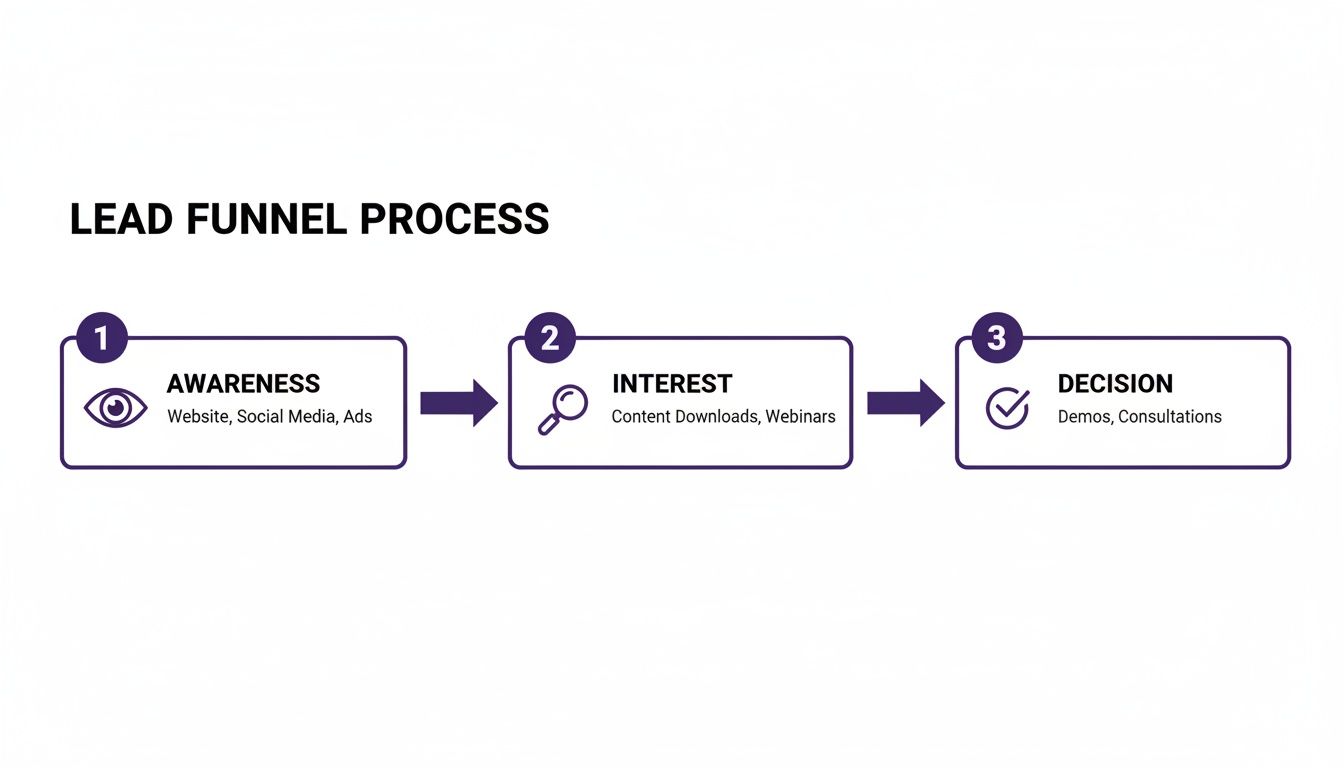
AI is the engine that speeds prospects through this funnel, automating the most time-consuming steps from awareness to decision.
Building a Modern Lead Generation Machine on Twitter
So, how do you actually do this? It boils down to three key steps.
-
Automated Prospecting: First, you define your Ideal Customer Profile (ICP) inside your automation tool. The AI then constantly scans Twitter for anyone who fits—a SaaS founder, a marketing head at a Series A company, or an e-commerce coach.
-
Hyper-Personalized Outreach: Next, you set up message templates that pull in variables from a prospect's profile, like their name, company, or a recent tweet. This one small touch makes a huge difference in response rates. To get a better sense of this, check out our guide on creating an effective AI Twitter bot.
-
Intelligent Follow-Ups: Finally, you can program automated follow-ups for anyone who doesn't reply. This simple step ensures no lead falls through the cracks and keeps the conversation going without you having to track everything manually.
By combining these, you transform Twitter from a platform that demands constant manual effort into a scalable, predictable engine for finding your next customers.
Common Lead Generation Mistakes to Avoid

It’s easy to spin your wheels on lead gen. Many founders fall into the same traps, working hard but getting nowhere. The key isn't to work harder; it's to work smarter by learning from others' mistakes.
One of the biggest blunders is casting your net too wide. A broad approach waters down your message until it's ignored. Instead of shouting at everyone, whisper to the right person by defining a laser-focused Ideal Customer Profile (ICP).
Another classic mistake is the copy-paste outreach message. People can spot a generic template from a mile away. You're far better off sending ten thoughtful messages to dream prospects than blasting a generic one to a thousand random contacts.
Giving Up Too Soon
The most common misstep? Giving up too early. Most founders send one or two messages and then stop, worried about being "pushy." The reality is, most sales happen in the follow-up. You need a system that handles polite, consistent persistence for you.
Here are a few other critical mistakes to sidestep:
- Ignoring Key Channels: Don't overlook the platforms where your audience actually hangs out. For B2B founders, Twitter is a goldmine. Research shows it's responsible for 82% of all social media leads. If you're not there, you’re leaving money on the table.
- Having No System: Firing off random DMs when you feel motivated is a recipe for disaster. You need a structured, repeatable process.
- Failing to Automate: Doing everything by hand doesn't scale. Using a tool like DMpro.ai to automate prospect scraping and send personalized DMs on Twitter lets you focus on talking to people who are already interested.
The core of lead generation in sales is building a machine. Every mistake you avoid helps that machine run smoother and faster.
Avoiding these pitfalls means shifting your mindset from "more is more" to a smarter strategy. When you nail your audience, personalize your outreach, and use automation to stay consistent, you build a powerful sales pipeline from day one. Dig deeper into the numbers by reading up on lead generation statistics.
Your Starter Checklist for a Winning Lead Gen System
Theory is great, but let's get practical. Building a predictable lead generation system is the most powerful thing you can do for your business, and it doesn't have to be complicated.
Think of this as the blueprint for your sales engine. It's a no-fluff checklist to build or fine-tune your process right now.
Step 1: Nail Your Ideal Customer Profile
Before you write a single message, you have to know exactly who you're talking to. Get crystal clear on your Ideal Customer Profile (ICP).
- What industry are they in?
- What's their job title?
- What specific problem are you solving for them?
- Where do they spend their time online? (Hint for founders: it’s probably Twitter).
Step 2: Choose Your Primary Channels
Stop trying to be everywhere at once. It's a recipe for burnout. Pick one or two channels where your ICP is most active and go all-in.
For many SaaS founders and agencies, outbound on Twitter is the fastest path to revenue. It gives you a direct line to decision-makers.
You can learn more in our guide to SaaS lead generation strategies.
Step 3: Get Your Essential Tools
You don't need a massive tech stack. You only need two things: a simple CRM to track conversations and an outreach tool to do the heavy lifting.
A tool like DMpro.ai is perfect for Twitter because it handles the tedious stuff—finding prospects and sending personalized DMs—freeing you up to just talk to warm leads. Down the road, you might hire a Lead Prospector Virtual Assistant to manage the process.
Step 4: Craft Your Offer and Messaging
Your outreach message needs to immediately answer one question for your prospect: "What's in it for me?"
Make it about them, not you. Offer real value right away—a quick insight, a relevant case study, or a solution to a problem you noticed on their profile. Keep it short, personal, and to the point.
Your goal isn't to sell in the first DM. It's to start a conversation.
Step 5: Launch, Measure, and Iterate
It's time to hit 'go'. Launch your campaign and track everything. Set clear goals for your key metrics, like how many SQLs you want each week or your maximum Cost Per Lead (CPL).
Pay close attention to response rates. See what messaging works and what falls flat. Then, relentlessly tweak and improve. This cycle of launching, measuring, and iterating is how you build a true lead generation machine.
Got Questions? We've Got Answers
As a founder, you're short on time and need straight answers. Here are a few common questions we hear about lead generation.
What’s the quickest way to get leads for a new SaaS?
When you're launching, speed is everything. Inbound marketing like SEO is a long-term play. If you need your first customers now, outbound lead generation on a platform like Twitter is usually the fastest route.
Get laser-focused on your Ideal Customer Profile (ICP). Find your people, start valuable conversations in the DMs, and don't pitch right away.
How much should I spend on lead generation?
There's no single answer, but it all comes down to two numbers: your Customer Acquisition Cost (CAC) and Lifetime Value (LTV). A solid rule of thumb is to have an LTV that's at least 3x your CAC.
Start small. Dedicate a manageable budget to one channel, like an automation tool. Track your Cost Per Lead (CPL) and how many leads become paying customers. Once a channel is profitable, pour more fuel on the fire.
Is AI lead generation just spam?
It's a fair question. The line between smart automation and spam is personalization and relevance. Blasting a generic, tone-deaf message to a massive list? That's spam.
But using a tool like DMpro.ai to find people already talking about a problem your SaaS solves, then sending a helpful, personalized message that references their tweet? That’s just smart, scalable outreach. It’s using tech to make your outreach feel more human, not less.
If you’re tired of manually sending DMs every day, try DMpro.ai — it automates outreach and replies while you sleep.
Ready to Automate Your Twitter Outreach?
Start sending personalized DMs at scale and grow your business on autopilot.
Get Started Free