
Your Guide to Using an AI Twitter Bot for Lead Generation
Discover how an AI Twitter bot can automate outreach and scale your lead generation. This practical guide covers strategies and tools for SaaS founders.
Think of an AI Twitter bot as your own tireless sales rep, working around the clock on Twitter. For a SaaS founder, this isn't just about scheduling posts. It’s a smart way to find qualified leads, kickstart conversations, and grow your reach without needing a huge team.
What Is an AI Twitter Bot and Why Should You Care?
Let's get straight to the point. The term "Twitter bot" often brings to mind spam accounts or basic auto-replies. But an AI Twitter bot is in a completely different league. It doesn’t just follow a simple script; it uses artificial intelligence to grasp context, spot genuine opportunities, and engage with people in a way that feels natural and human.
A basic automation tool is like a simple calculator. You tell it to "follow everyone using #SaaS," and it does exactly that—nothing more. It’s functional, but it's not smart.
An AI bot, however, acts more like an expert analyst. It doesn’t just process commands; it uncovers real insights. It can read a tweet and understand the intent behind the words. For instance, it can easily tell the difference between someone casually mentioning your competitor and someone who is actively complaining and looking for a new solution. That's a lead.
From Manual Grind to Automated Growth
As a founder, your time is your most precious asset. The old-school way of finding leads on Twitter meant endless scrolling, manual keyword searches, and firing off dozens of DMs, just hoping someone would bite. It's a slow, thankless grind that simply doesn't scale.
An AI-powered bot flips that entire model on its head. Instead of you hunting for leads, the bot brings them directly to you. It works 24/7, scanning conversations and flagging potential customers the moment they signal a need. If you're considering building one yourself, our guide on choosing a Twitter bot maker breaks down the different tools available.
This isn't a small tweak; it's a massive leap forward for scaling your distribution. It lets a one-person show have the impact of a full-fledged marketing department.
The Core Advantage: An AI bot isn't here to replace human connection. It’s designed to automate the most draining part of outreach—finding the right people and starting the conversation—so you can jump in and have meaningful talks with prospects who are actually interested.
To see just how different these two approaches are, let's put them side-by-side.
Manual Outreach vs AI Bot Automation: A Founder's View
The table below breaks down the practical differences between grinding it out manually and letting an AI bot handle the heavy lifting.
| Activity | The Manual Method | The AI Twitter Bot Method |
|---|---|---|
| Lead Discovery | Hours of daily scrolling through feeds, hashtags, and competitor mentions. | AI continuously scans for buying signals and pain points, delivering a curated list of leads. |
| Outreach | Manually copying and pasting DMs, trying to personalize each one. | Sends personalized, context-aware DMs automatically based on a user's recent activity. |
| Scale | Limited by how many hours you can physically spend on Twitter. | Nearly unlimited. Engages hundreds of targeted prospects while you focus on other tasks. |
| Consistency | Inconsistent effort based on your schedule and energy levels. | Runs 24/7, ensuring you never miss an opportunity, even when you're offline. |
| Data & Insights | Relies on gut feeling and anecdotal evidence to see what works. | Provides clear data on reply rates and engagement, allowing for constant optimization. |
The contrast is pretty stark. With a tool like DMpro, you’re not just checking tasks off a list; you’re building a predictable lead generation machine right into your growth strategy. This frees you up to focus on what actually moves the needle—improving your product and talking to customers who are ready to hear from you.
How AI Bots Find Your Ideal Customers on Twitter
This is where the real magic happens. Let's skip the dense technical jargon and talk about this from a practical, business-building perspective. Imagine you have a super-smart assistant working around the clock, sifting through millions of Twitter conversations to find your perfect customers. That's what a good AI bot does.
An advanced AI Twitter bot goes way beyond simple keyword matching. It uses Natural Language Processing (NLP) to actually understand the context and intent behind what people are saying in their tweets, bios, and replies. This is how it uncovers buying signals, frustrations, and mentions of your competition that you'd almost certainly miss otherwise.
Here’s a quick look at how this changes the game, moving you from the old manual grind to a much smarter, AI-driven workflow.
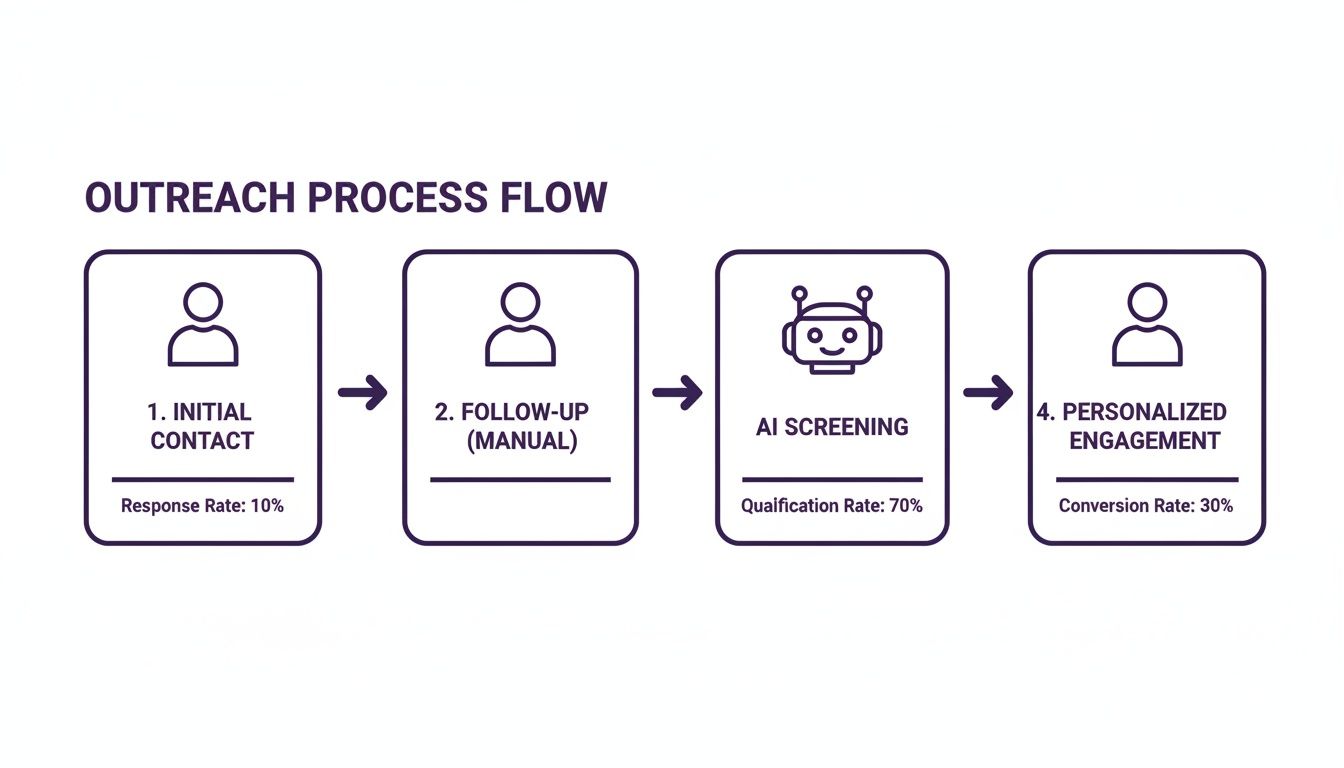
As you can see, the bot handles the heavy lifting of discovery and first contact, freeing you up to focus on having meaningful conversations with people who are already interested.
From Keywords to Buying Intent
The old way of doing things was to set up alerts for your brand name or a couple of industry hashtags. The problem? Your best leads are often talking about the problem you solve, not necessarily your brand.
An AI bot is designed to find these hidden opportunities. For instance, if someone tweets, "Does anyone know a good alternative to [Your Competitor]?"—boom. The bot flags that as a high-intent lead ready for a conversation. It recognizes that this person is actively searching for a solution just like yours.
The Real Power: This isn't about finding people who might be interested one day. It’s about pinpointing users who are expressing a need right now. This completely changes your outreach, turning cold DMs into timely, relevant touchpoints.
You can program the bot with specific triggers based on:
- Pain Point Language: Phrases like "frustrated with," "is so slow," or "wish there was a tool for..."
- Competitor Mentions: Any tweet discussing a direct competitor, especially if the tone is negative.
- Questions & Recommendations: People asking their network for help or advice on a problem your product solves.
To get the most out of your bot, you need to feed it smart criteria, which starts with understanding proven strategies for finding B2B leads. This foundation helps you build a much more effective search.
Building Your Automated Lead Pipeline
Once you’ve defined these triggers, the bot gets to work. It transforms the endless firehose of Twitter data into a predictable stream of qualified leads. It scans thousands of conversations in real-time and builds a hyper-targeted list of prospects who match your ideal customer profile.
This process is a game-changer because you stop guessing and start building a system based on actual, real-time user behavior. With a tool like DMpro, you can automate this entire lead scraping process, making sure your pipeline is always full of fresh, warm leads. You can see how its lead scraping feature automatically creates these targeted lists.
The scale of bot activity online is mind-boggling. Projections show that by early 2025, OpenAI's GPT bots alone could account for 13% of all global web traffic. When you consider that bots are already estimated to make up 80% of internet visits, it means only one out of every five visitors is human. Using a smart bot is essential to cut through all that noise.
By giving your AI Twitter bot precise instructions, you create a powerful engine that consistently delivers high-intent leads. It allows you to scale your outreach and grow your business without having to scale your manual effort.
Crafting Outreach Sequences That Actually Get Replies
Let’s be honest: automated outreach is a total waste of time if your messages sound like they were written by a clunky robot. Nobody replies to a generic "Hey, check out my product!" pitch.
The real magic of an AI Twitter bot isn’t just sending messages; it's learning the art of human-like conversation, but at scale. This means you have to design smart, multi-touch DM sequences that feel personal and actually offer something of value.
The goal is to start conversations, not just blast out links. One of the biggest mistakes I see founders make is jumping straight into a hard sell. That’s the social equivalent of asking someone to marry you on a first date—it’s awkward, and it almost never works. You have to warm them up first.

This is what it's all about: shifting from generic, impersonal blasts to personalized direct messages that actually spark a connection. A good AI bot makes this feel effortless.
The Power of the Warm-Up
The secret to getting replies often lies in building a little familiarity before you ever slide into the DMs. This is exactly where a smart AI bot can give you an edge. You can set it up to perform a few "warm-up" interactions that look just like how you'd naturally engage with someone's posts.
Think about it from their perspective. If a total stranger DMs you out of the blue, your guard is instantly up. But what if that same person had recently liked one of your tweets and left a thoughtful comment? You're far more likely to see them as a real human being. That small step can make a huge difference in your reply rates.
Here are a few simple warm-up actions your bot can handle for you:
- Like a relevant tweet: The bot can find a recent tweet that touches on the problem your SaaS solves and give it a like.
- Leave a thoughtful reply: Modern AI can do more than just say "Great point!" It can generate context-aware replies that actually add to the conversation.
- Follow the user: A simple follow is a low-key way to signal that you’re interested in what they have to say.
These little actions create a digital footprint, showing you're actually paying attention. By the time your DM lands in their inbox, your name is already a little familiar. Getting this right is key, and it's worth learning the details of mastering automatic Twitter replies for engagement.
Designing a Sequence That Nurtures Leads
Okay, so you’ve warmed up the prospect. Now it’s time for the DM sequence. The trick is to make it feel like a natural conversation that unfolds over time, not a pre-written script. A great sequence is always built on two things: personalization and value.
Your AI Twitter bot should be smart enough to pull specific details from a user's profile or their recent tweets to craft a unique opening line. This alone is often the difference between a message that gets read and one that gets deleted.
Founder-to-Founder Tip: Your first DM should never, ever be a sales pitch. It needs to be a conversation starter. Ask a question. Reference a shared interest. Comment on a recent article they posted. Your only goal for that first message is to get a reply.
Here’s what a simple, but highly effective, multi-touch sequence might look like:
- Day 1 (Warm-Up): The AI bot likes a relevant tweet from your prospect.
- Day 2 (First Touch): The bot sends a personalized DM. "Hey [Name], saw your tweet about [Topic]. I was just reading an article on that and thought you'd find it interesting. [Link]"
- Day 4 (Follow-Up): If you don't hear back, the bot sends a gentle nudge. "Just wanted to see if you had a chance to check that out. Curious to hear your thoughts on it."
- Day 7 (The Ask): Once they reply, you can naturally pivot to your solution. "Glad you liked it. We're actually building a tool at [Your SaaS] to solve this exact problem for founders. Open to a quick chat next week?"
This approach feels helpful, not pushy. Tools like DMpro.ai are built specifically to handle these kinds of sophisticated sequences without all the manual work. It automates the warm-up and the follow-ups, letting you step in when the lead is actually warm and ready to talk. If you want to get into the nitty-gritty, we have a complete guide on how to send automated Twitter DMs that convert.
The key is using automation to do the human parts of outreach at scale—things like personalization and thoughtful engagement. When you get that right, you stop feeling like a spammer and start building a real pipeline.
Staying Safe with Twitter Automation Best Practices
<iframe width="100%" style="aspect-ratio: 16 / 9;" src="https://www.youtube.com/embed/PyfupoIS5YQ" frameborder="0" allow="autoplay; encrypted-media" allowfullscreen></iframe>Let's be honest—the last thing any founder wants is to wake up and find their Twitter account suspended. When you bring an AI Twitter bot into your workflow, you’re walking a fine line between smart, scalable outreach and activity that just looks like spam. Staying on the right side of that line is everything.
This isn’t about trying to find sketchy loopholes in the system. It’s about using automation to start real conversations, not to fake them. Think of a well-designed bot as a hyper-efficient assistant who warms up leads for you, not as a spam cannon blasting out generic messages. The goal is to open doors in a way that respects both the platform and the person on the other end.
The good news? Operating safely is pretty straightforward if you stick to a few core principles. It all boils down to one simple idea: make your automation mimic natural, human behavior as closely as possible.
Think Like a Human, Not a Machine
The absolute fastest way to get your account flagged is to act like a robot. People don't send 50 identical DMs in five minutes. We’re a bit more random, a little slower, and we don’t repeat ourselves word-for-word. Your bot needs to act that way, too.
This is where the quality of your tool makes a world of difference. A cheap or poorly designed bot will just fire off messages on a rigid schedule, which is a massive red flag for Twitter's algorithms. A smarter tool, on the other hand, has safety features built right into its DNA.
Here’s what you should focus on:
- Set Realistic Sending Limits: Don't go from zero to a hundred overnight. A great starting point is 20-30 DMs per day, and you can slowly ramp that up as your account gets more seasoned.
- Randomize Your Intervals: Your bot should never send messages at the exact same interval. A good system will automatically add random delays—say, between 5 to 15 minutes—between actions to look more human.
- Use Spintax for Variety: Spintax is a simple way to create hundreds of variations of a single message. Instead of sending the same sentence repeatedly, you can create templates like
{Hey|Hi|Hello}to make sure every message that goes out is slightly unique.
Protect Your Reputation with Smart Filters
Automation without guardrails is a recipe for disaster. You need to control not just what your bot says, but also who it talks to and, just as importantly, what conversations it stays away from. This is absolutely critical for protecting your brand's reputation.
A key feature here is a negative keyword list. This is basically a "do not engage" list of words or phrases that tells your bot to back off immediately. You can use it to filter out sensitive topics, angry users, or irrelevant industries, ensuring your outreach is always happening in a positive context.
Founder-to-Founder Tip: Your negative keyword list should definitely include curse words, politically charged terms, and anything related to customer support complaints. The last thing you want is your bot pitching someone who is publicly complaining about a bug in your product.
This level of control isn't just nice to have; it's non-negotiable. For instance, a platform like DMpro.ai builds these safety mechanisms—like randomized intervals and daily limits—directly into its system. It’s designed from the ground up to keep your account healthy, so you can focus on the leads it generates instead of worrying about platform rules.
With automation becoming so common, using it responsibly is more important than ever. In fact, automated bots have officially surpassed human activity online, making up over 50% of global internet traffic. While many of these are harmless, a huge number are used for spam, which makes platforms extra cautious. You can read more about this trend and what it means on the Fortune website. By using your AI Twitter bot ethically, you make sure you stand out as a valuable connection, not just more noise.
How Integrated AI Like Grok Is Changing the Game
The world of AI on Twitter is moving at lightning speed, and much of that change is coming from tools built right into the platform. When a giant like X (formerly Twitter) rolls out its own powerful AI, it doesn't just add a new feature—it completely resets what users expect and creates a gold rush of opportunity for founders who are quick to adapt.
This is exactly what’s happening with integrated AI like Grok. It’s not some clunky third-party add-on; it's part of the X experience, capable of summing up trending topics and jumping into conversations with live information. This fundamentally changes the nature of engagement and opens up entirely new avenues for connecting with potential customers.
The rapid embrace of these native tools is the ultimate proof of just how critical AI has become in the Twitter ecosystem.
The Rise of Platform-Native AI
The growth of AI built into social platforms has been nothing short of explosive. Grok, for example, went from a standing start to 687 million visits in a single year—that's a mind-boggling 1,343,408% year-over-year increase. Its insane growth curve highlights the power of being part of the platform, making it the fastest-growing new player in a market where top chatbots pulled in a collective 55.9 billion visits. You can see the full breakdown in these findings on the AI chatbot market.
But this shift doesn't make specialized outreach tools obsolete. Not at all. In fact, it makes them more essential than ever.
A general AI like Grok is fantastic for giving you a summary of the news or answering broad questions. It wasn't, however, built to do something specific like generate leads for your business. That’s where a focused AI Twitter bot shines.
Complementing Grok for Lead Generation
Think of Grok as an incredibly smart researcher. It can give you a brilliant overview of the entire landscape, telling you what people in your industry are talking about. But it’s not going to knock on doors and find your next ten customers. That's a sales job.
Your outreach strategy should work with these native tools, not against them. While Grok is great for broad, top-of-funnel engagement, a specialized bot needs to be laser-focused on the specific tasks of spotting buying signals and starting personalized conversations.
Here’s how they can work in tandem:
- Grok spots a trend: It might flag a new pain point that’s bubbling up among your target audience.
- Your AI bot takes action: You use that insight to immediately launch a campaign that seeks out users who are discussing that exact problem.
This two-step approach lets you use platform-level intelligence to fuel hyper-targeted outreach. You're using the big-picture view to pinpoint the small, high-value conversations that actually move the needle for your business.
A dedicated outreach tool is designed to master that second part. For instance, a platform like DMpro.ai is built from the ground up for one thing: turning conversations into customers. It uses advanced AI personalization to craft DMs that reference a prospect's specific tweets, activities, and pain points—a level of detail that a general AI simply isn't equipped to deliver.
By combining the broad insights you get from tools like Grok with the focused execution of a dedicated outreach bot, you create a powerful, multi-layered strategy for scaling your SaaS distribution.
Measuring Success with Metrics That Actually Matter
Running an AI bot on Twitter without tracking its performance is like driving with your eyes closed. You’re definitely moving, but who knows if it’s in the right direction? To really grow your SaaS, you have to look past the easy-to-track vanity metrics like likes and follower counts. Let's be honest, those don't pay the bills.
The only thing that truly matters is your return on investment (ROI). Are the hours and money you're putting into automation actually turning into tangible business results? We're talking about building a reliable pipeline for leads, not just making a bit of noise on social media. As a founder, you know you can't improve what you don't measure, and that means focusing on KPIs that hit your bottom line.

Key Metrics for Your AI Bot Dashboard
To see how your bot is really doing, you need a simple, powerful dashboard. Forget about getting lost in complicated spreadsheets. Instead, zoom in on the numbers that show you the whole journey, from that first outreach to a closed deal.
Here are the essential metrics you should have front and center:
- Qualified Leads Identified: How many ideal prospects is your bot finding every day? This is the very top of your funnel and tells you if your targeting is sharp.
- DM Reply Rate: What percentage of people are responding to your initial messages? This is a huge indicator of how well your copy is landing.
- Positive Reply Rate: Out of all the replies, how many are genuinely interested versus telling you to get lost? This helps you understand sentiment and tweak your messaging.
- Link Clicks from DMs: If you're sending a link to your site or a case study, this tells you how many people are intrigued enough to click through. It’s a great measure of real interest.
- Meetings Booked: This is the big one. How many conversations started by your bot are converting into actual sales calls or demos?
Keeping an eye on these numbers gives you the power to make smart decisions. If one message template gets a 5% reply rate but another gets 15%, you know exactly which one to lean into.
Founder-to-Founder Tip: Just start by getting a baseline in your first week. From there, aim for small, steady improvements. The end goal is a predictable system where you know that for every 100 DMs the bot sends, you can count on a certain number of qualified meetings.
This is what separates a professional growth strategy from just trying things and hoping for the best. With a tool like DMpro.ai, you can track all of these KPIs right from your dashboard. The analytics are built to give you a quick, clear snapshot of what's working, so you can adjust your campaigns in real-time. It turns Twitter outreach from a guessing game into a reliable revenue stream.
Got Questions About AI Twitter Bots? Let's Dive In.
We've covered a lot of ground, but you probably still have a few questions rolling around in your head. I get it. Let’s tackle some of the most common ones I hear from founders who are on the fence about using an AI Twitter bot to grow their business.
Will Using an AI Twitter Bot Get My Account Banned?
This is the big one, right? The short answer is no, it's safe—but only if you do it the right way. The whole game is about mimicking how a real person would act, not blasting out spam like a machine gun. You wouldn't manually send 500 identical DMs in an hour, and your bot shouldn't either.
A good tool is built with safety as its foundation. Look for features like randomized sending times, daily activity limits, and message variations (spintax). These are crucial for staying well within the platform's rules. Think of it as a super-efficient assistant, not a sledgehammer. Tools like DMpro.ai are designed from the ground up to keep your account safe, so you can automate without looking over your shoulder.
Isn't This Just a Glorified Auto-Reply Tool?
Great question, and the difference is night and day. A simple auto-responder is a one-trick pony. It operates on a basic "if this, then that" rule. For example, "if someone new follows me, send this generic welcome message." It's reactive and, honestly, pretty limited.
An AI bot plays in a totally different league. It uses Natural Language Processing (NLP) to actually understand the meaning and intent behind a tweet. It can spot someone asking for software recommendations, complaining about a competitor, or describing a problem your product was built to solve. This is what allows for truly personal and relevant outreach that actually starts a real conversation.
The key takeaway: An auto-responder just reacts to a trigger. An AI bot proactively finds opportunities and starts meaningful conversations based on what people are actually talking about right now.
How Long Does It Really Take to Get Started?
You can get your first campaign up and running faster than your next lunch break. Seriously, setting up a focused lead generation campaign can take less than an hour.
It really just breaks down into three simple steps:
- Nail Down Your Target: Tell the bot who you're looking for. This could be people using certain keywords, hashtags, or even followers of a specific competitor.
- Write Your Messages: Craft a few different versions of your opening DM and any follow-ups you want to send.
- Set Your Pace: Decide how many actions the bot should take each day to keep things feeling natural and safe.
And that's it. The real magic isn't the quick setup; it's the time you save over the long haul. The bot takes over the mind-numbing work of prospecting, freeing you up to do what you do best: talking to the warm leads it brings you.
Can a Bot Genuinely Sound... Human?
Absolutely. Modern AI has gotten incredibly good at sounding natural. When you combine that with smart personalization—like pulling a detail from someone’s bio or referencing their latest tweet—the messages feel authentic.
Remember, the goal isn't to fool someone. It’s to start a genuine conversation, at scale, that adds value from the first touchpoint. By personalizing that opening line and showing you’ve paid attention, an AI bot can kick off chats that feel just as real as if you'd typed them out yourself.
If you’re tired of manually sending DMs every day, try DMpro.ai — it automates outreach and replies while you sleep.
Ready to Automate Your Twitter Outreach?
Start sending personalized DMs at scale and grow your business on autopilot.
Get Started Free