
Your Guide to Using a Twitter Marketing Bot for SaaS Growth
Learn how a Twitter marketing bot can automate outreach and scale lead generation. This guide covers benefits, risks, and strategies for SaaS founders.
Let's cut right to the chase. A Twitter marketing bot is your 24/7 sales assistant working for you on X (formerly Twitter). Forget the spammy reputation—we're talking about a smart tool that automates the repetitive, time-sucking tasks of modern outreach. It can find potential customers, send personalized DMs, and help you scale your SaaS distribution.
What Is a Twitter Marketing Bot?
As a founder, your most valuable asset is time. You can’t spend all day manually scrolling through Twitter, hunting for leads, and then typing out hundreds of nearly identical messages. It just doesn't scale. This is exactly where a good Twitter marketing bot comes in.
Think of it less as a mindless "bot" and more as an intelligent automation partner for your growth strategy. The whole point is to do smart, targeted outreach—not just blast generic messages at everyone.

Moving Beyond Basic Automation
The word "bot" probably makes you think of those old, clumsy tools that did nothing but follow random accounts and like tweets. Thankfully, we've moved on. The best tools today are far more sophisticated and built for precision.
They can:
- Scan thousands of profiles in minutes: Pinpointing your ideal customers based on their bio, recent tweets, or specific keywords they use.
- Start human-like conversations: Kicking off a conversation that feels genuinely personal and relevant, not like robotic spam.
- Run entire outreach campaigns: Handling the grunt work so you can jump in when it's time to build relationships and close deals.
For instance, a tool like DMpro can find users who just tweeted something like, "looking for a new CRM." From there, it can automatically send a personalized DM that directly mentions their tweet. Just like that, you've turned a cold outreach into a warm, perfectly timed conversation.
This is the key difference: moving from a high-volume, low-value game to one that’s all about creating valuable connections. It’s how you become a helpful solution instead of just another annoying notification. For any founder serious about building a reliable sales pipeline, a modern Twitter marketing bot is a total game-changer. You can find more details on how to get started in our guide to creating a Twitter bot.
Ultimately, this technology lets you build a lead generation machine that works for you around the clock, making sure you never miss a chance to connect with someone who needs what you're offering.
How Bots Drive SaaS Growth and Lead Generation
For any SaaS founder, a predictable sales pipeline is the holy grail. It’s what separates a struggling startup from a business that’s built to scale. This is where a modern Twitter marketing bot becomes a genuine growth engine, not just another tool in your tech stack.
Forget what you think you know about old-school, spammy bots. We're talking about smart, AI-powered systems designed for precision. Imagine automatically finding thousands of potential customers who just tweeted about a problem your software solves. Instead of spending hours hunting them down, the bot does the heavy lifting for you, 24/7.

Scaling Outbound Prospecting
Searching for leads by hand is a classic bottleneck. There’s only so much scrolling one person can do. Your time is much better spent actually talking to qualified prospects, not just trying to find them. An automated system shatters that limitation.
A bot can:
- Monitor keywords in real-time: It flags people actively talking about pain points your SaaS can fix. Someone tweets, "My current project management tool is a mess," and you're the first to know.
- Analyze user profiles: It can scan for specific job titles, industries, or keywords in user bios to build a laser-focused list of ideal customers.
This isn’t just about working faster; it's about consistency. A bot builds a perpetual pipeline of warm leads, delivering them right to you every single day.
Automating Personalized Outreach
Once you find the right people, the next challenge is starting a conversation that doesn't feel cold or robotic. This is where modern bots really shine. You can set up smart message templates that pull in specific details about each user, making every outreach feel like a one-to-one conversation.
A well-crafted automated DM isn’t spam. It’s a perfectly timed, relevant introduction that shows you’ve done your homework and can genuinely help.
For instance, a platform like DMpro can send a message that references a person's specific tweet or mentions something you noticed in their bio. This small touch makes a huge difference and dramatically boosts response rates. Instead of the typical 1-2% reply rate from cold outreach, our users consistently see 25-40% response rates. This transforms Twitter from just another social network into a reliable machine for generating leads. You can explore more on this in our guide to lead generation automation tools.
Building a Targeted Distribution Channel
Growing a SaaS business is about more than just grabbing leads; it’s about building an audience of people who know and trust you. A Twitter marketing bot helps you build a targeted distribution channel by consistently engaging with the right people in your niche.
This constant, focused engagement keeps your brand top-of-mind. So, when those prospects are finally ready to make a purchase, your name is the first one they think of. It's a long-term strategy that builds brand equity and creates a sustainable funnel for future growth.
The numbers don't lie. Recent trends in Twitter statistics show that the platform delivers a significant ROI for B2B marketers. With the majority of B2B firms already using X to find customers, automation gives you a serious leg up. It’s not just about sending DMs; it’s about starting the right conversations with the right people, every single day, to build a predictable engine for growth.
The Evolution from Spam Bots to Smart Assistants
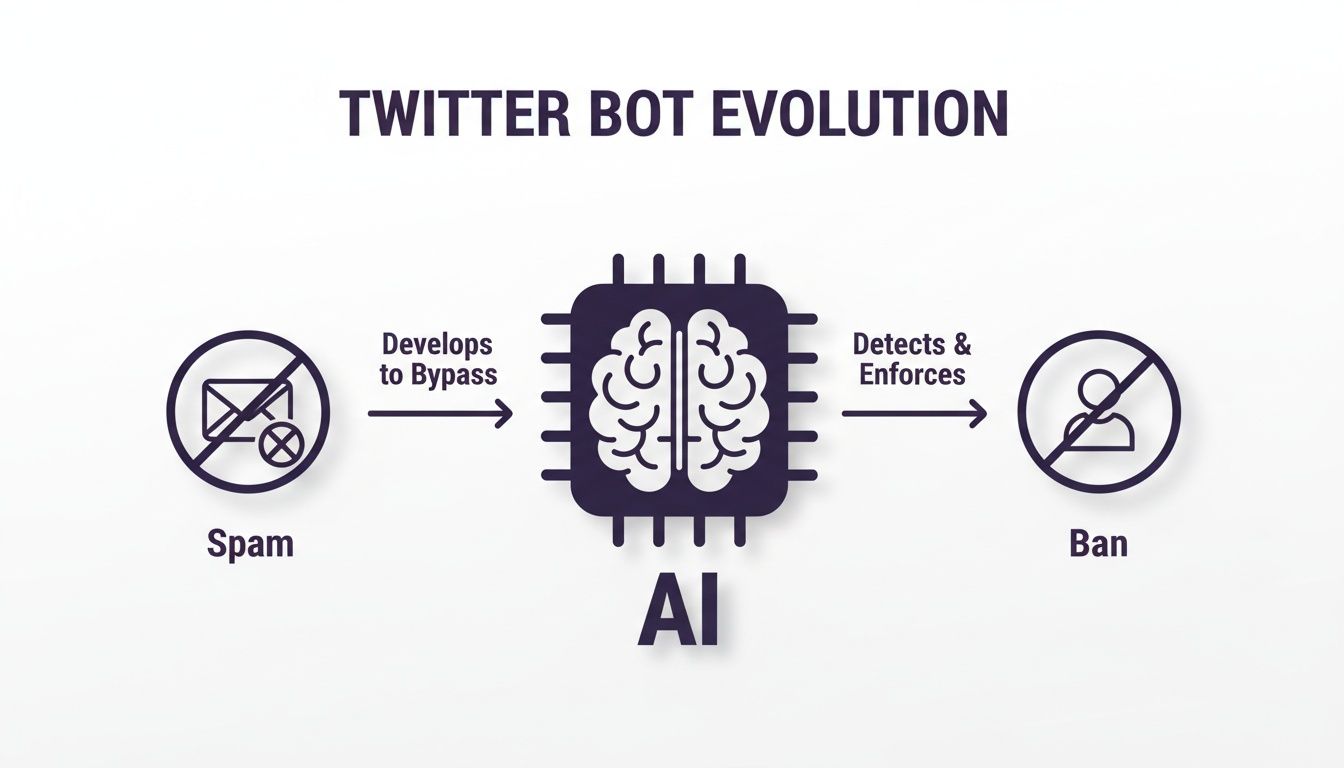
Let's be honest, when you hear the word "bot," you probably cringe a little. It brings back memories of those old-school, spammy scripts that used to flood Twitter with junk, all in the name of chasing vanity metrics like fake followers. They gave automation a really bad name, and for good reason.
Those early bots were clumsy. Their whole strategy was based on making a ton of noise, hoping someone would eventually pay attention. This approach didn't just annoy everyone; it put accounts at constant risk of being suspended. Twitter eventually cracked down, which forced a much-needed evolution.
That cleanup was the best thing that could have happened. The mindless spam tools started to disappear, and in their place, a much smarter, more strategic kind of Twitter marketing bot began to emerge.
The Rise of Intelligent Automation
Today's bots are less like clumsy robots and more like savvy AI assistants. Instead of just blasting out thousands of identical messages, these modern tools are all about precision, personalization, and safety. They’re built to help you create genuine connections, not just pump up your numbers.
This massive shift is thanks to big leaps in AI and machine learning. A bot can now understand context, figure out what a user is looking for, and interact in a way that feels surprisingly human. It's the difference between shouting at a crowd with a megaphone and having a personal assistant who knows exactly who to talk to.
How Modern Bots Protect Your Account
As a founder, your Twitter account is a huge asset. The last thing you want is for it to get shut down. That's why the best tools today are designed with safety at their core, turning automation from a risky gamble into a reliable growth engine.
Here’s how they do it:
- AI-Powered Profile Scanning: Instead of just blasting messages into the void, a tool like DMpro uses AI to scan thousands of profiles. It’s looking for specific keywords, job titles, and recent activity to build a hyper-targeted list of people who are a great fit for your SaaS.
- Smart Message Rotation: Sending the exact same DM over and over is a one-way ticket to getting flagged as spam. A safe bot uses smart message rotation and personalization to make every outreach feel unique, which helps you fly under the radar.
- Real-Time Health Monitoring: A good bot is always keeping an eye on your account's health. It tracks sending limits and engagement rates to ensure all your activity looks natural. If it senses any risk, it will automatically slow down to keep your account safe.
This isn't just about dodging a suspension. It's about building a sustainable outreach system that works—one that respects the platform's rules and the people you're trying to connect with.
The entire goal has shifted. It’s no longer about how many messages you can send; it's about how many meaningful conversations you can start. This new breed of AI assistant helps you scale your outreach in a way that feels personal, adds real value, and drives actual growth.
Using Twitter Bots Safely And Avoiding Suspension
Let's be real: using a Twitter marketing bot can be risky if you don't play it smart. Twitter has strict rules against spam and platform manipulation, and breaking them is a fast track to getting your account suspended. Nobody wants that. This is your guide to using automation the right way, so you can scale your outreach without risking your hard-earned reputation.
The biggest thing that gets accounts flagged is behavior that just doesn't look human. Sending thousands of identical, generic DMs in a short time is the fastest way to get noticed for the wrong reasons.
This is exactly why bot technology had to evolve. The early tools were clumsy and obvious, but modern platforms are built with safety and subtlety as a priority. As the platforms got smarter at spotting spam, the tools had to adapt, focusing on genuine connection instead of just raw numbers.
Safe vs. Risky Bot Behavior Checklist
To keep your account in good standing, you need to know the difference between smart automation and reckless botting. This checklist breaks down the key practices that separate a safe strategy from one that's likely to get you banned.
| Feature/Practice | Safe Approach (What to do) | Risky Approach (What to avoid) |
|---|---|---|
| Messaging Style | Personalized messages with variations. | Sending the same copy-paste message to everyone. |
| Account Activity | Distributes actions across multiple accounts to keep volume low. | Pushing thousands of actions through a single account. |
| Action Speed | Mimics human behavior with randomized delays. | Firing off DMs, follows, or likes as fast as possible. |
| Following Tactic | Focuses on engaging with relevant accounts. | Aggressively following and unfollowing accounts. |
| Platform Limits | Built-in features to stay well below Twitter's rate limits. | Ignoring rate limits and pushing actions to the max. |
| Monitoring | Real-time health checks that pause campaigns if an account is at risk. | "Set it and forget it" approach with no safety monitoring. |
Ultimately, the goal is to make your automated activity look as natural and human as possible.
Must-Have Safety Features In A Twitter Marketing Bot
When you're looking at different tools, safety features should be at the top of your list. A trustworthy Twitter marketing bot is designed to protect your account first and automate tasks second.
You absolutely need a tool with built-in safeguards. For instance, DMpro includes automatic safety controls designed to mimic human behavior. One of its key features is smart account rotation, which spreads your outreach across multiple accounts. This keeps the activity level on any single profile looking completely natural and prevents you from hitting platform limits.
Think of it like a traffic controller for your outreach. Instead of sending all your messages down one crowded highway, it spreads them out across several smaller roads, ensuring a smooth and safe journey.
Another critical feature is real-time health monitoring. This keeps a constant eye on your accounts for any warning signs, automatically pausing or slowing down campaigns if it senses any risk. Using email spam checker tools can even give you insight into the kind of language that triggers filters. And while knowing how to handle a Twitter suspension is good backup knowledge, preventing it is always the best strategy.
In the end, using automation safely comes down to choosing a tool that values quality over quantity. The objective isn't just to send more DMs; it's to start more meaningful conversations without putting your account in jeopardy.
How to Choose the Right Twitter Marketing Bot
<iframe width="100%" style="aspect-ratio: 16 / 9;" src="https://www.youtube.com/embed/fUL7f-LcgtU" frameborder="0" allow="autoplay; encrypted-media" allowfullscreen></iframe>Not all bots are created equal. Choosing the wrong one can be a massive waste of time, burn through your budget, and—worst of all—get your account shut down. As founders, we can't afford any of those outcomes. Here’s a simple framework for picking the right tool for your SaaS.
The market is crowded, but a few core capabilities separate the powerful tools from the ones that will just cause headaches. You need to focus on what actually moves the needle for lead generation and keeps your account safe for the long haul.
AI-Powered Targeting
The very first thing to look for is intelligent targeting. A basic bot might let you search for keywords, but a great one uses AI to find leads based on real-time activity and deep profile analysis. It's the difference between finding people who might be interested and finding people who are actively looking for a solution right now.
A top-tier Twitter marketing bot should be able to:
- Scan thousands of profiles daily: Analyzing bios, recent tweets, and engagement patterns to zero in on your ideal customer profile (ICP).
- Identify buying signals: Catching tweets like "looking for a new CRM" or "does anyone know a good project management tool?"
- Filter out the noise: Finding the specific people who are most likely to convert, not just a massive list of low-quality leads.
For example, the AI in a platform like DMpro is built specifically for this. It digs through profiles to find qualified leads, so your outreach is always aimed at the right audience from the start.
Deep Personalization at Scale
Once you've found the right people, you need to start conversations that don't sound like they came from a robot. Generic, copy-paste messages are dead on arrival. True personalization is what gets replies, and a good tool makes this possible even when you're reaching out to hundreds of people a day.
Look for a tool that allows smart message templates. These aren't just basic mail-merge fields like {{first_name}}. They should let you reference a user's specific tweet or mention something from their bio. This context is what turns a cold DM into a warm conversation.
The goal is to make every person feel like you wrote that message just for them. It’s the single biggest factor in boosting response rates from a dismal 1% to a game-changing 25-40%.
Built-In Safety and Compliance
This is non-negotiable. Any tool you consider must have safety as its core design principle. A reckless bot can destroy your account overnight. The bot landscape has massively influenced lead generation, where posts with images get 150% more retweets, according to Twitter engagement statistics. This makes a tool that can safely deliver qualified leads incredibly valuable.
Essential safety features include:
- Smart Account Rotation: Spreading activity across multiple accounts to keep the volume on any single profile looking natural.
- Human-Like Behavior: Mimicking real user patterns with randomized delays between actions.
- Real-Time Health Monitoring: Automatically pausing campaigns if an account is at risk of being flagged.
When you're weighing your options, exploring a detailed AI chatbot comparison can give you a broader perspective. Ultimately, you need a bot that works with the platform's rules, not against them. Choosing the right tool is an investment in a sustainable, scalable lead generation channel.
Your Step-by-Step Plan for an Automated Campaign
Alright, enough theory. Let's get hands-on and walk through exactly how to get your first automated lead generation campaign off the ground. This is a practical, step-by-step plan to take you from a blank slate to a live campaign that fills your pipeline.
The goal here isn't to build something overly complex; it's to be effective. We want to launch fast, see what the data tells us, and then refine.
Step 1: Define Your Ideal Customer Profile
Before you do anything else, you have to know exactly who you’re talking to. Don’t just guess—get laser-focused on your Ideal Customer Profile (ICP).
Who are they?
- What’s their job title? (e.g., "SaaS Founder," "Head of Growth")
- What industry do they operate in? (e.g., "Fintech," "Martech")
- What keeps them up at night? (e.g., "struggling with lead gen," "wasting time on manual outreach")
A crystal-clear ICP is the foundation of any good campaign.
Step 2: Craft Compelling DM Templates
Your first message is your first impression. It needs to grab their attention, feel personal, and not come across as spam. The best DMs offer immediate value and open the door for a real conversation.
Here’s a simple, effective template:
"Hey {{firstName}}, saw your tweet about looking for a new project management tool. I run a startup that helps teams like yours simplify their workflow. Any interest in a quick chat?"
Why does this work? It's direct, it shows you were paying attention, and it offers a clear next step. With a tool like DMpro, you can create a few different versions of these messages to keep your outreach feeling fresh.
Step 3: Set Up Your Campaign Parameters
Now for the fun part: telling your Twitter marketing bot what to do. This is where you set up the targeting rules based on your ICP. You’ll tell the bot which keywords, phrases, or user profiles to look for.
For example, you could target anyone who has recently tweeted:
- "looking for a CRM"
- "recommendations for an SEO tool"
- "hiring a marketing agency"
This ensures your outreach is perfectly timed and highly relevant. A good platform makes this process incredibly simple. You can dive deeper into the nuts and bolts of setting up automated direct messages on Twitter in our detailed guide.
Step 4: Launch and Monitor Your Results
With your ICP, messages, and targeting locked in, you’re ready to hit launch. But your job isn’t over. Now it’s time to watch your performance.
Here are the key metrics to keep an eye on:
- Response Rate: Are people actually replying? A healthy rate is 25-40%.
- Lead Quality: Are the replies coming from people who fit your ICP?
- Conversion Rate: How many of these conversations are turning into qualified leads or meetings?
Keep a close watch on these numbers and don't be afraid to tweak your message templates or targeting criteria. Continuous optimization is how you turn a good campaign into a great one.
Frequently Asked Questions
As founders, we're always looking for an edge, but it's smart to ask the right questions before diving into a new tool. Here are some straight-up answers to the things founders and marketers wonder about when it comes to using a Twitter marketing bot for scalable lead generation.
Is Using a Twitter Marketing Bot Against the Rules?
This is the big one. The short answer: it depends on how you use it. Using a bot isn't automatically against the rules, but Twitter cracks down hard on spam, platform manipulation, and aggressive, impersonal automation.
A safe bot works within these guidelines by acting more like a human assistant than a spam cannon. The trick is to pick a tool built for compliance. For example, a platform like DMpro is all about sending highly personalized outreach instead of generic junk, which helps your activity look natural and keeps your account safe.
How Much Time Can I Actually Save with a Bot?
Honestly, the time savings are huge. If you’re prospecting on Twitter manually—finding profiles, checking their activity, and writing personal messages—you can easily lose 2-4 hours every single day. An automated tool boils that entire process down to about 15-20 minutes of setup for each campaign.
Once you've done that, it just runs 24/7 in the background. It’s out there finding targeted leads for you while you're coding, taking sales calls, or even sleeping. That easily adds up to 10-20 hours a week of reclaimed time.
What Kind of Response Rates Should I Expect?
Your response rates will live or die by your targeting and message quality. If you just blast out generic, spammy DMs, you'll be lucky to see a 1-2% response rate, and you’re just asking to get your account flagged.
But when you use a smarter tool that leverages AI for deep targeting and genuine personalization, the game completely changes. Your outreach feels relevant and comes across like a real one-to-one conversation.
This is why founders using modern platforms are consistently seeing response rates between 25% and 40%. When you reach out to the right person at the right time with a message that actually speaks to them, you stop being an interruption and start being a potential solution.
If you’re tired of manually sending DMs every day, try DMpro.ai — it automates outreach and replies while you sleep.
Ready to Automate Your Twitter Outreach?
Start sending personalized DMs at scale and grow your business on autopilot.
Get Started Free