
Targeting Optimization: A Founder's Guide for 2026
Master targeting optimization in 2026 with our founder's playbook. Reach smarter audiences, reduce ad waste, and scale your business effectively.
You spend three days writing a cold DM sequence, cleaning a lead list, and tweaking your opener until it sounds sharp. Then the replies come in, and half of them are from people who were never a fit in the first place. They want partnerships you don't offer, they run businesses you don't serve, or they're just vaguely curious with no buying intent.
That's usually not a messaging problem. It's a targeting problem.
In founder-led outbound, especially on X, targeting optimization isn't some abstract ad-tech exercise. It's a simple loop you run every week: signal → segment → message → measure → refine. If that loop is loose, you burn hours writing better copy for the wrong people. If that loop is tight, even a plain message can start conversations with the right buyers.
The good news is that this doesn't need a giant RevOps stack. You can run it with a spreadsheet, a scraper, your DM workflow, and a short Friday review.
Why Most Targeting Optimization Fails Before It Starts
Most bad campaigns are broken before the first message goes out.
The pattern is familiar. A founder defines the ICP as “B2B SaaS companies that care about growth,” grabs a recycled list, blasts one message to everyone, and judges the whole channel by whatever comes back. That's not targeting optimization. That's list roulette.
The real failure happens upstream
Three things usually cause the mess:
- The segment is fuzzy: “SaaS founder” sounds clear until you realize it includes bootstrappers, agencies that call themselves SaaS, newsletter operators, and people building side projects.
- The signal is weak: Scraped follower lists and stale bios tell you very little about who's active, who has a current pain point, and who can buy.
- The system has no loop: Teams send one batch, glance at reply volume, then move on. Nobody feeds the learning back into the next round.
A lot of marketers talk about personalization as if it alone fixes this. It doesn't. A recent meta-analysis found personalized advertising creates a small but statistically significant lift over non-personalized ads, with an average effect size of d = 0.16 across 114 effect sizes and 11,786 participants in the evidence base, which is strong support for the idea that relevance matters, even if the gains are usually modest (personalized advertising meta-analysis).
That's the useful takeaway. Personalization helps, but it won't rescue a bad audience.
Practical rule: If your replies feel random, don't rewrite the DM first. Tighten who gets it.
What targeting optimization actually looks like
Good targeting optimization is a weekly operating habit.
It looks like this:
- Pull fresh signals from real activity, not just profile data.
- Build a narrow segment around one clear buying pattern.
- Match one message to that pattern.
- Track qualified replies, not vanity engagement.
- Cut what misses and expand what converts.
That whole cycle can take less than an hour a week once the workflow is set. The payoff isn't magical copy. It's fewer wasted conversations, cleaner feedback, and a list that gets sharper every time you touch it.
The Five Building Blocks of Targeting Optimization
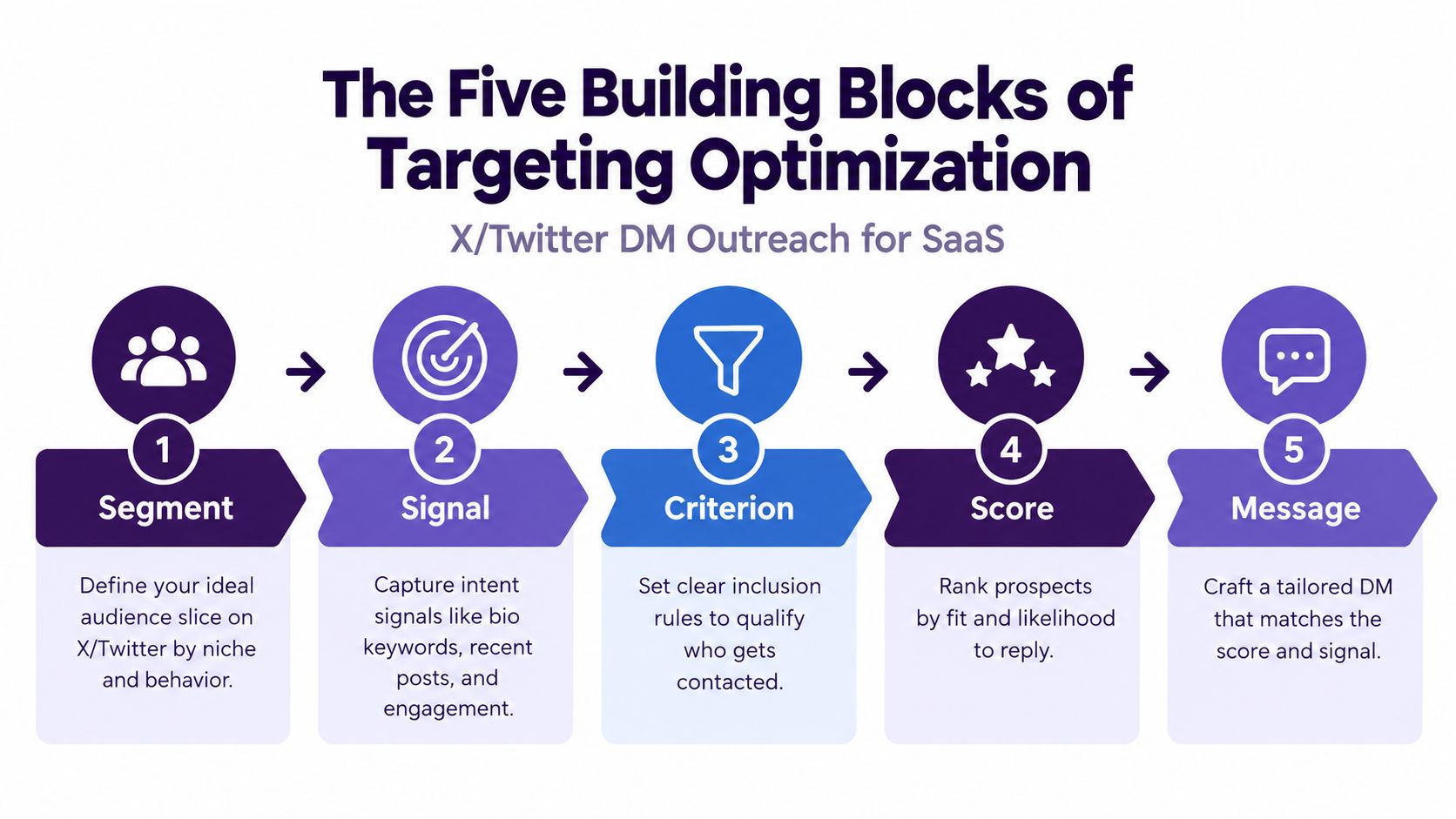
If you want a targeting system that holds up under scale, build it from five parts: segment, signal, criterion, score, and message. Many have pieces of this, but they treat them like a checklist. They work better as a sequence.
Start with the segment
Say you sell a SaaS product for growth teams. A usable segment is not “SaaS leaders.” It's something closer to heads of growth at Series A SaaS companies who post publicly on X and talk about acquisition, onboarding, or pipeline.
That gives you a real slice of the market, not a vibe.
If you work account-first, it helps to think in layers. This guide on how to manage target accounts is useful because it frames targeting as account selection plus contact prioritization, not just a giant contact list.
Then define the signal and criterion
A signal is the behavior or attribute that suggests relevance. In X outreach, useful ones include a recent job change, a post about hiring SDRs, or repeated mentions of CAC, onboarding, or demo volume.
A criterion is the hard rule that decides inclusion. For example:
- Bio contains “Head of Growth,” “Growth Lead,” or “VP Growth”
- Active in the last few weeks
- Posts about growth, hiring, or demand gen
- Exclude agencies, recruiters, and crypto accounts
That's where most of the filtering power lives. If you want a practical breakdown of how tighter filters improve lead quality, this piece on improving lead quality is worth reading.
Add a score so not everyone gets the same treatment
Scoring keeps your team from treating every lead like a top-priority lead.
A simple model works:
- High score: exact role match, recent post on a pain point, active account
- Medium score: role match, weaker activity signal
- Low score: partial fit, no clear recency
That score should control message depth. High-score contacts get a specific first line tied to recent activity. Low-score contacts get a lighter, broader opener.
Later in the workflow, video can help your team explain this scoring logic internally:
<iframe width="100%" style="aspect-ratio: 16 / 9;" src="https://www.youtube.com/embed/4zJZFIx7yHU" frameborder="0" allow="autoplay; encrypted-media" allowfullscreen></iframe>Message comes last, not first
Founders often invert the process. They start with copy.
The message should be the output of the first four blocks. If the signal is “just posted about hiring outbound reps,” the opener references that. If the signal is weak, the message stays simple and non-creepy.
Targeting gets expensive when you write custom copy for people who never should've been in the campaign.
That sequence matters. When reply quality drops, you don't rebuild from scratch. You inspect which block is leaking and fix that one.
Writing Segment Criteria That Filter You People
Most founders think they have an ICP. What they usually have is a broad description that sounds good in a pitch deck and performs badly in outreach.
“SaaS founders, 10 to 50 employees, interested in growth” is a classic example. It's too loose to filter junk. You'll pull consultants, creators, micro-agencies, and people who liked one growth thread six months ago.
Weak criteria versus tight criteria
Here's the difference in a form you can use.
| Criterion | Weak Version | Tight Version |
|---|---|---|
| Role | SaaS founders | Founder, co-founder, head of growth, or growth lead |
| Company type | SaaS | B2B SaaS with a sales-led or product-led motion |
| Interest | Interested in growth | Bio or recent posts mention growth, acquisition, pipeline, onboarding, or demand gen |
| Activity | No filter | Recently active on X and posting about work-related topics |
| Fit exclusions | None | Exclude agencies, recruiters, investors, NFT, crypto, and “growth hacker” meme accounts |
| Personalization input | None | At least one usable recent post, bio phrase, or hiring signal |
That shift is the whole game. If you need a clean primer on the basics, what is audience segmentation is a solid refresher before you start turning your ICP into rules.
Turn fuzzy intent into testable rules
A better segment reads like a filter set, not a persona:
- Role filter: Founder, co-founder, head of growth, VP growth
- Company filter: B2B SaaS only
- Content filter: Must mention growth, onboarding, sales, pipeline, or product marketing in bio or recent posts
- Activity filter: Must be active enough to make a DM timely
- Disqualifier filter: Remove agencies, freelancers, ghostwriters, recruiters, and obvious hobby accounts
For a broader strategy view, this article on understanding market segmentation maps well to this kind of narrowing process.
Why hard criteria beat pretty personas
The point of segment criteria isn't elegance. It's control.
A weak segment gives you volume and confusion. A tight segment gives you fewer names, but the names belong in the campaign. That makes every later step easier: the score is cleaner, the opener sounds more natural, and the weekly review tells you something useful.
When a list gets smaller after you tighten filters, that's usually progress, not loss.
If your first pass still attracts weird replies, add more disqualifiers before you touch the copy.
Wiring Signals Into Personalized Outreach at Scale
The best personalization doesn't feel like personalization. It feels like relevance.
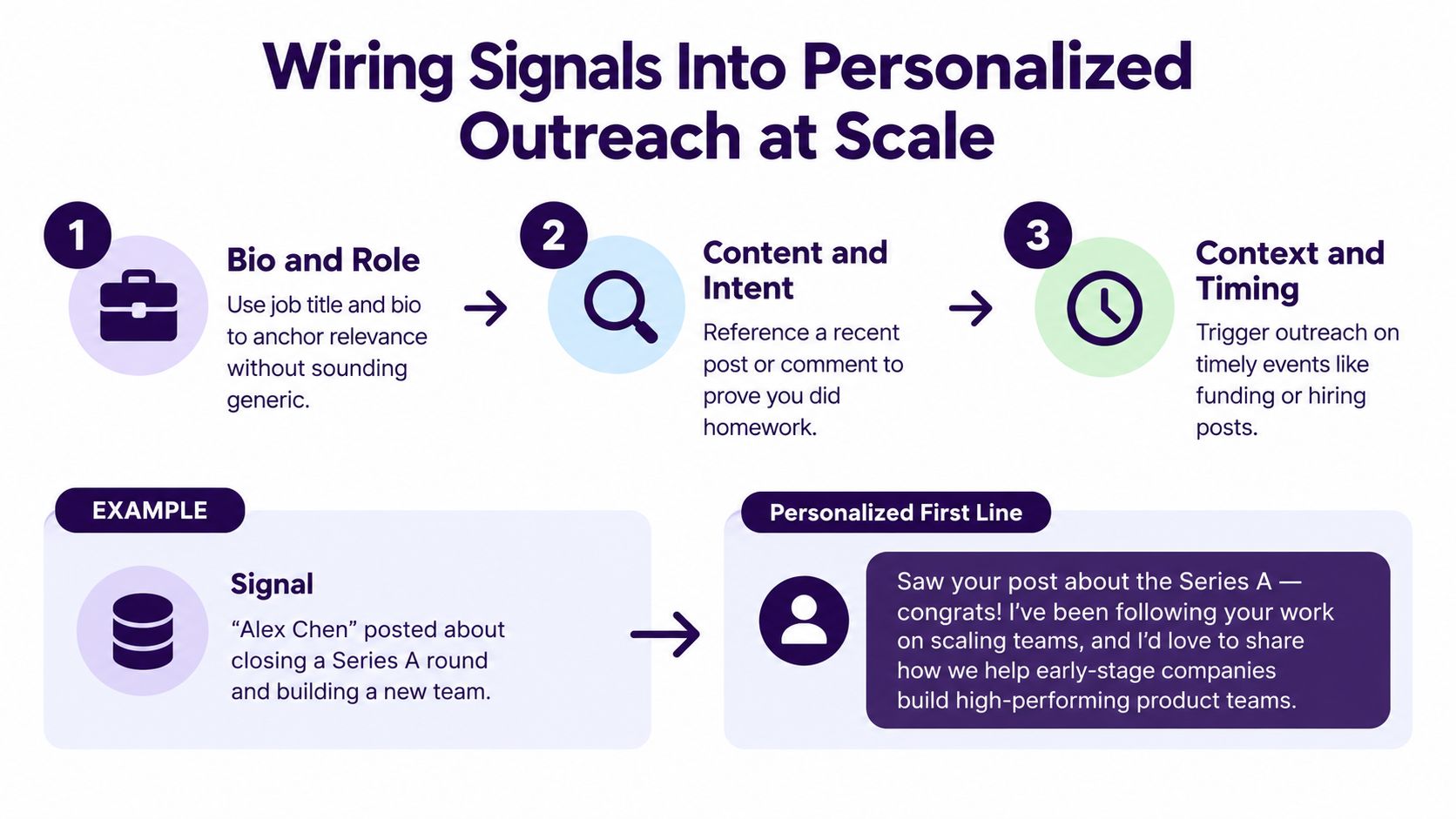
That matters on X because people can smell forced flattery in one line. If your opener sounds like “Loved your amazing insights on growth,” you've already lost. Strong outreach uses one real signal, ties it to the reason for the message, and moves on.
The three signal classes worth using
Not every available signal deserves to drive a message.
The ones worth wiring into outreach are:
- Bio and role: Job title, company type, stated focus, and who they seem to serve
- Recent activity: A recent post, shared link, reply pattern, or clear topic cluster
- Intent triggers: Hiring, launch chatter, pricing-page behavior in your own stack, or public competitor mentions
The trap is trying to use all of them at once. One signal is enough if it's timely.
A practical resource here is this B2B personalization at scale playbook. It does a good job showing how to standardize personalization without turning every message into manual labor.
Use a wiring pattern, not handcrafted copy
A simple pattern works well:
- Detect the signal
- Tag the contact
- Choose the matching template
- Inject the signal into one conditional line
- Throttle by recency
That last part matters more than many realize. A historical study on personalized online advertising found that high-degree personalization worked best immediately after a consumer visited the advertiser's store, but the effect declined quickly over time, which the authors described as overpersonalization. The same research also showed that timing and placement changed performance materially, not just the fact of personalization itself (historical personalization study).
That logic carries over to DMs. A stale signal is often worse than no signal.
What this looks like in practice
A founder-to-founder opener can stay simple:
Saw your post about hiring on growth. Usually that means lead volume matters less than lead quality for the next stretch.
That works because it uses the signal to frame the problem. It doesn't praise their thread or summarize their bio back to them.
For teams that want scale without copy-paste fatigue, tools like DMpro can group prospects by signal patterns such as hiring, launch activity, or audience engagement, then apply templates that adapt to those clusters. For tracking signal inputs before the DM even goes out, this guide to activity tracking is a useful companion.
Keep three guardrails in place:
- Keep signals recent: old context creates awkward outreach
- Use a fallback line: if no signal exists, don't force one
- Review the first batch by hand: the first few messages usually reveal bad tags fast
That's how you keep personalization cheap, fast, and sane.
Picking the Right Channel for the Right Intent
Founders often pick a channel based on comfort. That's a mistake.
The better question is: where does the buyer signal show up first, and how easy is it to act on it? For some offers, that's X. For others, it's LinkedIn. For others, retargeting only works after someone already knows you exist.
Compare channels by signal, not by habit
| Channel | Signal Freshness | Intent Strength | Cost / Qualified Reply | Reply Quality |
|---|---|---|---|---|
| X DM outreach | Very fresh when prospects post publicly | Good for cold-but-warm audiences with visible activity | Usually lower when signals are public and targeting is tight | Strong when offer matches recent activity |
| LinkedIn outbound | Solid for role-based targeting | Strong for B2B title targeting | Usually higher because attention is crowded | Good when profile data is rich and message is direct |
| Meta retargeting | Depends on your site or content traffic | Strong when the user already engaged with your brand | Can be efficient for warm audiences, weak for pure cold starts | Best after prior intent exists |
Retargeting is where hard benchmark data becomes useful. An industry benchmark reported retargeting display ads at an average CPC of $0.76 versus $1.30 to $1.95 for prospecting display campaigns, average CPM of $5.65, and average CPA of $26 versus $49 for prospecting, which is a 47% reduction. The same benchmark reported RLSA campaigns with a 5.2% average CTR versus 3.8% for regular search ads, and retargeting CTR around 0.7% versus roughly 0.07% for standard display ads (retargeting benchmarks).
That doesn't mean Meta wins by default. It means warm intent is usually cheaper than cold reach.
A practical week-one test
Run the same offer across three lanes:
- X DMs to prospects with recent public activity
- LinkedIn outbound to the same buyer role
- Meta retargeting only if you already have warm traffic
Use one spreadsheet. Log segment, opener, reply quality, and next step. Keep the follow-up cadence consistent.
If you want a broader view of where each lane fits, this roundup of lead generation channels is useful.
Match the channel to signal velocity. Fast public signals belong in fast channels.
X tends to win when your buyer thinks in public. LinkedIn tends to win when role precision matters more than recency. Retargeting wins after intent already exists.
Measuring Targeting Optimization the Right Way
If you can't explain why a segment improved, you didn't optimize it. You just got a different outcome.
That's why measurement has to come before scaling. A lot of teams “optimize” targeting based on gut feel, total replies, or who seemed most interesting. None of that helps when you need to repeat results next month.
Four metrics worth tracking
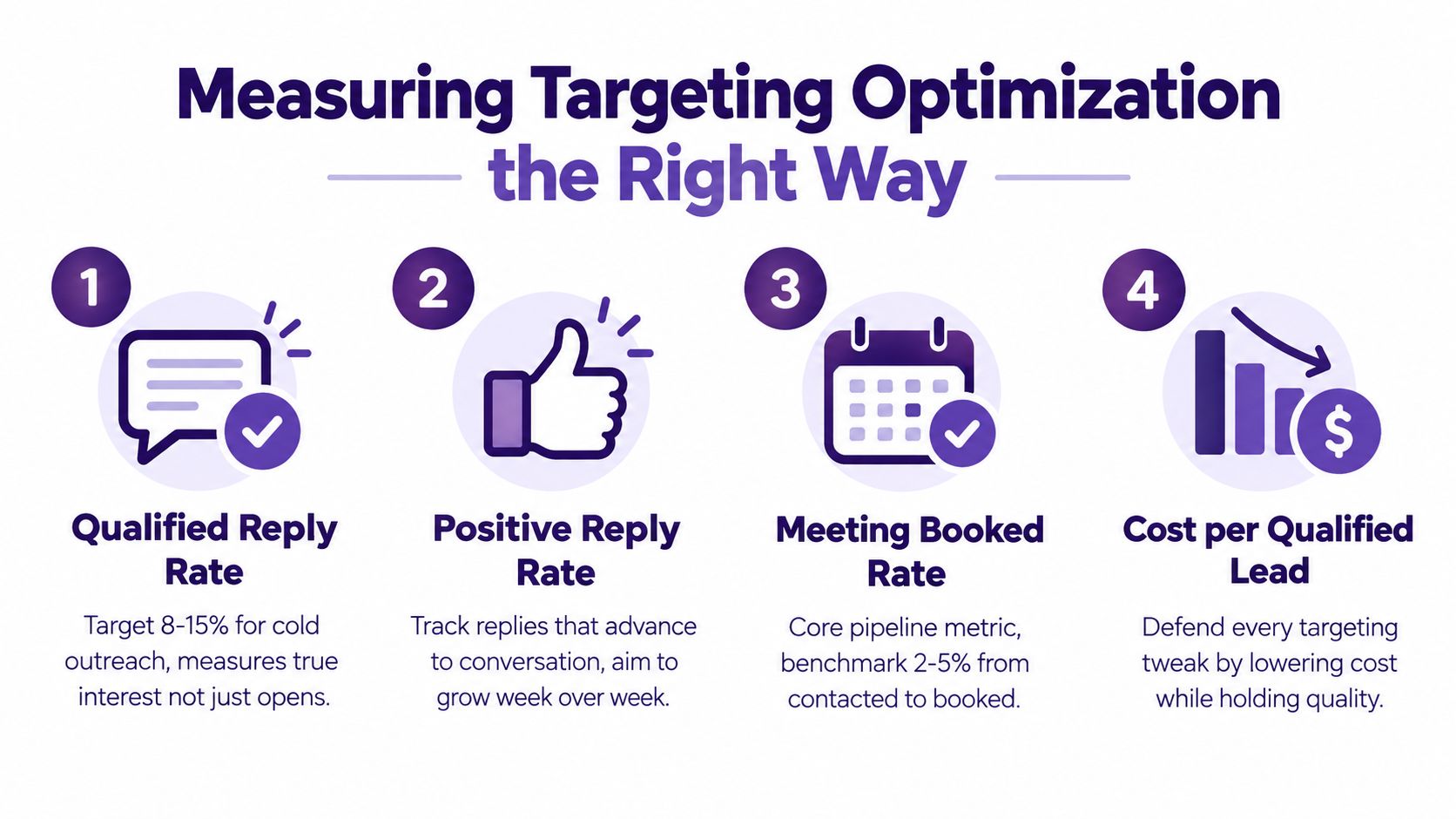
Use a short scoreboard:
- Qualified reply rate: replies from people who match the segment and are open to the problem
- Positive reply rate: replies that move the conversation forward
- Meeting booked rate: the share of contacted prospects that become real calls
- Cost per qualified lead: the clearest defense for any targeting change
The article brief benchmark ranges for some of these. In practice, what matters most is consistency in your own definition and review rhythm.
Why measurement frameworks matter more than bigger audiences
One of the cleanest warnings in targeting comes from campaign measurement. AudienceProject analyzed 13,000 audience-targeted digital campaigns across 6 markets and found average targeting accuracy was about 45%, while under 10% of digital campaigns had audience measurement done properly across basics like reach, frequency, accuracy, demographics, and affinity (AudienceProject summary).
The lesson isn't that targeting is broken. It's that many teams never verify whether the audience they paid for is the one they reached.
For X outreach, the equivalent mistake is simpler: you log sent messages but not whether each reply came from a segment you meant to hit.
A review cadence that doesn't waste your week
Use a light cadence:
- Daily: scan signal-level weirdness, like bad tags or irrelevant pulls
- Weekly: compare reply quality by segment
- Bi-weekly: review channel performance
- Monthly: review message patterns and template drift
Pin one chart where the team can see it: reply rate by segment, sorted by volume.
Ignore vanity metrics that don't help decision-making. Impressions won't tell you if the segment is wrong. Follower count won't tell you if the buyer has pain. Cold DM open rate often creates more noise than clarity.
Operator's note: Reach is not the goal. Fit is the goal.
A short Friday template works well:
- Which segment produced the most qualified replies?
- Which segment produced noise?
- Which signal created the cleanest opener?
- What one filter gets added or removed next week?
That kind of review prevents slow drift. It keeps the loop honest.
Common Targeting Mistakes and How to Fix Them
The biggest targeting mistakes don't usually look dramatic. They look normal, which is why teams keep repeating them.
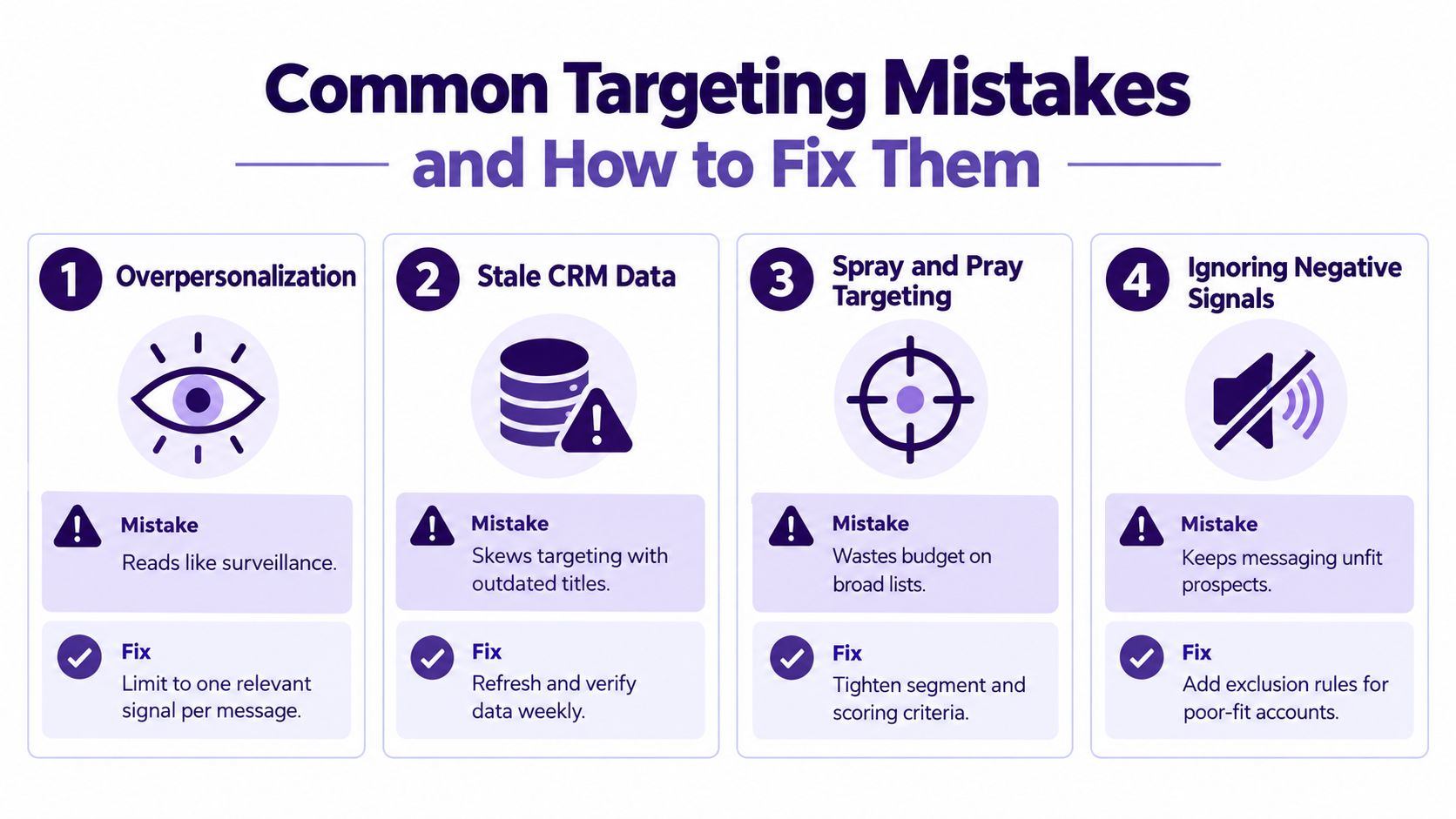
Mistake one and two
Overpersonalization is the first one. If your DM references too much detail, people don't read it as thoughtful. They read it as surveillance. The fix is simple. Use one relevant signal, not three.
Stale data is the second. Old titles, inactive accounts, and outdated CRM enrichment poison every downstream decision. Refresh your segment inputs often and suppress contacts that no longer fit.
Privacy also makes stale assumptions worse. Independent reporting found 56% of respondents already face audience-targeting limitations in regulated regions, nearly 40% report audience-data availability issues, and 61% expect audience targeting to be the most affected area as privacy rules expand. The same reporting noted weak visibility into actual delivery parameters from major ad repositories, which makes blind trust in platform targeting even riskier (privacy and targeting limits).
Mistake three and four
Ignoring platform limits is a quiet killer in X automation. X's API rate limits are endpoint-specific and usually reset in 15-minute windows, though some endpoints use 24-hour windows, and if you exceed a limit the API returns HTTP 429 until reset (X API rate limits). On the standard v1.1 DM endpoint, the ceiling is 1,000 requests per 24 hours per user and 15,000 per 24 hours per app (X DM rate limit reference).
That means your targeting logic and send logic can't live in separate worlds. Segment caps, rotation, and pacing are part of targeting optimization because they determine whether a good audience gets contacted reliably.
Channel-blind targeting rounds out the list. A segment that works in X DMs won't automatically work the same way in LinkedIn or paid retargeting. Public-post signals are great for X. They're weaker in channels where the same context isn't visible. Rewrite the message and scoring rules per lane instead of cloning the whole setup.
The fix in every case is the same habit: go back to the loop. Check the signal, tighten the segment, adjust the message, measure the response, then refine.
If you want to turn that loop into a repeatable system, DMpro helps automate X outreach by finding prospects, organizing signals, and running cold DM campaigns without the daily manual grind. If you're tired of manually sending DMs every day, try it and let the workflow run while you focus on closing the right conversations.
Ready to Automate Your Twitter Outreach?
Start sending personalized DMs at scale and grow your business on autopilot.
Get Started Free