
How to Improve Lead Quality: A Founder's Playbook
Learn how to improve lead quality with this founder-tested playbook covering targeting, scoring, messaging, and measurement tactics that actually move
You're staring at 400 leads in HubSpot. Twelve have taken calls. The SDR team has stopped trusting the list, and every new form submission gets treated like a potential distraction rather than a sales opportunity.
That's the wrong diagnosis. Your team doesn't necessarily need more leads or a more complicated scorecard. It needs a lead-quality system that verifies fit, intent, timing, and ownership before a record moves downstream.
This is how to improve lead quality in practice, especially when your growth motion includes SaaS outbound and X or Twitter DMs. The score matters, but the handoffs matter more.
The Real Reason Your Pipeline Is Full of Junk
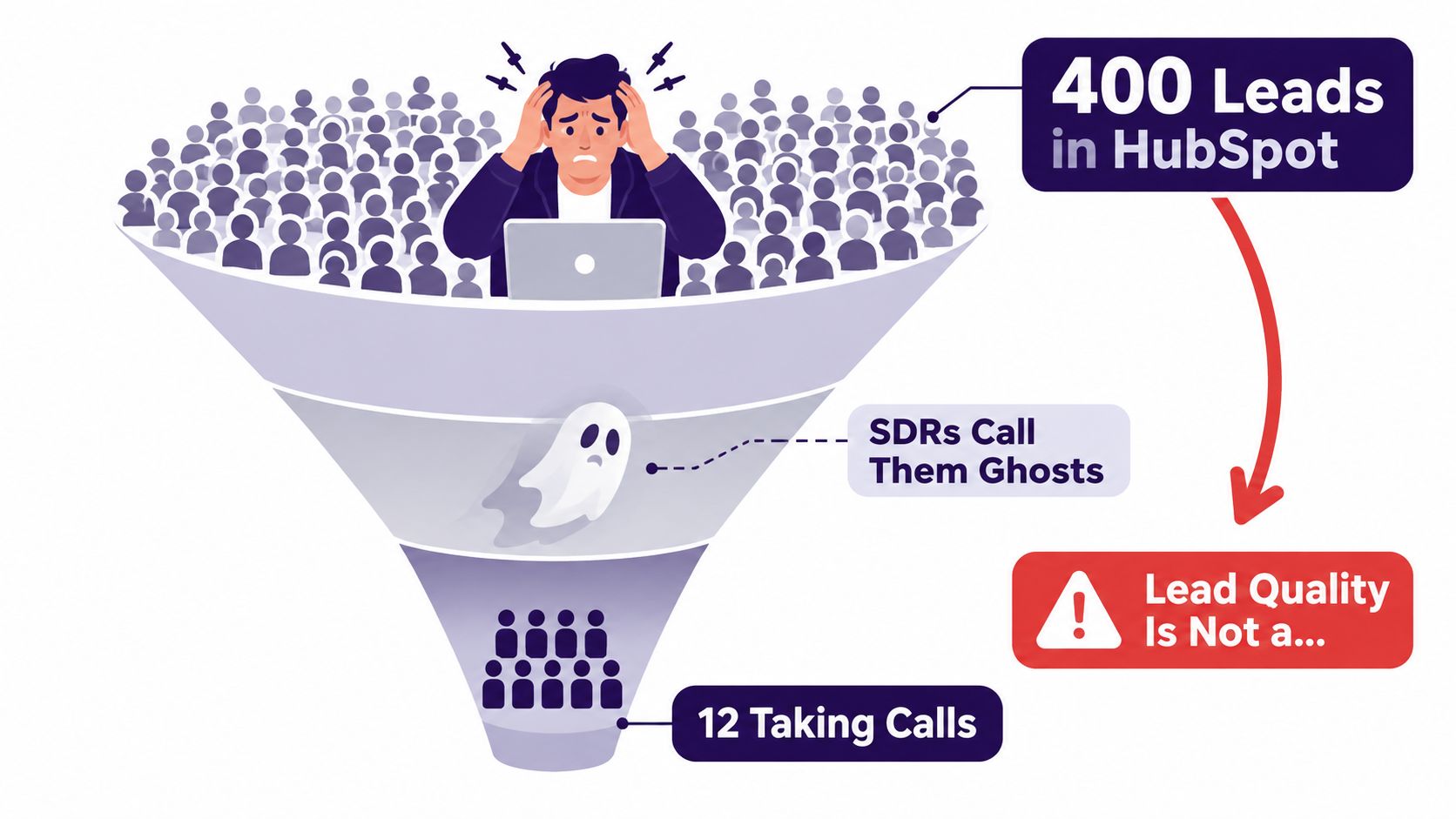
A crowded CRM can hide a broken revenue process. Marketing marks a contact as qualified because they downloaded something. An SDR accepts the record because it crossed an arbitrary threshold. An AE discovers that the company is too small, the contact has no buying authority, and the problem isn't urgent.
That's not a scoring failure. It's a handoff failure.
The first leak happens between marketing and SDRs. The teams may agree that a lead “looks interested,” but they haven't agreed on which company traits, roles, or actions justify sales attention. The second leak occurs between SDRs and AEs, when a booked conversation gets passed over without a verified problem, decision process, or next step. The final leak appears between AEs and closed-won, because nobody feeds outcomes back into the original targeting and qualification rules.
Practical rule: A lead isn't qualified because it entered a stage. It's qualified because the next team can trust what the previous team verified.
The benchmark gap explains why this hurts so much. Only 44% of companies currently use lead scoring, leaving more than half to judge lead quality without a systematic model, according to Landbase's lead qualification statistics. In the same source, only about 13% of MQLs become sales-qualified opportunities, while sales-accepted lead rates average 26% in one Salesforce-based benchmark set.
Historical funnel data points to the same lesson. A Salesforce-based survey of 5,500 sales professionals across 27 countries found that top-quartile B2B companies converted 3.2% of website visitors into qualified leads, compared with 0.8% for average performers, as summarized by The Starr Conspiracy's B2B lead-generation benchmarks.
The rest of the system has to answer seven questions:
- Who should enter the funnel?
- Which signals indicate real intent?
- What must a prospect confirm before handoff?
- How should X activity change outreach timing?
- What happens to borderline leads?
- Which stage is leaking?
- How do closed-lost outcomes change the model?
The scorecard sits downstream. The work starts with the ICP, the data, and the agreement between teams.
Define Your ICP Like You Mean It
An ICP shouldn't be a sentence on a strategy slide. It should be a working filter that tells a marketer who to attract, an SDR who to contact, and an AE which conversations deserve time. A useful LeadBeast guide to ICP is a good reference if your current definition is still mostly instinct.
Take a vertical SaaS company selling to mid-market logistics businesses. Its firmographic profile might require:
- Company size: 200 to 2,000 employees
- Geography: United States or United Kingdom
- Operating model: Private fleet operations
- Existing spend: More than 50k on logistics software
Then define the buyer, not just the account. The target might be a VP of Operations or Director of Logistics who has held the role for at least three years and has either recently been promoted or is under board pressure to reduce costs.
The disqualifiers are just as important. Agencies, consultants, companies with fewer than 50 employees, and organizations operating in stealth should be removed before they consume sales capacity.
Use this template when documenting the profile. For another practical perspective on the exercise, see what an ideal customer profile means.
| Attribute Type | Firmographic | Buyer Persona | Timing Signal |
|---|---|---|---|
| Must-haves | Target industry, size, geography | Relevant function and seniority | Active project or visible business pressure |
| Nice-to-haves | Matching technology stack | Tenure, ownership of a relevant KPI | Recent promotion, hiring, launch, or expansion |
| Automatic disqualifiers | Outside territory, too small, wrong business model | Student, vendor, irrelevant role | No active problem or stated priority |
Validate the profile against revenue
Pull the last 10 closed-won deals and compare each account against the new checklist. If fewer than 60% fit the proposed ICP, the definition is still too loose. That isn't a verdict on the customers. It's evidence that the team hasn't identified the pattern it can reliably pursue.
Also compare closed-lost deals. Look for recurring mismatches in size, role, geography, implementation complexity, or urgency. Your disqualifier list should come from expensive mistakes, not from assumptions about who “probably won't buy.”
Build a Scoring Model That Actually Filters
A useful score should change what your team does next. If every lead lands in the same sales queue, the model is decoration.
Start with three categories and make each one answer a different question:
- Firmographic fit, 0 to 30 points: Does the account resemble the customers you can serve well?
- Behavioral intent, 0 to 40 points: Has the person or account taken actions associated with evaluation?
- Engagement recency, 0 to 30 points: Is the signal current enough to justify action now?
For firmographic fit, award points for the target employee band, matching technology stack, and recent funding where those factors correlate with your sales motion. For behavior, prioritize pricing-page visits, repeated sessions within 14 days, replies to outbound, and booked meetings. Engagement recency should reward current activity rather than historical curiosity.
The requested point model can look like this:
| Signal Category | Max Points | Decay Window | Example Signals |
|---|---|---|---|
| Firmographic fit | 30 | Persistent, reviewed when data changes | Employee band, tech-stack match, recent funding |
| Behavioral intent | 40 | Older than 30 days loses 50% of value, older than 60 days reaches zero | Pricing visit, repeat visit, reply, booked meeting |
| Engagement recency | 30 | Updated continuously | Recent X interaction, content engagement, demo-page activity |
Route the result according to the action it deserves:
- Under 40 points: Nurture, with no immediate SDR assignment
- 40 to 70 points: SDR warmup and manual verification
- Over 70 points: AE review and immediate qualification
The brief's proposed benchmark says conversion rises from 2% below 40 points to 18% above 70 points, but that claim isn't supported by the verified research available here. Treat those thresholds as a testable operating hypothesis, not a universal benchmark. Calibrate them against your own accepted, opportunity, and closed-won outcomes.
Intent also decays at different speeds. First-party behavior typically loses value after 7 to 14 days, third-party topic surges after 21 to 30 days, and business-change signals after 45 to 90 days, according to B2B lead qualification benchmarks from The Starr Conspiracy.
Use a system that updates scores as activity happens. A spreadsheet reviewed once a week can help you design the rules, but it can't reliably represent a prospect whose intent changed this morning. Teams building this workflow can also review automated lead scoring as a model for connecting activity to routing.
Write Qualification Questions That Surface Intent
Generic questions create generic answers. “What problem are you trying to solve?” forces the prospect to write your discovery brief for you, and many won't.
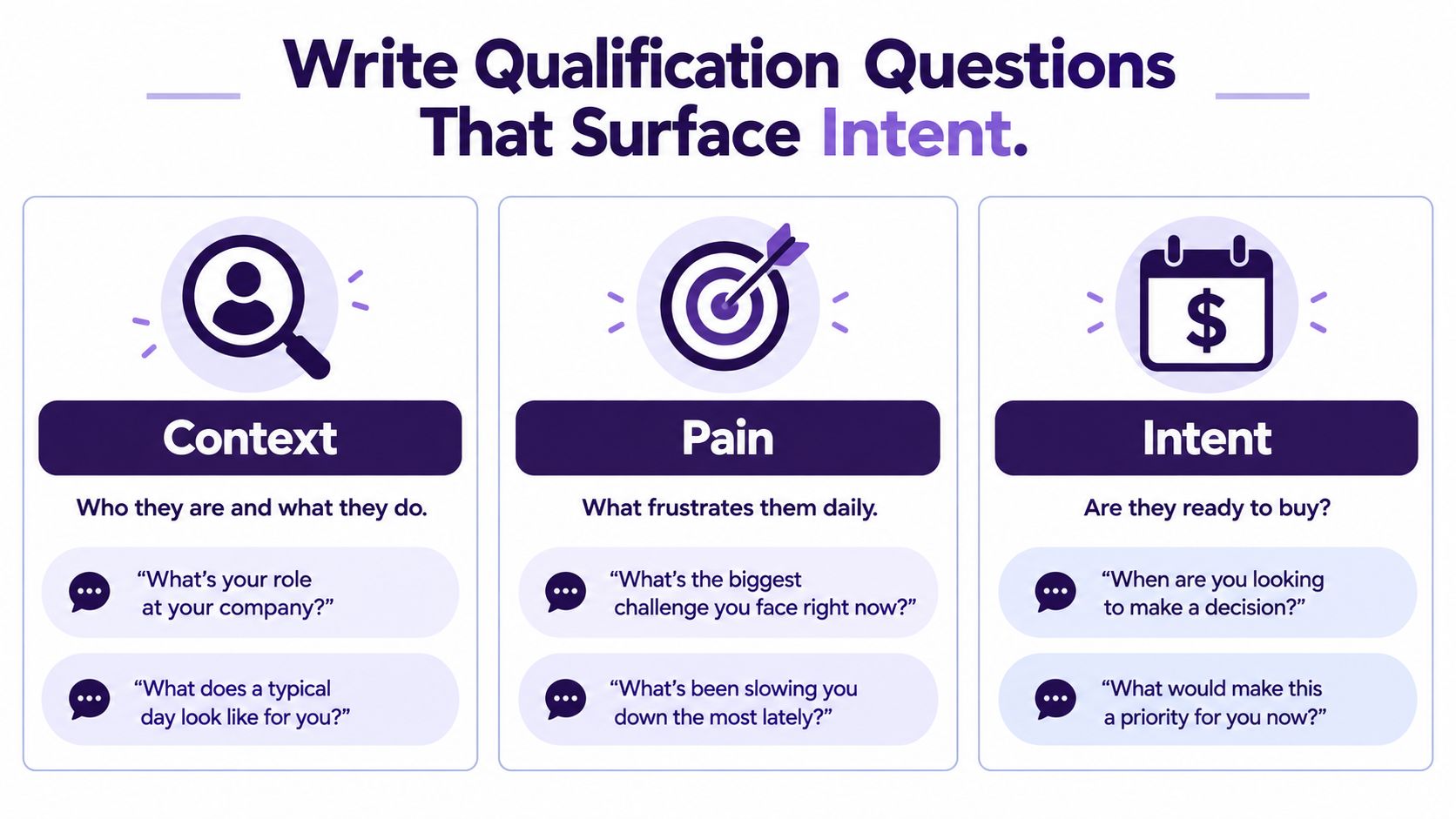
Ask questions that expose context, capability, and commitment instead.
- Context: What triggered the search? What changed inside the business?
- Capability: Who owns the decision? How does the team usually fund this type of project?
- Commitment: What happens if nothing changes? Is there a date or consequence attached to the problem?
These categories map to the practical qualification checks sales teams need without turning the first exchange into an interrogation.
The generic DM sounds like this:
“Saw your profile, love what you're building.”
It says nothing about the prospect's situation and gives them no reason to respond. A stronger opener uses four lines:
- Observation: Mention a specific post, hiring move, product launch, or operational detail.
- Hypothesis: Explain the problem that signal may indicate.
- Proof: Give a short, relevant example of how you've seen the issue appear.
- Low-friction ask: Ask whether the observation is relevant, rather than requesting a meeting immediately.
For example:
“You mentioned hiring two implementation managers after the product launch. That usually creates pressure on handoffs and onboarding capacity. We've seen SaaS teams lose qualified opportunities when those workflows stay manual. Is that a problem your team is dealing with?”
Qualify without wasting the next team's time
A reply is not proof of intent. Ask one follow-up question based on what the prospect already revealed.
If they mention a trigger, ask what caused it. If they mention a project, ask who else is involved. If they describe a costly consequence, ask what deadline makes it important now. Avoid stacking several qualification questions in one message. The goal is to create a useful exchange, not reproduce a form inside a DM.
Disqualification should also be direct and respectful. If the contact lacks authority, ask who owns the decision and offer to include them. If there's no budget, explain that you don't want to force a process that isn't funded. If there's no urgency, move the lead to nurture rather than pretending the conversation is sales-ready.
That protects the prospect's attention and saves the SDR and AE from a handoff built on politeness rather than intent.
Run Signal-Driven Outreach on X and Twitter
X gives outbound teams something many databases miss, public context. A hiring post can reveal a capacity problem. A funding announcement can indicate expansion. A complaint about an incumbent can expose dissatisfaction before the buyer fills out a form.
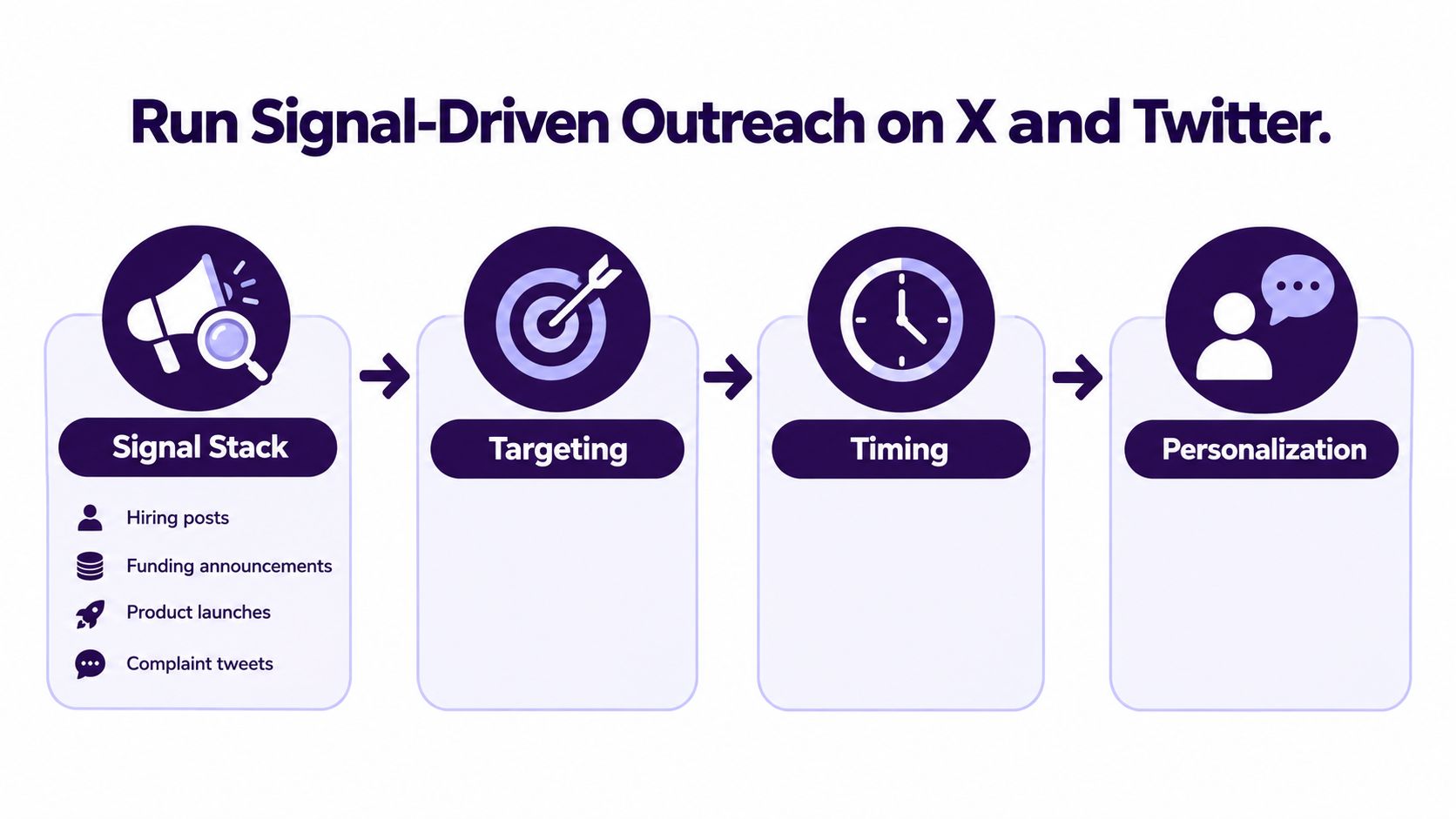
Build a signal stack, then assign each signal a shelf life. A complaint tweet may be useful immediately and nearly irrelevant later. A product launch can remain relevant for days or weeks, while a hiring pattern may support a longer follow-up window. The point isn't to pretend every signal has a precise expiration date. It's to stop treating old activity as current intent.
Use a simple execution loop
Start by monitoring:
- Hiring posts: New roles can reveal growth, process strain, or a technology change.
- Funding announcements: Expansion often creates new operational priorities.
- Product launches: Launches can create demand for distribution, implementation, or support.
- Complaint tweets: Dissatisfaction with an incumbent creates a timely conversation.
- Competitor engagement: Replies and discussions can reveal active research.
Warm the profile through genuine engagement for 3 to 5 days, then send a DM anchored to the signal. Follow up after 48 hours with a different angle, not a repeated “just checking in.” Break up after a fourth touch if there's no useful response.
Public replies, DMs, and quote-tweets serve different jobs. Reply publicly when your observation adds value to the conversation and you're comfortable creating visible proof. Use a DM when the subject involves internal process, budget, or a sensitive problem. Quote-tweet when your perspective can stand alone and the interaction itself supports social proof.
Four hooks worth testing
- Observation hook: “You're hiring for lifecycle marketing while expanding into a new segment. Are you rebuilding the outbound motion around that change?”
- Contrarian hook: “Many teams respond to more hiring by adding more tools. That often creates another handoff problem before it solves the first one.”
- Resource hook: “Your post about routing leads between regions reminded me of a short framework we use to separate fit from urgency. I can send it if useful.”
- Question hook: “When a prospect shows interest on X but doesn't book, who owns the next step on your team?”
Personalization needs a budget. Spend roughly 90 seconds checking the prospect's recent posts, role, company change, and likely pain. The brief calls for a 3x reply lift, but no verified source supplied here supports that figure, so test it rather than presenting it as a promise. Research from Autobound on targeting prospects through X posts cites Belkins data showing personalized outreach referencing a specific pain point can reach up to 18% response rates, compared with 5% to 9% for generic cold email.
For well-run X DM campaigns, XAutoDM's cold DM benchmark guide presents 8% to 15% reply rate as a realistic target. Automation can help with consistency, but it shouldn't replace signal review. A tool such as Twitter direct-message automation belongs after targeting and qualification rules, not before them.
Measure What Matters After the Handoff
Lead quality is proven after the handoff. A lead that replies but never reaches a qualified meeting may be engaging with the message, not buying the product.
Track the funnel in stages:
| Stage | Benchmark Target | What a Leak Signals |
|---|---|---|
| DM-to-reply rate | 35%+ target from the operating model | Weak hook, poor timing, or channel mismatch |
| Reply-to-conversation rate | 40%+ target from the operating model | Replies are polite but lack usable intent |
| Conversation-to-qualified-meeting rate | 25%+ target from the operating model | Qualification is too loose or the offer is misaligned |
| Qualified-meeting-to-opportunity rate | 60%+ target from the operating model | Meeting acceptance is inflated or handoff evidence is weak |
These targets are internal operating targets from the proposed framework, not universal verified benchmarks. Use them as starting points and replace them with your own baseline after enough consistent routing and tracking.
Read the stages together. A high reply rate with weak meeting conversion usually means the targeting or intent interpretation is wrong. A low reply rate points toward the message, timing, or channel choice. A strong meeting rate with weak opportunity creation suggests the team is labeling conversations as qualified before the AE validates a real commercial path.
The feedback loop must run quickly. Every sales-call outcome should update the scoring model within 48 hours, not wait for a quarterly review. Record why the lead was accepted, why it was rejected, whether the role had authority, and whether the stated problem had a credible timeline.
A shared CRM stage is enough to start. Add a weekly spreadsheet if your reporting is immature, or use a lightweight workflow tool such as DMpro for campaign and reply tracking. Teams managing BDR workflows can also use BDRs from hireSDR.com as a reference point for role and process design.
Stop celebrating MQL volume. Track cost per qualified meeting, sales-accepted lead rate, source-level opportunity progression, and the reasons for disqualification. These measures tell you whether the funnel is becoming more usable.
For dashboard discipline, see KPI monitoring for revenue teams.
Your 30-Day Iteration Loop
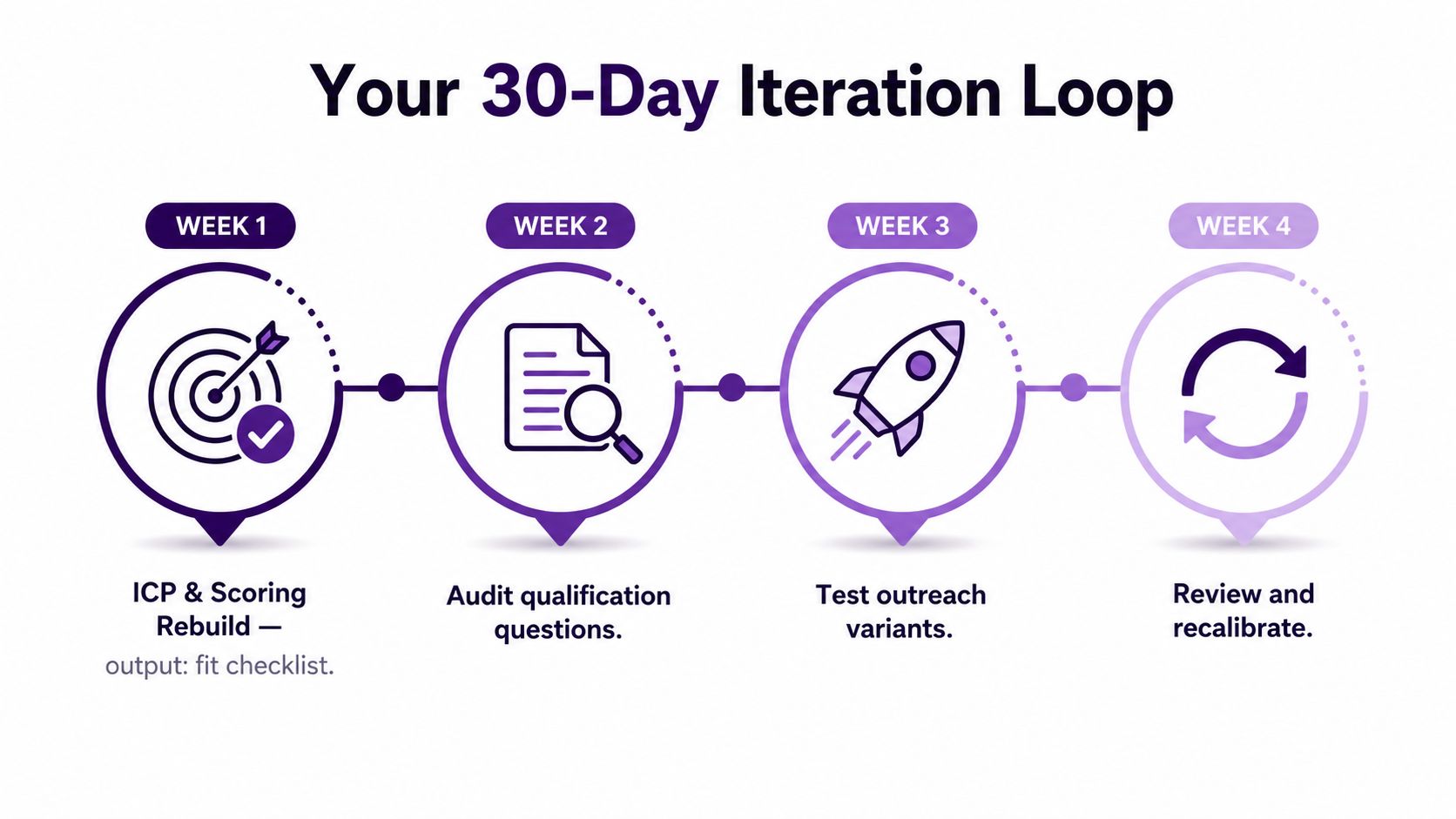
A lead-quality system improves through repeated adjustments, not a one-time CRM cleanup. Give each week one job and one output.
Week one rebuilds the inputs
Write the ICP checklist, the disqualifiers, and the score model. Pull recent closed-won and closed-lost records, then compare the proposed rules against what moved forward. The output should be a documented fit checklist and an updated point model that marketing, SDRs, and AEs can all use.
Week two tests the conversation
Rewrite DM openers around observable signals. Create qualification questions for context, capability, and commitment. Test the scripts against 50 prospects, logging reply rate and intent-surfacing rate rather than treating every response as success.
Keep the variants distinct. One message can lead with a hiring signal, another with a complaint about an incumbent, and another with a product launch. If every version says the same thing in different words, you won't learn which signal carries useful intent.
Week three connects X to routing
Add signal triggers from X to the outreach queue. Review the first cohort of scored replies against closed deals, accepted conversations, and dropped leads. If a signal produces engagement but no qualified movement, reduce its weight or require a second signal before handoff.
Many teams find that profile fit alone isn't enough. A perfect ICP match with stale data or no active problem still creates a weak lead.
Week four retires noise
Remove low-yield sources, rewrite the weakest question, and lock the next experiment. Don't change every variable at once. If you alter the audience, signal, message, and routing threshold together, you'll have no idea what caused the result.
The habit that compounds is a Friday 20-minute review of three metrics:
- MQL-to-SQL conversion: Are marketing-qualified records becoming accepted sales conversations?
- SQL-to-opportunity rate: Are accepted conversations showing commercial potential?
- Disqualified-but-engaged leads: Did any rejected prospects reveal timing, authority, or budget changes worth revisiting?
The final operating rule is simple. Capture X intent signals, route each prospect through the same fit checklist, record the human qualification outcome, and feed that outcome back into scoring. That closes the loop between prospecting and revenue instead of leaving the model frozen at the moment a lead enters the CRM.
If you want to automate the repetitive part of X prospecting, DMpro can help find and organize relevant profiles, run cold DM campaigns, and track replies against the qualification process you define. Try it to turn signal-driven outreach into a repeatable workflow, while your team focuses on the conversations that deserve a call.
Ready to Automate Your Twitter Outreach?
Start sending personalized DMs at scale and grow your business on autopilot.
Get Started Free