
How to Quote a Tweet on X to Drive Real Engagement
Learn how to quote a tweet on X with actionable strategies. This guide covers why, when, and how to use quote tweets to boost engagement and generate leads.
When you quote a tweet, you're not just sharing someone else's post—you're adding your own voice to it. It’s a simple feature, but it’s way more strategic than a basic retweet. It lets you add your unique perspective, kickstart a real conversation, and get on the radar of founders and prospects who matter.
Why Quoting a Tweet Is a Growth Superpower

Let’s be real—as a founder, your time is your most valuable asset. You can't afford to be on social media just for the sake of it. Mastering the quote tweet is a game-changer because it turns passive scrolling into a strategic move for scaling your SaaS distribution.
Hitting the retweet button just amplifies someone else's message. But when you quote a tweet, you add your own layer of insight or analysis. You’re turning a passive share into an active contribution that builds your brand.
Build Authority and Start Conversations
This simple action is a powerful way to position yourself as an expert. By adding thoughtful commentary to industry news or a prospect's post, you show you're not just scrolling—you're engaged and have valuable ideas to contribute. It’s like confidently adding a key point to an important discussion.
This is especially effective for lead generation. Instead of sliding into DMs with a cold pitch, you can warm up a prospect by quoting their tweet about a business challenge and offering a genuinely helpful tip. That public interaction is the perfect icebreaker for a follow-up message. You can find more strategies like this in our guide on how to boost your Twitter tweet engagement.
The Algorithm Loves Added Value
Think about what X wants: it wants to keep people hooked. A quote tweet almost always sparks more replies and deeper engagement than a simple retweet, which tells the algorithm that your content is worth showing to more people.
This feature didn't even exist until it officially launched in 2015, and it completely changed how conversations unfold. Today, with over 557 million monthly active users, the algorithm favors content that adds commentary and drives interaction. If you want to dive deeper, you can find more fascinating X trends in these Twitter statistics. Learning how to increase social media engagement overall will make your quote tweets even more powerful.
How to Quote a Tweet, Step-by-Step
Ready to jump in? Learning how to quote a tweet is simple, and the process is pretty much the same whether you're at your desk or on your phone.
Let's walk through the exact clicks you need to make to add your voice to the conversation.
On the X Website (Desktop)
When you're doing outreach or engaging with potential customers from your computer, the web app is usually the fastest way to go.
First, find the tweet you want to build on. Just below the tweet's text, you'll see a row of icons. Look for the retweet icon—it looks like two arrows chasing each other in a square.
Click it.
A small menu will pop up with two choices: "Repost" and "Quote."
Select "Quote." This opens a new post window with the original tweet neatly embedded at the bottom. Now, you can type your own commentary, add relevant hashtags, or tag other accounts. Once you’re happy with it, just hit the "Post" button.
On Your Phone (iOS & Android)
The process is just as easy when you're on the move. The X app for both iPhone and Android is designed for quick interactions, so quoting a tweet only takes a couple of taps.
Once you're in the app, the steps are identical to the web version.
Find the tweet you want to share and tap that same retweet icon. You’ll see the two choices again: "Repost" and "Quote."
Tapping "Quote" brings up a new screen where you can add your thoughts above the embedded tweet. This is perfect for reacting to industry news in real-time or engaging with a lead's post the moment you see it.
For founders managing multiple accounts or wanting to save ideas for later, learning how to use drafts on Twitter can be a real time-saver.
Quote, Retweet, or Reply: The Founder's Playbook
Knowing how to quote a tweet is easy. The real skill is knowing when to do it.
Should you quote, retweet, or just reply? For founders, making the right call is the difference between adding to the conversation and just adding to the noise. Every interaction on X is a chance to build your brand, connect with peers, or find your next customer.
A simple retweet is a nod of approval. It's perfect for amplifying a partner’s big announcement. Think of it as a low-effort way to show support without needing to add your own two cents.
Replies, on the other hand, are for direct conversations. They're ideal for jumping into a discussion with a potential user who mentioned a problem you can solve. Replies are less about broadcasting your message and more about building a direct line to one person.
The Strategic Edge of a Quote Tweet
So, when should you quote a tweet? When you have something meaningful to add. It’s your chance to put a spotlight on a post and say, “Pay attention to this, and here’s my take on it.” This is your go-to move for positioning yourself as an expert and getting on the radar of high-value accounts.
Here are a few times a quote tweet is the right play for SaaS lead gen:
- Add Your Analysis: An industry report drops. Instead of just retweeting, quote it with your single biggest takeaway.
- Showcase Your Expertise: A potential customer tweets about a challenge. Quote them with a genuinely helpful tip. You’re providing public value before you ever think about sending a DM.
- Disagree Respectfully: Stumble upon a take you don’t agree with? Quoting it is the best way to offer a thoughtful counter-perspective and start a healthy debate.
This decision tree breaks down the simple mechanics of how to quote a tweet on any device, so you can focus less on the "how" and more on the "why."
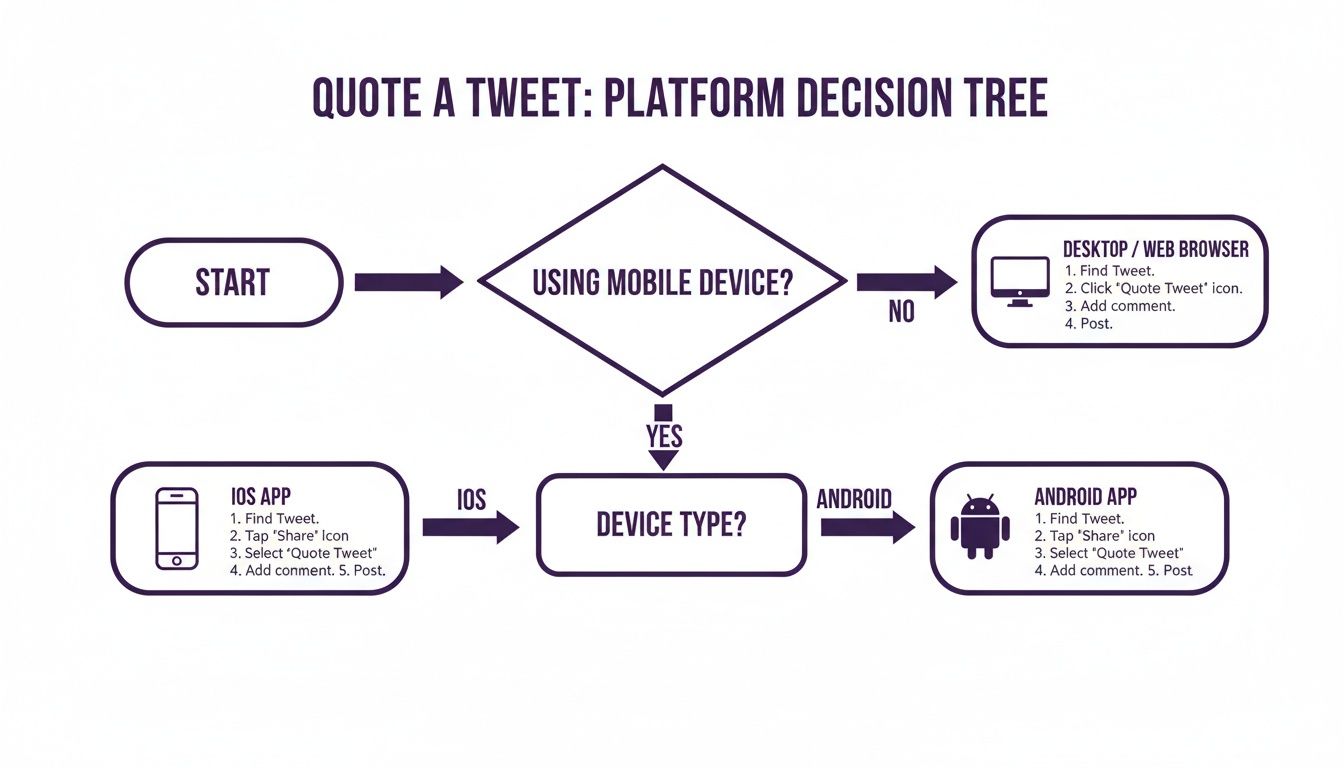
As you can see, the steps are pretty much the same everywhere. That leaves you to focus on the strategy behind your engagement.
For scaling outreach, this becomes incredibly powerful. Say you want to connect with another founder. Quoting their latest product launch with genuine, specific praise is a fantastic way to warm up the introduction. You can even use tools to help. For example, a platform like DMpro can help you find these high-value opportunities, letting you add that personal touch with a quote before automating a personalized DM follow-up.
Quote vs. Retweet vs. Reply: Which to Use When
To make it even clearer, here’s a quick breakdown to help you decide which action to take based on your goal as a founder.
| Action | Best For | Founder-to-Founder Example |
|---|---|---|
| Quote | Adding your unique perspective, commentary, or analysis to someone else’s content. Great for thought leadership and lead gen. | A fellow founder posts a thread on their fundraising journey. You quote it adding, “This is spot on. The one thing I'd add from our pre-seed round is...” |
| Retweet | Quickly amplifying a message you agree with or showing support without needing to add your own words. | You see a founder you admire share a great article on product-market fit. You simply retweet it to your followers. |
| Reply | Engaging in a direct, public conversation with a specific person or thread. Best for asking questions or building a 1:1 connection. | A founder asks, “What’s the best CRM for a lean startup?” You reply directly with your recommendation and a brief reason why. |
Ultimately, it comes down to being intentional. Don’t just retweet because you can. Choose the action that best serves your goal, whether that’s building a relationship or sparking a meaningful conversation. That’s how you turn simple engagement into a real pipeline.
Using Quote Tweets for Smarter Lead Generation
Alright, let's talk about how this simple feature can actually fill your sales pipeline. For anyone running a SaaS, every action on X should be intentional. A quote a tweet isn't just another way to engage; it's a strategic first touchpoint that can warm up a cold lead instantly. It's all about finding the right moment.
Your ideal customers are on X right now. They're asking for tool recommendations, venting about a business problem, or celebrating a small win. Each of these is a wide-open door.
When a founder tweets, "Anyone have a solid project management tool they love?" a cold DM is one option. But quoting their tweet with a genuinely helpful tip—without a hard sell—positions you as an expert. You become a resource, not just another salesperson.
The goal here is to be helpful first. A quote tweet that offers a quick, valuable insight into a founder’s hiring problem will always outperform a generic DM. For businesses in competitive spaces, like marketing SaaS companies, this is how you cut through the noise.
Finding and Converting Opportunities
The tricky part is finding these conversations consistently. Manually searching for keywords is a time-consuming grind. This is where outreach automation makes all the difference.
Tools like DMpro are built to scan X for these high-intent tweets, serving up perfect engagement opportunities. Imagine a feed filled with founders running into the exact problems your SaaS was built to solve. From there, you just have to quote a tweet with a useful thought or a quick tip.
This two-step process is incredibly powerful: offer public value first, then start a private conversation. After you’ve helped someone out with a quote tweet, a follow-up DM referencing that public interaction feels natural and welcome, not interruptive.
This method can seriously boost your response rates. With the right system, you can quote a tweet and then follow up with an automated (but personalized) DM to achieve 25-40% response rates. That blows typical cold outreach numbers out of the water.
By blending smart public engagement with targeted private outreach, you're not just sending messages; you're building a repeatable system for generating high-quality SaaS leads.
Crafting the Perfect Quote Tweet Every Time

Anyone can hit the "Quote" button, but crafting one that actually gets noticed is a different story. A great quote tweet is a chance to add your voice, build your authority, and get people talking.
The golden rule? Always add a new perspective. If you're just echoing what the original tweet said, you might as well have just retweeted it. Your commentary is the entire point.
Key Ingredients for a Great Quote
Your mission is to make another founder stop their scroll. Here are a few reliable ways to do that:
- Ask a provocative question. Flip the original statement on its head and challenge your audience to think.
- Offer a counterargument. You don't have to be confrontational, but a well-reasoned, respectful disagreement drives incredible engagement.
- Add data or a key statistic. Nothing strengthens (or debunks) a point faster than a solid fact.
- Inject some relevant humor. A clever, witty take can make your quote tweet incredibly memorable and shareable.
Since they were introduced in 2015, quote tweets have become a cornerstone of marketing and conversation on X. With the platform projected to have 557-561 million active users by 2026, mastering this feature is non-negotiable. The algorithm even treats them like high-quality replies, rewarding the value they add. You can learn how the algorithm prioritizes content on TweetArchivist.com.
Etiquette and Best Practices
Finally, a quick word on etiquette. It’s simple, really. Tag the original poster so they see your addition to the conversation, but never tag a bunch of random accounts—it just comes off as spammy. A relevant hashtag or two can help discovery, but stuffing them in is a bad look.
The best quote tweets feel authentic. Whether you're adding praise, a joke, or a different viewpoint, it should sound like it's coming from you. This is how you build a real connection with your audience.
If you want to sharpen your content skills even further, our guide on how do you write a tweet has plenty more practical advice.
A Few Common Questions About Quoting Tweets
Let's clear up some questions that always pop up when founders start using quote tweets more strategically.
Can I Quote My Own Tweet?
Absolutely, and you should. Quoting your own tweet is a fantastic way to bring an older post back to life with a fresh perspective. You can also use it to add a crucial update or create a thread after you've already posted. It’s an effective way to keep an important message visible.
What Happens if the Original Tweet Is Deleted?
This is an important one. If the original tweet you quoted gets deleted, the embedded post in your quote tweet will simply disappear. Your comment will remain, but it will be floating there without its original context, usually with a message that says "This post is unavailable."
Does the Original Poster Get a Notification?
Yes! And this is exactly what makes it such a powerful tool for lead generation. The moment you quote their tweet, the original poster gets a notification. This simple act immediately puts you on their radar, making it a perfect, low-pressure way to start a conversation with a prospect.
A great quote tweet is like a friendly wave from across the room at a networking event. It gets you noticed and shows you have something valuable to add, all without being intrusive.
Is It Better to Quote a Tweet or Use a Screenshot?
Always quote the tweet. Taking a screenshot severs the connection to the original author and prevents your own audience from clicking through to see the original context.
Quoting isn't just better etiquette—it's smarter strategy. It keeps the conversation linked, gives credit where it's due, and notifies the original poster, which is exactly what you want when you're trying to build real relationships.
Turn Conversations into Customers
<iframe width="100%" style="aspect-ratio: 16 / 9;" src="https://www.youtube.com/embed/CrdmNs0JCKM" frameborder="0" allow="autoplay; encrypted-media" allowfullscreen></iframe>Getting the hang of quoting tweets is a great start. It's how you jump into conversations and begin building relationships. But if you’re a founder looking to scale your SaaS, that's just the first step. The real challenge is turning those small interactions into consistent outreach that actually finds new customers.
Manually keeping track of every conversation and sending hundreds of DMs is a huge time sink. As a founder, that's where outreach automation can give you a serious edge.
Instead of getting bogged down in repetitive tasks, you can use a tool to handle the grunt work. This frees you up to stop prospecting all day and start focusing on what really matters: having high-value conversations and closing deals. It’s all about working smarter, not harder.
Think of it as building a reliable system that turns those first hellos into a real sales pipeline. Your energy is better spent on strategy and growth, not manual tasks. Good automation lets you scale your efforts without scaling your workload.
If you’re tired of manually sending DMs every day, try DMpro.ai — it automates outreach and replies while you sleep.
Ready to Automate Your Twitter Outreach?
Start sending personalized DMs at scale and grow your business on autopilot.
Get started