
How Founders Can Actually Boost Twitter Engagement (and Get Leads)
Learn how to boost your Twitter tweet engagement with proven strategies. Turn likes and replies into a scalable lead generation engine for your SaaS.

As a founder, your time is gold. You can't waste it chasing vanity metrics. That's why focusing on Twitter tweet engagement is so critical. It's not about an ego boost from likes; it's about finding the clearest signal of who's actually interested in the problem you solve.
High engagement is like a live feed of potential customers raising their hands.
Why Twitter Engagement is Your Growth Engine

Let's be real. Most founders treat Twitter like a broadcast channel. They blast out product updates, drop blog links, and wonder why they hear crickets. The problem? They're measuring the wrong thing, usually follower count.
A big following doesn't pay the bills. An engaged audience does. Engagement is the bridge between shouting your message and starting a real conversation. It's how you build a community around your solution.
From Vanity Metrics to Actionable Signals
When people engage with your content, it’s a powerful sign that your message is landing. It validates that you understand their pain points, which is the foundation of trust. Every interaction is a valuable data point.
- Likes signal quiet agreement.
- Replies open the door to direct conversations.
- Retweets act as social proof, amplifying your message to new audiences.
These aren't just feel-good stats. They're actionable signals telling you exactly who to talk to. Someone who replies to your tweets about a specific industry problem is a much warmer lead than a random follower.
Your Twitter feed is your top-of-funnel filter. Engagement sorts the casual scrollers from the high-intent prospects who are actively looking for a solution like yours.
The Foundation for Scalable Lead Generation
This is where the magic happens. A solid engagement strategy turns Twitter from a time-suck into a predictable customer acquisition channel. When you create content that sparks interaction, you're building a warm audience.
This audience is primed for outreach because you've already built a connection. Instead of sending cold DMs that get ignored, you can approach them with context. For example, a tool like DMpro helps automate this by spotting users who engage with your content and then sending a personalized message referencing that interaction.
This simple workflow turns passive engagement into active business conversations, creating a pipeline and predictable revenue. It all starts by prioritizing Twitter tweet engagement—not as the end goal, but as the critical first step in building a scalable growth engine for your SaaS.
Understanding the Metrics That Actually Matter
Engagement isn't one fuzzy number. It's a collection of signals telling you what your audience cares about. As a founder, you need to decode these signals to know if you're building a community of potential customers or just shouting into the void.
A huge mistake is thinking all engagement metrics are equal. A 'Like' is a quiet nod—it shows resonance, but it’s a low-effort action. A 'Reply,' however, is the start of a conversation. It's an invitation to connect directly with someone.
Then you have the 'Retweet.' This is the ultimate endorsement. When someone retweets you, they’re putting their reputation on the line to share your message with their audience. It's a powerful signal of trust and the main engine for organic reach.
Calculating Your True Engagement Rate
The most common mistake I see founders make is calculating their engagement rate based on follower count. This is a vanity metric because most of your followers will never see your tweet. The number that truly matters is impressions.
Your engagement rate should be: (Total Engagements / Total Impressions) x 100. This formula gives you an honest look at how compelling your content is to the people who actually saw it.
You can find this data in your native Twitter Analytics. Focus on this rate—not just the raw number of likes—to get a clear picture of your content’s performance. To get a better handle on this, you can learn more about what impressions mean on Twitter in our detailed guide.
This simple shift moves you from chasing follower numbers to optimizing for real interaction, which is how you turn Twitter into a lead-gen machine.
Benchmarking Your Performance
So, what’s a “good” engagement rate? It’s probably smaller than you think. The median engagement rate on Twitter is a razor-thin 0.046%, according to data from sites like MetricsWatch.
Don’t let that number discourage you. Use it as a baseline. One analysis showed a tweet with 73,556 impressions and 1,782 engagements hitting a 2.4% rate—that’s over 50x the median. Your goal isn't to beat some random average; it's to consistently improve your own rate.
To help you decode what each action means for your business, here’s a simple breakdown.
A Founder's Guide to Twitter Engagement Metrics
This table breaks down the key engagement metrics, what they mean, and how they connect to generating leads.
| Metric | What It Signals | Why It Matters for Lead Generation |
|---|---|---|
| Replies | Active Interest & Questions | Opens a direct line for conversation, qualification, and relationship building. |
| Retweets | Strong Agreement & Trust | Amplifies your message to new, relevant audiences, acting as powerful social proof. |
| Likes | Passive Agreement & Awareness | Identifies a broad audience of "lurkers" who are interested but not yet ready to talk. |
| Link Clicks | High Intent & Consideration | Shows someone is actively seeking more information, moving them down your funnel. |
By understanding what each metric signals, you can prioritize the actions that lead to real business outcomes. A flurry of replies is far more valuable for lead generation than a spike in likes.
Actionable Tactics to Increase Tweet Engagement

Knowing your metrics is one thing, but improving them is another. The good news is that boosting your Twitter tweet engagement doesn't require a giant marketing team. It comes down to a few proven tactics any founder can start using today.
The goal isn't just to rack up empty clicks. It’s about creating content people genuinely want to interact with. Let’s get into the strategies that work.
Spark Conversations with Open-Ended Questions
The easiest way to get a reply is to ask for one. But there's a right and a wrong way. Ditch yes/no questions and ask something that invites a real opinion or a story.
Instead of tweeting, "Do you like remote work?" ask, "What's one non-obvious tool that makes your remote workflow 10x better?" The second one gets people thinking and sharing something valuable.
This simple shift turns your feed from a monologue into a community forum. It shows you care about what your audience thinks, which is a killer way to build loyalty and kickstart conversations with potential customers.
Share Your Founder Journey Authentically
People connect with people, not logos. Your journey—the wins, the losses, and the ugly moments—is one of your greatest assets. Sharing your struggles and lessons learned builds a real connection.
A tweet about a nasty bug you squashed or a sales call that went sideways is far more relatable than another polished product announcement. Authenticity stops the scroll.
This human-first approach creates an emotional hook. It makes your audience feel like they're on the journey with you, making them more likely to engage and, eventually, trust your product.
Use Threads and Polls Strategically
Sometimes, 280 characters isn't enough. Twitter threads are perfect for telling a deeper story, breaking down a complex topic, or sharing a step-by-step guide. Every tweet in a thread is another chance for engagement.
Polls are another fantastic, low-effort way to get quick feedback and bump your numbers. They're simple for your audience to interact with and can give you valuable insights into what they care about.
- Threads: Great for repurposing a blog post or sharing a detailed case study.
- Polls: Perfect for asking about feature priorities or what content to create next.
These formats are built for interaction. For more ideas, take a look at our guide on how to write a tweet that gets noticed and grabs your audience from the first line.
Leverage Simple Visuals to Stop the Scroll
Your tweets are fighting for attention in an infinitely scrolling feed. A simple visual—a screenshot, a GIF, or a basic chart—can make your post pop. You don’t need to be a design wizard.
A screenshot of a line of code, a funny GIF that nails the founder experience, or a simple graph can work wonders. Visuals cut through the noise and immediately draw the eye.
Once you've created great content, you need to make sure people see it. It's worth learning how to promote a tweet to amplify your efforts and get the engagement cycle started with a much bigger group of potential customers.
Using Replies and Retweets to Amplify Your Reach
If a like is a quiet nod, a reply or a retweet is someone grabbing a megaphone. These two actions are the heavy-hitters of Twitter tweet engagement. They represent the shift from someone seeing your content to actively broadcasting it for you. This is how you find explosive growth.
Likes are nice, but they don't get more eyes on your content. Retweets are the ultimate endorsement. When someone retweets your post, they're showing it to their entire network—an audience you might never have reached on your own.
This is how you break out of your bubble. A single retweet from a respected account in your niche can send more high-quality traffic your way than a hundred likes ever could.
The Art of Creating Shareable Content
So, what makes someone hit that retweet button? It's less about luck and more about strategy. Shareable content usually fits into a few key buckets:
- Surprising Data: A wild statistic or a counter-intuitive insight that stops the scroll.
- Valuable Frameworks: A simple, step-by-step guide that helps people solve a real problem.
- Relatable Founder Challenges: Honest stories about the struggles other founders are facing.
The common thread is value. You're giving your audience a tool to look smarter, work better, or feel seen. That's the kind of content that earns a share.
A retweet is a currency. People "spend" it on content that makes them look good to their own followers. Your job is to create that currency for them.
The data backs this up. Retweets can make up nearly 50% of all tweet activity during major conversations. For example, one analysis of COVID-19 discussions showed a staggering 1,893,385 retweets (49%) out of 3.87 million total interactions. You can discover more insights about these engagement patterns here.
Mastering the Underrated Reply Game
While retweets broadcast, replies build connections. This is the most overlooked strategy for establishing authority on Twitter. It’s about jumping into the right conversations and adding real value.
The goal isn't to spam, but to become a recognized voice. Find influential accounts your ideal customers follow and become a consistent, thoughtful contributor in their replies. Don't just leave a generic "Great point!"
- Offer a different perspective: Respectfully challenge the original idea.
- Provide a supporting example: Share a personal story or data point.
- Ask a clarifying question: Show you're thinking about the topic.
This is a laser-focused lead generation tactic. By showing up with valuable insights, you’re putting yourself right in your potential customers' line of sight.
It's also a great way to spot warm leads. If someone engages with your thoughtful reply, that’s a strong signal. From there, you can use a tool like DMpro to move the public exchange to a private one, sending a personalized DM that references your conversation to make the outreach feel natural. For a deeper look at getting more visibility, check out our guide on how to promote a tweet.
Turning Engagement Into a Scalable Lead Engine
So, you're getting more likes, replies, and retweets. Great. But as a founder, you know high twitter tweet engagement doesn't pay the bills. This is where we bridge the gap and turn those metrics into a predictable lead engine.
Every interaction is a signal. It's a breadcrumb left by someone interested in the problems your business solves. The challenge isn't just getting these signals; it's acting on them at scale without living on Twitter 24/7. That requires a system.
Identifying Leads Hiding in Plain Sight
Your best leads are already in your notifications. They're the people who consistently reply to your threads or share your content. These aren't cold leads. They’re warm prospects who have essentially raised their hand.
The first step is to filter the noise. A thoughtful reply is a much stronger signal than a passing like. Look for patterns. Who keeps showing up? Who asks smart questions? These are your VIPs.
Your engaged audience is a pre-qualified list of prospects. They’ve self-selected by showing interest, making your outreach warmer and more relevant.
This simple flow is key to turning content into opportunities.
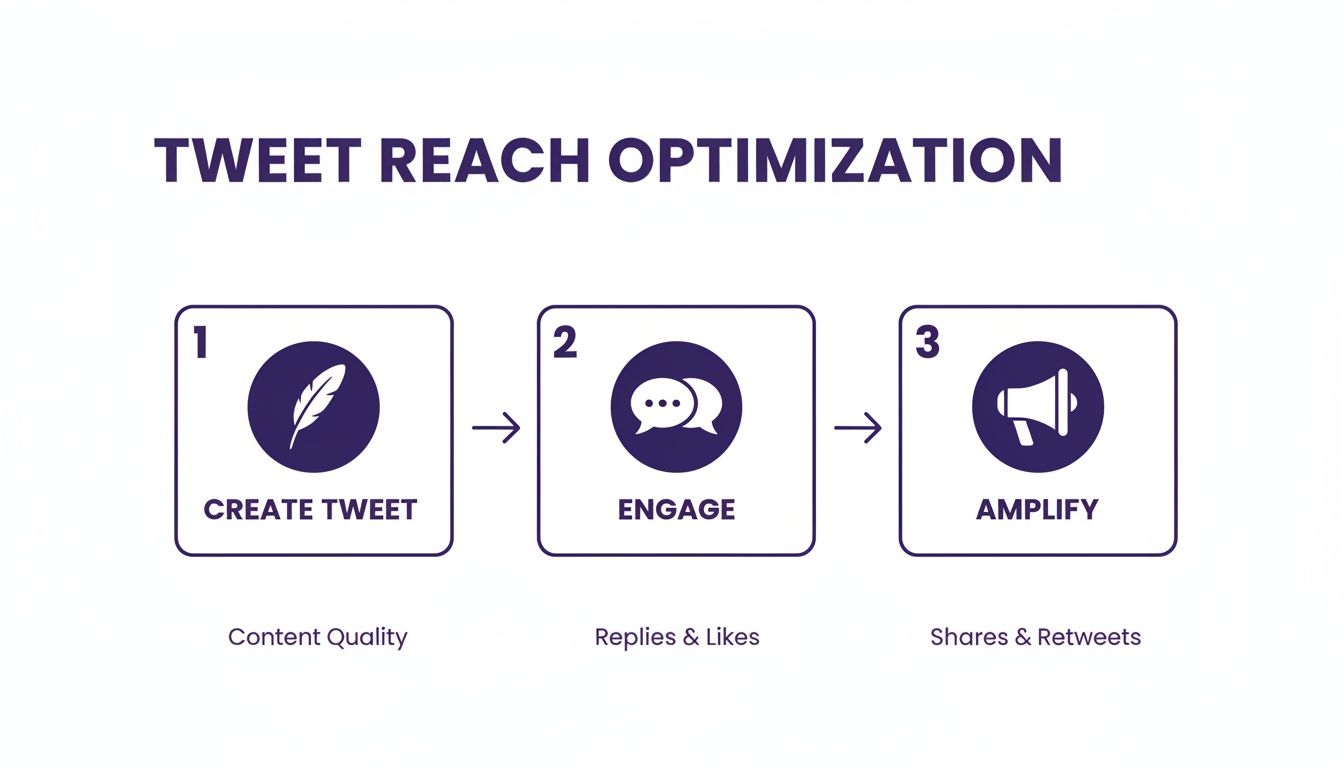
It’s a repeatable process: create valuable content, spark engagement, and then use that interaction to pinpoint potential leads.
From Manual Outreach to Automated Conversations
Once you’ve spotted these high-intent folks, start a conversation. But manually tracking every reply and sending DMs one by one is a surefire way to burn out. It doesn't scale. This is where automation is a founder’s secret weapon.
Imagine a workflow that runs in the background. A user replies to your tweet about scaling sales teams. Minutes later, they get a personalized DM referencing their comment and asking a relevant question. This isn't spam; it's a context-aware conversation starter.
This is what a tool like DMpro is designed for. You can set up triggers based on engagement with specific tweets or keywords. For example, you could automatically reach out to anyone who replies to your threads about lead generation, saying:
- "Hey [Name], saw your reply to my thread on lead gen. Great point about [mention their specific comment]. Curious, what’s your biggest bottleneck with outreach right now?"
This kind of personalization at scale is impossible to manage manually. The outreach feels natural because it’s directly connected to an action they just took.
This system transforms your Twitter account from a content platform into a lead generation machine. You’re building a system that turns passive engagement into active sales conversations—even while you sleep.
If you’re tired of manually sending DMs every day, check out DMpro.ai — it can automate your outreach and replies while you sleep.
How to Measure and Optimize Your Engagement
<iframe width="100%" style="aspect-ratio: 16 / 9;" src="https://www.youtube.com/embed/ftj1br4VJbU" frameborder="0" allow="autoplay; encrypted-media" allowfullscreen></iframe>What gets measured gets improved. If you're tired of throwing content at the wall and hoping something sticks, it’s time to get systematic about your Twitter tweet engagement. This is about building a simple feedback loop to make smart, data-backed decisions.
Stop worrying about what everyone else is doing and focus on your own progress. Are you doing better this month than last month? That’s the only comparison that matters.
Creating a Simple Feedback Loop
Your best friend here is Twitter’s native analytics. It's free, powerful, and gives you all the data you need to see which tweets are winners and what topics resonate.
Here’s a straightforward process:
- Post: Post consistently for a few weeks to gather enough data.
- Measure: At the end of the month, open your analytics. Hunt for the outliers—the tweets that blew the others away.
- Learn: Dig into why they performed so well. Was it the format (thread, video)? The topic? The tone?
- Iterate: Do more of what worked. Cut back on what fell flat. Then, start the cycle again.
This simple loop turns gut feelings into a repeatable strategy. To stay on top of relevant conversations, you can also use Twitter keyword alerts tools.
Setting Realistic Benchmarks
While your own growth is your north star, it helps to have a sense of the landscape. Average engagement rates on Twitter hover around 0.03-0.05%. This gives you a rough baseline to set tangible goals.
The goal isn’t just to post; it’s to build a system that learns and improves. Every tweet is a small experiment that provides feedback on what your audience cares about.
Once you’ve identified a tweet that’s getting attention, you can use a tool like DMpro to automatically send a personalized message to everyone who liked or replied. This closes the gap between measurement and outreach, turning your most engaging content into genuine conversations.
This is how you move from just "doing Twitter" to building a real distribution channel. For an even deeper look, you can check out our guide on using Twitter Analytics.
Answering Your Top Questions
Let's tackle some common questions founders ask about using Twitter to grow their business. No fluff, just what actually moves the needle.
How Often Should I Be Tweeting?
Consistency beats volume. Aim for 1-3 high-quality tweets a day. The goal isn't to flood timelines with low-effort posts.
But the real secret is what you do off your timeline. Spending time replying and adding to other people's conversations will build your reputation far faster than just broadcasting from your own account.
What’s a Good Engagement Rate on Twitter?
The median rate is a tiny 0.046%. If you're hitting that, you're average. Don't be average.
A good starting goal is to get above 0.1%. Your best content should hit 1-2% or higher. Most importantly, track your own progress and aim for a rate that’s consistently improving. And always calculate your engagement rate based on impressions, not followers.
Is It Really Possible to Get B2B Leads from Twitter?
Yes, 100%. But you have to change your approach. Stop thinking about gaining followers and start thinking about starting conversations. Every reply, retweet, and like is a signal from someone interested in what you do.
When people engage with tweets about the problems your business solves, you've found a list of warm leads. You just have to act on those signals.
For example, a tool like DMpro.ai can scale these interactions. Imagine someone replies to your tweet about an industry challenge. It can automatically send them a personalized DM, instantly turning that public chat into a private business conversation.
What's the Biggest Mistake Founders Make on Twitter?
Broadcasting without listening. Too many founders just drop a link, log off, and wonder why there's no engagement. That's a digital bullhorn, not a conversation.
Real twitter tweet engagement is about being an active, helpful member of your community. Ask good questions. Leave thoughtful replies. Share great content from others. Give value freely. Build relationships for the long haul.
If you’re tired of manually sending DMs every day, try DMpro. It automates outreach and replies while you sleep. Get started for free at dmpro.ai.
Ready to Automate Your Twitter Outreach?
Start sending personalized DMs at scale and grow your business on autopilot.
Get Started Free