
A Founder's Guide to No Code Automation for Scaling
Discover how to use no code automation to scale your business. Learn to automate lead generation, outreach, and sales workflows without any coding.
Let's get straight to it. Think of no code automation as hiring a team of digital assistants who work 24/7. They handle your repetitive tasks, they never get tired, and they never make typos. It’s all about connecting the apps you already use to create powerful, hands-off workflows—without needing a developer.
This isn't just about efficiency; for a SaaS founder, it's about building a scalable distribution model that doesn't rely on endless manual work.
What No Code Automation Really Means for Founders
As a founder, your most valuable asset is your time. But how much of it is spent on things that don't actually move the needle? Manually scraping Twitter for leads and sending endless DMs—it's a grind that grinds your growth to a halt.
This is where no code automation flips the script.
Imagine setting up a chain of digital dominoes. You push the first one, and a whole sequence of events unfolds automatically. You set the rules once, and the work gets done every single time.
Here’s a simple example: a new lead engages with your content on Twitter. Instead of you scrambling, an automated workflow kicks in:
- It qualifies the lead based on their bio and recent activity.
- It sends a personalized, relevant opening DM.
- It adds them to your CRM as a new prospect.
This isn't about saving a few minutes. It's about building a system to scale your SaaS distribution without scaling your headcount. Your team is freed up to focus on what humans do best: building relationships and closing deals.
Why This Matters Now More Than Ever
This isn't some niche tech trend; it's a massive shift in how businesses operate. The market for no-code and low-code tools ballooned to $26.9 billion in 2023, growing nearly 20% in a single year.
Even more telling? By 2025, Gartner predicts a whopping 70% of new applications built by companies will use these technologies. That's a huge leap from less than 25% back in 2020.
The takeaway is clear: your competitors are already using automation to work faster. Sticking to manual processes is like showing up to a speedboat race with a rowboat.
Manual Grind vs Automated Flow
See the real difference when you switch from manual tasks to automated workflows for your SaaS.
| Business Task | The Old Way (Manual Hours) | The New Way (No Code Automation) |
|---|---|---|
| Twitter Lead Gen | 10-15 hours/week searching profiles | 10-minute setup, then runs 24/7 |
| Onboarding New Users | 1-2 hours per new user | Fully automated welcome sequence |
| Sales Outreach | 20+ hours/week on cold DMs | AI-driven conversations start automatically |
| Reporting | 5 hours/week compiling data | Real-time dashboards, updated instantly |
The numbers speak for themselves. The time you get back is time you can reinvest into your product, strategy, and customer relationships.
Let’s take outreach on Twitter. The old way is a painful cycle of manually searching keywords, scrolling through profiles, and copy-pasting DMs. It’s slow and impossible to do at scale.
The new way uses no code automation tools built for this exact job. A platform like DMpro.ai, for instance, finds prospects who fit your ideal customer profile based on their tweets or bio. From there, it kicks off personalized, AI-driven conversations, turning a manual time-sink into a lead generation machine that runs while you sleep.
To see how this applies to the bigger picture, check out our comprehensive guide to sales automation.
Ultimately, it’s about building a predictable pipeline without manual labor. You create systems to handle the grunt work, which frees you up to be the visionary your company needs.
The True Business Impact of Automated Workflows
Forget just saving time—let’s talk about real-world results that hit your bottom line. Adopting no-code automation isn't a minor tweak. It's a strategic shift that changes how your SaaS operates, grows, and competes.
At its core, it’s about slashing operational costs. Instead of hiring another person for data entry or customer follow-ups, you build a workflow that does it flawlessly for a fraction of the cost. This lets you run a leaner operation without sacrificing quality.
This approach also dramatically shortens your sales cycle. Picture a small SaaS startup trying to go toe-to-toe with an industry giant. By automating lead nurturing on Twitter, they ensure every potential customer gets a timely, personalized follow-up. No more leads slipping through the cracks.
Achieving More with Less
The whole idea boils down to leverage. You're doing more with the people and resources you already have. This means launching marketing campaigns faster and making smarter, data-backed decisions without needing a dedicated analyst.
To really get it, you need a solid grasp of what workflow automation truly is and how it refines processes. Think of it as the engine powering this new, smarter way of working.
For instance, an automated workflow can pull performance data from your ad platforms, your CRM, and your payment processor into a single dashboard. Suddenly, you have a real-time pulse on your business's health without spending hours in spreadsheets.
As a founder, your job is to build systems, not just do the work. No-code automation is the ultimate system-building tool for those of us who can't code but need to scale fast.
The Staggering ROI of Automation
The numbers behind this shift are hard to ignore. We're not just talking theory; the impact is measured in massive efficiency gains.
Companies are seeing incredible returns. The financial upside is huge. For example, some studies show organizations can save an average of $4.4 million over three years by not having to hire more developers. They're also seeing a 58% revenue increase from customer-facing apps built with no-code tools.
It’s no surprise, then, that this approach can deliver a whopping 362% ROI and speed up project delivery by up to 90%.
Turning Automation into Revenue
So, how does this translate into a scalable distribution model for a SaaS business? It’s all about creating predictable, repeatable revenue streams.
Let's take Twitter outreach as the prime example. Manually finding and engaging with hundreds of potential leads every day is unsustainable for a small team. But a specialized tool like DMpro automates this entire process.
- It finds your leads: The system scans Twitter for users talking about problems your SaaS can solve.
- It starts the conversation: Based on their recent activity, it sends a personalized opening DM.
- It nurtures the relationship: It can handle the initial back-and-forth, qualifying the lead before a human ever steps in.
This transforms a time-consuming, hit-or-miss activity into a reliable lead generation machine. You're not just saving time; you're building a scalable engine that consistently brings in qualified conversations and new customers. This is the true power of no-code automation—turning manual effort into predictable growth.
How to Build Your First Lead Generation Machine
Theory is great, but let's build your first automated lead generation engine. We’ll focus on a powerful workflow for B2B founders: automating outreach on Twitter.
The idea isn't to spam. It's to build a smart system that finds your ideal customers, starts genuine conversations, and gets demos on your calendar—all while you sleep. We're using technology to make your outreach timely, relevant, and scalable.
This is all about translating effort into tangible results, like cutting costs, boosting sales, and winning back your time.
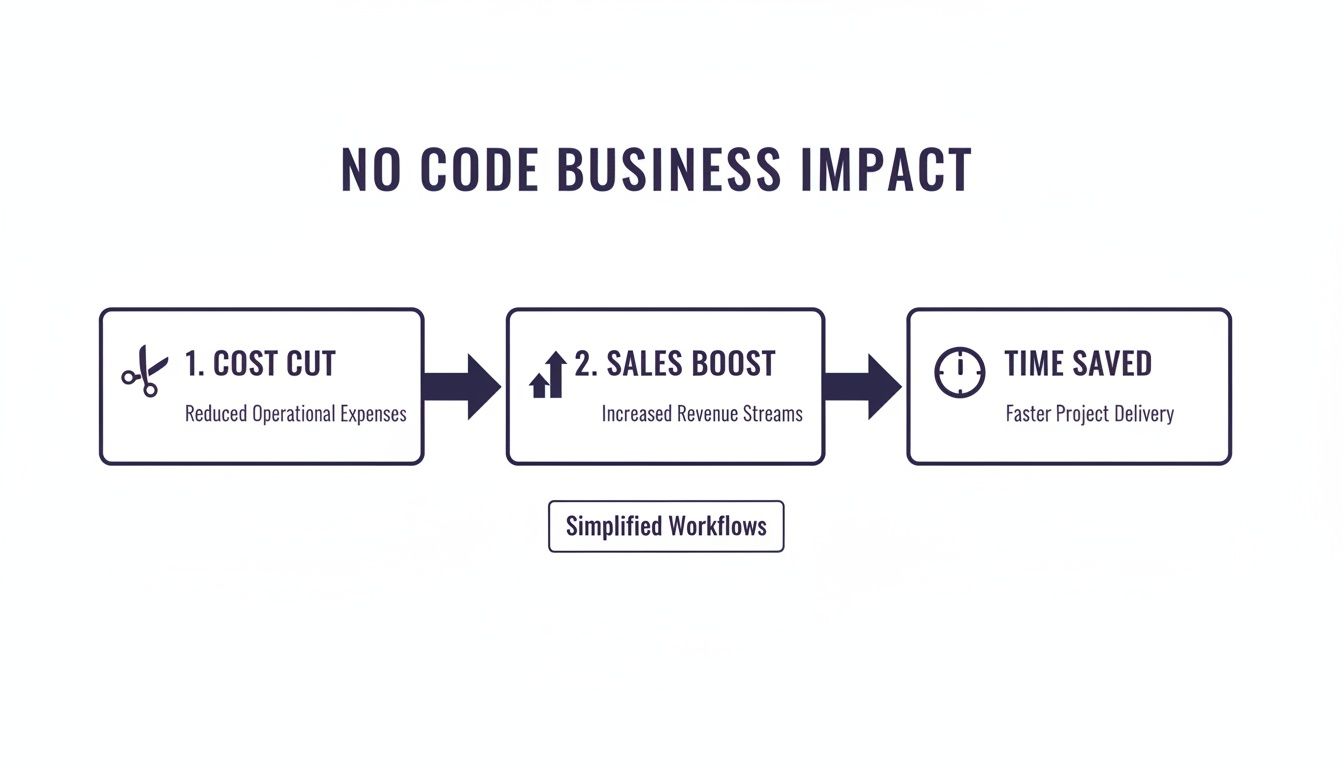
This process shows how automation turns manual tasks into real growth.
Step 1: Pinpoint Your Ideal Customer and Their Trigger Event
Before you touch any tool, be crystal clear on who you're targeting. Who feels the exact pain your product solves? Is it a "Head of Growth at a Series A fintech company" or a "founder of a bootstrapped e-commerce brand"? The more specific, the better.
Once you know who, define the trigger—the digital signal that screams, "This is a perfect prospect, right now!" On Twitter, this could be:
- A specific keyword: Someone tweets, "any recommendations for a good project management tool?"
- A question: A user asks, "how do I reduce my customer churn rate?"
- Joining a conversation: Someone replies to an industry influencer’s post on a relevant topic.
Think of this trigger as the first domino. It's the event that sets your entire automated workflow in motion.
Step 2: Choose Your Automation Tools
To make this work, you’ll need a couple of no-code tools. I think of them as the brain and the specialist.
- The Connector (The Brain): A platform like Zapier or Make. Its job is to watch for your trigger in one app (Twitter) and then tell another app what to do. It’s the central hub for your operation.
- The Specialist (The Action Tool): For Twitter outreach, DMpro.ai is the specialist. It’s designed not just to send a message, but to find the right people and start a conversation that feels human.
You set up your Connector to listen for your trigger on Twitter. The moment it finds a match, it grabs the data—like the user's profile and the tweet's content—and passes it to your Specialist tool. If you want to dive deeper, our guide on proven SaaS lead generation strategies explores the bigger picture.
Step 3: Design the Action and Data Flow
This is where the magic happens. What exactly takes place after the trigger fires? This is the action, and it’s about more than sending a generic, "Hey, check out my SaaS!" message. That’s a one-way ticket to being ignored.
A great automated outreach campaign doesn't feel automated. It feels like a timely, helpful response to a problem someone just shared. Personalization at scale is the name of the game.
Your action sequence needs to be thoughtful. With a platform like DMpro, you can design a message that directly references the prospect's original tweet. For instance:
"Hey [Name], I saw your tweet about looking for a new project management tool. We built ours specifically for [their industry] to solve [the exact problem they mentioned]. Might be worth a look."
Referencing their context instantly makes your message stand out. The data flow is straightforward: the trigger passes the tweet content and user info to your outreach tool, which uses that data to populate a personalized message template.
From there, you can make the workflow even smarter. Add a step to log the new lead in a Google Sheet or your CRM, creating a seamless pipeline. What you’ve just built is a machine that turns public conversations into qualified leads, running 24/7 without you lifting a finger.
Essential Automation Playbooks for SaaS Growth
Once you've built your first lead gen machine, you'll see the magic of no-code automation. But that’s just scratching the surface. The trick to scaling your SaaS is to apply that same mindset to other crucial areas.
Let’s go beyond finding new leads and look at three more proven playbooks. These are the workflows that separate the startups that hit a wall from the ones that grow like clockwork.
Playbook 1: Automated Customer Onboarding
The moment a user signs up is your make-or-break opportunity. If their first experience is clunky or silent, you're inviting them to churn. This playbook ensures every new user is guided straight to their "aha!" moment.
The goal is simple: deliver the right information at the right time.
- Instantly: A personalized welcome email lands in their inbox, maybe from the founder's account.
- Day 2: Send a quick-start guide or a link to a short, helpful tutorial video.
- Day 4: A check-in message highlights a key feature they haven't tried yet.
- Day 7: Send one last tip and ask for feedback.
This creates a polished journey that makes users feel valued from day one, boosting activation and retention rates without your team lifting a finger.
Playbook 2: Automated Content Distribution
You just spent hours on a fantastic blog post. Hitting "publish" isn't the end. This playbook turns that single piece of content into a multi-channel marketing campaign that runs on its own.
Think of it as your instant amplification system.
- Social Sharing: The system automatically pushes the post link with a custom message to your Twitter, LinkedIn, and Facebook profiles.
- Email Newsletter: It grabs the article's title and summary, drops it into your email tool (like Mailchimp or ConvertKit), and sends it to your subscriber list.
- Internal Alerts: It pings your team in Slack with the live link so they can share it with their own networks.
This workflow guarantees your content gets in front of the largest possible audience, every single time. It saves you from hours of tedious copy-pasting.
Playbook 3: Automated Sales Pipeline Management
As leads pour in, the biggest danger is letting them slip through the cracks. This playbook ensures every deal keeps moving forward. It's like a digital sales assistant for your whole team.
This is where you connect your CRM to your communication and task management tools. A solid outreach sequence is the starting point; our guide on sales cadence best practices can help you structure it perfectly.
The best automation doesn’t replace your sales team; it empowers them. It handles the administrative grunt work so they can focus on building relationships and closing deals.
Here’s a practical example. When a lead from a tool like DMpro.ai is qualified in your CRM:
- Task Assignment: A new task is automatically created and assigned to the right salesperson in Asana or Trello.
- Follow-Up Reminders: If there’s no activity logged within 48 hours, the system sends a nudge to the salesperson via Slack.
- Deal Stage Updates: When a demo is booked, the deal is automatically moved to the next stage in your pipeline.
This playbook creates a tight, leak-proof sales process, ensuring timely follow-ups and giving you a crystal-clear view of your pipeline.
Choosing the Right Tools for Your Automation Stack
Jumping into no-code automation can feel overwhelming. But as a founder, you don't need a hundred different gadgets—you just need the right few to build a powerful, lean tech stack.
Think about your stack like an elite team. You don't want redundant roles. You want specialists who work together seamlessly. Let's break down the essential tool categories you'll need.
The Four Core Tool Categories
Most effective automation stacks use a mix of four types of tools.
-
The Connectors: These are the nervous system of your stack. Tools like Zapier and Make are the glue between your other apps. They watch for a trigger in one app and kick off an action in another.
-
The Builders: These platforms build web pages, apps, or internal dashboards without code. Think Webflow for a marketing site or Bubble for a complex web app.
-
The Databases: This is where your data lives. Airtable and Notion are flexible, no-code databases that can become the single source of truth for your business.
-
The Specialists: These are my favorite. Specialist tools do one high-value task exceptionally well. While a connector can handle basic tasks, a specialist brings deep functionality for a specific purpose, like scaling your outreach.
Why Specialist Tools Are Your Secret Weapon
That last category is where you find the game-changers. For any founder focused on growth, automating sales and lead generation is a must. This is where a specialist tool like DMpro.ai becomes the most valuable player in your stack.
A general tool might send a basic message, but DMpro is built from the ground up for intelligent Twitter outreach. It handles the entire process: finding hyper-relevant leads, starting personalized conversations with AI, and managing the campaign safely and effectively.
It’s the difference between a generic multitool and a precision instrument.
When you're weighing your options, our guide on the top lead generation automation tools can give you a much broader look at what's out there.
Building Your Starter Stack
You don't need a dozen subscriptions on day one. Start small with a focused stack designed to get more customers. As you build, considering the best LinkedIn automation tools can also boost your outreach on other platforms.
Your goal isn't to collect tools; it's to build systems. A simple, three-tool stack that generates five qualified leads a day is infinitely more valuable than a complex, ten-tool stack that just creates noise.
To get you started, here is a breakdown of the essential tools you might need.
Your No Code Automation Starter Kit
A clear breakdown of essential no code tools by category to help you build your stack.
| Tool Category | What It Does for You | Top Tool Examples |
|---|---|---|
| Connectors | Acts as the "glue" that links your different apps and passes data between them. | Zapier, Make, Integrately |
| Builders | Lets you create websites, landing pages, and web apps without writing code. | Webflow, Bubble, Softr |
| Databases | Stores and organizes your data (leads, customers, projects) in a flexible way. | Airtable, Notion, Google Sheets |
| Specialists | Excels at one specific, high-value task like outreach, email marketing, or analytics. | DMpro.ai (X outreach), Mailchimp (Email), Mixpanel (Analytics) |
This table gives you a roadmap. You don't need one from every category right away, but understanding their roles helps you make smarter choices.
Here’s a lean and mean starter stack for automating B2B lead generation:
- A Connector: Start with Zapier or Make to connect your workflows.
- A Database: Use Airtable or a simple Google Sheet to log new leads.
- A Specialist: Plug in DMpro.ai to run your Twitter outreach on autopilot.
This simple setup connects your lead source to your database, creating a smooth pipeline that finds prospects and organizes them for your sales team. It’s a strategic framework for a tech stack that delivers results, not complexity.
Common Pitfalls and How to Avoid Them
Jumping into no-code automation feels like discovering a superpower. But it’s easy to make mistakes that can hurt your brand and waste your time. Let’s walk through the traps I’ve seen other founders fall into, so you can sidestep them.
The single biggest mistake is over-automating your communication until it loses all human touch. Shooting off a DM the second someone follows you almost always comes across as robotic and pushy. People can spot generic automation from a mile away—it’s an instant turn-off.
Another major pitfall is setting up sloppy triggers. If your rules for outreach are too broad, like targeting anyone who uses a common hashtag, you'll end up spamming people who couldn't care less about your product. This doesn't just get you ignored; it can damage your brand's reputation.
Staying on the Right Track
So, how do you get the upsides of automation without the cringe? Start small. Don't try to automate your entire business on day one.
Pick one simple, high-impact workflow and get it right. Map out the entire process on paper before you even log into a tool. What’s the trigger? What’s the ideal outcome? This forces you to think through the logic and, most importantly, the customer experience.
Always optimize for the person on the other end.
Your automation should feel like a helpful, timely interaction, not a robotic intrusion. The goal is to make the recipient feel like you’ve paid attention to them specifically, even when a system is doing the work.
Smart Automation in Action
This is where specialist tools make all the difference. For example, when using a platform like DMpro.ai for Twitter outreach, the worst thing you can do is blast a generic message to hundreds of people.
The right way is to use its AI to create hyper-personalized messages based on a prospect's recent activity. Did they just ask a question your SaaS can answer? Did they just complain about a problem your product solves?
- Start with one simple workflow: Automate finding leads before you automate outreach.
- Map your process first: Visualize the journey from your prospect's point of view.
- Always test and monitor: Keep a close eye on your workflows to catch any weird behavior.
By referencing that specific context, your outreach becomes relevant and valuable, not robotic. This thoughtful approach helps you build a powerful no-code automation engine that builds relationships and drives growth.
Time to Roll Up Your Sleeves and Build
Alright, you've got the concepts, you've seen the workflows, and you know the tools. Now comes the fun part: building your own automated systems.
If there's one piece of advice to take away, it's this: start small. Pick one nagging problem that’s eating up your time and solve that first. Don't try to automate your entire business in a weekend.
Maybe your first project is as simple as automatically capturing leads from Twitter, or maybe it's smoothing out your customer onboarding. Whatever it is, focus on getting that one thing working. The goal is progress, not perfection.
By adopting no-code automation, you're not just saving time. You're building a smarter, more efficient business—one that can scale without you becoming the bottleneck. It's about creating systems that let you operate like a much larger company.
If you’re tired of manually sending DMs every day, try DMpro.ai — it automates outreach and replies while you sleep.
Ready to Automate Your Twitter Outreach?
Start sending personalized DMs at scale and grow your business on autopilot.
Get Started Free