
Managing multiple social media accounts: A founder's guide
Discover practical steps for managing multiple social media accounts, from content planning to automating outreach and turning posts into leads.
As a founder, managing social media can feel like a second full-time job you never asked for. The real goal isn't just juggling a dozen platforms; it's about turning that activity into a predictable engine that drives real growth for your SaaS. It all starts by getting ruthless about which channels you focus on—and which ones you ignore.
The Founder's Dilemma: Juggling Social Accounts
Everyone tells you to be everywhere online. "You have to be on Twitter! Don't forget LinkedIn! Are you making TikToks?" The list goes on. In practice, trying to do it all just leads to burnout, a muddled message, and a lot of time spent with very little to show for it.
If you're feeling overwhelmed, you're not alone. It’s a classic startup struggle when you’re trying to code the product, talk to users, and somehow market the thing all at the same time. That nagging fear that you’re neglecting one platform while focusing on another can be paralyzing. For founders stuck in this cycle, it’s worth exploring some practical strategies to manage multiple social media accounts without burnout.
From Chaos to a Distribution Engine
Here’s the good news: you don't need to be everywhere. You just need to be incredibly effective where it actually matters. The trick is to shift your thinking from "managing accounts" to "building a distribution system." That means setting up repeatable workflows that bring in leads without eating up your entire day.
The average person hangs out on around 6.83 different social media platforms each month. For a business, this means showing up on places like Twitter, LinkedIn, and others is key to reaching different pockets of your audience. But each one demands its own unique touch.
The secret isn't managing more accounts; it's building a smarter system. Find the one or two channels where your ideal customers live, and build an automated machine to engage them there.
For many B2B SaaS founders, Twitter is a goldmine. It's where you can talk directly to potential customers, establish yourself as an expert, and spark conversations that lead to sales. The big challenge, of course, is doing that at scale without spending your life in the DMs.
This is where automation becomes your secret weapon. Imagine you're running a few different Twitter accounts, each targeting a specific customer profile. Instead of manually sending hundreds of messages, a tool like DMpro can handle the initial outreach for you. It can send personalized DMs based on what people tweet about or who they follow. This frees you up to focus on what humans do best: engaging with warm replies and closing the deal.
At the end of the day, winning at social media is about choosing your battles. Stop spreading yourself thin. Pinpoint the platforms that will move the needle for your business, then build a lean, automated system to dominate them.
Build a Lean Content and Scheduling System
The biggest time-suck for any founder isn't just juggling multiple social accounts. It's the relentless pressure to constantly feed the content beast. If you feel like you're on a hamster wheel, it's time to build a system that works for you. This isn't about hiring a content team; it's about being lean and smart.
The game changes when you adopt a "pillar and spoke" model. You create one solid piece of content—your pillar. Then, you break it down into dozens of smaller pieces for each platform—your spokes. This simple shift turns one big effort into a full week's worth of posts, all without burning you out.
This is the typical journey I see founders go through, moving from total chaos to a place where they're in complete control.
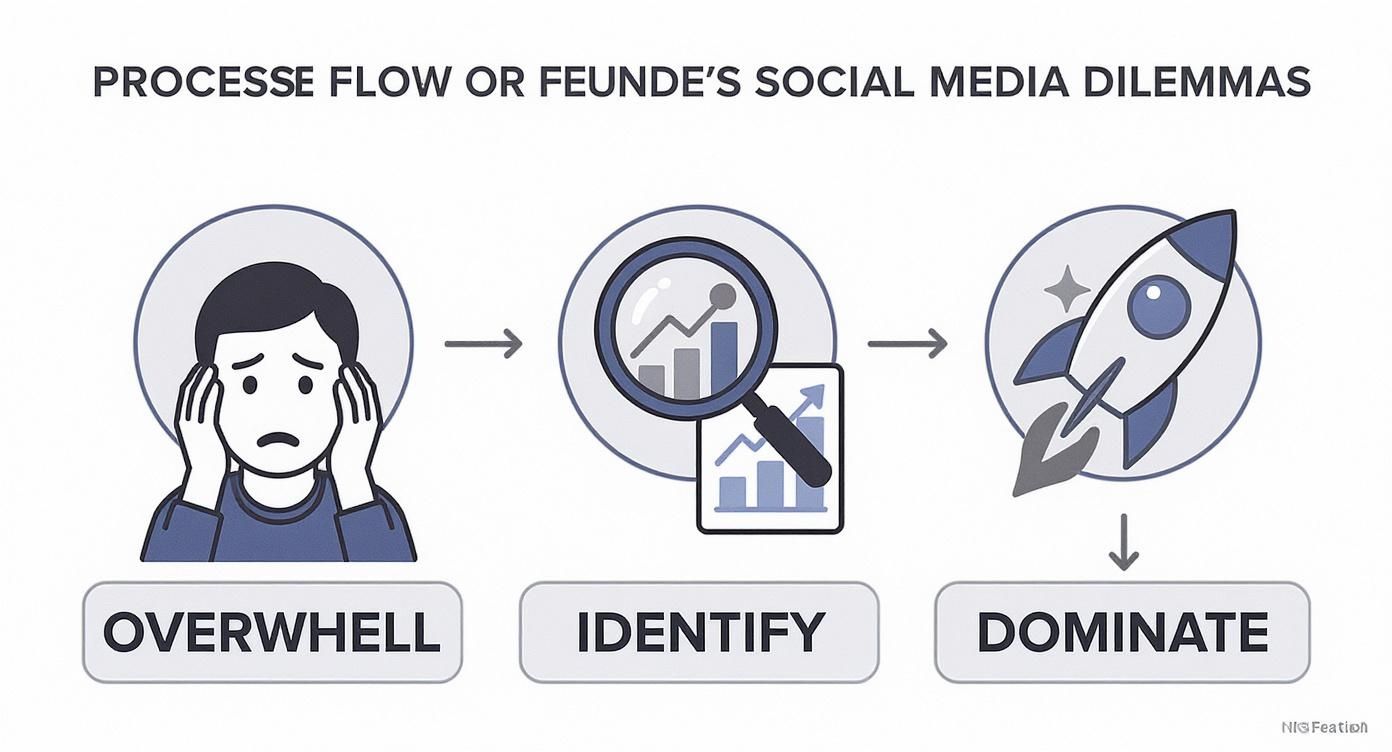
The point is, getting a handle on this isn't about some complex strategy. It's about identifying what works and building a repeatable process to make it happen.
The Pillar and Spoke Model in Action
So, what does this look like in the real world?
Let’s say you just published a 1,500-word blog post about a pain point your SaaS solves. The amateur move is to just tweet the link and call it a day. The pro move is to repurpose that single asset into a content goldmine.
Here’s how that one blog post can fuel your entire week:
- A 10-part Twitter thread: Pull out key stats or actionable tips from the article and turn each one into a tweet.
- A LinkedIn carousel: Summarize the main sections of the post into visually punchy slides.
- A few short-form videos: Fire up your phone and record yourself explaining three of the core concepts.
- A newsletter edition: Go deeper on one specific takeaway, giving your subscribers an exclusive angle.
You’re not just cross-posting. You’re adapting your core message to fit how people actually use each platform. All of a sudden, one piece of work powers your whole content engine for the week.
Master Your Workflow with Batching and Scheduling
Consistency is everything on social media, but posting live every day is a recipe for burnout. This is where batching becomes your superpower.
Instead of waking up and thinking, "What should I post today?", you set aside one block of time each week. During that session, you create all your "spokes" from that week's pillar content. Get it all done at once.
Once your content is created, a scheduling tool is non-negotiable. Logging in and out of different platforms to post manually is a monumental waste of time. A good scheduler lets you load up everything for the week and then it just runs on autopilot. If you need a hand picking one, our guide on choosing the right Twitter post scheduler breaks down what a busy founder actually needs.
Your goal is to create a predictable rhythm. When content creation and scheduling become a system, you stop thinking about what to post and start focusing on the conversations and leads your content generates.
This single shift frees up an incredible amount of mental energy. The system handles the repetitive stuff, leaving you free to engage with comments, jump into relevant discussions, and focus on the high-impact activities that actually move the needle for your business.
Scale Your Outreach Without Sounding Like a Robot
Okay, so your content machine is humming. Now what? It's time to turn that activity into actual conversations and, ultimately, leads for your SaaS. The quickest way to grow is to scale your outreach, but there’s a catch—no one wants to receive a generic, robotic DM.
The real skill lies in automating your outreach so that it still feels personal and human. This is especially true on a platform like Twitter, where authentic conversation is king.
The goal isn't just to pump out more messages. It’s to start more genuine conversations. We need to move beyond lazy pitches like "Hey, check out my SaaS" and start crafting templates that are personalized enough to actually earn a reply. Smart automation handles the heavy lifting, freeing you up to jump in the moment a real connection is made.
This shift isn't just a "nice-to-have"; it's a necessity. According to Sprout Social’s research, people's habits are changing fast. Younger users are driving this trend, making it critical for brands to not just be present but to be actively engaging.
Crafting Outreach That People Actually Reply To
Let’s be honest: generic DMs are a waste of everyone's time. To get a response, your outreach has to feel like it was written for that person, even if it’s part of a larger automated campaign. The trick is to use smart triggers and personalization variables.
Instead of a one-size-fits-all pitch, build templates that reference specific details you can pull automatically. For example:
- Trigger on a keyword: If someone tweets about "struggling with project management," your automated DM could say, "Hey [FirstName], saw your tweet about project management headaches. I've been there. Have you ever tried a tool that...?"
- Reference their bio: If their bio says "building a SaaS in public," your message could be, "Hey [FirstName], love that you're building in public. We're doing the same. Curious how you're handling [specific problem]?"
This is where a purpose-built tool becomes your best friend. With something like DMpro.ai, you can set up campaigns that target users based on the keywords they use or who they follow. The platform then sends personalized initial DMs 24/7, putting your outreach on autopilot. To see how this works, check out our guide on how to send automated Twitter DMs that don’t feel like spam.
Key Takeaway: The goal of automation isn't to replace human conversation. It's to create the opening for one. Automate the first touchpoint, then jump in personally as soon as you get a positive reply.
Do's and Don'ts of Safe Automation
When you’re scaling outreach across multiple accounts, you have to play it smart to stay on the right side of platform rules. Getting this wrong can land your accounts in hot water.
Here are a few ground rules we've learned from managing dozens of accounts:
The Do's:
- Warm up new accounts. Don't just create a new account and immediately start blasting hundreds of DMs. Start slow. Gradually ramp up your activity over a few weeks.
- Use spintax and variables. Always vary your message templates. Using spintax (like "{Hey|Hi|Hello}, [FirstName]") makes each message unique, which is critical for account health.
- Set realistic daily limits. Stick to sensible daily caps for DMs and follows. Pushing the limits is a quick way to trigger a platform's anti-spam alarms.
The Don'ts:
- Send the exact same message to everyone. This is the fastest way to get flagged as spam. Personalization isn't just for getting replies; it's a safety measure.
- Ignore your reply rates. If your reply rates are tanking, something is wrong. Tweak your messaging before you keep scaling.
- Use the same IP for all accounts. This is a rookie mistake. When managing multiple profiles, using different proxies is essential to keep them from being linked and flagged.
Manual Outreach vs Automated Outreach
To really understand the impact of automation, it helps to see a side-by-side comparison. Manually sending a handful of DMs each day simply can't compete with a system designed for scale.
| Factor | Manual Outreach | Automated Outreach (e.g., DMpro.ai) |
|---|---|---|
| Time Investment | Hours per day | Minutes to set up, then runs 24/7 |
| Scale | Limited to a few dozen DMs daily | Can send hundreds of DMs per day |
| Consistency | Relies on daily human effort; inconsistent | Runs continuously without breaks or holidays |
| Personalization | High, but extremely time-consuming | High, using dynamic variables at scale |
| Follow-Ups | Easy to forget or miss | Automated and perfectly timed |
As you can see, automation isn't just about sending more messages—it's about creating a consistent, scalable system that works for you even when you're not at your desk. Let technology do the grunt work so you can focus on building genuine relationships.
How to Scale Your Accounts Safely
When you start automating outreach across multiple accounts, you’re playing a different game. It’s no longer just about content; it's about managing risk. And let me be clear: this is where "playing it safe" is absolutely critical. One wrong move can get your accounts restricted or, even worse, banned. Your entire lead gen engine can vanish overnight.
Think of this as your operational security manual. These aren't just theoretical guidelines. They're hard-won lessons from people in the trenches who've learned exactly where the platforms plant their tripwires.
The Art of the Warm-Up
You can't just spin up a new Twitter account today and start hammering out hundreds of DMs tomorrow. That’s a one-way ticket to getting flagged. The platforms are constantly on the lookout for natural, human-like behavior, so your job is to give them exactly that.
This process is what we call "warming up" an account. It’s all about gradually increasing its activity over several days or weeks to build up a legitimate history of normal engagement.
A simple warm-up schedule I've seen work well looks something like this:
- Week 1: Follow 10-20 relevant accounts each day. Like a few dozen tweets. Drop a handful of genuine replies. Keep it light.
- Week 2: Bump your follows up to 20-30 per day. Start liking and replying a bit more. Now you can start sending 10-15 DMs daily.
- Week 3 & 4: Continue this slow and steady increase until you hit the daily outreach volume you’re aiming for.
This gradual ramp-up mimics how a real person would naturally start using the platform. It builds trust with the algorithm and keeps your accounts flying under the radar.
Respect the Unwritten Rules and Daily Limits
Every platform has limits, but they rarely post the exact numbers. From experience, we’ve learned that staying within sensible daily boundaries is the key to long-term account health. Trying to push those limits is a short-term game you will eventually lose.
While these numbers can shift, a safe starting point for a fully warmed-up Twitter account is somewhere in the ballpark of 25-40 DMs per day. Consistently going much higher than that is just asking for trouble. For a deeper dive into these thresholds, check out our guide on the Twitter direct message limit and how to work within it.
The real goal isn't to send the absolute maximum number of messages possible. It's to send the maximum number of safe messages consistently, day in and day out. Slow and steady wins this race.
Why Message Variation and Proxies Are Non-Negotiable
If you send the exact same copy-and-pasted message to hundreds of people, you look like a spammer. To get around this, you have to use spintax. Spintax is just a way of writing a message template that includes multiple variations for specific words or phrases.
For example, a snippet like "{Hey|Hi|Hello}, {I saw|I noticed} your tweet..." can generate several unique openings. A good automation tool like DMpro.ai handles this for you, making sure every DM sent from your account is slightly different. That variation is a massive signal to the platform that you're not a bot.
The other non-negotiable for anyone serious about managing multiple accounts is using proxies. A proxy masks your real IP address. If you run five Twitter accounts from the same Wi-Fi, the platform can easily connect the dots. If one account gets flagged, the rest are immediately at risk.
By assigning a unique proxy to each account, you make them appear as if they're being operated from different locations. This is a fundamental safety measure that isolates each account, so a problem with one doesn't bring down your entire operation.
Measure What Actually Drives Revenue
It’s easy to get caught up in the dopamine hit of likes and new followers. But those "vanity metrics" don't pay the bills. As a founder, your time is your most precious resource, and you need to know if your social media efforts are actually generating revenue or just making noise.
Let's cut through the fluff. This is about building a simple dashboard—even if it's just a spreadsheet—that tells you exactly which accounts, campaigns, and messages are bringing in real business. When you have that data, social media becomes a predictable, scalable channel for growing your SaaS.

Ditch Vanity Metrics for Actionable KPIs
When you're running multiple accounts for lead generation, especially on platforms like Twitter, you have to shift your focus from top-of-funnel buzz to bottom-of-funnel results. It’s great if a post gets a lot of likes, but if it doesn't lead to a single conversation or demo, did it actually move the needle?
Here are the key performance indicators (KPIs) you should be tracking obsessively:
- Reply Rate: Your first and most important signal. It tells you if your initial outreach messages are compelling enough to get a response.
- Positive Reply Rate: Not all replies are good replies. You need to zero in on the percentage of responses that show genuine interest ("Tell me more," "Sounds interesting").
- Meetings Booked: How many of those positive conversations are turning into actual demos or sales calls on your calendar?
- Customers Acquired: The ultimate metric. How many of those meetings converted into paying customers?
Tracking these numbers gives you a crystal-clear view of your entire funnel. If your reply rate is high but no one books a meeting, you know the problem is in how you handle the conversation.
Your goal isn't just to be active; it's to be effective. A simple tracking system that connects social media activity directly to revenue is the single most powerful tool you can build for your growth strategy.
Building Your Lean Revenue Dashboard
You don’t need a complicated business intelligence tool to get started. Honestly, a simple Google Sheet can be incredibly powerful. Create a new sheet for each month and track the performance of each of your social accounts across the KPIs we just covered.
This dashboard should quickly tell you which accounts are your top performers and which message templates are killing it. This is what allows you to make smart, data-backed decisions instead of just guessing what works.
For instance, a tool like DMpro can automate a lot of this for you. Instead of manually counting replies, its built-in features let you monitor campaign performance at a glance. You can see which outreach campaigns have the highest reply rates, helping you double down on your winners and kill the losers fast. To get a better sense of how this works, you can explore DMpro's approach to analytics and reporting.
The table below breaks down these core metrics and why each one is so critical for a SaaS founder focused on growth.
Key Performance Indicators for Social Outreach
| Metric | What It Measures | Why It Matters for SaaS Founders |
|---|---|---|
| Reply Rate | Percentage of initial DMs that get a response. | Indicates the effectiveness of your targeting and opening message. |
| Positive Reply Rate | Percentage of replies that express interest. | Filters out noise and shows true lead quality. |
| Meetings Booked | Number of demos or calls scheduled from outreach. | Directly links social activity to the sales pipeline. |
| Customers Acquired | Number of new paying customers from the channel. | The ultimate proof of ROI and channel viability. |
By obsessively tracking these four numbers, you turn managing multiple social media accounts from a guessing game into a science. You'll know exactly what's working, what's not, and where to invest your energy to drive real, measurable revenue.
Your Simple Social Media Management Playbook
Alright, let's pull all of this together. We've talked strategy, but now it's time to build your actual playbook—a clear, step-by-step guide to get you out of the weeds.
Think of this as your final checklist for moving past the chaos of reactive social media management. The goal isn't just to be more organized; it's to reclaim your time and build a system that generates leads without constant hand-holding.
As a founder, your focus is your most valuable asset. Every minute you're stuck manually posting or copy-pasting DMs is a minute you aren't improving your product or talking to your best customers. Building a smart system is the only way to scale your efforts without burning out.
Your Final Checklist for Success
To transform your social media from a time-sink into a reliable distribution engine, you only need to nail three core pillars.
-
Build a Lean Content System: Ditch the daily "what should I post?" scramble. Use the pillar-and-spoke model to slice one big idea into a full week of content. Then, get it all loaded into a scheduler and let it run.
-
Automate Outreach Intelligently: The name of the game is starting conversations at scale. Smart templates and tools like DMpro can handle those crucial first touchpoints, which frees you up to jump into conversations once a lead is warm.
-
Measure What Matters: Forget vanity metrics. The only numbers that really move the needle are reply rates, meetings booked, and customers acquired. This is how you turn social media into a predictable revenue channel.
An effective social media strategy is the foundation that holds all of this together, giving you the clarity to execute consistently.
The big takeaway is this: your social media accounts should work for you, not the other way around. Implement systems that run in the background, so you can focus on what you do best—building a great company.
How Many Social Media Accounts Are Too Many?
Honestly, there’s no secret number. The right amount is the number of accounts you can manage well enough to see a real return. My advice? Start small. Pick one, maybe two, platforms where you know your customers hang out. For most B2B SaaS companies, that’s going to be Twitter or LinkedIn.
It's way more effective to master a single channel than to spread yourself thin across five. Get a solid, repeatable process going on your main platform first. Once that's running smoothly and bringing in leads, then you can think about expanding.
This is where automation helps. A tool like DMpro can run outreach campaigns on several Twitter accounts at once, letting you scale up without having to hire a full-time social media manager right away.
Should I Post the Exact Same Content Everywhere?
Definitely not. But you should use the same core idea. That’s a key difference. Just copy-pasting the same link everywhere is lazy marketing, and your audience will see right through it.
The smarter move is to repurpose your content for each specific channel. Think about it this way: one solid blog post can be spun into multiple pieces of native content.
- Twitter: A punchy thread that breaks down the key takeaways.
- LinkedIn: A professional-looking carousel with a few visual slides.
- Instagram/TikTok: A short Reel or video explaining one core concept from the post.
You're just changing the packaging to fit the audience. It’s a little extra work upfront, but it pays off with way better engagement and makes every piece of content you create work that much harder for you.
If you’re tired of manually sending DMs every day, try DMpro.ai — it automates outreach and replies while you sleep.
Ready to Automate Your Twitter Outreach?
Start sending personalized DMs at scale and grow your business on autopilot.
Get Started Free