
A Founder's Guide to Using a Twitter Post Scheduler for Lead Gen
Discover how a Twitter post scheduler can save you time, boost engagement, and scale your SaaS distribution. Your complete guide to winning on X (Twitter).
Ever feel like you’re glued to X, trying to find the perfect moment to post? It’s a huge time sink. A Twitter post scheduler lets you write your posts in advance and set them to publish automatically.
For a busy founder, this isn't just a nice-to-have. It’s a game-changer for scaling your SaaS distribution.
Why a Twitter Post Scheduler Is Your Secret Weapon

As a founder, your most precious resource is time. Every minute you spend manually publishing a post is a minute you could have spent talking to users, improving your product, or closing a deal.
This is where a Twitter post scheduler becomes a core part of your growth machine. It’s not just about convenience. It’s about building a system that grows your brand and brings in leads while you focus on what really matters.
Reclaim Your Focus and Time
Imagine having a content machine that works for you around the clock. You can set aside a couple of hours on a Monday to "batch" create all your content for the week, plug it into the scheduler, and get back to building your business.
This one habit helps prevent founder burnout. Instead of feeling that constant pressure to be "on," you can relax knowing your brand is maintaining a consistent presence. Your feed stays alive, even when you're asleep or in meetings.
A consistent presence builds trust and keeps you top-of-mind. Sporadic posting signals inconsistency—the last thing you want potential customers to associate with your SaaS. A scheduler makes consistency effortless.
There's a reason these tools are booming. The global market for social media scheduling tools was valued at USD 17.5 billion in 2022 and is expected to hit USD 51.8 billion by 2027. This highlights how vital a streamlined social media plan has become. You can learn more about the rise of social media scheduling tools and the impact they're having.
Turn Consistency Into an Asset
A scheduler helps turn your Twitter account from a time-sucking chore into a predictable lead-generation channel. When your content is planned and delivered consistently, it sets the stage for powerful outreach automation.
This consistency also makes any automated DM campaigns, like those you might run with a tool like DMpro, feel more genuine. A prospect is far more likely to respond to a message from an active, value-driven account than from a profile that looks like a ghost town.
Scheduling is the first step in building that powerful, automated distribution channel.
Choosing Your Tool: Native Scheduler vs. Third-Party
You've got two main paths for scheduling your posts on X: the free, built-in scheduler, or a dedicated third-party tool.
The native scheduler is fine if you're just starting out. It’s simple and gets the basic job done. No frills, no fuss.
But as a founder, you're not just trying to "post stuff"—you're building a content engine to drive growth. The native scheduler is like a manual screwdriver. A third-party tool is the full power drill set, built for speed and scaling your outreach.
The Limits of Native Scheduling
Twitter’s free tool is intentionally basic. You can schedule individual tweets and threads, but that's where it ends. You won't get a visual content calendar, you can't automatically recycle your best content, and the analytics are non-existent.
This forces you into a clunky workflow that doesn't save much time. If you're serious about making X a core part of your distribution strategy, you'll hit its ceiling almost immediately.
Why Third-Party Tools Are a Game-Changer
This is where specialized schedulers completely change the game. They’re designed for founders who think in systems, not just isolated tasks.
Think of it this way: the native tool helps you post. A third-party tool helps you build an entire content strategy. It’s the difference between doing a job and building a machine that does the job for you.
Here’s a look at the features that make a real difference for lead generation.
Native Twitter Scheduler vs. Third-Party Tools
Here’s a feature-by-feature comparison to help you decide which scheduling solution fits your SaaS growth goals.
| Feature | Native Twitter Scheduler | Third-Party Schedulers |
|---|---|---|
| Basic Scheduling | ✅ Yes (Tweets & Threads) | ✅ Yes (Often more advanced) |
| Visual Content Calendar | ❌ No | ✅ Yes |
| Evergreen Content Queue | ❌ No | ✅ Yes |
| Advanced Analytics | ❌ No | ✅ Yes |
| Smart Time Suggestions | ❌ No | ✅ Yes |
| Multi-Account Management | ❌ No | ✅ Yes |
| Bulk Upload/Scheduling | ❌ No | ✅ Yes |
| Content Curation | ❌ No | ✅ Yes (Usually) |
As you can see, third-party tools are about strategy and optimization. They give you the features you need to turn X into a predictable source of leads.
Here's what those powerful features actually mean for you:
- Evergreen Content Queues: This is huge. You build a library of your best, timeless content that the tool automatically re-shares. Your profile stays active and provides value, even when you're focused on product.
- Advanced Analytics: Finally, you can see which posts drive profile visits, engagement, and link clicks. This data tells you what your audience wants, so you can stop guessing and create more content that converts.
- Smart Scheduling: Many tools analyze your audience's activity and suggest the best times to post for maximum reach. It takes the guesswork out of hitting that sweet spot for engagement.
- Multi-Account Management: Juggling a personal brand and a company profile? This is a must-have. You can manage everything from a single dashboard. If you're managing multiple accounts, we wrote a helpful guide on the topic you can read for more details.
These tools are built around one core idea: your content should keep working for you long after you hit "schedule." It becomes an asset that fuels growth, warms up leads, and makes your outreach—like automated DMs with a tool like DMpro.ai—so much more effective.
Key Features That Drive Real Growth
Not all schedulers are built the same. As a founder, you can't waste money on tools with features that don't actually move the needle on lead gen. You need a system that makes your content smarter at bringing in leads for your SaaS.
Let's skip the fancy bells and whistles and focus on the features that genuinely save you time and get you tangible results.
The Must-Have Scheduling Features
First up are the absolute essentials. Without these, you might as well just use the free, native scheduler.
- Thread Scheduling: X is built for storytelling. A solid scheduler lets you build and schedule entire threads with ease, so you can share your expertise without being glued to your screen.
- Visual Content Calendar: Seeing your entire week of content at a glance is a game-changer. It helps you find gaps, maintain a healthy mix of content, and keep your brand's story consistent.
- Evergreen Content Queue: This is your secret weapon for scaling distribution. You fill a queue with your best, timeless posts, and the tool automatically re-shares them. It keeps your profile active and valuable, even when you're swamped.
Power Features That Give You an Edge
Once you have the basics down, look for features that give you a real strategic advantage. This is what separates good tools from great ones.
Think of it this way: the must-haves help you execute your plan. The power features help you create a better plan in the first place.
A huge one is AI-powered idea generation. When you're staring at a blank screen, these tools can spark inspiration by suggesting relevant topics or rewriting your posts in different tones. It’s like having a co-founder whose only job is content.
Another game-changer is 'best time to post' recommendations. Instead of guessing, these tools analyze when your audience is most active and tell you the exact times to schedule posts for maximum reach. The average engagement rate on X is a tiny 1.57%, so timing is everything. You can discover more insights about X engagement on Postwise.ai to see why every advantage counts.
Finally, you absolutely need in-depth analytics. You have to know what's working. Which topics get the most clicks? What posts are bringing in new followers? This data is how you refine your strategy and double down on what your audience loves. You can learn more about the importance of analytics and reporting in our guide.
Your Simple Content Scheduling Workflow
Alright, let's get practical. You need a workflow that saves time and keeps your content pipeline full. Here's a simple system to get your time back and make your X profile work for you.
The whole game changes with content batching. Instead of waking up and thinking, "What should I post today?", you set aside one block of time—maybe two hours on a Monday—to write all your posts for the entire week. This is a massive unlock for any busy founder.
Once your posts are written, you'll load them into your scheduler. But don't just throw them in there. Organize your content into a few key categories.
Build Your Content Pillars
Think about the different ways you can provide value. Most of your content will likely fall into a few core "pillars" or themes.
Here are a few ideas to get you started:
- Founder Stories: Share lessons learned, challenges overcome, and a peek behind the curtain of building your business. This builds connection and trust.
- Industry Insights: Post your take on trends, news, and the common headaches your customers face. This positions you as an expert.
- Product Updates & Wins: Announce new features, share customer success stories, and show how your product solves a painful problem.
- Questions & Polls: The easiest way to start a conversation is to ask a question. Use polls to get feedback and learn what your audience cares about.
This infographic shows how a scheduler's features fit together to create a smooth process, from writing the post to seeing what works.
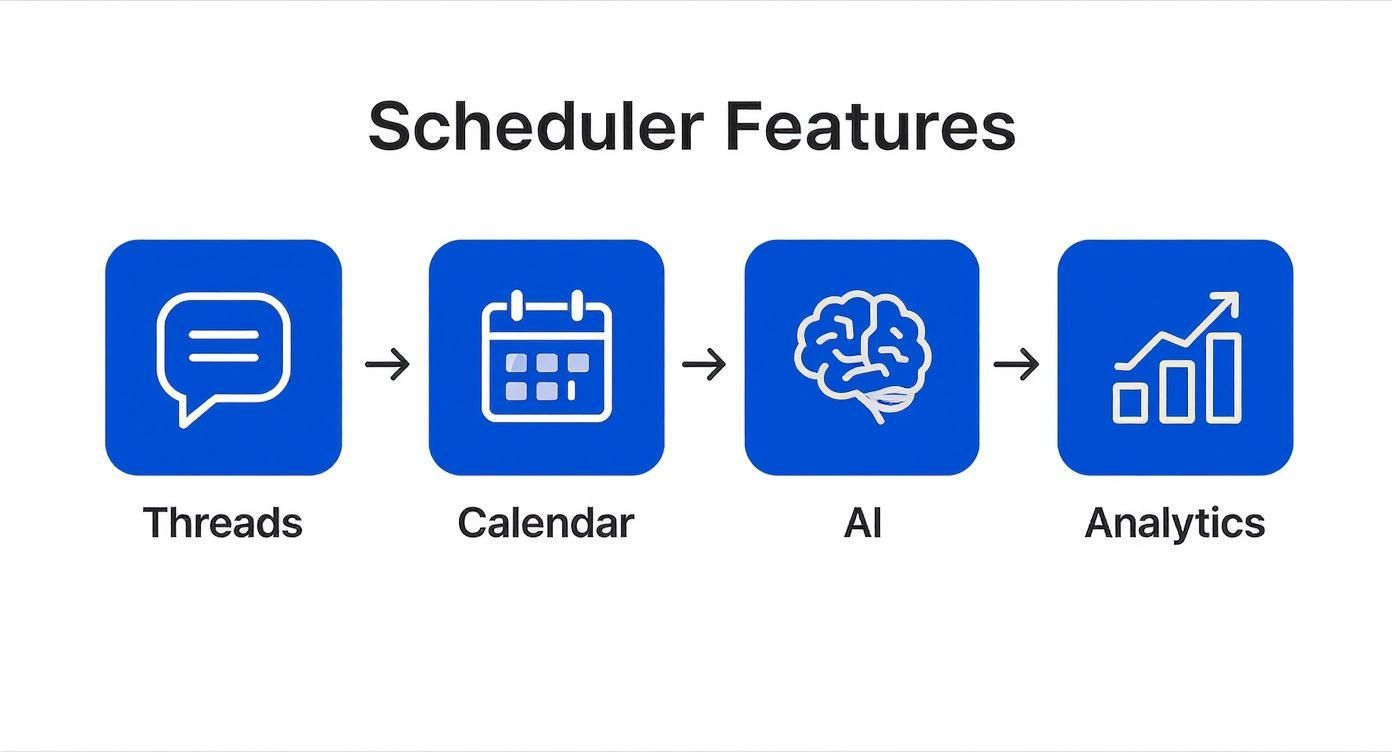
As you can see, features like thread creation and calendar views feed directly into your analytics. This creates a feedback loop where you're constantly learning and improving.
Create an Evergreen Queue
Now for the magic trick. An evergreen queue is a library of your best, most timeless content that your scheduler automatically re-posts for you. These are the posts that are always relevant—your best advice and helpful tips.
Think of your evergreen queue as your 24/7 brand ambassador. It keeps your feed active with high-value content, driving continuous traffic and engagement. This is how a solo founder can maintain an always-on presence.
When you fill your scheduler with a mix of fresh, timely posts and evergreen content, you create a content machine that never stops. That consistency is vital when you're doing any kind of automated outreach.
If you're using a tool like DMpro to automate your cold DMs, a consistently valuable feed makes those messages feel a lot warmer. Your profile has already built credibility before your message even lands in their inbox. If you need a refresher, check out this quick-start guide on setting up your first campaigns to see how it all fits together.
From Scheduled Posts to Automated Leads
So, you’ve got your content engine humming with a Twitter post scheduler. Your profile is alive and putting out valuable stuff. What's next? As a founder, attention is nice, but you need to turn that attention into revenue.
This is where you bridge the gap between your content and your sales funnel. Scheduling posts isn't just about shouting into the void; it's about creating chances to start a conversation.
Turning Engagement Into Conversations
When someone likes, retweets, or replies to one of your scheduled posts, that's a signal. They're raising their hand to show they're interested. Trying to track all those interactions manually is impossible. This is where outreach automation gives you a massive advantage.
You can connect the dots between broadcasting your message and starting the one-on-one chats that lead to demos and sales. This is how you build a real distribution channel.
The goal isn't just to be seen; it's to be engaged with. Your scheduler gets you seen. Your automation strategy gets you customers.
What makes this so effective is that it’s timely and relevant. Instead of sliding into someone's DMs out of the blue, you’re reaching out because of a specific action they just took. The context is already there, making the conversation feel natural.
Building an Automated Lead Funnel
Imagine a system that automatically starts a conversation with anyone who engages with your best content. For instance, with a tool like DMpro.ai, you can set up a campaign that sends a personalized DM to anyone who likes a specific post you scheduled about a new feature.
That changes everything. While your scheduler keeps your profile active, your outreach automation turns that engagement into actual leads. This is especially powerful when you consider users spend an average of 30.9 minutes daily on X. Your scheduled posts have a great shot at grabbing their attention. You can explore more detailed stats about X usage on SocialChamp.com to see how big the opportunity is.
This combination is how you scale distribution. Your scheduler builds the audience and establishes authority. Then, your automation tool sifts through that audience, identifies interested people, and starts conversations for you. You can dive deeper into setting this up in our guide to Twitter automation. It’s a one-two punch that transforms your X account into a powerful lead generation machine.
Finding Your Perfect Posting Cadence
So, you've got a scheduler ready to go. But firing off posts whenever you feel like it won't move the needle. Real growth on X comes from being consistent in a smart way—knowing what to post and when to post it.
<iframe width="100%" style="aspect-ratio: 16 / 9;" src="https://www.youtube.com/embed/Zi236qY6t-I" frameborder="0" allow="autoplay; encrypted-media" allowfullscreen></iframe>Think of your scheduler as the engine, but your strategy is the GPS. Without a clear direction, you’re just burning fuel.
First, uncover your audience's "golden hours." This is when your ideal followers are online and ready to engage. Dive into your analytics and look for patterns. Most good scheduling tools have built-in analytics that do this heavy lifting for you, pointing out your peak engagement windows.
After just a week or two of consistent posting, you’ll start to see a clear picture of when your content hits the hardest.
How Often Should You Post?
Let's talk frequency. Three times a day? Ten? The truth is, there's no single magic number. It depends on your goals and what your audience responds to.
Instead of searching for a universal rule, ask yourself: "What posting schedule allows me to deliver consistent value without burning out?" For most founders starting out, aiming for 2-5 high-quality posts per day is a fantastic, sustainable benchmark.
That range hits the sweet spot. It’s frequent enough to stay on people’s timelines but not so demanding that you sacrifice quality.
Here’s a simple game plan to find your rhythm:
- Start with 3 posts per day: Morning, midday, and evening.
- Keep an eye on engagement: After a week, look at your numbers. Are certain time slots outperforming others?
- Adjust and test: If morning posts get crickets, try moving that content. If your audience is super active, experiment with adding a fourth post.
Keep Your Content Mix Fresh
Finally, let's talk about variety. No one wants to follow an account that posts the same type of content over and over. A good scheduler makes it easy to plan a diverse content calendar.
A healthy content strategy should blend different formats:
- Threads: Perfect for diving deep into complex topics.
- Single Tweets: Great for quick thoughts or asking questions.
- Polls: An amazing way to boost engagement and get direct feedback.
- Images & Videos: These are your scroll-stoppers.
By mixing it up, you make your profile a genuinely interesting place to visit. When you combine this with a smart, consistent schedule, your scheduler becomes a powerful machine for growing your audience and generating leads.
Your Questions Answered
Jumping into any new tool brings up a few questions. When it comes to using a Twitter post scheduler, most founders worry about the same handful of things. Let's tackle these head-on.
How Far Ahead Should I Schedule My Posts?
This is all about striking the right balance. A great starting point is scheduling content one week in advance.
That timeframe gives you enough structure to be consistent without being completely rigid. It lets you batch-create your content, but still leaves you room to jump on a trending topic or share a spontaneous thought.
Can Using a Scheduler Hurt My Engagement?
This is a common myth. The answer is a firm "no"—as long as you're smart about it. The X algorithm doesn't penalize you for using a third-party tool. What does hurt engagement is posting generic, robotic-sounding content.
A scheduler is just a tool. It's the quality of your content that matters. If you use it to post high-value content consistently, your engagement will grow.
The secret is to pair your scheduled content with real-time interaction. Let the scheduler handle consistency, which frees you up to reply to comments, join conversations, and build relationships.
What Are the Most Important Metrics to Track?
It’s easy to get lost in vanity metrics. As a founder focused on lead generation, you only need to worry about a few key numbers.
Focus on these three:
- Link Clicks: Is your content getting people to click through to your website or landing page? It's a direct measure of whether your posts inspire action.
- Profile Visits: After seeing your post, how many people were intrigued enough to check out your profile? This is a fantastic indicator of potential new leads.
- Engagement Rate (Replies & Retweets): Likes are nice, but replies and retweets show that your content is starting conversations. These interactions often spark valuable DMs.
Time to Put Your Twitter Growth on Autopilot
So there you have it—a founder's playbook for using a Twitter post scheduler to save time, build a brand, and turn your profile into a reliable source of leads.
The real shift happens when you stop posting on a whim and start building an automated, strategic system. It's moving from a daily chore to a well-oiled machine that works for you 24/7.
Batching your content, plugging it into a smart scheduler, and linking it to a powerful outreach tool is the secret to scaling distribution. For example, using a scheduler draws in the crowd, while a tool like DMpro starts the conversations that lead to sales.
This entire system is designed to give you your time back. Time you can spend building your product and talking to customers. You're not just posting anymore; you're building a growth engine.
If you’re tired of manually sending DMs every day, try DMpro.ai — it automates outreach and replies while you sleep.
Ready to Automate Your Twitter Outreach?
Start sending personalized DMs at scale and grow your business on autopilot.
Get Started Free