
Navigating the Twitter Direct Message Limit
Hitting the Twitter direct message limit? This guide helps founders understand the rules, avoid getting blocked, and scale outreach without suspension.
So, what's the deal with the "Twitter direct message limit"? It’s not a single number. Think of it as a smart system X (formerly Twitter) uses to filter out spam and keep conversations genuine. It’s a crucial piece of the puzzle for any founder using DMs for lead generation.
For most established accounts, the official daily cap is around 500 DMs. But if your account is new or hasn't built much trust, you’ll hit much tighter, unwritten limits. Getting a handle on this system is non-negotiable for scaling your outreach.
Cracking the Code of X's DM Limits
If you're using X for outreach, you've probably hit a wall and wondered what the actual rules are. The platform is intentionally a bit vague about the exact numbers—if they published a hard rule, spammers would just game it.
Instead, X uses what I call a "trust-based" system. It's like a credit score for your profile. Your account’s age, engagement, and overall behavior all feed into this score, which ultimately decides how many DMs you can send.
A brand-new account starts with a low score and can't send many messages. But as you build a history of genuine engagement—getting replies, having conversations, and not getting flagged as spam—your trust score goes up. A higher score means more freedom to send DMs.
This entire system rests on a few core ideas that work together.
Think of it like a hierarchy. Your account's "trust" sits at the top. This trust directly influences all the layers below it: your daily sending limit, your hourly limit, and how sensitive the platform is to your actions (behavioral flags).
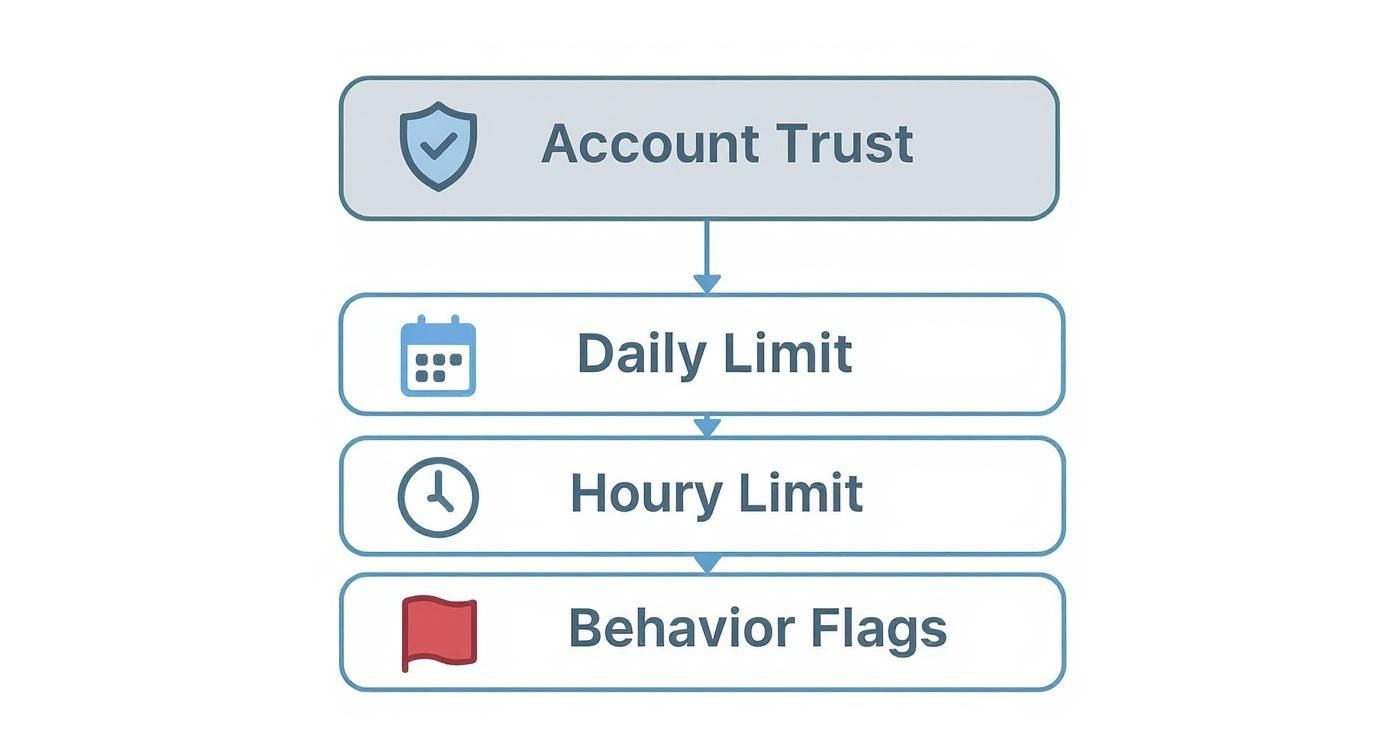
Simply put, a high-trust account can get close to the official limits without a problem. A low-trust account will hit invisible roadblocks much sooner.
The Different Limits You Need to Know
To help you get a clearer picture, I've broken down the limits you'll encounter on X. This quick table gives you the essentials at a glance.
Twitter DM Limits at a Glance
| Limit Type | Typical Cap | What It Means for Founders |
|---|---|---|
| Daily Limit | 500 DMs | This is your absolute max per day. Consistently hitting it signals aggressive outreach to the algorithm. |
| Hourly/Rate Limit | Unpublished | Prevents you from sending too many DMs too quickly. Think of it as a speed bump for outreach. |
| Behavioral Flags | Varies | Based on your actions, like sending identical links or having a low reply rate. It’s all about quality over quantity. |
These layers work together to paint a full picture of your activity. Let's dig a little deeper into what each one means for your outreach strategy.
Deeper Dive into DM Limits
There are three main types of limits every founder needs to be aware of:
-
The Daily Limit: This is the one everyone knows—the official cap of 500 DMs per day for most accounts. Treat this as a ceiling, not a target. Getting close to it day after day is a huge red flag for the algorithm.
-
Hourly and Rate Limits: These are the invisible tripwires. X doesn't publish these numbers, but they stop aggressive, spammy behavior in short bursts. For example, firing off 50 DMs in five minutes is far more likely to get you restricted than spacing them out over a few hours.
-
Behavioral Flags: This is where context is king. The algorithm doesn't just count your messages; it analyzes how you send them. Are you copy-pasting the same generic link to dozens of people? Are your messages getting ignored? These actions will get you flagged, even if you’re well under the daily 500 DM cap.
On a positive note, while X is strict about the number of DMs you send, it's generous with how long they can be. As of 2024, a single DM can be up to 10,000 characters long. That’s plenty of space for a thoughtful, personalized message. For a broader look at length restrictions, you can check out this social media character counts guide.
Why X Puts Such Tight Limits on DMs
Ever wonder why you hit a wall sending DMs on X? It can feel like the platform is trying to sabotage your outreach, but it's not personal. It's about protecting the user experience.
Think about it from your prospect's side. If their inbox was constantly flooded with generic sales pitches, they'd stop checking DMs altogether. That space for genuine connection would vanish, and the platform's value would drop for everyone—including us founders trying to build real relationships.

The Algorithm is Always Watching
To keep DMs useful, X’s algorithms act as a bouncer. They’re constantly on the lookout for behavior that feels less like a human and more like a spambot. It’s not just about the number of messages you send, but how you send them.
The system is fine-tuned to detect patterns that signal low-effort outreach. Knowing what trips these alarms is the first step to flying under the radar and making the platform work for your SaaS.
Here are the main red flags the algorithm spots:
- Sending Too Fast: Blasting out dozens of DMs in a short window is the clearest sign of spammy automation. Real conversations don't move at that pace.
- Identical Messages: If you're sending the exact same message to everyone, you might as well wear a sign that says "SPAM." Personalization is critical.
- Getting Ignored: A low reply rate tells X that your messages are unwelcome. It's a huge indicator that you're hitting the wrong audience or your pitch is off.
- Getting Reported: This is the big one. When a user marks your message as spam, it’s a direct hit to your account’s reputation. Too many of these, and you’re done.
This focus on spam behavior is a relatively recent development. For a long time, the main constraint was simply length. DMs used to be just 140 characters, a relic from X’s SMS days. It wasn't until August 2015 that this limit was removed, opening the door for real conversations. You can read more about this in how Twitter enhanced private messaging.
A Founder's Approach to Outreach
Once you start thinking like the platform, your strategy shifts. The game isn't about finding hacks to send more DMs; it's about sending better ones.
Your outreach should feel like a welcome conversation, not an interruption. When you prioritize quality and personalization, you naturally align with Twitter's goals, which keeps your account safe and improves your results.
This mindset is how you scale distribution without getting shut down. It's the philosophy behind smart automation tools like DMpro. Instead of just blasting messages, it helps you personalize at scale and randomize sending patterns to look completely natural. By playing by the rules, you turn limits from an obstacle into a framework for effective outreach.
What It Looks Like When You're Hitting a DM Limit
Hitting an X direct message limit isn't like slamming into a brick wall. It’s more subtle. At first, things just feel a bit off, and then suddenly, you're completely stuck. For anyone running outreach campaigns, spotting these early warnings is key to keeping things moving.
The platform doesn't send you a friendly heads-up. The signals are usually indirect and easy to mistake for a random glitch—right up until your outreach grinds to a halt. Learning to spot these signs lets you ease off the gas and sidestep a much bigger headache.
The Telltale Red Flags
When the algorithm starts getting nervous about your DM activity, it’ll give you little nudges. Pay close attention if you see these problems:
- Failed Sends: This is the classic sign. You hit "send," but the message hangs, or you get a generic error that says, “Message could not be sent.” This often means you’ve tripped an unpublished hourly limit.
- A "Prove You're Human" Check: Suddenly, you’re logged out and asked to solve a CAPTCHA or verify your phone number. This is X telling you to take a timeout.
- The Silent Ghosting: This one is the most frustrating. On your end, the DM looks like it sent perfectly. But the recipient never gets it. You're shouting into the void, which can tank your campaign's performance without you knowing it.
Think of these warnings as your cue to pause. If you try to power through them, you're asking for a more serious account restriction that could sideline you for days.
Rate Limits vs. Account Reviews: What's the Difference?
It's important to know if you're dealing with a simple rate limit or a full-blown account review.
A rate limit is like a yellow card. It’s a temporary warning. You sent too many DMs too quickly, so X puts you in a cool-down corner for a few hours.
An account review is the red card. This happens when you repeatedly ignore the warnings or your activity is so aggressive it triggers a manual review. This is a much bigger deal and can lead to a longer suspension. By spotting the early warnings, you can avoid this.
Practical Strategies to Avoid Getting Blocked
Knowing the rules is one thing; driving is another. This is your playbook for scaling outreach on X without getting your account sidelined. The goal isn't just to dodge the twitter direct message limit; it's about building a sustainable way to connect with potential customers.
The guiding principle is simple: quality over quantity. Your messages should feel like a thoughtful conversation, not a robotic broadcast. When you focus on genuine engagement, you send all the right signals to X’s algorithm.

Warm Up Your Account First
Before you send a single cold DM, you have to warm up your account. Nothing screams "spam" louder than a new or dormant profile that suddenly starts firing off hundreds of messages. It's the biggest red flag you can wave.
Here’s how to do it right:
- Engage Authentically: Spend time liking, replying to, and reposting content from others in your niche. Join conversations without pitching. This builds a natural activity history.
- Optimize Your Profile: A complete profile is a credible one. Make sure your bio is clear, you have a professional headshot, and a link to your SaaS.
- Follow Relevant People: Start building your network by following potential leads and leaders in your industry. This signals you’re here to connect, not spam.
You're essentially building social proof for the algorithm. You're proving you’re a real person here to add value.
Personalize Every Single Message
Sending the same copy-pasted message to everyone is the fastest way to get flagged—and ignored. Personalization is your best defense against spam filters and your key to getting replies.
Even small touches make a world of difference. Mention a recent post they made or a project in their bio. It instantly shows you’ve done your homework. This isn't just about staying safe; it’s about getting results.
A personalized opening line is more than just good manners—it’s a powerful positive signal to the X algorithm. High reply rates tell the platform your messages are welcome, which increases your account's trust score.
This is where smart outreach automation is a game-changer. For example, a tool like DMpro can use AI to scan a person's profile and automatically create unique opening lines based on their recent activity. This lets you send messages at scale without losing that critical personal touch.
Pace Yourself Like a Human
Finally, act like a person, not a bot. No real human sends 50 DMs in five minutes. Spacing out your messages throughout the day is crucial for staying under the radar of hourly rate limits.
While X is generous with message length, it watches frequency closely. The official limit might be 500 DMs per day, but new accounts hit much stricter, unwritten walls. To get a better feel for how X thinks about messaging, you can check out the history of Twitter’s messaging features).
The good news is that smart automation tools handle this pacing for you, randomizing send times to make your activity look completely organic.
How to Scale Your Outreach Safely with Automation
Let's be real: sending DMs one by one won't build a predictable pipeline for your SaaS. It’s a slow grind. Your time is better spent closing deals, not hunting for them. This is where outreach automation comes in—but you have to be smart.
Let's bust a myth: "automation will get your account suspended." That's only true if you're using a cheap, spammy bot. There’s a world of difference between a basic bot and an intelligent platform designed to respect the twitter direct message limit. The first is a sledgehammer; the second is a scalpel.
A smart tool works with X's rules, not against them.

Making Automation Look Human
The secret to safe automation is making it look like a real person is behind the keyboard. Human activity is a little random and spread out. That’s the behavior you want to mimic.
This is how a sophisticated tool like DMpro is built to work. It doesn't just fire off messages. It orchestrates them by automatically randomizing send times and adding slight delays. The result? Your outreach pattern looks completely organic and human.
This approach lets you send messages consistently all day without tripping the platform’s velocity filters, which are designed to catch aggressive, bot-like behavior.
Smart automation isn’t about sending more messages faster. It’s about consistently sending better messages at a safe, human-like pace, so you can focus on building your business.
Personalization at Scale Is Your Best Defense
Beyond timing, the content of your message is your biggest advantage. Personalized DMs get more replies, and every reply sends a positive signal to the X algorithm. But personalizing hundreds of messages by hand is a recipe for burnout.
This is where AI-driven automation becomes a founder's secret weapon. Instead of relying on generic templates, a smart tool can:
- Scan a prospect’s profile for their latest tweets, bio keywords, and interests.
- Generate unique, relevant opening lines for every person.
- Reference specific details that prove you’ve paid attention.
This gives you the best of both worlds: scaled outreach volume with the high-quality, personal touch that keeps your account safe and gets people to write back. You can see how this works in our guide on how to send automated Twitter DMs the right way.
When you combine intelligent pacing with genuine personalization, you build a powerful, scalable lead generation machine.
If you’re tired of manually sending DMs every day, try DMpro.ai — it automates outreach and replies while you sleep.
Your Essential Twitter Outreach Checklist
<iframe width="100%" style="aspect-ratio: 16 / 9;" src="https://www.youtube.com/embed/JSA2oezQWOU" frameborder="0" allow="autoplay; encrypted-media" allowfullscreen></iframe>Alright, let's turn theory into a practical game plan. Think of this as your roadmap to running outreach campaigns that get leads without raising red flags.
Phase 1: Account Setup
Your profile is your digital handshake. A well-built profile tells prospects and Twitter's algorithm that you're legitimate.
- Complete Your Bio: Clearly explain who you are and what your SaaS does. An empty bio is a classic spammer move.
- Use a Professional Headshot: People trust faces. A real photo builds instant credibility.
- Add a Pinned Post: Pin a tweet that offers real value, like a case study, a helpful thread, or a link to a free resource.
Phase 2: The Warm-Up
You wouldn't redline a car's engine on a freezing day. The same goes for your Twitter account. Build a history of normal, human activity before you scale your DMs.
- Engage Daily: Spend at least 15-20 minutes every day liking, replying, and reposting content in your niche.
- Follow Relevant Accounts: Build your network by following industry leaders and potential clients.
- Wait Before You DM: Give your account at least a full week of this consistent warm-up activity before you launch your first big outreach campaign.
Phase 3: Daily Outreach
This is where consistency matters. The goal is to act like a real person to avoid hitting that dreaded twitter direct message limit.
- Personalize Everything: Every message needs to feel unique. Mention a recent tweet or something from their bio.
- Pace Your Sends: Don't blast out all your DMs at once. Spread them naturally throughout the day.
- Track Your Reply Rate: If you're getting zero replies, it's a huge sign your messaging is off and needs to be adjusted.
Tools like DMpro can handle this entire phase for you. It uses AI to personalize messages and schedules them at safe, randomized times so you don't have to. Check out our quick start documentation to get your first campaign running right.
Phase 4: Troubleshooting
Even with the best strategy, you might bump into a temporary limit. Don't panic.
- If You Get a Warning: Stop all DMs immediately. Go back to light, organic engagement (liking, replying) for a day or two.
- If Messages Fail to Send: You've probably hit an hourly rate limit. Take a break for a few hours before trying again.
If you’re tired of the daily grind of manual DMing, try DMpro.ai — it automates your outreach and replies while you sleep.
Frequently Asked Questions
Got questions about X's DM limits? You're not alone. Here are quick answers to what we hear most from founders scaling their outreach.
Does X Premium Increase the Daily DM Limit?
This is a common myth. Getting X Premium gives you perks like a blue checkmark, but it doesn't officially raise the 500 DM daily limit.
The real benefit is the added credibility from the checkmark, which can boost reply rates. But at the end of the day, the same rules apply. If you're sending spam, X will flag you, premium or not.
What's the Difference Between a Temporary Block and a Suspension?
A temporary block is a slap on the wrist. It’s an automated timeout triggered by a spike in activity, like sending too many DMs too fast. It usually lasts a few hours and is X's way of telling you to cool it.
A permanent suspension is the real deal. This happens after repeated violations. It’s incredibly difficult to get your account back, so treat temporary blocks as serious warnings.
Can I Use Multiple Accounts to Get Around the DM Limit?
This seems like a clever workaround, but it's a risky game. X's rules prohibit platform manipulation. Running a fleet of accounts for coordinated outreach is a textbook example of what they consider spam.
Their systems are smart enough to link these accounts, and when they do, they often suspend the entire network at once.
A safer and more effective path is to build authority with a single, high-quality account. Tools like DMpro are designed to help you manage a high volume of DMs safely from one profile, which is how you build a genuine brand. We cover more concerns like this on our DMpro FAQ page.
If you’re tired of manually sending DMs every day, try DMpro.ai — it automates outreach and replies while you sleep.
Ready to Automate Your Twitter Outreach?
Start sending personalized DMs at scale and grow your business on autopilot.
Get Started Free