
Your SaaS Ideal Customer Profile Template for Twitter Growth
Stop guessing and start selling on Twitter. Use our ideal customer profile template to find and engage high-value leads for your SaaS with precision.
Let's be real. As a founder, an ideal customer profile template isn't just another marketing doc. It's the blueprint for a scalable growth engine. Without one, you’re just throwing darts in a dark room—and that gets expensive, fast.
This one document separates outreach that gets ignored from conversations that actually turn into demos. It's the foundation for scaling your distribution, especially on a platform like Twitter.
Why Generic Outreach Is Killing Your SaaS

Your time is your most valuable asset. Every hour you pour into outreach needs to be an investment, not a sunk cost. But when you’re sending generic, copy-pasted DMs on Twitter, you might as well be setting that time on fire.
That "spray and pray" approach feels like spam because it is spam. Your prospects are smart; they can spot a lazy, impersonal message from a mile away.
The result? Ignored DMs, a damaged brand reputation, and a sales pipeline that’s completely dry. It’s a frustrating loop that keeps you spinning your wheels without gaining any real traction.
The True Cost of Guesswork
Operating without a razor-sharp Ideal Customer Profile (ICP) means you're running on guesswork. You think you know who needs your product, but you don't have the data to back it up. This has painful consequences:
- Wasted Hours: Your team burns time chasing leads who will never convert, lack the budget, or don't have the problem your SaaS solves.
- Abysmal Conversion Rates: Generic messages get deleted. A solid ICP lets you craft messages that hit on specific pain points—which is how you get replies.
- Weak Product-Market Fit: When you listen to feedback from the wrong people, you build features for users who aren't a good fit, pulling your product in the wrong direction.
A well-defined ICP isn’t about excluding people. It's about focusing your limited energy where it will actually make a difference. It turns your outreach from random noise into a predictable, targeted system for growth.
This is especially true on Twitter, where authenticity is everything. You have to cut through the noise with a message that proves you've done your homework. A great ICP is your cheat sheet for doing just that.
Before you build your profile, you need to learn how to identify your target audience—it's the critical first step. Getting this right is the foundation of any successful lead generation campaign on Twitter.
Download Your Ideal Customer Profile Template
Strategy is great, but as founders, we live and die by execution. So, let’s get right to it. I’ve built a simple but powerful ideal customer profile template for B2B SaaS founders looking to scale their outreach on Twitter.
Grab your copy right here:
- Download the Ideal Customer Profile Template (Google Sheet)
- Download the Ideal Customer Profile Template (CSV)
This isn’t just an empty spreadsheet. We’re going to walk through exactly how to fill it out and, more importantly, how to turn that raw data into a high-performance outreach machine for lead generation.
Breaking Down the Template Columns
I designed this template to be practical. It’s built around three core categories that give you a complete picture of your best customers, so you can find more of them.
Here's what you'll find inside:
-
Firmographics: This is your company-level data—industry, company size, revenue, and location. It answers the question: "What type of business are we selling to?"
-
Technographics: This is where you dive into their tech stack. What CRM do they use? Which marketing automation tools have they bought? Knowing this is a goldmine for crafting hyper-relevant outreach.
-
Psychographics: This is where the magic happens. Here, you dig into their goals, their biggest challenges, and—critically for us—where they hang out and what they talk about on Twitter. This gives you the "why" behind their decisions.
Filling this out shouldn’t be a guess. Start by identifying your top 10-15 "super users"—the customers who are crushing it with your product. Analyze what they have in common to build a data-backed foundation for your ICP. If you want to go deeper, the team at Cognism has some great insights on building data-driven profiles.
The real power of an ICP isn't just knowing who to target, but how to talk to them. The "Pain Points" column in your template should directly inspire the opening lines of your DMs.
This is what elevates your outreach from generic spam to a conversation that proves you’ve done your homework. It’s often the difference between getting ignored and booking a demo.
A Filled-Out Example for a SaaS Startup
To make this tangible, let’s imagine we’re a SaaS company with an AI-powered content scheduling tool for early-stage B2B tech startups.
Here’s a quick look at how we might fill out our template.
ICP Template Breakdown for a B2B SaaS Company
| Attribute Category | Example Field | Example Data Point | Why It Matters for Outreach |
|---|---|---|---|
| Firmographics | Company Size | 10-50 employees | They're agile but often lack dedicated content teams, making our tool a perfect fit. |
| Technographics | Marketing Tools | Uses HubSpot, Mailchimp | We can mention our native integration, making the value prop immediately obvious. |
| Psychographics | Biggest Pain Point | "Struggling to maintain a consistent content pipeline while building the product." | This is our DM opener. We lead by addressing their exact problem. |
| Psychographics | Twitter Behavior | Follows growth leaders like @justinwelsh and engages in #buildinpublic chats. | We know where to find them and what conversations they care about. |
See how specific that is? Every single data point becomes fuel for your outreach.
When you use a tool like DMpro, you can map these attributes directly into your outreach automation. You can target users based on keywords in their bio or the accounts they follow, ensuring every DM feels personal and relevant. This is how you build a scalable system that actually starts conversations.
How to Find and Validate Your ICP Data
An ICP template is worthless if it's filled with guesses. You end up with generic outreach that falls flat. The real magic happens when you put on your detective hat and gather clues from the real world—clues that point to your best-fit customers.
This doesn't have to be some massive research project. It’s about being observant and knowing where to look. Let's dig into a few practical ways to find and validate the data that will turn your ICP into a lead-generating machine.
Start With Your Happiest Customers
Your best source of truth is your existing customer base. I don't mean everyone, though. I mean the ones who truly get your product and can't live without it.
Don't just stare at their data in a spreadsheet. Talk to them.
Reaching out for a quick chat isn't weird. You're not selling; you're asking for their expert opinion. A simple message works wonders:
"Hey [Name], we're working on making [Your Product] even better and noticed you've been getting great results. Would you be open to a quick 15-minute chat? I'd love to get your insights."
During these calls, your job is to listen. Ask open-ended questions:
- "What was going on in your business that made you look for a solution like ours?"
- "What specific problem does our tool solve for you day-to-day?"
- "Before us, what were you using? What was frustrating about it?"
- "Where do you hang out online to learn about new tools or strategies?"
These interviews are gold. You’ll hear the exact language your best customers use to describe their pain points, which you can then mirror in your cold outreach to instantly connect with similar prospects.
Become a Digital Detective on Twitter and LinkedIn
Once you have a clearer picture, it's time to find more people just like them. For this kind of research, Twitter and LinkedIn are my go-to platforms.
Use Twitter's Advanced Search
This is one of the most powerful, underused tools for B2B research. You can zero in on conversations where people are actively asking for help with problems you solve.
Try searching for phrases like:
- "anyone recommend a tool for..."
- "how do you handle..."
- "so frustrated with..."
- "[competitor] alternative"
You'll get a raw, unfiltered stream of pain points in real-time. Every one of these tweets is a clue that helps sharpen your ICP's psychographic profile.
Analyze Your Competitors' Followers
This one is a classic for a reason. Go to the Twitter profiles of your competitors and look at who follows them. These aren't random people; they've raised their hand to show they're interested in solutions in your space.
Scan their bios. You'll quickly spot patterns in job titles, company types, and interests. This is a great way to validate the firmographic data in your ICP template. After all, a huge part of this is learning how to identify your target audience, and this is a shortcut to getting there.
Uncovering Deeper Motivations
Firmographics tell you who your ideal customers are, but psychographics—their goals, frustrations, and motivations—let you write outreach that actually connects.
This is where your research maps directly to your outreach strategy. If you're using an outreach automation tool like DMpro.ai, you can set up campaigns that target people based on the exact keywords you find.
For example, if your ICP consistently talks about "scaling content," you can build a campaign that finds users tweeting that phrase and automatically sends a personalized message. This is how you connect research directly to your lead flow and get better at figuring out how to qualify sales leads before you even speak to them.
Turning Your ICP Into an Outreach Machine
Alright, you've done the work. You've talked to customers and filled out your ideal customer profile template. So, what now? It's time to turn that spreadsheet into a lead-generating engine.
An ICP gathering dust in a Google Drive folder won't grow your business. Its real value comes alive when you connect every data point directly to your outreach strategy, especially on Twitter.
Think of each column in your ICP template as a personalization variable you can use to make your cold DMs feel surprisingly warm.
Mapping Template Fields to Your DMs
Let's get practical. Your goal is to transform that static document into a dynamic messaging system that gets replies.
-
Pain Points Column: This is your conversation starter. Instead of a bland "Hey, saw your profile," you can open with, "Noticed you're a founder scaling a dev tools company—know how tough it can be to keep the product backlog from exploding." You’re instantly speaking their language.
-
Tech Stack Column: Use this for an immediate relevancy hook. If your template shows your best customers use HubSpot, your message can say, "Saw you're using HubSpot. Our tool has a native integration that helps streamline lead data right into your CRM." It’s an instant, no-fluff value prop.
-
Goals/Aspirations Column: This shows you’ve done your homework. A message like, "As you're scaling your team to 50, our project management tool can help keep everyone aligned," connects your solution to their growth goals.
This entire process is about moving from raw information to validated insights that fuel your outreach automation.
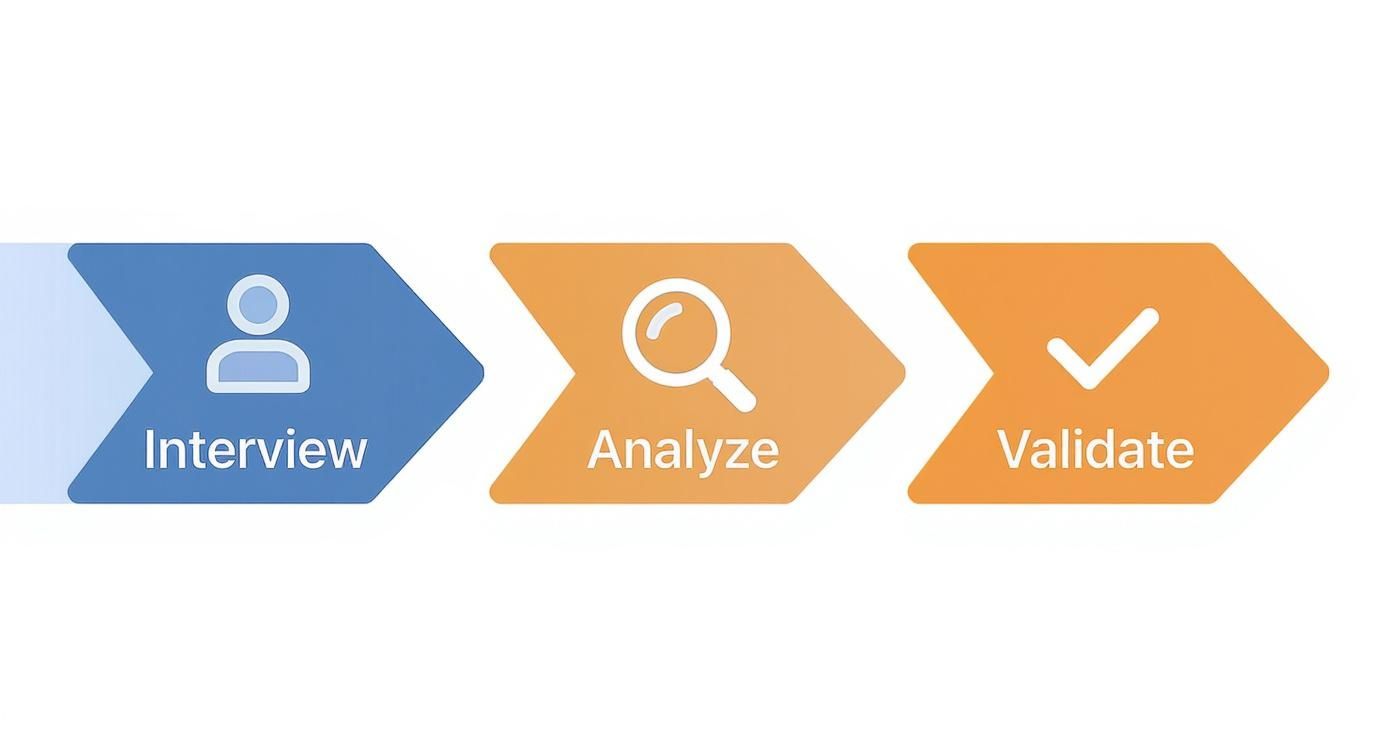
Each step builds on the last, ensuring your final ICP is grounded in solid evidence, not just wishful thinking.
From Manual Grind to Automated Scale
Manually hunting for profiles that match your ICP and writing unique DMs one by one is a soul-crushing grind. It’s simply not scalable for a founder.
This is where smart outreach automation becomes your secret weapon for scaling distribution.
A tool like DMpro.ai is built to put your ICP to work. You can take the specific keywords, job titles, and follower patterns you've identified and plug them straight into an automated outreach campaign.
For example, you could set up a campaign that targets:
- Users with "SaaS Founder" or "Head of Growth" in their bio.
- People who follow key industry voices like Justin Welsh.
- Accounts that recently tweeted about a challenge like "hiring SDRs" or "reducing churn."
The goal isn't just to send more DMs. It's to send better DMs to the right people, consistently. You're building a system that works for you 24/7, engaging prospects who perfectly match your ICP while you focus on building the product.
This approach transforms your outreach from a manual task into a predictable growth pipeline. To see how modern tech can amplify your efforts, check out different AI-powered lead generation strategies.
The system scans thousands of Twitter profiles, pinpoints the ones that fit your criteria, and sends a personalized DM. It’s the difference between hunting for leads one-by-one and building a machine that brings them to you. For a deeper dive, check out our guide on effective messaging on Twitter.
Common ICP Mistakes Most Founders Make
Nailing your first ideal customer profile template feels like a huge win. But there are a few classic pitfalls that can derail your outreach before it even starts. Trust me, I’ve stumbled into most of them.
The biggest trap? Thinking of your ICP as a one-and-done assignment. It’s not. It’s a living document that needs to evolve with your business.
Being Too Broad or Too Narrow
Finding the right balance for your ICP is a Goldilocks situation. Founders almost always go too far in one direction.
First, you have the "we sell to anyone in marketing" ICP. This is so vague it's meaningless. When you try to talk to everyone, nobody listens.
Then there's the other extreme: the "VP of Marketing at a Series B fintech in San Francisco with exactly 152 employees" ICP. You get so specific that you exhaust your market in a week.
Founder Tip: Aim for focus, not rigidity. Instead of a single job title, think about their core responsibilities. Instead of a fixed employee count, think in terms of a growth stage, like "companies scaling from 20 to 50 people."
Creating It Once and Forgetting It
Your business changes. Your market changes. The ICP you sketched out in beta will look different after your first 100 customers.
Letting your ICP get stale is like navigating a new city with an old map. You’ll end up lost, wondering why your messages are falling flat.
I recommend a simple quarterly review:
- Look at Your Best New Customers: Who were your top five wins this quarter? What do they have in common?
- Dig Into Churn: Who left, and why? Were they a bad fit from the start?
- Listen to Sales Calls: What new problems are prospects bringing up?
- Update Your Template: Tweak your ICP based on what you just learned.
A regular check-in keeps your outreach razor-sharp. When you use an ideal customer profile template the right way, it can boost sales productivity by up to 20% and cut the sales cycle by around 15%. You can dive deeper into these powerful insights on ICP efficiency from brand.dev.
Ignoring Negative Personas
This is a big one. It's easy to focus on who you want to sell to that you forget to define who you don't want as a customer. This is your "negative persona"—the client who is a nightmare for your business.
We all know the type. They:
- Drain your support team with endless tickets.
- Never get the value and churn out fast.
- Demand features that have nothing to do with your roadmap.
Defining this anti-ICP helps you say "no" to the wrong leads early. When you're running outreach automation in a tool like DMpro.ai, you can even use this to filter out these profiles automatically, saving your team a ton of time.
Putting Your Ideal Customer Profile to Work
So, you've done the work. You have the template filled out and a clear picture of who you're selling to. But filling out your ideal customer profile template isn't the finish line—it's the starting gun.
Now it's time to turn that document into a system that consistently brings the right leads to you. This is your roadmap from random DMs to a predictable pipeline that grows your business.
From Document to Action
A razor-sharp ICP is the most direct path to scalable distribution for a SaaS company. It’s a living guide.
As you learn from every sales call, customer email, and market shift, your ICP should evolve with you. This constant refinement makes your outreach sharper over time. It’s how you build real momentum.
You're trading manual guesswork for a predictable growth engine. Every conversation helps you fine-tune your targeting, making sure you're always talking to the people who desperately need what you've built.
The real power of an ICP is turning customer insights into automated, personalized outreach. It’s about building a system that hunts for your best-fit customers so you don't have to.
This is the system that lets you step off the hamster wheel of manual prospecting. If you want to see how this works, check out our guide on setting up automated direct messages on Twitter. It’s a perfect example of connecting a well-defined ICP directly to an outreach channel.
Ultimately, the goal is to build a repeatable process that takes you from unpredictable outreach to a consistent flow of high-quality leads.
If you’re tired of manually sending DMs every day, try DMpro.ai — it automates outreach and replies while you sleep.
Answering Your Top ICP Questions
We’ve gone through the nuts and bolts, but a few questions always pop up. Let's tackle them so you can move forward with confidence.
How Specific Should My ICP Actually Be?
The goal is to be focused, not microscopic. You need enough detail to make your messaging feel personal, but not so specific that your entire market could fit in a conference room.
"VPs of Marketing at Series B fintechs in SF" is too narrow. A better ICP is "Growth leaders at B2B SaaS companies with 20-100 employees scaling their content marketing." See the difference? It gives you clear guardrails without boxing you in.
How Often Should I Update My ICP Template?
Think of your ICP as a living document, not a stone tablet. Markets change, your product evolves, and your understanding of your customers deepens.
As a rule of thumb, review your ICP every quarter. Sit down with your team and look at your best new customers from the last 90 days. Why did they buy? At the same time, look at who churned. This feedback loop is what keeps your targeting sharp.
A stale ICP is the fastest route to ineffective outreach.
Can I Have More Than One ICP?
Not only can you, but as you grow, you probably should. You might find you have a sweet spot with early-stage startups and a growing base of mid-market customers.
The trick is to treat them as separate profiles. An early-stage founder has different pain points than a director at a 500-person company. Create a unique ICP for each segment, then build targeted outreach campaigns in a tool like DMpro.ai that speak directly to their individual needs.
What's the Difference Between an ICP and a Buyer Persona?
This one trips people up, but it's simple when you break it down.
-
An ICP (Ideal Customer Profile) is about the company. It's the firmographics—industry, company size, revenue. It answers, "What kind of company is a perfect fit for us?"
-
A Buyer Persona is about the person inside that company. It’s about their job title, frustrations, and career goals. It answers, "Who do we need to talk to, and what do they care about?"
You need both. The ICP gets you to the right front door, and the buyer persona tells you how to start a great conversation.
If you’re tired of manually sending DMs every day, try DMpro.ai — it automates outreach and replies while you sleep.
Ready to Automate Your Twitter Outreach?
Start sending personalized DMs at scale and grow your business on autopilot.
Get Started Free