
A Founder's Guide to Boosting Engagements on Twitter
Struggling with low engagements on Twitter? Learn how to turn likes and replies into a predictable lead pipeline with actionable strategies for founders.
Engagements on Twitter are simply the actions people take on your posts. We're talking about the classics: likes, replies, retweets, and clicks. But for a founder, these aren't just vanity metrics. They're critical signs that someone has stopped scrolling and is actually paying attention.
This is the moment a passive observer becomes a potential lead.
What Twitter Engagement Really Means for Founders
Let's be honest, as a founder, you don't have time for metrics that don't drive growth. A huge follower count looks great, but it doesn't keep the lights on. Real engagements on Twitter, on the other hand, are the bedrock of a solid lead generation engine for your SaaS.
Think of it this way: impressions are the number of people who walk past your storefront. It’s a measure of foot traffic, nothing more. Engagements are the people who actually stop, peer in the window, and maybe even step inside to look around. Each one of those actions tells you something important.
The Anatomy of an Engaged User
When a potential customer interacts with your content, they’re basically raising their hand to say, "Hey, I'm interested!" Let's break down what these core actions really tell you:
- Likes: This is the quick nod of approval. It’s a low-effort tap that says, "I see this, and I find it interesting or agree with it."
- Replies: A much stronger signal. Someone invested time to type out a thought, ask a question, or share their opinion. They're opening the door to a conversation.
- Retweets: This is a public endorsement. The user found your content so valuable they put their name on it and shared it with their own network. It’s a massive boost for social proof.
- Clicks (Link/Profile): This is the clearest sign of intent. They wanted to know more about you, your product, or a resource you shared. Clicks are often the first concrete step into your sales funnel.
Getting a feel for what each interaction means is the first step. Before we get into boosting these numbers, it helps to understand the basic mechanics of the Twitter platform itself.
While impressions give you a baseline for reach, true engagement is what separates passive viewership from active interest. If you want a deeper dive on the difference, check out our guide on impressions on Twitter.
By focusing on these interactions, you stop shouting into the void and start building a community. The real goal is to turn those likes and replies into meaningful conversations, and eventually, into demos and paying customers. That's where a smart strategy comes in.
What Counts as Engagement on X? A Founder's Guide to the Numbers
As a founder, you know the drill: if you can't measure it, you can't improve it. So let's get into the nitty-gritty of engagements on X (formerly Twitter) without making it feel like a statistics lecture.
The single most important number to watch is your engagement rate. Think of it as your content's pulse.
The formula is straightforward: (Total Engagements ÷ Total Impressions) x 100. This simple percentage tells you how many people who saw your post actually did something about it.
Impressions are just the eyeballs—the number of times your tweet appeared on someone's screen. Engagements are the actions that prove they were paying attention.
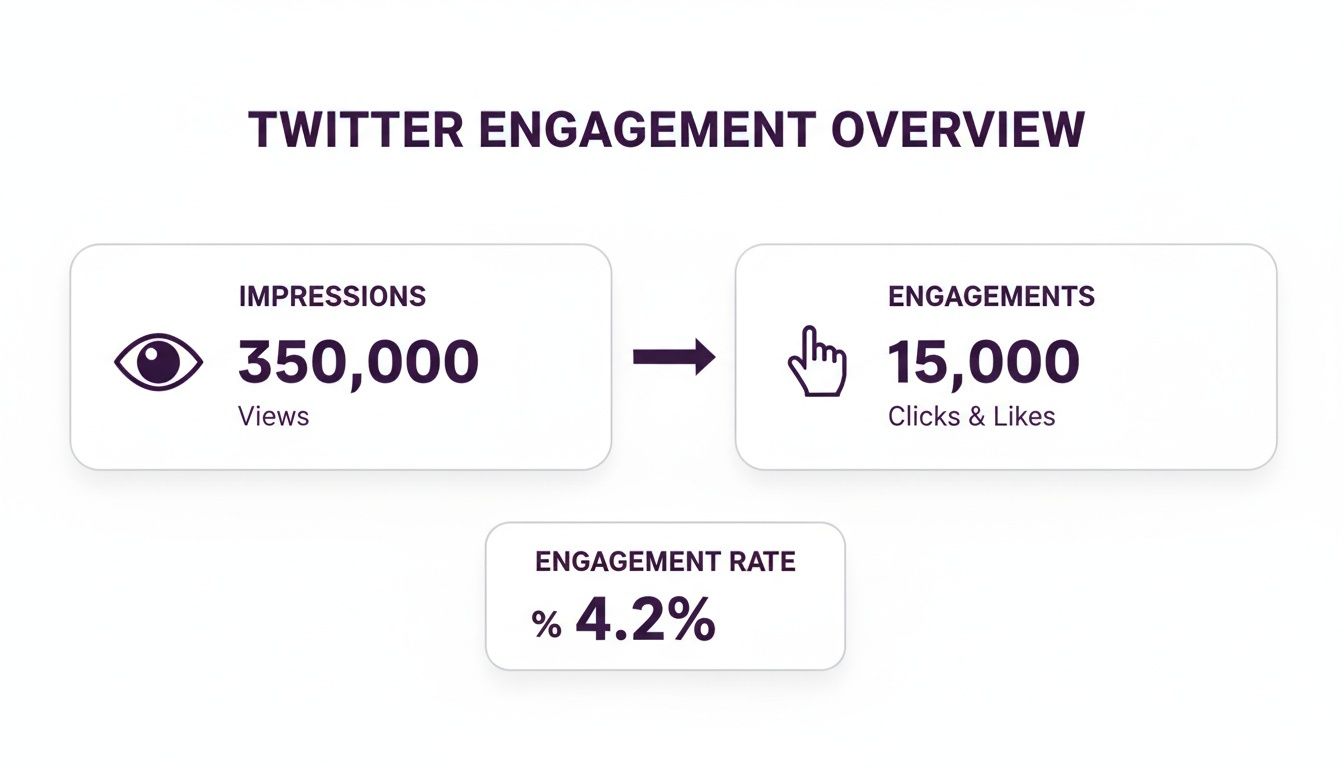
A mountain of impressions looks great, but it's just noise. The real win is turning that visibility into actions that actually grow your business.
A Quick Look at the Core Metrics
To really understand your engagement rate, you have to know what goes into it. Each metric tells a slightly different story about what your audience finds valuable.
| Twitter Engagement Metrics at a Glance | | :--- | :--- | :--- | | Metric | What It Measures | Why It Matters for Founders | | Impressions | How many times your tweet was seen. | The top of your funnel. This is your total potential reach. | | Likes | A simple nod of approval. | A quick, low-effort signal that your content is on the right track. | | Replies | Someone starting a public conversation. | Shows your content is thought-provoking and sparks community interaction. | | Retweets | Someone sharing your tweet with their own audience. | A powerful endorsement that expands your reach to new networks. | | Link Clicks | Someone clicking a URL in your tweet. | A high-intent action that drives traffic to your website, blog, or landing page. | | Profile Clicks | Someone visiting your X profile. | Shows curiosity about who you are and what your company does. A key step toward a follow or a site visit. |
These are the building blocks of your engagement strategy. Understanding the role each one plays is the first step to creating content that doesn't just get seen—it gets results.
What's a Good Engagement Rate, Anyway?
So, what's the magic number to aim for? Prepare to be humbled. Across all industries, the median engagement rate on X is a tiny 0.046%.
That's not a typo. It underscores just how hard it is to cut through the noise. A massive follower count is pure vanity if your audience is asleep. If you want to see how you stack up, a great place to start is digging into your own Twitter account analytics.
This brutal benchmark is precisely why a smarter approach is non-negotiable. Why shout into the void when you can have a direct, meaningful conversation? This is where a tool like DMpro changes the game for SaaS lead generation. By using AI to scan profiles and send personalized DMs that speak directly to a prospect's work or interests, you can transform cold outreach into a warm conversation. We've seen reply rates jump to an incredible 25-40%, making that median rate feel like a distant memory.
Just look at what's possible. Kevan Lee, a marketing leader at Buffer, once shared that his team turned 73,556 impressions into 1,782 engagements. That’s a 2.4% engagement rate—not just good, but in a completely different league. It shows the massive gap between average and what's achievable with the right strategy.
Proven Tactics to Increase Your Twitter Engagement

Alright, we’ve covered what engagement is and how to track it. Now for the fun part—actually getting more of it. Let’s skip the generic advice like "post great content." As a founder, you need a playbook that gets real results without eating up your entire day.
These are specific, founder-tested strategies designed to boost your engagements on Twitter and kickstart some meaningful conversations. Think of each one as a mini-strategy you can start using right away.
Craft Value-Driven Threads That Solve Problems
A single tweet is fine for a quick thought, but threads are where you really build authority. A well-crafted thread acts like a mini-blog post, solving a very specific problem for your ideal customer. It immediately positions you as an expert and gives people a great reason to follow you and jump into the conversation.
Don't just list facts. Structure your thread like a story with a clear beginning, middle, and end. Start with a powerful hook that grabs attention, break down the solution step-by-step, and finish with a solid takeaway or a question to get people talking.
Founder-to-Founder Tip: Don't just share what you do; share how you do it. Documenting your journey—a recent mistake, a small win, a tough lesson—provides incredible value. It feels far more authentic than a polished marketing message, and that kind of transparency is what builds a real community.
Ask Open-Ended Questions to Spark Replies
It sounds simple, but one of the most effective ways to drive replies is to just ask better questions. A closed-ended question that gets a "yes" or "no" is a conversation killer. Instead, you want to ask open-ended questions that invite people to share their own opinions and experiences.
Instead of asking, "Do you use automation tools?" try something like, "What's the one automation tool you couldn't live without, and why?" See the difference? The second one prompts a story, not just a one-word answer. This simple switch can dramatically increase your replies and create a lively discussion.
Use Polls for Quick, Interactive Feedback
Twitter Polls are a seriously underrated tool for generating fast and easy engagement. People love sharing their opinions, and polls make it completely frictionless. All it takes is a single tap, which is a much lower bar for entry than typing out a full reply.
Use polls to:
- Do some quick market research: Ask your audience about their biggest frustrations.
- Get feedback on new features: Let your users vote on what you should build next.
- Start a lighthearted debate: Settle a classic industry argument just for fun.
Polls don't just pump up your engagement metrics; they give you valuable insights straight from your target audience. It’s a win-win.
Leverage Visuals That Stop the Scroll
In an endless feed of text, a strong visual can make your tweet impossible to ignore. You don't need to be a professional graphic designer, either. Simple screenshots, clean graphs, or even a perfectly chosen GIF can significantly boost engagement.
Tweets with images consistently get more interaction than those without. A visual can help explain a complex idea in seconds, show off a result, or just add a human touch to your content. Try sharing a screenshot of a key metric from your dashboard or a simple chart that illustrates a point you’re making. To really dive deep, explore our post on building a powerful marketing strategy for Twitter.
Engage With Others to Get Engagement Back
Twitter is a two-way street. You can't just broadcast your own content into the void and expect people to show up. The absolute fastest way to grow your own engagement is to thoughtfully engage with other people in your niche.
Set aside 15-20 minutes a day to leave meaningful comments on posts from other founders, industry leaders, and potential customers. Don't just drop a "great post!" Add to the conversation, ask a smart follow-up question, or offer a different perspective. This gets you on the radar of influential accounts and their followers, which drives relevant attention right back to your profile.
Of course, finding and engaging with the right people to scale your SaaS distribution can be a huge time sink. This is where smart outreach automation comes in. A tool like DMpro can identify active, relevant users based on their engagement, letting you focus your manual efforts where they count most while automating outreach to a wider—but still targeted—audience.
How High-Engagement Moments Reveal Growth Secrets
Some of the best lessons for boosting your engagements on Twitter don't come from marketing playbooks; they come from watching what happens during massive global events. When something big is happening, Twitter becomes the planet's real-time town square. These spikes in activity aren't just fascinating to observe—they're a masterclass for founders on what makes content catch fire.
Think about it. What if you could bottle just a tiny fraction of that energy and point it toward your own niche? You don't need a worldwide crisis to do it. The core principles are the same: be timely, be relevant, and create content that’s incredibly easy to share.

Breaking down these moments gives us a blueprint. It shows us what makes people stop scrolling and start sharing, and that's the secret every founder wants to crack.
The Anatomy of a Viral Moment
Let’s get specific. In early 2020, as the COVID-19 pandemic started to unfold, researchers dug into a massive set of tweets. In Washington state alone, they pulled over 7.7 million tweets in just a few weeks. The breakdown was stunning: a whopping 49% of them were retweets. Replies made up another 29%. And original, from-scratch tweets? Only 13%. Louisiana showed a similar story, with retweets climbing to 54%.
This data tells us exactly how people use the platform when information feels urgent—they shift from creating content to amplifying it. You can dig deeper into these historical engagement patterns in the full research.
This isn't just a history lesson; it's a deep insight into human behavior online. When news is critical or super relevant, we become amplifiers. Our first instinct isn't to just consume the information, but to share it.
The Big Takeaway: The data proves a simple truth: the easiest content to share is what gets shared the most. Retweets are the engine of virality. For a founder, this means your content has to be designed for amplification right from the start.
Turning History into a B2B Strategy
So, how does a global event from 2020 help you find SaaS leads today? The pattern holds, even if the scale is different. Your "major event" isn't a pandemic; it’s a new industry report, a competitor’s massive funding round, or a sudden shift in market sentiment.
These are your high-engagement moments.
By tapping into these trending conversations, you make your content part of something much bigger. You’re no longer shouting into an empty room. Instead, you're adding a valuable voice to a discussion people are already deeply invested in.
A Modern Blueprint for Engagement
Here’s how you can take these lessons and apply them to get more engagements on Twitter:
- Find Your "News Events": Set up alerts for keywords critical to your industry. This could be anything from "AI in marketing" to your top competitor's name. Be the first one with a smart take.
- Create "Amplifyable" Content: When news breaks, don’t just state the facts. Offer a unique angle, a bold prediction, or a quick summary that saves people time. Make it easy for others to retweet you to look smart.
- Spark the Conversation: Don't just post and run. End your tweet with a question that invites others to weigh in on the news. This turns a simple broadcast into a conversation starter, which is exactly what drives those valuable replies.
The key is to connect your expertise to what people are already buzzing about. This approach instantly makes you relevant and your content far more shareable.
Of course, finding everyone who’s engaging with these topics and reaching out one by one would take forever. This is where you can work smarter. A tool like DMpro can automatically spot users engaging with specific keywords or hashtags and send them a personalized message, turning a high-engagement moment into a direct lead generation opportunity—without all the manual work.
Turning High Engagement Into a Predictable Lead Pipeline
Let's be honest: high engagements on Twitter are great for the ego, but they don't pay the bills. Revenue does. This is where we connect the dots between likes and leads, turning all that buzz on your timeline into a real, predictable pipeline for your SaaS.
Think of every engagement as a signal. A like, a reply, a retweet—each one is a person raising their hand to say, "Hey, I'm interested in what you're talking about." These aren't just faceless accounts; they're your warmest audience. You just need a system to turn that initial interest into a genuine conversation.

The goal here is simple: stop treating engagement as a vanity metric and start seeing it for what it truly is—the very top of your sales funnel.
Identifying Your Most Engaged Followers
First things first, you need a simple way to keep an eye on your "super-fans." These are the folks who consistently show up. They don't just like a single post; they jump into your threads, share your insights, and ask smart questions.
You can start doing this manually just by paying close attention to your notifications. Who are the names you see popping up over and over? Jot them down or create a private Twitter List to track these high-value people. They’ve already proven they're invested, which makes them the perfect candidates for a more direct chat.
This small group is where your outreach efforts will have the highest return. You're not starting a cold conversation; you're just continuing one they already started.
From Public Timeline to Private DMs
Once you've spotted these key people, the next move is to take the conversation from the public timeline into private DMs. This is a critical step. A public reply is great for visibility, but a one-on-one DM is where you build an actual relationship and uncover potential sales opportunities.
The trick is personalization. A generic, copy-pasted sales pitch will shut down the conversation before it even begins. Your opening message needs to feel like a natural next step.
Founder-to-Founder Tip: Your first DM should directly mention their specific engagement. This simple act proves you're paying attention and aren't just another bot blasting out messages. It builds trust instantly.
For example, instead of a canned pitch, try something like this:
- "Hey [Name], I really appreciated your comment on my thread about scaling SaaS distribution. You mentioned [their specific point]. What's the biggest challenge you're facing with that right now?"
This isn't a sales pitch; it's a conversation starter. It respects their input and invites them to open up about their problems—which is the first step in any sales process.
Scaling Your Outreach Without Losing the Personal Touch
Right about now, you're probably thinking, "This sounds great, but I don't have time to manually track and message everyone who engages." And you're right. As a founder, your time is your most precious resource.
This is where smart outreach automation becomes a game-changer. The manual process works perfectly for your top 5-10 most engaged followers, but it just doesn't scale. To build a truly predictable pipeline for your SaaS, you need a system that can handle this outreach in volume while still feeling completely personal.
A tool like DMpro is built for this exact purpose. It can automatically identify active users based on their engagement with certain topics or accounts and then send them a personalized DM that feels like you wrote it yourself. It can reference their recent activity, their bio, or their interests to craft an opener that actually gets a reply.
This frees you from the daily grind of manual prospecting. You can set up campaigns that run 24/7, turning a steady stream of engagements on Twitter into qualified sales calls booked right on your calendar. It’s the bridge between having a warm audience and having a scalable lead engine.
Why Automated Outreach Is Your Engagement Superpower
<iframe width="100%" style="aspect-ratio: 16 / 9;" src="https://www.youtube.com/embed/CrdmNs0JCKM" frameborder="0" allow="autoplay; encrypted-media" allowfullscreen></iframe>Let's be honest. Trying to manually track and message every single person who engages with your content is a fast track to burnout. It just doesn't scale. As a founder, you know that high engagement is great, but it's only the first step. The real prize is turning that initial flicker of interest into a reliable pipeline of leads for your SaaS.
This is where intelligent outreach automation comes in, and it's your secret weapon.
We're not talking about the spammy, generic bots from a few years ago. Today's AI-powered tools are sophisticated. Think of them as a dedicated sales development rep who works 24/7. These systems can sift through thousands of profiles, pinpoint users who fit your ideal customer profile, and use their recent activity to craft a DM that feels personal and relevant.
This completely flips the script on cold outreach. You’re no longer just another interruption in someone's day. Instead, you're starting a warm conversation based on something they've already shown they care about. The result? Your response rates go way, way up.
From Manual Grind to a Scalable Engine
Think about how you split your time now. How much is spent just looking for people versus actually talking to qualified leads? The whole point of automation is to reverse that ratio. It handles the heavy lifting of finding and engaging potential customers so you can focus on what really matters—closing deals and growing your business.
Keeping an eye on monthly X engagement rates shows just how much things can change. Averages are all over the place, making it tough to rely on fixed targets. Just look at past campaigns; a resonant topic can easily pull in millions of impressions, driven by a wave of retweets and replies. For founders targeting a massive market like the US, with its 106 million users, learning to tap into these high-engagement patterns is crucial. You can find more context on these fluctuating social media benchmarks on SocialStatus.io.
Tools like DMpro are a perfect example of this new approach. Instead of you spending hours hunting for leads, it can automatically deliver 500+ targeted prospects to your inbox every day. Each one gets a personalized DM that references their recent activity, often leading to response rates between 25-40%. You can learn more about how to set up automated direct messages on Twitter in our guide.
Now, if you're going to operate at that kind of scale, you need to make sure your outreach runs smoothly without hitting platform limits. That's why it's a smart move to use the best rotating residential proxies to keep your campaigns reliable and effective. It's the key to building a truly scalable lead engine.
A Few Lingering Questions About Twitter Engagement
Alright, we've walked through everything from the basic metrics to scaling up your outreach. But I know that when you're a founder, the theory is one thing, and putting it into practice is another. Let's tackle some of the most common questions I get, with straight-to-the-point answers you can actually use.
Think of this as your final cheat sheet to clear up any confusion.
What's the Real Difference Between Impressions and Engagements?
Let's use an analogy. Imagine your tweet is a storefront window display.
Impressions are just the number of people who walked by your store. It tells you how many eyeballs could have seen your tweet, but it doesn't mean they actually stopped or cared. It's a measure of potential reach, nothing more.
Engagements, on the other hand, are the people who stopped, looked at the display, and then walked into your store. These are your likes, replies, retweets, and clicks. For a founder, impressions are a vanity metric; engagements are the first real sign of genuine interest—the start of a potential lead.
How Many Times a Day Should I Actually Post to Get More Engagement?
You’ll hear a lot of different numbers thrown around, but there’s no single magic formula. The truth is, quality and consistency beat a high-volume firehose approach every single time. Instead of pushing out ten mediocre tweets a day, focus on creating 1-3 high-value posts or threads. That’s far more manageable for a busy founder and much more effective.
The key is consistency. Posting regularly teaches the algorithm—and more importantly, your audience—to look for your content. The goal isn't to be the loudest voice in the room, but the most consistent and valuable one in your niche. Play around with your posting schedule and keep an eye on your analytics to see what resonates with your audience.
What's the Very First Step to Turn Engaged Followers Into Actual Sales Leads?
This is the most important part. The first and most crucial step is to spot your most engaged followers and take the conversation into the DMs. This is where you shift from broadcasting a message to building a real relationship.
But please, don't just slide in with a hard sales pitch. That's a surefire way to get ignored.
Start a real conversation. Reference the specific post they engaged with. You could say something like, "Hey [Name], appreciate the comment on my thread about [Topic]. Curious, what's your biggest headache with that right now?" This opens a natural, no-pressure dialogue and proves you’re paying attention.
This simple, personalized approach is how you build trust and start uncovering real business needs.
If you’re tired of manually sending DMs every day, try DMpro.ai — it automates outreach and replies while you sleep.
Ready to Automate Your Twitter Outreach?
Start sending personalized DMs at scale and grow your business on autopilot.
Get started