
A Founder's Guide to Twitter Account Analytics
Stop guessing. Use Twitter account analytics to find leads and scale outreach. Learn the key metrics that actually drive SaaS growth in this founder's guide.

As a founder, you're obsessed with numbers. MRR, CAC, LTV—these are the metrics that define your business. So why isn't that same data-driven mindset applied to your X (Twitter) account?
For too many founders, X is a "post and pray" game. We're here to change that. This guide breaks down how to treat X as a powerful, measurable sales channel for your SaaS. It all starts with looking past vanity metrics and focusing on the data that actually drives lead generation.
Move Beyond Vanity Metrics in Your Twitter Outreach

Most founders get stuck chasing the wrong things on X. They post content, get a flurry of likes, and then wonder why their pipeline is still empty. The problem isn't the effort; it's the focus. Likes feel great, but they don't book demos.
The breakthrough happens when you treat every tweet and DM as a tiny experiment. Your twitter account analytics are hiding clues that can help you find and win over your next 100 customers.
From Social Noise to Sales Signals
Your goal on X isn't to be popular; it's to scale your distribution and get leads. This requires measuring what matters for lead generation. Instead of getting excited about followers, you should be focused on metrics that signal real buying intent from your ideal customers.
Think about it this way:
- Profile Visits: This is huge. When someone sees your tweet and clicks your profile, that's a powerful signal. They've gone from passive scroller to active investigator.
- Reply Rates from Ideal Customers: A high reply rate from your target audience is worth infinitely more than thousands of likes. Are the right people engaging? That's the key question.
This small shift in perspective transforms your X account from a content feed into a lead-gen machine. You're tapping into a massive, active audience just waiting to be engaged.
The most successful founders on X don't just post content; they analyze engagement to understand what their market truly cares about. A spike in profile visits after a specific tweet isn't a vanity metric—it's a customer signal.
This table breaks down the crucial shift from feel-good numbers to metrics that actually move the needle for your SaaS.
From Vanity Metrics to Actionable Insights
| Vanity Metric (What Most Track) | Actionable Metric (What Founders Should Track) | Why It Matters for Lead Gen |
|---|---|---|
| Likes & Retweets | Profile Visits after a tweet | Shows your content is compelling enough to make someone investigate your solution. |
| Follower Count | New Followers from your ICP (Ideal Customer Profile) | Measures if you're attracting potential buyers, not just a random audience. |
| Overall DM Reply Rate | Positive DM Reply Rate from Qualified Leads | Tells you if your outreach messaging resonates with people who can actually buy. |
| Tweet Impressions | Link Clicks to your landing page or demo booking page | Directly measures how many people are taking the next step in the sales process. |
Seeing the difference? One set of numbers inflates your ego; the other inflates your pipeline.
This data-first approach is the foundation for scaling your outreach, whether you're tracking manually or using automation. A tool like DMpro, for example, becomes incredibly powerful when you know which signals to track. It helps you automate outreach to the right people—the ones already showing interest through actions like profile visits and targeted engagement.
For more deep dives into founder-led growth strategies, head over to the DMpro blog.
How to Access Your Native Twitter Analytics Dashboard
So, where is all this powerful data hiding? The good news is X gives you a solid set of numbers right out of the box. You don't need a third-party tool to get started.
Getting there is dead simple. Just go directly to analytics.twitter.com and log in with your X account. That's it. This dashboard is your starting point for turning raw numbers into real lead signals for your outreach.
Navigating the Dashboard for the First Time
Once you're in, you’ll see a 28-day summary. It can look like a lot at first, but don't get overwhelmed. As a founder focused on lead generation and distribution, there are only a few key areas you need to watch.
Here’s what you'll see on the main dashboard—a snapshot of how your account has been doing over the last month.

This high-level view gives you core metrics like your total Tweet impressions, profile visits, and new followers. Keep an eye on those little red and green percentages. They’re a quick way to tell if your strategy is gaining steam or losing momentum.
The main tabs you'll be using are:
- Home: Your 28-day performance summary and monthly highlights.
- Tweets: A detailed breakdown of how every single tweet performed. This is where you’ll find what's resonating.
- More: This tab holds deeper analytics for things like videos.
Honestly, just focus on the "Home" and "Tweets" tabs. They contain 90% of the data you'll need to start making smarter decisions about your outreach. If you need more guidance on initial setups, our getting started guide can walk you through similar foundational processes.
The native analytics dashboard is surprisingly powerful for a free tool. A founder can quickly identify which content themes drive profile visits—a strong indicator of lead intent—without spending a dime.
From here, you can start connecting these numbers to your actual outreach. Let's say you notice a tweet about a specific SaaS pain point drove a spike in profile visits. That's your signal to double down on that topic in your DMs.
When you pair these insights with an automation tool like DMpro, you can build outreach campaigns around proven topics. Your DMs will land better because the data already told you they would. This simple feedback loop—analyze, then automate—is the key to scaling your SaaS distribution on X.
Finding the Metrics That Actually Point to New Customers
Alright, you've found the analytics dashboard. Now for the important part: figuring out which numbers actually matter for lead generation.
Let's cut through the noise. Impressions and likes are nice, but as a founder, you're hunting for signals that lead to real customer interest. These are the numbers that connect your content directly to your pipeline.
From Views to Visits: The First Real Signal
The single most overlooked metric in X analytics is Profile Visits.
Think about it. Someone sees your tweet. It strikes a chord. They take that extra step to click on your name and see who you are. That’s a huge signal of intent. It's the digital equivalent of someone walking into your store.
They've gone from a passive scroller to an active investigator. This is why a tweet with 1,000 impressions and 50 profile visits from your ideal customer profile (ICP) is infinitely more valuable than one with 10,000 impressions and only 5 profile visits.
When you see a spike in profile visits tied to a specific post, that’s your green light to:
- Go deeper on that topic. Your audience is telling you this is a problem they have.
- Check who engaged. Are they good-fit leads for your SaaS?
- Sharpen your DM outreach. You just found the perfect conversation starter.
Are You Pulling in the Right Crowd?
Another metric worth a quick glance is your Top Follower for the month. This shows you the most influential account that just followed you. While it's just one data point, it's a great gut check.
If your top new followers are consistently other SaaS founders, VCs, or leaders in your target industry, you know your content is resonating with the right people.
This is especially important given the global nature of X. The platform is huge, with the United States having around 108 million users and Japan not far behind with 71 million. A quick look at follower demographics helps you know if you're building an audience in the right regions. You can read more about X's global user distribution to get a better sense of your potential reach.
Tracking follower demographics isn't just about geography. It's about confirming you're building an audience of potential buyers, not just casual fans. If your new followers don't match your ICP, your lead generation efforts will fall flat.
The final piece of the puzzle is Link Clicks. This is the most direct signal you can get. When you share a link—to a blog post, case study, or landing page—every click is someone raising their hand and saying, "Tell me more."
If your link clicks are consistently low, it's a sign your call-to-action isn't compelling enough.
These three metrics—Profile Visits, Follower Demographics, and Link Clicks—are the cornerstones of a smart outreach strategy. Once you find a topic that drives high engagement, you can use a tool like DMpro to start conversations at scale with the people who showed interest. That’s how you turn analytics into an actual sales pipeline.
Turn Analytics into a High-Performing DM Strategy
Data is useless if it just sits in a dashboard. The magic happens when you connect your twitter account analytics to your outreach. This is how you stop guessing and start building a predictable pipeline for your SaaS.
Think of your analytics as a direct feedback loop from your ideal customers. Every spike in engagement and every top-performing tweet is a clue. It’s telling you exactly what your market wants to hear.
From Top Tweet to Perfect DM
Let's get practical. Head over to your X Analytics and find your "Top Tweet" from the last 28 days—the one that drove the most profile visits or engagement from the right kind of accounts.
What was the topic? A specific pain point for SaaS founders? A surprising industry stat?
Whatever it was, you've just struck gold. That topic is your new best friend for cold outreach. It’s no longer a guess—it's a proven conversation starter. You can immediately spin that insight into a powerful opening line for your DMs.
This visual breaks down the process of turning numbers into real customer signals.
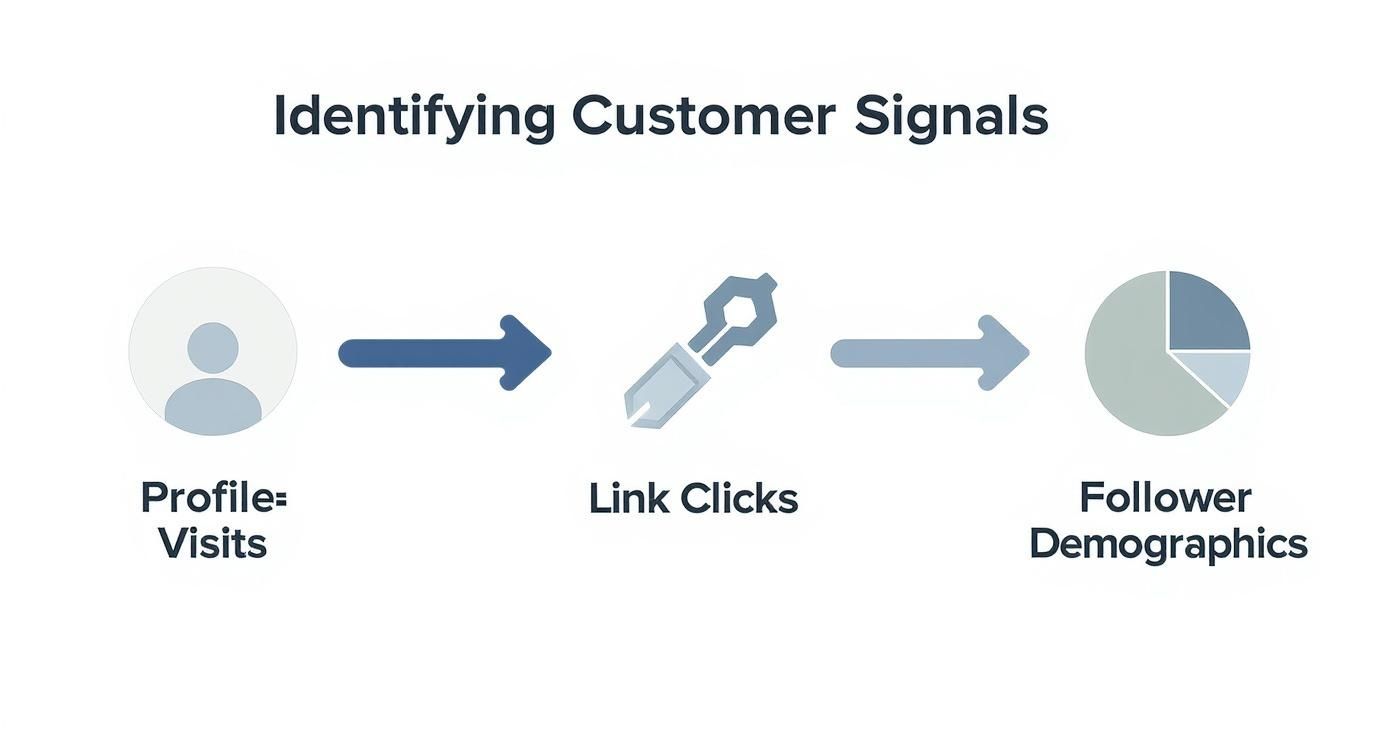
The flow is simple. High-value metrics like profile visits aren't just vanity numbers; they’re signposts pointing you toward what you should be talking about in your DMs.
Building Data-Driven Outreach Lists
Analytics can also sharpen your targeting. Did you notice a jump in new followers from fintech after you posted about a specific compliance issue? That's a signal that there’s a pocket of opportunity.
Forget generic lead lists. You can now build a hyper-targeted list based on real-time interest. Start by identifying the key accounts that engaged with that content, then expand your search to find similar profiles.
This approach transforms your outreach from a scattergun blast to surgical strikes. You're joining conversations your audience already started with their likes and replies. It's a much warmer approach, and it gets far better results.
Don't just look at what tweet performed well, but who engaged with it. If a dozen VPs of Sales liked your post on improving SDR efficiency, you have a pre-qualified list of prospects to start a conversation with.
Test and Automate Your Best Angles
Once you have a few proven angles from your analytics, it’s time to scale them. This is where outreach automation becomes your unfair advantage.
For instance, you could take the topics from your top three tweets and turn them into three distinct DM campaigns. Using a tool like DMpro.ai, you can set these campaigns up to run in parallel, letting the data tell you which message gets the highest reply rate.
This creates a powerful, data-driven engine for your lead generation. You analyze what works, build targeted DMs based on those insights, and then automate the outreach to start hundreds of conversations at scale.
This is how you stop sending generic DMs and start conversations that actually lead to demos for your SaaS.
Build a Simple Reporting System That Actually Works
You don't need a massive spreadsheet to make sense of your Twitter account analytics. As a founder, your time is your most precious resource. The goal isn't to get lost in data; it's to spot key signals in 15 minutes, make a smart call, and get back to building.
The key is building a simple, repeatable habit. A quick weekly check-in is all you need. Forget tracking every vanity metric. Just focus on the few that directly tie back to generating leads.
Your 15-Minute Weekly Twitter Analytics Check-In
I recommend a quick routine every Monday morning. It’s all about answering three simple questions:
- What content drove the most profile visits last week?
- Are our new followers a good fit for our ICP?
- Which tweet got the most link clicks to our site?
Answering these gives you a clear roadmap for the week. You'll know exactly what topics to double down on in your content and outreach.
A consistent, 15-minute weekly review is far more powerful than a complex, six-hour deep dive you only do once a quarter. Simplicity and consistency are your secret weapons for turning analytics into a predictable growth engine.
Here’s a simple checklist to guide your weekly review. This keeps you focused on the metrics that drive growth and make your outreach successful.
Your 15-Minute Weekly Twitter Analytics Check-In
| Metric to Check | What to Look For | Action to Take This Week |
|---|---|---|
| Top Tweet (by Impressions) | What topic or format got the most eyes? Was it a thread, a single image, a question? | Create another piece of content using that same successful format or topic. |
| Profile Visits | Look for spikes. Which tweets sent people to your profile to learn more? | Double down on that style of content that makes people want to see who you are. |
| New Followers | Scan the bios of new followers. Are they your target audience (e.g., founders, marketers)? | If yes, keep your content strategy as is. If no, tweak your messaging to be more specific to your ICP. |
| Link Clicks | Which call-to-action or link actually got clicked? Was it a blog post, a landing page? | Craft another tweet with a similar CTA, or promote that high-performing link again. |
This quick scan tells you what resonates and what falls flat, allowing you to iterate and improve week after week.
Knowing When to Go Beyond Native Analytics
X’s built-in dashboard is a fantastic start, but you'll eventually hit a ceiling. While native tools tell you what happened, dedicated third-party platforms help you understand why.
Tools like Sprout Social or Hootsuite offer deeper insights into keyword performance, helping you fine-tune your content. As your outreach becomes more sophisticated—especially when you start automating it—it makes sense to bring in tools that offer more granular data.
This is where platforms like DMpro come in. They have their own metrics focused specifically on outreach. For example, our built-in analytics and reporting features are designed to give founders the exact data needed to optimize their automated outreach, closing the loop between your content strategy and your sales pipeline.
Your Data-Driven Growth Engine on X
<iframe width="100%" style="aspect-ratio: 16 / 9;" src="https://www.youtube.com/embed/ktbeQKH0HtE" frameborder="0" allow="autoplay; encrypted-media" allowfullscreen></iframe>Let's pull this all together. Think of your X (Twitter) account analytics as the blueprint for building a predictable growth engine for your SaaS. When you track the right metrics, you stop hoping for leads and start creating them systematically.
This is the shift that matters. You go from guessing what your audience cares about to knowing what they respond to. Every tweet becomes an experiment, every jump in profile visits a green light, and every DM a targeted conversation.
From Random Actions to Predictable Outcomes
The real power of analytics is turning your X account into a constant feedback loop.
- You post content based on a hunch about a customer pain point.
- You dive into the data to see which posts are driving profile visits and link clicks.
- You tweak your messaging based on what the numbers prove is working.
- Finally, you scale up your DM outreach using those proven messages.
This simple process transforms your X activity from shouting into the void to having meaningful dialogues with potential customers. You're no longer just "doing social media." You're operating a lead generation machine that helps you scale distribution.
The ultimate goal of analyzing your X data is to make every single action on the platform count. It's about efficiency—getting more qualified leads with less wasted effort.
This data-backed approach is what separates founders who stumble upon a few leads from those who build a reliable pipeline. Once you know which topics trigger genuine interest, you can feed those insights directly into your outreach strategy.
For example, you can use a tool like DMpro to automate conversations around those high-performing themes. This ensures your automated outreach is not only efficient but also highly relevant, leading to the kinds of reply rates that actually book demos for your SaaS.
If you’re tired of manually sending DMs every day, try DMpro — it automates outreach and replies while you sleep. Find out more at https://dmpro.ai.
Ready to Automate Your Twitter Outreach?
Start sending personalized DMs at scale and grow your business on autopilot.
Get Started Free