
Twitter Who Unfollowed: Actionable Insights for Founders
Find out who unfollowed you on Twitter and why, plus practical tips to re-engage and grow your audience. twitter who unfollowed insights you can use today.
Figuring out who unfollowed you on X (formerly Twitter) isn't just an ego check. For a founder, it's some of the most honest market feedback you'll ever get. Every unfollow is a data point telling you what your audience loves—and more importantly, what’s pushing them away.
Why Tracking Unfollowers Is a Secret Growth Metric
Ever watch your follower count yo-yo? You gain a few, you lose a few. For those of us building a business, that fluctuation isn't just noise; it's a critical signal. Treating unfollows as a vanity metric is a rookie mistake. A better way to look at it? It’s free, real-time feedback on your messaging, content, and targeting.
When someone in your target market hits that unfollow button, they're sending a clear message. Maybe that last sales-heavy post felt too aggressive. Perhaps your content veered off-topic. This is gold. It’s the kind of information that helps you sharpen your ideal customer profile and fine-tune your entire distribution strategy on X.
Uncover Powerful Audience Patterns
By paying attention to these dips, you start seeing patterns. Did you lose a chunk of followers after a big promotional campaign? That’s a clear sign you need to rethink your sales approach. Each unfollow is a chance to stop wasting time on outreach that actually repels the exact people you’re trying to attract.
This isn't a new idea. Back in the early 2010s, growth hackers were all over the follow/unfollow strategy. A 2015 experiment from Agorapulse put hard numbers to it. One of their test accounts grew its followers by 101%, while another saw a 73% increase. They did it by following targeted users and, crucially, unfollowing those who didn't engage or follow back.
But here's the real win for founders: engagement. Link clicks shot up 44%, replies jumped 90%, and likes climbed 77%. This proves that a well-managed follower list isn't just about the count; it directly leads to more powerful interactions, which is exactly what you need for lead generation.
Turn Feedback into Action
At the end of the day, understanding who leaves is about efficiency. It helps you build a tighter, more engaged community—the perfect launchpad for scalable lead generation. You stop shouting into a void and start having real conversations with potential customers. It’s about turning a negative signal into a powerful tool for growth. By digging into your Twitter analytics, you can get a clearer picture of who is sticking around.
The goal isn't to prevent every single unfollow. It's to understand the why behind the trends. That's how you build a stronger, more qualified audience that actually wants to hear from you.
The Manual Grind: Checking Unfollowers the Old-School Way
Before we get into smarter, automated solutions, let's talk about the manual way to see who's jumped ship. X (Twitter) won't send you a notification when someone unfollows, so you're left to do the detective work yourself.
It’s a free method, but be warned: it’s a massive time-sink.
In theory, the process is straightforward but clunky. You have to compare your ‘Following’ list against another user’s ‘Followers’ list. For instance, if you get a gut feeling a high-value prospect has unfollowed you, you’d have to go to their profile, click on their "Followers," and search for your handle. If you're not there, you have your answer.
Why This Method Doesn't Scale for Founders
Now, imagine doing that for more than a couple of accounts. It's incredibly tedious and simply wasn't designed for anyone serious about scaling a business. Checking one or two key profiles is one thing, but what about the dozens—or hundreds—of leads you're trying to nurture?
The manual approach completely falls apart at scale. It highlights a few core problems:
- It’s reactive, not proactive: You’re only checking people you already suspect have bounced. You have no way of discovering the ones you aren't thinking about.
- There’s zero historical data: You have no idea when they unfollowed. That context is gold for understanding what might have caused it.
- It burns founder time: Your time is far more valuable closing deals or building your product than endlessly scrolling through follower lists.
The manual grind is a painful but useful lesson. It gives you a firsthand look at why automation isn't just a nice-to-have—it's a necessity for growth. Smart founders know scalable problems demand scalable solutions.
This thinking goes way beyond just tracking unfollows. Manually checking followers is the strategic equivalent of sending every cold DM by hand. Sure, it works for a day or two, but you'll never build a predictable, repeatable pipeline that way.
If you're ready to move past these manual bottlenecks, our guide on no-code automation is the perfect next step. The whole point is to build systems that do the heavy lifting for you.
Using Third-Party Tools to Track Unfollowers Safely
Let’s be honest. If you're a founder trying to scale, manually checking who unfollowed you isn't just tedious—it's a massive waste of time. Your energy is better spent on your product, your team, or talking to customers. This is where third-party tools come in, transforming a mind-numbing task into an automated flow of useful data.
But a word of caution: not all tools are created equal. You need a reliable service that gives you the right information without putting your account at risk. The market is full of shady apps, so it's crucial to know what you're looking for.
This decision tree illustrates the choice you face: stick with the slow, manual grind or embrace a scalable, automated solution.
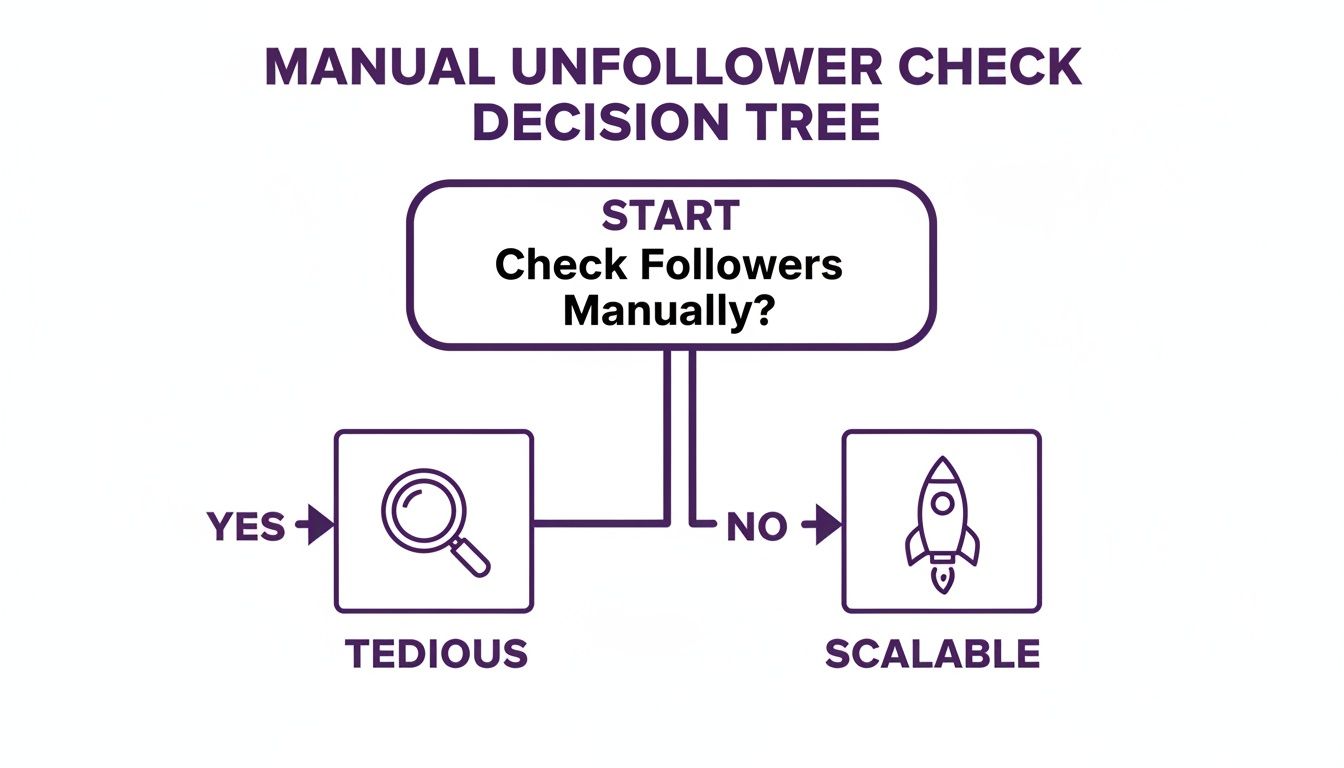
The takeaway here is simple. While manual methods don't cost money, they cost you time—and your time is your most valuable asset.
Choosing a Trustworthy Unfollower Tool
So, how do you tell the good tools from the bad ones? There's one golden rule: never give out your password. Legitimate services will always use OAuth, which is X’s own secure method for granting access without you handing over your login details. If an app asks for your password directly, it's a giant red flag. Just walk away.
Beyond that, here are a few other things I look for:
- API Usage: A good tool is transparent about how it uses the X API. This shows they're respecting the platform's terms of service.
- Data Privacy: Always give their privacy policy a quick scan. You need to be sure they aren’t selling your data.
- Core Features: Does it just spit out a list of unfollowers, or does it give you more context? I look for features like historical data, filters for inactive accounts, and the ability to "whitelist" people you never want to unfollow.
To get a broader view of your options, checking out some of the best social media scrapers can point you toward effective and safe tools for keeping tabs on your followers.
I've put together a quick comparison of some popular options to help you see what's out there.
Feature Comparison of Popular Unfollower Tools
This table gives you a side-by-side look at some of the leading tools for tracking X unfollowers. I've focused on what matters most for business use: safety, core features, and whether it can scale with you.
| Tool Name | Core Function | Safety (API Use) | Best For |
|---|---|---|---|
| Tweepi | AI-driven unfollow suggestions and follower management | Uses secure OAuth login | Founders focused on audience quality and engagement |
| Circleboom | Comprehensive X account management, including unfollower tracking | Uses secure OAuth login | Users needing an all-in-one management suite |
| Unfollower Stats | Basic unfollower and new follower tracking | Uses secure OAuth login | Individuals who want a simple, no-frills tracker |
| Who Unfollowed Me | Daily tracking of unfollows, mutes, and blocks | Uses secure OAuth login | Power users who need detailed daily reports |
Ultimately, the best tool is one that fits your workflow and gives you actionable data without compromising your account's security.
From Unfollow Data to Growth Strategy
Here’s the thing: the real value isn't just seeing a list of people who left. It's about what you do with that information. For serious X users, these tools are non-negotiable. Some have reported 30-100% follower growth simply by strategically managing their follower-to-following ratio.
Think about it. With a median engagement rate on X at just 0.029%, having a bunch of inactive followers just dilutes your reach. Pruning these accounts is critical for getting your message seen. This is a core part of building an effective outreach engine. In a similar way, a tool like DMpro automates outreach campaigns, running 24/7 to connect with new prospects.
Think of these tools less as a way to track losses and more as a system for maintaining a high-quality, engaged audience. A clean follower list is the foundation for effective lead generation.
This is where your strategy shifts from reactive to proactive. Instead of just seeing who's gone, you can use these insights to build a much stronger, more engaged audience.
For example, by identifying and removing inactive accounts, you make sure that when you send a message, it’s actually reaching people who are listening. This makes any future outreach, whether manual or automated, way more effective. You can even analyze the follower overlap with your competitors to find new people to connect with.
Understanding Why People Unfollow You
<iframe width="100%" style="aspect-ratio: 16 / 9;" src="https://www.youtube.com/embed/cLBVeHnBRao" frameborder="0" allow="autoplay; encrypted-media" allowfullscreen></iframe>Okay, so you have a list of people who hit the unfollow button. It’s easy to get caught up in the individual names, but the real unlock is asking a more powerful question: why did they leave? This is the moment you shift from just tracking numbers to diagnosing your strategy.
An unfollow is a quiet form of feedback. It’s your audience telling you something about your content, your posting schedule, or maybe even your brand's voice. As founders, we have to get good at interpreting these signals.
Think about it this way: if you launch a new series of posts and suddenly see a spike in unfollows, that's your market telling you to reconsider. It's raw, immediate data that can save you from pouring time and resources into an angle that just isn't connecting.
Decoding the Reasons for an Unfollow
Most people don't unfollow randomly. There's usually a reason, and it often falls into one of a few common categories. Getting a handle on these helps you look at your own X account more objectively.
Here are the usual suspects I've seen time and again:
- Too Much Selling: Your feed started looking like a non-stop commercial. People follow for value and insights—not a constant sales pitch.
- Content Drift: You built an audience talking about SaaS growth, but now your feed is full of crypto takes. They followed you for one thing, and you started delivering another.
- Weird Posting Cadence: You're either machine-gunning their timeline with 10 posts in an hour or going silent for weeks. Both are frustrating.
- Their World Changed: Honestly, sometimes it's not you. Their career shifted, their interests evolved, and your content just isn't what they need anymore.
A single unfollow isn't a crisis. Natural churn happens. What you need to watch for are the patterns. A sudden exodus after you post something specific? That’s where the gold is.
The Bigger Picture: Platform Trust and Volatility
We also can't ignore the platform itself. X has been on a wild ride since Elon Musk's $44 billion acquisition, and that chaos affects user behavior and your follower count.
This instability has led to big swings in the user base, impacting lead generation for everyone. Before the takeover, X had nearly 400 million monthly active users. By the end of 2024, that number had dropped to a global 335 million. If you're curious, the full breakdown of X (Twitter) statistics is worth a read.
This environment makes efficient outreach more critical than ever. Trying to do it all by hand can get you rate-limited in a heartbeat. That’s where a smart tool like DMpro comes in. It helps navigate the platform's volatility by using multi-account rotation and built-in safety checks to send hundreds of AI-personalized DMs every day without getting flagged.
The core idea is retaining your audience's attention. Just as it's vital to figure out why people unfollow on X, it's also helpful to look at broader engagement principles. For example, learning how to lower bounce rate on a website can teach you a lot about keeping people hooked, a lesson that applies everywhere.
Turning Unfollow Insights into a Scalable Outreach Strategy

This is where it all comes together. Knowing who unfollowed you on X is one thing, but using that information to build a lead generation machine is where the magic happens. It’s about moving from a reactive, defensive position to a proactive growth strategy.
The raw data is just the starting line. The real power is in weaving these insights into your larger outreach and distribution plans.
Re-Engage or Refocus Your Efforts
When a high-value prospect unfollows, your first instinct might be to chase them. Maybe they unfollowed by mistake. A quick, friendly message can sometimes bring them back.
But be careful. Trying to win back every lost follower is a classic founder's trap. It’s a low-impact activity that will drain your time. The smarter move isn’t about recapturing people who left; it's about building a powerful pipeline of ideal customers who are excited to follow you from the start.
Think about it: instead of spending hours on damage control, what if you could proactively connect with thousands of qualified prospects who are a much better fit? That’s how you scale.
Your main goal isn't to plug every tiny leak in the bucket. It's to open a firehose of fresh, high-quality leads that fills the bucket way faster than it could ever drain.
This is where automation tools become a game-changer. For example, instead of manually hunting for leads, a platform like DMpro can scan thousands of relevant profiles around the clock. It finds your ideal customers based on their bio, tweets, and engagement, then kicks off a conversation with a personalized DM.
Suddenly, you’ve flipped the script. You’re no longer reacting to lost connections; you’re creating new ones at scale.
Build an Outreach Engine Fueled by Quality
A clean, engaged follower list is the foundation of any successful outreach strategy on X. When your audience is made up of people who are actually interested in what you have to say, every DM you send is far more likely to get a response. This is why follower quality is so important.
Here’s a simple framework for how this works:
- Define Your Ideal Customer: Get laser-focused on who you want to talk to. What are their job titles? What hashtags do they follow? Who are the key influencers in their space?
- Automate Prospecting: Let a tool do the heavy lifting of finding these people for you. This frees you up from the soul-crushing grind of manual searches.
- Personalize at Scale: Write outreach messages that feel personal but can be sent to hundreds. Referencing a recent tweet or shared interest can skyrocket your reply rates.
- Measure and Double Down: Keep an eye on which messages get the best responses and do more of what works. Your unfollow data can give you clues about what doesn't work.
This system turns a reactive metric—who unfollowed you—into a proactive engine for growth. You’re building a predictable pipeline of conversations. For more hands-on tips, check out our guide on automated direct messages on Twitter.
Ultimately, you want to spend less time worrying about the handful of people who left and more time building relationships with the thousands who are waiting to connect with you. That’s how you build a real distribution channel for your SaaS.
Got Questions? Here Are Some Answers
Here are a few common questions that pop up when founders start digging into who's unfollowed them on X. Let's clear them up.
Does X Send a Notification When Someone Unfollows You?
Nope. X doesn’t tell you when someone hits the unfollow button. This is an intentional design choice to keep the focus on public engagement.
This means you’re left with two options: meticulously compare follower lists by hand (which is a massive time-drain) or use a third-party service that does the heavy lifting for you. For any founder serious about growth, automation is the only way to go.
Is It Safe to Use Third-Party Apps for Tracking Unfollowers?
It can be, but you need to be careful. The key is to pick apps that use X’s official API and authenticate through OAuth. This is the secure method where you grant an app permissions without ever giving them your password.
Big red flag: If a tool asks for your X username and password directly, run the other way. Handing over your login details is a huge security risk that could get your account compromised or even suspended.
Always stick with well-known, reputable services that are upfront about how they work. The right tool will give you insights without putting your account in jeopardy.
Should I Stress About Every Single Person Who Unfollows Me?
Honestly? No. Chasing down every single unfollow is a recipe for burnout and a terrible use of your time. Follower churn is part of the game. People's interests shift, they clean up their feeds, or sometimes they just tap the button by accident.
Instead of getting bogged down by individual losses, zoom out and look for patterns.
- Did you see a drop after you started a new content series?
- Did a certain promotional tweet push people away?
That’s where the valuable insights are. The goal isn't to stop every person from leaving; it’s to understand the trends that cause them to leave. This helps you build a more resilient, engaged audience over time. A smaller, fired-up community will always be more valuable for lead generation than a massive, silent one.
If you’re tired of manually sending DMs every day, try DMpro.ai — it automates outreach and replies while you sleep. Find out more at https://dmpro.ai.
Ready to Automate Your Twitter Outreach?
Start sending personalized DMs at scale and grow your business on autopilot.
Get Started Free