
A Founder's No-BS Twitter Marketing Plan for Scalable Growth
Struggling to generate leads on X? Discover a founder-friendly twitter marketing plan to define goals, automate outreach, and scale your pipeline.
A solid Twitter marketing plan is your roadmap for turning X into a predictable lead-generation machine. This isn't about posting random thoughts and hoping for the best. It’s a deliberate strategy where every action—from your tweets to your DMs—is engineered to attract your ideal customer and fuel real business growth.
This is about revenue, not vanity metrics.
Building A Twitter Plan That Actually Generates Leads
Let's be honest. Most marketing "plans" you find are full of fluffy advice like "be authentic" and "engage your audience." As a founder, you don't have time for that. You need a lean framework that ties directly to business outcomes—like booking more demos or scaling your SaaS distribution.
That's what we're going to build.
Forget those 47-page strategy decks. A powerful Twitter marketing plan rests on a few core pillars that prioritize action over theory. The goal is to create a system that works for you, one you can execute consistently without it eating up your entire day.
To get started, let’s boil down the essentials into a simple table. This is your foundation.
Core Components of a Lean Twitter Marketing Plan
A quick overview of the essential pillars for a results-driven plan on X.
| Component | Founder-Focused Goal | Key Metric |
|---|---|---|
| Clear Objectives | Set a tangible business target. | Number of booked demos per month. |
| ICP Definition | Know exactly who you're talking to. | MQLs from X matching the ICP. |
| Content Strategy | Create content that solves their problems. | Engagement rate on value-driven posts. |
| DM Outreach | Start conversations that lead to sales. | Positive reply rate to DMs. |
Getting these four things right is 90% of the battle. The rest is execution and refinement.
Set Goals That Matter
Your entire plan lives or dies by this question: What is the business goal? "Getting more followers" is not a business goal. "Booking 20 qualified demos per month from X" is.
Your objectives must be specific, measurable, and tied directly to revenue. This clarity simplifies every other decision. Once the goal is clear, you instantly know what kind of content to create and who you need to connect with.
Here are a few founder-focused goals:
- Generate Leads: Aim for a specific number of new, qualified leads entering your pipeline each week.
- Book Meetings: Track how many discovery calls or demos are sourced directly from your X outreach.
- Scale SaaS Distribution: Use your X presence to drive sign-ups for a webinar or downloads for a new case study.
Define Your Ideal Customer
You can't generate leads if you don't know who you're looking for. A vague description like "we target SaaS companies" is useless. You have to get granular.
Who is the decision-maker you need to reach? What's their job title? What specific problems are they complaining about on X right now?
Creating a detailed Ideal Customer Profile (ICP) is the foundation of any successful outreach. This deep understanding lets you tailor your content and DMs, making them infinitely more effective. For a strong marketing strategy on Twitter, a well-defined ICP is non-negotiable.
"A precise ICP is the difference between shouting into the void and having a quiet, productive conversation with your next customer. It allows tools like DMpro to find the right people at scale, but the intelligence starts with you."
This groundwork—setting real goals and defining your target—is what transforms X from a social network into a powerful customer acquisition channel. It’s the first step before you write a single tweet or send a single DM.
Pinpointing Your Ideal Customers on X
Let's be blunt: a vague audience is a recipe for wasting time. Your entire X marketing plan hinges on knowing exactly who you're trying to reach. "SaaS founders" just won't cut it. You need to get so specific you could practically write their biography.
This precision is what makes or breaks your outreach. It's the difference between sending a thousand ignored DMs and a hundred that spark real conversations.
<iframe width="100%" style="aspect-ratio: 16 / 9;" src="https://www.youtube.com/embed/3T5lHKGYe7E" frameborder="0" allow="autoplay; encrypted-media" allowfullscreen></iframe>From Vague Ideas to a Concrete ICP
Your Ideal Customer Profile (ICP) is a living document, not something you create once and forget. It's the blueprint guiding every piece of content you share and every person you contact. The goal is to build a profile so clear you can spot your ideal customer just by scrolling their X profile.
You have to dig into the details of their professional lives, moving way beyond a job title.
- What’s their actual role? A technical founder buried in code has wildly different problems than a VP of Sales obsessed with quotas.
- How big is their company? A founder at a 10-person startup wears a dozen hats. A director at a 500-person corporation navigates bureaucracy. Their needs aren't the same.
- What tools are in their stack? People love talking about software. Look for mentions in their bio or tweets (e.g., "HubSpot power user," "building with React"). This is a massive buying signal.
- Who do they follow? Checking if they follow key industry influencers or even your direct competitors tells you a ton about their challenges.
This level of detail is what makes smart automation so powerful. When you can tell a tool like DMpro to find "founders of B2B SaaS companies under 50 people who mention 'MRR' in their bio," you get a laser-focused list of leads. It all starts with you doing the upfront research. We go deeper in our guide to creating an ideal customer profile template.
Using X Search Like a Pro
I'm always surprised how few founders use X’s advanced search to its full potential. It's one of the most powerful, underutilized lead-gen tools out there. Forget just typing in a keyword. You can slice and dice the entire user base to find exactly who you need.
Let’s say you’re selling a project management tool for remote dev teams. You could search for users with "developer" in their bio, who also tweet about "remote work," and follow accounts like @github. Instantly, you’ve narrowed the field from millions to a few thousand highly relevant prospects.
X has a massive user base, with around 557 million monthly active users globally. And while it's popular with younger professionals, that demographic now includes the very founders and decision-makers in tech you need to reach. What's really interesting is that 22.4% of users are paid subscribers, which signals a highly engaged group that’s comfortable paying for premium services—a perfect audience for most B2B offers. You can dig into more of these X user statistics on SocialPilot.
Translating Business Goals into X Objectives
Your ICP tells you who to target. Your business goals tell you what to achieve. The next step is connecting the two with clear, tangible objectives for your X activity.
Vague goals like "increase engagement" are useless. Actionable objectives like "generate 20 qualified demos per month from outreach to VPs of Marketing" give you a real target to aim for and measure against.
Here’s how to translate broad company goals into specific X objectives:
| Business Goal | Specific X Objective |
|---|---|
| Increase Q3 Revenue | Book 30 sales calls with C-level execs at fintech startups via DMs. |
| Grow User Base | Drive 500 sign-ups for our new beta from developers in North America. |
| Build Brand Authority | Get mentioned in 10 industry-relevant threads per month by engaging with our ICP. |
This process forces you to be realistic and focused. It ensures every minute you spend on the platform contributes to moving the needle for your business. This is the strategic foundation that makes a twitter marketing plan a real asset, not just another task on your to-do list.
Creating Content That Starts Conversations
Let's be real: spending hours crafting a masterpiece thread only to hear crickets is a founder's worst nightmare. The goal isn't to go viral; it's to build authority and open doors for lead generation. Your Twitter marketing plan needs a sustainable content strategy that pulls in your ideal customers, consistently.
Forget pleasing everyone. Your content should act as a filter. It needs to attract the right people and gently repel those who aren't a good fit. You're building a signal, not just adding to the noise.

Define Your Core Content Pillars
Instead of scrambling for ideas, anchor your content around two or three core "pillars." These are the topics where your expertise directly solves your customer's biggest headaches. This is the foundation for everything you post.
For example, if you're selling a project management tool for remote dev teams, your pillars could be:
- Asynchronous Communication: Share practical tips and simple frameworks for making remote work actually work.
- Dev Team Productivity Hacks: Post about specific tools, workflows, and common pitfalls you see teams fall into.
- The Founder's Journey: Offer a peek behind the curtain. Sharing the struggles of building your company creates trust and makes you relatable.
Sticking to these pillars ensures every post is laser-focused on your ideal customer. Each tweet should solve a tiny problem, offer a fresh perspective, or showcase your know-how. That’s how you build authority.
Build a Sustainable Content Calendar
Founder burnout is real. A complicated content calendar is a surefire way to flame out. Simplicity and consistency are your best friends here.
Start with a schedule you can maintain, no matter how busy things get. It could be as simple as this:
- Monday: A quick, value-packed tip from Pillar 1.
- Wednesday: A link to an interesting article or tool (related to Pillar 2) with your unique take.
- Friday: A thought-provoking question or personal reflection tied to Pillar 3.
This gives you a simple framework so you aren't staring at a blank screen. More importantly, it creates a rhythm. Your audience learns what to expect from you, which builds loyalty.
Go Beyond Your Own Posts
Here's the secret: the most valuable conversations happen on other people's posts. Your content builds your profile, but jumping into existing discussions is how you get in front of ideal customers right now.
The magic of X isn't just broadcasting. It's about finding where your ideal customers are already talking and adding value to their conversations. This is the ultimate warm-up before you ever think about sending a DM.
This proactive engagement is a cornerstone of a smart Twitter marketing plan. It positions you as a helpful expert, not just another person selling something. When you consistently show up in relevant threads with smart insights, people notice.
The platform is built for this. Recent data shows the average comments per post on X jumped 107% year-over-year. This tells us the algorithm rewards quality engagement and users are more open to real interaction than ever. You can dig into more of these social media trends on Hootsuite's blog.
When you finally slide into the DMs, it won't feel cold. It’ll feel like the natural next step in a relationship you’ve already started building. This is the groundwork that makes automated lead generation tools like DMpro so effective.
How to Scale Outreach with Smart DM Automation
Okay, the foundation is set. You know who you’re talking to and you’re consistently publishing content that builds authority. Now it’s time for the part that drives revenue: turning that engagement into business opportunities.
This is where your Twitter marketing plan shifts from brand building to serious lead generation. But let's be honest, sending DMs one by one is a soul-crushing grind. It’s the definition of unscalable work. As a founder, your time is your most precious asset.
The only way to grow is with smart outreach automation—a system that works for you 24/7, starting conversations while you’re focused on building your product.
Moving Beyond Manual DMs
The old-school approach doesn't cut it when you're trying to build a business. Manually prospecting and firing off a few DMs a day might land you a lead here and there, but you'll hit a ceiling fast. It's not a predictable way to build a sales pipeline.
The goal isn't just to send more DMs; it's to send better DMs at a scale that moves the needle. This means using technology to do the heavy lifting, but without losing the personal touch that gets replies.
This is where AI-powered tools become a founder's best friend. They can analyze thousands of profiles in minutes, pinpoint prospects who perfectly match your ICP, and then send a personalized message that feels like it was written just for them.
The screenshot above shows how you can define your ideal customer right inside a tool like this, creating a campaign that pretty much runs on its own. This is how you stop doing a manual task and start building a lead-gen machine.
Crafting DMs That Actually Get Replies
Here's a hard truth: automation without personalization is just spam. Nobody replies to generic messages. The secret to making outreach automation work is making every message feel unique and relevant.
This is easier than it sounds. You don’t need to write a custom novel for every prospect. Instead, you build smart templates that dynamically pull in specific details from a user's profile.
Here’s a simple framework for a DM that works:
- The Personal Hook: Start with a specific reference. A recent tweet, a project in their bio, or a common interest you noticed.
- The Value Prop: Quickly connect what you noticed to what you do. How does your solution fit into their world? Keep this brief.
- The Soft CTA: End with a low-friction question. Ditch "Want a demo?" and try "Mind if I share a quick link that explains it better?"
"A great automated DM doesn't feel automated at all. It feels like you took the time to understand the person you're reaching out to. That's the bar you need to hit for a 25-40% reply rate."
Tools like DMpro are built for this. They use AI to scan profiles for these personal details—like names, interests, or recent activity—and automatically weave them into your messages. This lets you send hundreds of highly personalized DMs every day. For more on this, a dedicated Warm DM Playbook can give you the exact strategies for crafting effective, personalized messages that scale.
Best Practices for Safe and Effective Automation
When you start scaling your outreach, you have to be smart. The goal is to keep your accounts healthy and avoid getting flagged. This isn't about blasting out as many messages as possible; it’s about a sustainable, long-term strategy.
Your automation workflow should always put safety and quality ahead of sheer volume.
- Smart Message Rotation: Never send the exact same message on repeat. You should have multiple variations of your outreach templates. A good tool will automatically rotate through these to make your activity look more human. You can learn more about how to set up automated direct messages on Twitter in our guide.
- Multi-Account Strategy: For serious growth, relying on a single account is risky. It’s better to spread outreach across a few different accounts—maybe your personal profile and a co-founder's. This minimizes risk and lets you safely increase your total daily volume.
- Stay Within Platform Limits: The platform has daily limits on DMs. Any professional tool worth its salt will have built-in safety controls that automatically manage sending rates, keeping you well within those limits.
When you combine a crystal-clear ICP with smart automation and safe sending habits, you can build a powerful and predictable lead generation engine on X. It's the ultimate upgrade to any twitter marketing plan, turning the platform into a core driver of business growth.
Choosing Your Tools and Measuring What Matters
A brilliant Twitter marketing plan is useless without the right tools to execute it and the right metrics to measure it. As a founder, you can't afford a bloated tech stack or get lost in metrics that don't move the needle. This is about building a lean, effective workflow that takes you from the first "hello" to a closed deal.
Your toolkit doesn't need to be complicated. It just needs to work. Focus on a few core functions: scheduling content, automating outreach, and getting clear analytics. Everything else is noise.
Building Your Lean Tech Stack
The real goal here is to create a seamless process. Your content warms up the audience, your outreach starts conversations, and your analytics tell you if it's actually working.
You only need a few essentials:
- Content Scheduling: A simple scheduler is your best friend for staying consistent without having to live on the platform. Consistency builds authority.
- Outreach Automation: This is the engine of your lead generation. Sending DMs by hand is a recipe for burnout. A tool like DMpro is built to do the heavy lifting, sending hundreds of personalized messages a day so you can focus only on the replies that matter.
- Analytics and Reporting: You have to know what's working at a glance. Are your DMs getting replies? Are those replies turning into meetings?
This focused approach connects all your efforts. You're not just posting content into the void; you're using it as air cover for your automated outreach.
This diagram breaks down how a smart automation process works, boiling it down to three simple, repeatable stages.
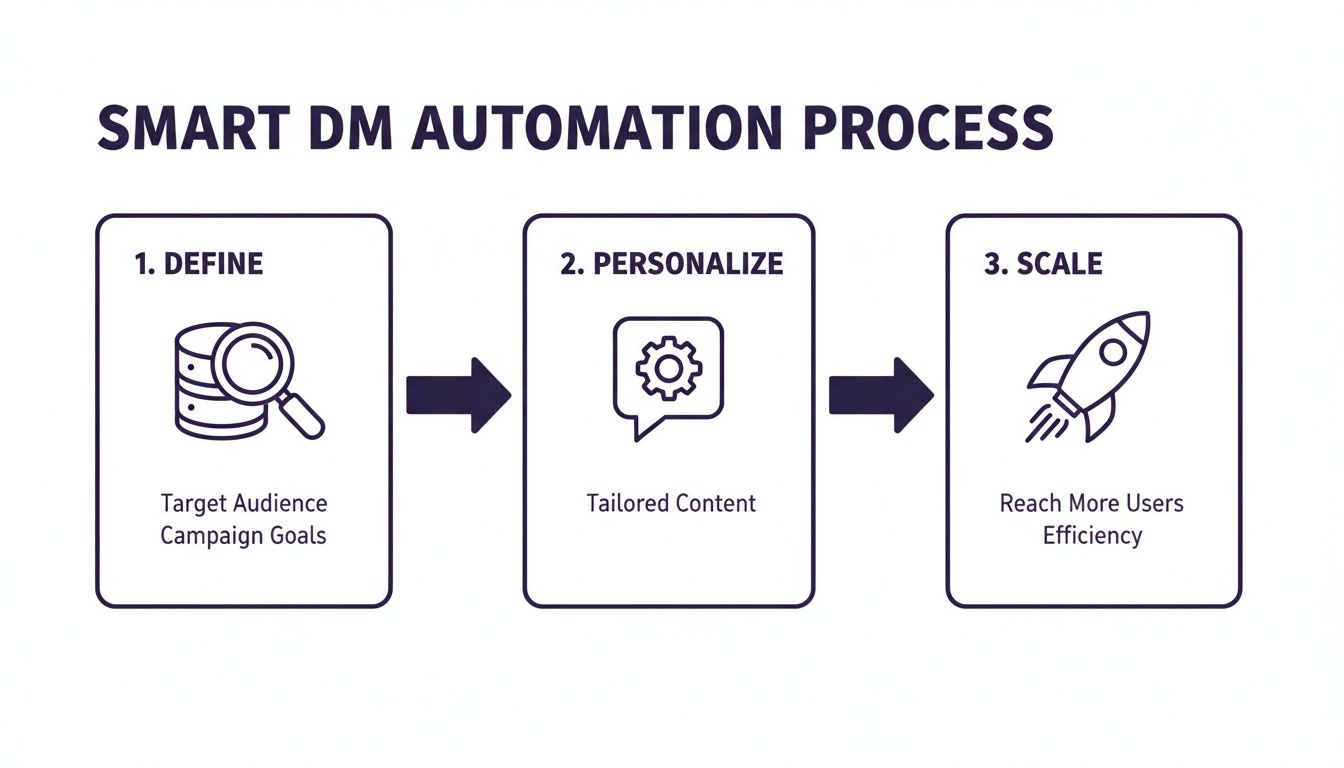
This simple loop—defining your target, personalizing the message, and then scaling the outreach—is the core of any successful lead generation campaign on X.
The KPIs That Actually Matter to a Founder
Forget vanity metrics. Follower count and impressions might feel good, but they don't pay the bills. As a founder, you only have time for numbers you can directly tie to revenue.
Here are the only KPIs you really need to obsess over:
- DM Positive Reply Rate: What percentage of your DMs get a warm response? This is the most important health metric for your outreach. If it's low, your targeting or messaging is off. You should be aiming for 25% or higher.
- Meetings Booked from X: How many qualified sales calls did your activity on X generate this week? This is the bridge between social media chatter and your sales pipeline.
- Customer Acquisition Cost (CAC) from X: How much did it cost you—in time and tools—to land a new customer from this channel? This tells you if your X strategy is profitable.
- Revenue Sourced from X: This is the bottom line. How much new MRR can you trace directly back to your work on the platform?
Your dashboard should be dead simple. It needs to answer one question: "Is our activity on X making us money?" If you can't answer that in 10 seconds, your tracking is too complicated.
Even with all the market changes, X is still a powerhouse for B2B. It currently contributes 12.73% of all B2B social media leads. The platform has a massive ad reach and a solid click-through rate, making the opportunity for scalable outreach undeniable.
Creating a Simple Performance Dashboard
You don't need a fancy BI tool to track what really matters. A simple spreadsheet is more than enough when you're starting out. Just set it up to track your core KPIs on a weekly basis.
To really get this right, look for tools that have solid analytics features built-in. The right platform will give you this data without you having to hunt for it.
Your dashboard should let you spot trends in an instant. Is your reply rate dipping? Time to test new message templates. Are meetings booked on the rise? Double down on what you're doing right.
This data-driven loop of executing, measuring, and adjusting is what separates a professional growth strategy from just "posting on social media." It’s how you build a predictable revenue engine.
Frequently Asked Questions
When you're building a business, it's easy to get lost in the weeds of a Twitter marketing plan. Here are some straight-up answers to the questions we hear all the time from other founders.
Can I Just Focus on Organic Content and Skip DMs?
It's a tempting shortcut, but you'd be leaving a ton of revenue on the table.
Think of it this way: your organic content is your booth at a giant conference. It looks great, builds your brand, and pulls in people who wander by. But the real business gets done when you step out from behind the booth and talk to people.
DM outreach is exactly that—it's the proactive conversation starter. It's how you connect directly with perfect-fit customers who might never have stumbled upon your content.
A solid Twitter marketing plan uses content to build authority and DMs to turn that authority into sales calls. One without the other is like an engine with no fuel.
You can't just wait for people to find you. If you want predictable growth, you have to go out and find them.
How Do I Balance Automated and Manual Activities?
This is the secret to scaling your outreach without sounding like a robot or burning out. Let automation handle the repetitive, top-of-funnel tasks, which frees you up for the high-value, human conversations that matter.
Here's a simple framework that just works:
- Automate the First Touch: Use a tool like DMpro to find your ideal customers and send that initial, personalized message. This is the grunt work that's impossible to do by hand at scale.
- Handle Replies Manually: The second someone replies with interest, that's your cue. Jump in and take over. From that point on, it’s a genuine, one-on-one conversation. Automation gets the door open; you walk through it.
This hybrid approach gives you the best of both worlds: the massive scale of automation combined with the personal touch that builds relationships and closes deals.
Organic vs Automated Outreach At a Glance
| Activity | Best For | Primary Benefit | Tool Example |
|---|---|---|---|
| Manual Engagement | Building relationships with key accounts, engaging with industry leaders, nurturing warm leads. | Deep, authentic connection and brand building. | TweetDeck / Native X |
| Automated Outreach | Top-of-funnel lead generation, reaching a large volume of ideal customer profiles. | Scale, efficiency, and predictable pipeline generation. | DMpro |
Ultimately, you need both. Automation fills the top of your funnel, and manual engagement helps you convert those opportunities.
Won’t My Outreach Feel Spammy and Impersonal?
It absolutely will... if you do it wrong.
The line between effective outreach and spam is relevance. Spam is blasting a generic message to a huge, untargeted list. It's lazy marketing.
Smart outreach is laser-focused and feels personal. You get there by doing two things well:
- Nail Your ICP: Get incredibly specific about who you’re talking to. The more niche your audience, the more your message will resonate.
- Use Personalized Hooks: Don't just say "Hi [First Name]." Reference something specific from their profile—a recent post, a project in their bio, or a shared interest. Modern tools like DMpro can automate this, pulling in unique details for each person.
When a message is clearly for them, it doesn't feel like spam. It feels like you’ve done your homework.
How Much Time Should I Expect to Spend on This Daily?
If you're doing everything manually, a serious Twitter marketing effort can easily chew up 2-3 hours a day. That's time spent creating content, engaging, and sending DMs one by one. As a founder, you just don't have that kind of time.
This is where a smart, automated system changes the game.
With the right setup, your daily time commitment can shrink to just 20-30 minutes. That time is spent purely on the good stuff: reviewing positive replies from your campaigns and having conversations with people who are already interested. That’s the efficiency that makes X a truly scalable channel for winning new customers.
If you’re tired of manually sending DMs every day, try DMpro.ai — it automates outreach and replies while you sleep.
Ready to Automate Your Twitter Outreach?
Start sending personalized DMs at scale and grow your business on autopilot.
Get Started Free