
How to Find Consulting Clients: a Founder's Guide
Learn how to find consulting clients using a repeatable system. This founder-focused guide covers targeted outreach, automation, and converting leads.
Tired of the feast-or-famine cycle? One month you're drowning in client work, the next you're frantically scrolling Twitter, wondering where the next project will come from. This rollercoaster is exhausting, and it’s no way to build a sustainable consulting business.
The truth is, finding clients shouldn't be about random hustle. It's about building a predictable machine that consistently brings the right clients to you. Let's break down how to get off that rollercoaster for good.
Build a System to Attract Consulting Clients
Let’s be real, founder to founder. Building a business that lasts isn't about landing one more gig. It’s about creating a predictable pipeline so you can focus on what you do best. This all starts with laying the groundwork for a client acquisition system that works for you, not the other way around.
The entire process boils down to three core ideas: define your ideal client, find where they hang out, and attract them with a message that actually solves a problem they care about.
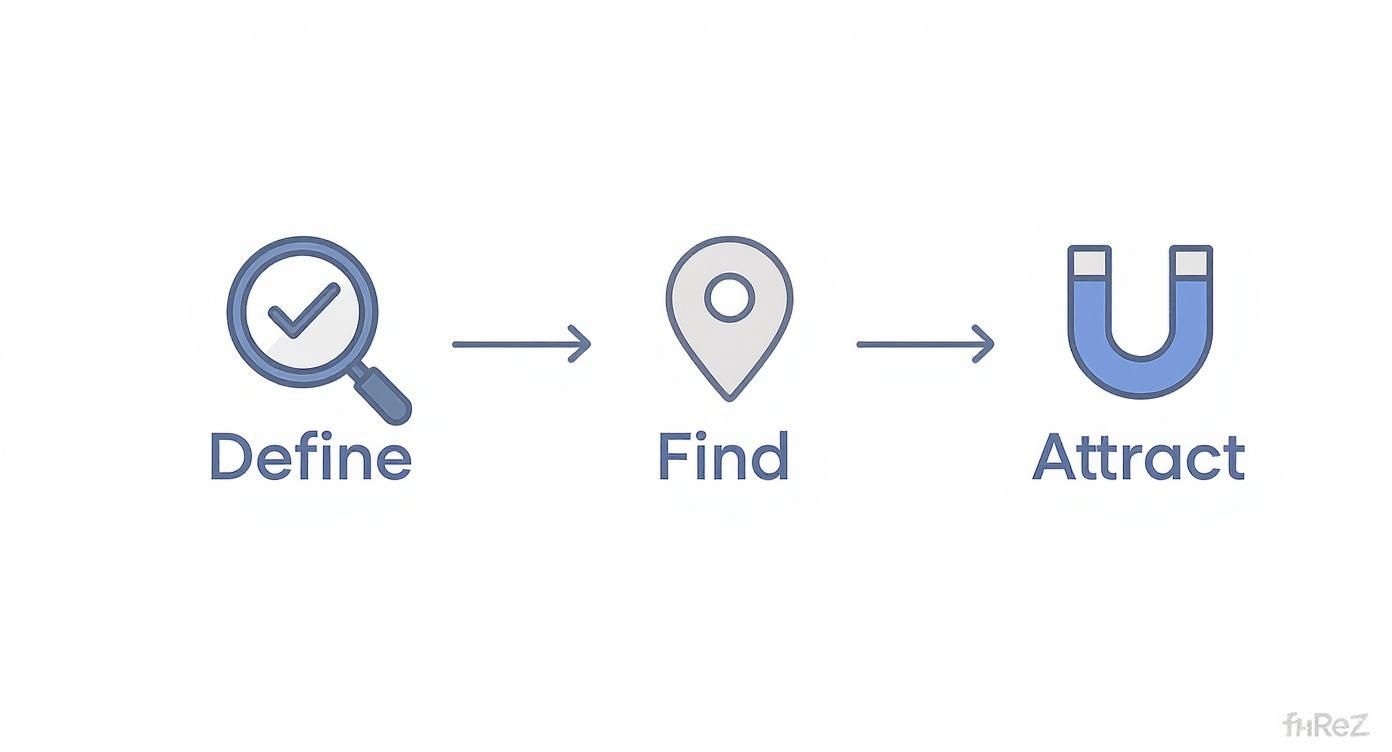
This visual shows you exactly where to start. Success begins with absolute clarity on who you serve before you even think about your outreach strategy.
Laying the Foundation for Growth
The first real step is a mindset shift. Stop asking, "How can I find one client today?" Instead, ask, "What system can I build to attract ten clients this quarter?" This simple change reframes your work from one-off tactics to building a long-term asset. A solid system is the core of any modern outbound sales strategy that gets results.
This isn't just about making your life easier. It's about positioning your consultancy for serious growth in a booming market. The management consulting world is expected to jump from $410.5 billion in 2024 to an incredible $1.23 trillion by 2034. To grab a piece of that pie, you have to align your services with specific, evolving business needs.
From Manual Effort to a Repeatable Machine
A system turns your manual, one-off actions into a process you can repeat, measure, and improve. Yes, it takes some upfront work to define your target and nail down your message, but the payoff is a scalable engine for growth. This is where you map out your ideal client's journey and pinpoint the exact moments where you can step in and add value.
A great system isn't about working harder; it's about making your effort count more. It's the difference between pushing a boulder uphill and letting gravity do the work for you.
Now, think about the cost of not having a system. Every hour you spend on random outreach is an hour you’re not spending on billable work or strategic planning. Knowing your numbers is crucial, which is why understanding your client acquisition cost is non-negotiable. The frameworks in our guide on calculating https://www.dmpro.ai/blog/saas-customer-acquisition-cost are just as relevant for consultants as they are for software companies.
Ultimately, this system is your path to predictable revenue.
Know Your Ideal Client and Where to Find Them
If your outreach feels like you're shouting into the void, there's a good reason why. Broadcasting a generic message is a surefire way to get ignored. Before you ever think about writing a DM or an email, you have to get crystal clear on who you're actually trying to help.
This is the first, and most important, step: building a rock-solid Ideal Customer Profile (ICP). We're not just talking about surface-level details like company size or industry. To really connect, you need to go deeper and understand the person behind the job title.

Go Beyond Basic Demographics
Think like a detective. Your goal is to uncover the motivations, frustrations, and goals that drive your ideal client every day.
Ask yourself these kinds of questions:
- What's the one business problem that literally keeps them awake at night?
- What have they already tried to fix it, and why didn't it work?
- How do they talk about their challenges? What specific words and phrases do they use on platforms like X or LinkedIn?
When you know these answers, your outreach practically writes itself. You can mirror their language and speak directly to their most urgent needs. Suddenly, you're not just another consultant pitching a service—you're a problem-solver who genuinely gets it.
You’re not just defining a target market. You're trying to understand their world so intimately that hiring you feels like the obvious, inevitable next step.
Find Where Your Clients Actually Hang Out Online
Once you have a clear picture of who you're looking for, the next question is where to find them. Spreading yourself thin across every social media platform is a classic rookie mistake that leads to burnout. Don't do it.
Instead, pick one or two channels where your ideal clients are most active and go all-in. For most B2B consultants, especially those focused on SaaS and tech, this usually means platforms like X (formerly Twitter) and LinkedIn. These aren't just digital résumés; they are living, breathing databases of founders talking openly about their work, their struggles, and their goals.
You can literally search for keywords related to their pain points and find a feed of people who might need your help right now. This is how you stop chasing cold leads and start engaging with people who are already halfway to buying. If you're not sure how to tell the difference, our guide on what is a qualified lead can help you spot the real opportunities.
This focused approach is critical, especially when you consider the size of the market. North America alone makes up around 40% of the global consulting industry. And with 82.7% of the nearly one million consulting businesses operating as solo practitioners, standing out is everything. Getting your targeting right isn't just a "nice to have"—it's your biggest competitive advantage. You can dig deeper into these numbers and more over on Melisa Liberman's blog.
Nailing your ICP is the foundation for everything that follows. Get this right, and you're building your client acquisition system on solid ground.
Craft Outreach That Actually Gets Replies
Let’s be honest: cold outreach gets a bad rap because most of it is terrible. It's generic, self-serving, and gets deleted on sight. But once you've truly defined your ideal client, your outreach doesn't feel cold at all. It feels like the start of a real conversation.
The point isn't just to get a reply—it's to get a reply from the right person. A great message comes across less like a pitch and more like a helpful observation from a peer. It shows you've actually done your homework and understand their world before you ask for even a minute of their time.

The Anatomy of a Winning Cold DM
On a fast-moving platform like Twitter, you have seconds to grab someone's attention. Ditch the long, formal intros. Your message has to be sharp, personal, and deliver value immediately.
A solid cold DM really only needs three things:
- The Hook: Kick things off with a genuine compliment or a specific observation about their recent work. This is your proof that you’re not a bot.
- The Bridge: Connect what they’re doing to a problem you solve. Frame it as a hypothesis, not an accusation.
- The CTA: Wrap up with a low-friction question that’s easy to say "yes" to. Don't ask for a 30-minute call right away; just ask for their thoughts.
Imagine you're a SaaS distribution consultant trying to connect with early-stage B2B founders. Instead of the tired old "I can help you grow," get specific.
"Hey [Name], saw the new feature you launched for [Their SaaS] – love the approach to solving [problem]. Noticed you mentioned you're looking to scale distribution. Have you considered [specific strategy] to get it in front of more enterprise clients?"
See how that works? It’s not about you. It’s about them, their project, and a specific challenge they’re likely thinking about. This simple, personalized structure is something you can explore further in our guide on how to send DMs on Twitter.
Scaling Personalization Without Losing Your Mind
Writing one perfect message is easy enough. But sending hundreds? That's where most consultants and founders get stuck. You know personalization is the key, but you don't have eight hours a day to spend researching profiles and typing out messages.
This is where smart automation becomes your secret weapon. You can build templates based on your proven formula and use tools to populate the personalized details. It’s all about building a system that allows you to have more quality conversations, not just more outreach.
For instance, a tool like DMpro helps with this exact problem. You can set the criteria for your ideal client, and it goes to work finding relevant profiles on Twitter and sending personalized DMs that reference their recent activity. It’s not spam; it’s scaling the part of your outreach that actually gets results.
The Art of the Follow-Up
Sometimes, the timing just isn't right. A lack of a response doesn't always mean "no." People are busy. Your goal is to stay on their radar without becoming an annoyance.
A good follow-up strategy is simple: add more value. Don't just send a lazy, "Just checking in." Instead, share a relevant article, point them to a useful tool, or offer an insight connected to your first message. Give it a few days, and keep it brief and genuinely helpful.
This is another part of the process where automation can be a lifesaver. You can set up simple follow-up sequences that automatically trigger if you don't get a reply. This ensures no one slips through the cracks and frees you up to focus on the warm conversations your outreach is generating. It’s how you turn a messy, manual task into a reliable client-finding machine.
Automate and Scale Your Client Acquisition
So, you've found an outreach message that consistently gets replies. Fantastic. You've cracked the code—you know who to target and exactly what to say to pique their interest. But sending those messages one by one? That's a direct flight to burnout. It's time to build a system that scales this success without chaining you to your desk all day.
This is where smart automation enters the picture. The goal isn't to blast out generic, soulless spam. It's about taking the personalized, high-value approach that you know works and systematizing it. This frees you up to focus on what actually moves the needle: closing deals and delivering amazing work for your clients.
Build Your Outreach Machine
The first step is to turn your manual process into a repeatable workflow. You've already got your winning message templates and a crystal-clear idea of your Ideal Customer Profile. Now, let's put them to work at scale.
This is especially powerful on platforms like X, where you can pinpoint potential clients based on keywords they use, accounts they follow, or conversations they're jumping into right now. Trying to track all that manually is a recipe for madness.
With the right setup, you can build campaigns that automatically:
- Identify prospects who fit your specific criteria (like SaaS founders talking about "churn").
- Send an initial DM using your proven, personalized template.
- Follow up on autopilot if they don't reply after a few days, adding a bit more value without you lifting a finger.
This completely transforms your outreach from a daily grind into a consistent, lead-generating engine humming along in the background.
The point of automation isn’t to remove the human element. It's to automate the tedious tasks so you can spend more time on the human conversations that actually lead to contracts.
Using The Right Tools for the Job
This is precisely what tools like DMpro.ai were built for. Instead of burning hours every day scrolling Twitter and copy-pasting DMs, you can set up a campaign in minutes. You define your ideal client, craft your message sequences, and let the system handle the heavy lifting of finding and engaging them.
It’s designed to replicate the thoughtful, personalized outreach that works, but at a scale that's simply impossible to manage by hand. This means you’re consistently starting conversations with qualified leads even while you’re busy on discovery calls or deep in client work. For a deeper look, our guide on how to send automated Twitter DMs walks you through the entire setup process.
Track Your Pipeline Like a Founder
Automation will fill your inbox with conversations, but you still need a simple way to track everything. Don't overcomplicate this—you don't need a pricey, complex CRM to get started. A basic spreadsheet or a Trello board will do the job perfectly.
Just create columns for each stage of your process:
- Contacted: Everyone who has received your initial message.
- Replied: Prospects who have responded and are now in a conversation.
- Qualified: Leads you've confirmed are a great fit for your services.
- Proposal Sent: Qualified leads who have received a proposal from you.
- Closed/Won: Your newest clients!
This simple system gives you a clean, visual overview of your pipeline. You can see where leads might be getting stuck and what's working with just a quick glance. It turns the messy art of finding clients into a science you can measure, manage, and improve over time. Combine smart automation with simple tracking, and you've built a truly scalable client-finding machine.
Turn Conversations Into Consulting Contracts
<iframe width="100%" style="aspect-ratio: 16 / 9;" src="https://www.youtube.com/embed/JCV5czXqk0w" frameborder="0" allow="autoplay; encrypted-media" allowfullscreen></iframe>So, you got a reply. That's a great start, but let's be real—a full inbox doesn't pay the bills. Signed contracts do.
This is where the real work begins. You need to shift from being a prospector to a closer, and that means skillfully guiding the conversation from a casual "hey" to a signed deal. The secret is having a simple, repeatable process for qualifying leads and moving them down the line. Without one, you’ll burn hours on calls with tire-kickers, draining your energy and killing your momentum.
Qualify Hard and Fast
Your time is your most valuable asset. Stop giving it away to prospects who aren't serious or can't afford you. The goal of that first call isn’t to sell; it’s to diagnose. You're a doctor, not a salesperson. Your job is to figure out if this is a lead actually worth pursuing.
Pull together a short checklist of your non-negotiables. It doesn’t have to be complicated.
Mine looks something like this:
- Budget: Can they actually afford a real solution, or are they just window shopping?
- Urgency: Is this a “hair on fire” problem they need to solve now, or just a "nice-to-have" idea for next year?
- Authority: Am I talking to the person who can actually write the check, or just an intern doing research?
Being direct about these things right away saves everyone a massive headache. You’re not being rude; you’re being a professional who respects their time and your own.
The fastest way to find your next great client is to quickly disqualify the bad ones. Stop spending your best energy on prospects who will never convert.
Master the Discovery Call
A great discovery call is all about them, not you. Shut up and listen. Your only job is to ask smart, open-ended questions that get them to articulate their pain in their own words.
It helps to understand the bigger picture. The global consulting industry is rocketing towards $1.06 trillion by 2025. A huge piece of that is driven by the frantic need for digital transformation, a space growing at nearly 28.5% annually. You can find more insights about these industry trends here.
Your prospects are feeling this pressure. They aren't just buying your services; they're buying a lifeline to stay competitive. Use that knowledge to frame your questions. Once they've told you exactly what's broken, you can position your service as the most logical, effective way to fix it.
Craft a Proposal That Closes Itself
If the discovery call went well, the proposal should be a slam dunk. This isn’t the time for a big reveal or any surprises. It's just a document that clearly summarizes everything you already talked about and agreed on.
Keep it simple and focused on four things:
- The Problem: State their challenge back to them, using their own words.
- The Solution: Briefly outline your plan and what you’ll deliver.
- The Investment: Clearly state the price and payment schedule. No fuzzy math.
- The Next Steps: Tell them exactly what to do to say "yes" and get started.
A solid proposal reinforces that you listened and you have a plan. It makes signing the contract feel like a simple, obvious formality—the final piece of the puzzle that kicks off a great new client relationship.
Got Questions About Finding Clients? Let's Tackle Them.
Even with the best system in place, you're going to have questions. It’s just part of the process. I get asked a lot of the same things by fellow founders trying to nail this down, so let's get into some straight-up answers.

How Much Outreach Should I Be Doing Every Day?
Forget "as much as you can"—that's a recipe for burnout. The real answer is consistency over intensity.
Sending 10-20 highly personalized, thoughtful messages to people who are a perfect fit for your services will always beat spamming 100 generic DMs. Quality is everything here.
Pick a daily number that feels completely doable for you, even on a busy day. This is a long-term game. A sustainable pace is what gets you clients, not a frantic sprint that you can't maintain.
What if I Get Ghosted After a Great Call?
First off, it happens to everyone. Don't take it personally. A prospect going silent rarely means "no." It usually means they got pulled into ten different fires that felt more urgent at that moment.
Your job isn't to pester them; it's to gently stay on their radar.
Wait about a week, then follow up with something genuinely helpful. Don't just ask, "Hey, any update?" Send a link to a relevant article, share a quick insight about your conversation, or mention a new tool they might find useful. The goal is to be helpful, not needy.
The best consultants are specialists, not generalists. You're better off being the go-to expert for one type of client with one core problem than being a decent option for everyone.
How Should I Handle Objections to My Price?
If you keep hearing "that's too expensive," it’s almost always one of two things. Either you're talking to people who genuinely can't afford your rates, or you haven't properly connected your work to a tangible return on investment.
Go back to your discovery call process. You need to dig deep into the real-world cost of them not solving their problem. What is it costing them in lost revenue, wasted time, or missed opportunities each month?
Frame your fee as an investment that solves that costly problem. When the value you deliver is crystal clear, the price suddenly seems a lot more reasonable.
Should I Automate My Outreach From Day One?
Absolutely not. Start by doing it all by hand. Seriously. Send your first 50-100 DMs manually.
Think of this as your research phase. You'll learn exactly what language gets a response, what pain points resonate most, and how to refine your pitch in real time. This hands-on experience is priceless.
Once you've found a message and a process that consistently gets replies, that's the time to bring in automation. A tool like DMpro.ai is there to scale what's already working. You give it the winning formula, and it handles the repetitive outreach so you can spend your time on what really matters: having conversations and closing deals.
If you’re tired of manually sending DMs every day, try DMpro.ai — it automates outreach and replies while you sleep. Visit https://dmpro.ai to start your free trial.
Ready to Automate Your Twitter Outreach?
Start sending personalized DMs at scale and grow your business on autopilot.
Get Started Free