
How to Build Ideal Customer Profile That Converts
Learn how to build ideal customer profile step by step with data sources, scoring, and templates to focus outreach and close better-fit customers faster.
You've spent the week sending messages to founders, marketers, and sales leaders who look vaguely relevant. Some reply with polite curiosity. Most don't reply at all. The few who book calls turn out to have no budget, the wrong tools, or a problem your product can't solve well.
That isn't usually an outreach problem. It's a targeting problem.
Learning how to build an ideal customer profile means creating a revenue filter, not a polished persona document. A useful ICP tells you which accounts deserve attention, which ones need nurturing, and which ones should never enter your pipeline. It also gives your messaging a sharper point, whether you're running founder-led sales, SaaS distribution, or automated outreach on X.
The system below starts with real customers, converts evidence into a weighted score, adds negative fit, and stays current through regular reviews. By the end, you'll have a practical workflow you can put into operation this week.
Why Most Ideal Customer Profiles Fail Before Outreach Starts
A founder writes, “Our ICP is B2B SaaS companies with growing teams,” then hands sales a list of thousands of accounts. The wording sounds focused until reps have to decide which companies deserve research, which have a real problem, and which should be left alone.
Broad profiles create activity without focus. Lead lists expand, personalization becomes shallow, and sales reps qualify accounts that were poor fits from the start. The team measures messages sent instead of pipeline created because the criteria never force a useful choice.
A working ICP identifies the companies most likely to buy and get value from your product. It should help you assess the operating environment, problem urgency, budget fit, and practical path to adoption. ZoomInfo's practical ICP guidance describes ICP development as a data-enrichment process using firmographic, technographic, behavioral, intent, use-case, and budget signals.
Practical rule: If your ICP makes the target list bigger, it probably isn't an ICP yet.
The broad-profile trap
Broad profiles describe who could use a product, not who is likely to buy it now.
“Marketing teams” might include a solo consultant, a global enterprise, and a company with no outbound motion. Their buying process, urgency, technology, and willingness to pay differ. One message cannot speak credibly to all three.
Founder preference creates another blind spot. You may enjoy selling to startups, while your strongest customers are established firms with a particular integration, a dedicated operator, and a repeatable acquisition motion. Personal experience can generate a useful hypothesis. It cannot replace customer evidence.
Documentation helps marketing and sales work from the same criteria, but a document sitting in a folder changes nothing. According to SalesHive's ICP scoring guide, companies with a strong ICP see roughly 68% higher win rates. The guide also reports that only 42% of companies have a formally documented ICP. Treat those figures as directional benchmarks, then test your own profile against pipeline and closed-won results.
What a useful ICP changes
A focused ICP changes four operating decisions:
- Who gets researched: Sales investigates accounts with evidence of fit.
- Who gets a message: Outreach reflects a recognizable problem and buying context.
- Who gets routed first: High-fit accounts receive faster, more relevant follow-up.
- Who gets excluded: Poor-fit accounts stay out of sales and support workflows.
The strongest version is an operational scoring and suppression system. It assigns weights to fit signals, lowers priority when evidence is weak, and blocks accounts that repeatedly waste time. The target list should shrink. If every account still qualifies, the scoring rules are not doing their job.
Review the system quarterly. Customer mix, product scope, pricing, and buying behavior change, so a profile that worked last quarter can become too broad. Compare score bands with active pipeline and closed-won accounts, then adjust the weights and exclusions.
Start with recent closed-won data, enrich missing fields, identify shared attributes, and test the first score against active opportunities. Once the audience is defined, DMpro can help execute X campaigns against those accounts instead of sending broad-list outreach.
Gather the Four Data Layers That Power a Real ICP
A target account can look perfect in a spreadsheet and still fail during implementation. Build the evidence set first, then score only what you can verify or clearly label as unknown.
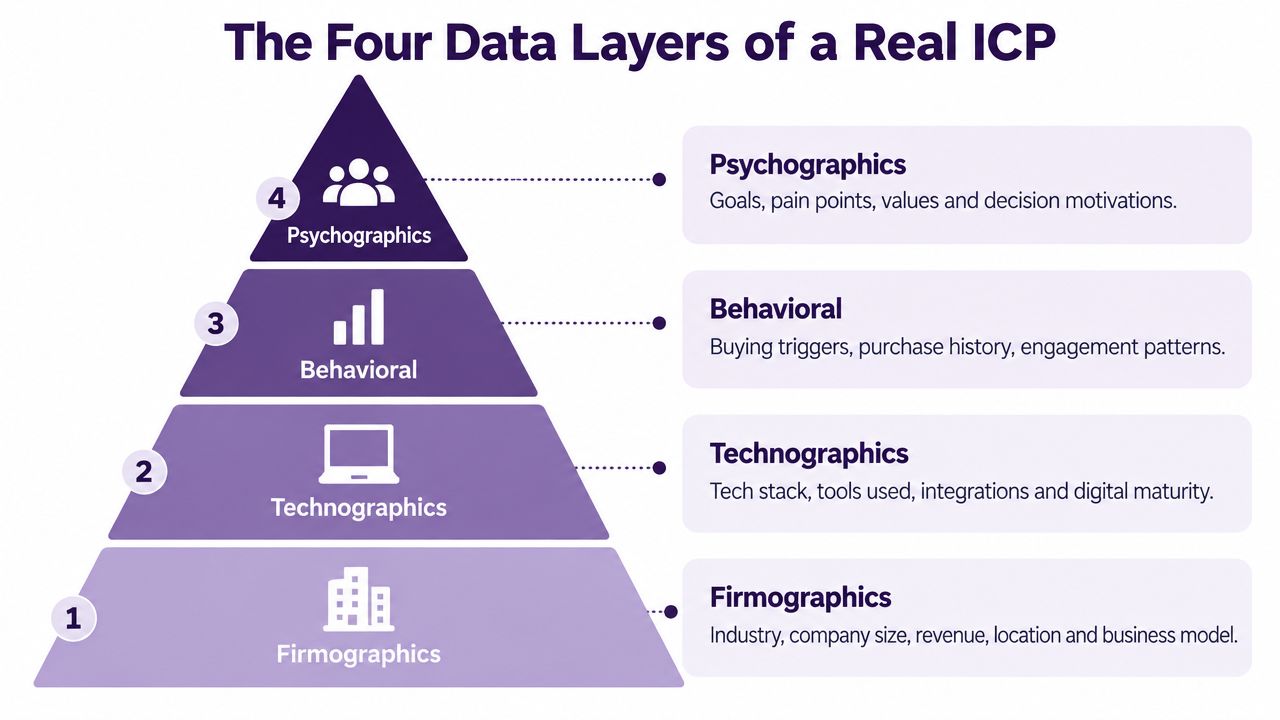
A practical ICP uses four data layers: firmographics, technographics, behavioral and intent signals, and use-case and budget fit. Treat these layers as an operating checklist, not a persona description. Each one should help sales decide whether an account belongs on the target list, needs more research, or should be suppressed.
Start with firmographics
Firmographics define the account's operating context.
Collect industry, company size, revenue range, geography, business model, growth stage, and serviceable market. For a SaaS product, headcount may matter less than whether the account has the team structure needed to adopt the product. For an agency, geography and service model may determine whether delivery remains profitable.
Start in the CRM. Add enrichment where fields are incomplete, then verify details through company websites, LinkedIn company pages, hiring boards, and public funding alerts. With these boundaries set, use enrichment to fill the gaps found in your CRM audit before scoring. Prioritize fields that predict adoption friction, not fields that are easy to collect.
Map the technology environment
Technographics show whether your product fits the account's existing workflow.
Record the CRM, analytics tools, communication platforms, ecommerce system, data warehouse, advertising tools, and required integrations. An account may match the right industry and size, yet still be a poor target because its current stack makes implementation expensive or slow.
The stack also signals operational maturity. A company hiring for lifecycle marketing, revenue operations, or data engineering may be more prepared than one managing the same work manually. Track the tools in use, integrations required, data ownership, and habits implied by that setup.
Use this lead quality framework for SaaS teams to keep target records usable for qualification and routing, not just research.
Add behavior and intent
Behavioral and intent signals explain why now.
Look for buying signals, relevant hiring patterns, product engagement, repeat visits to high-intent pages, event participation, funding events, leadership changes, and searches for problems your product solves. Create a source map before assigning scores. Otherwise, sales may treat an inferred signal as confirmed demand.
A hiring board can reveal a new function. A funding alert can indicate changing priorities. Engagement data can separate active research from casual website traffic. Record the signal, its source, and how recently it appeared.
Test use-case and budget fit
The final layer checks whether the account has a problem worth solving and the economic room to solve it.
Capture the use case, current workaround, urgency, expected outcome, budget ownership, approval process, and cost of inaction. An account can match every firmographic rule and still be a poor customer if the problem is peripheral or implementation demands too much internal work.
Keep the inventory honest. Mark every field as verified, enriched, inferred, or unknown. Unknown data should reduce confidence rather than become a positive score. Teams often lose focus by scoring assumptions as facts, so set a suppression rule for accounts with too many unverified fields.
The result should be a smaller, defensible account set. Refresh the source fields and scoring inputs quarterly as customer mix, product scope, pricing, and buying behavior change.
Find Your Best Customers and Extract What They Share
Your first ICP should come from customers who already proved they can buy, adopt, and stay with your product. Brainstorming can suggest categories, but closed-won accounts show which traits travel with revenue.

Pull your top 20–40 customers or review the last 12–24 months of closed-won deals, as recommended by Tomba's practical ICP workflow. Include sales data, onboarding notes, product usage, support history, expansion activity, and churn context where available.
Do not rank accounts by revenue alone. A large contract that drains support time can be a worse fit than a smaller account that adopts quickly, renews cleanly, and expands without constant intervention.
Look for concentration, not averages
Averages hide the pattern you need.
If your best customers come from several industries, the average industry tells you little. Concentration analysis asks a sharper question, which attributes keep showing up among accounts with strong commercial and operational outcomes?
Review each account across:
- Commercial quality: deal size, payment behavior, expansion potential, and profitability.
- Sales efficiency: sales-cycle length, number of stakeholders, and level of education required.
- Customer health: onboarding friction, support burden, usage depth, retention, and advocacy.
- Structural fit: industry, size, geography, technology, business model, and use case.
Then identify 3–5 shared attributes that seem to predict revenue quality. Keep them only if they help separate strong accounts from weak ones. If an attribute sounds strategic but does not change targeting, cut it from the draft.
Interview the accounts that make the pattern clearer
CRM records show what happened. Customer interviews often show why.
Ask how the team found the problem, what triggered the search, who joined the evaluation, what alternatives they considered, and what proof they needed before buying. Ask what changed after adoption and which part of the product delivered the most value.
You do not need a polished persona interview. You need language and decision context your outreach can use without sounding generic. A customer may describe a workflow issue in a way your team never considered, or reveal that the first responder was not the economic buyer.
Use prospect research tools for outbound teams to organize account and contact evidence before you write a message.
After the interviews, place the findings beside the CRM attributes. Separate recurring evidence from one-off anecdotes. One enthusiastic customer should not redefine the ICP.
Use the shrinking-list test
Take the draft criteria and apply them to your addressable market.
If the profile still returns tens of thousands of accounts, it is too broad to guide a real campaign. Narrow it by adding a meaningful use case, technology requirement, growth signal, geography, or buying trigger before launch. A useful ICP should shrink the list to accounts your team can work.
Create a separate suppression list at this stage. Record account types that repeatedly show low willingness to pay, poor adoption, long cycles, or heavy support requirements. Your ICP tells the team who to pursue. The suppression list tells them who to stop pursuing.
<iframe width="100%" style="aspect-ratio: 16 / 9;" src="https://www.youtube.com/embed/dPrmK95xvjk" frameborder="0" allow="autoplay; encrypted-media" allowfullscreen></iframe>Score and Tier Every Account So Sales Knows Who to Prioritize
A profile only matters when it changes who gets attention first.
Score each account on a 0–100 fit score built from weighted attributes, then use the score to route effort. Start with a simple model in a spreadsheet. Give more weight to the signals that separate strong accounts from weak ones, then define what a strong, partial, or weak match looks like for each field.
Build the score around evidence
A practical scoring model usually includes:
- Industry fit
- Company size and revenue fit
- Technology fit
- Geographic fit
- Use-case fit
- Buying or intent signals
- Economic and operational fit
Do not give every field the same weight. A required integration may matter more than geography. A clear buying trigger may matter more than a broad industry label. The score should mirror how your product creates value and why deals close or stall.
| Attribute | Weight Example | Scoring Signal |
|---|---|---|
| Industry | 20 | Core vertical receives full points, adjacent vertical receives partial points |
| Company size | 15 | Team structure and resources match the adoption model |
| Tech stack | 20 | Required tools or integrations are already present |
| Geography | 10 | Account operates in a supported market |
| Use case | 20 | Documented problem matches the product's strongest outcome |
| Buying signals | 15 | Hiring, engagement, funding, or explicit research indicates timing |
Treat the weights as a starting point, not a fixed formula. Review them after comparing score bands with real outcomes. DMpro's automated lead scoring workflow is useful here because it keeps the same logic applied across new accounts instead of letting reps improvise.
Route accounts by tier
Use the tiering rules to keep pipeline focused:
- 70+ points: high-fit accounts for direct sales attention and outreach.
- 40–70 points: nurture or research further before assigning intensive resources.
- Below 40 points: suppress unless new evidence changes the score.
Keep the thresholds visible in your CRM. Reps should see why an account landed in a tier, which fields drove the result, and what would move it up. That matters more than having a clever score name.
Prove whether the model works
The score is only useful if it predicts commercial outcomes. Compare in-profile and out-of-profile accounts on win rate, sales-cycle speed, retention, and net revenue retention. If the high-fit group does not outperform the rest, the model needs work.
Maybe the weights overvalue visible company traits and underweight use case. Maybe the profile points to accounts that can buy but do not stay. Maybe sales is chasing the right accounts with the wrong message. Either way, the fix is in the scoring rules, not in a prettier persona doc.
Document every revision. A score without version history is hard to trust, hard to debug, and hard to improve.
Sharpen Your Profile With Negative Fit and Buying Behavior
Most ICP documents describe the accounts a team wants. Stronger systems also define the accounts it should avoid.
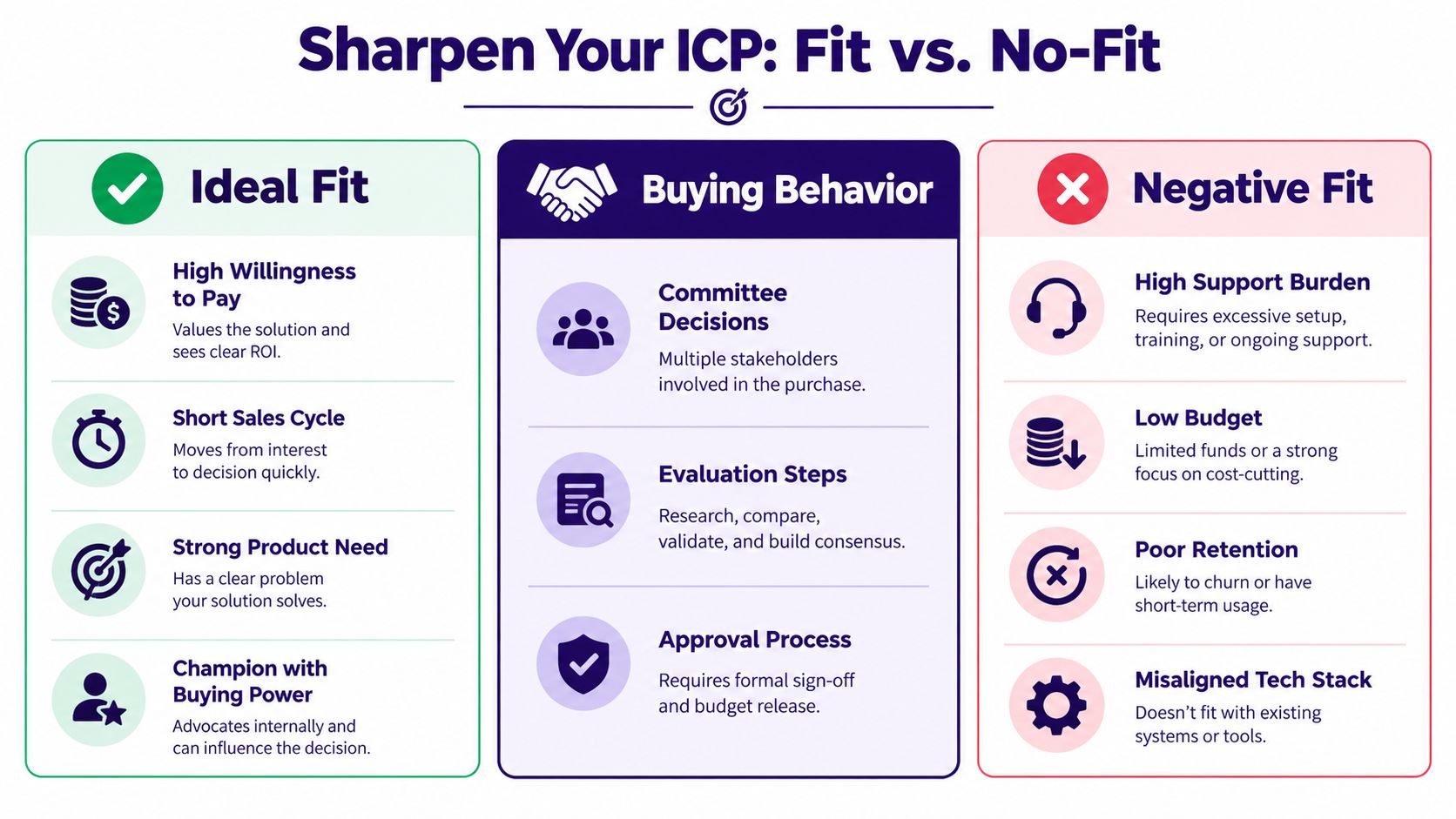
Negative fit isn't pessimism. It's capacity planning. A customer who needs constant support, resists the pricing model, or requires an operating model your team can't deliver may produce revenue and still damage the business.
Design the no-fit rules
Review lost deals, churned accounts, stalled opportunities, and support-heavy customers. Look for repeated disqualifiers:
- High support burden: The account needs work your product or team can't provide efficiently.
- Low willingness to pay: The problem exists, but the account won't support a sustainable commercial relationship.
- Long sales cycles: Approval complexity consumes more effort than the opportunity justifies.
- Poor operational fit: Implementation depends on systems, permissions, or workflows you don't support.
- Weak retention potential: The customer can purchase but has no durable reason to keep using the product.
Guidance on negative ICP design recommends making these exclusions explicit instead of stopping at industry, size, and geography.
Negative rules should be specific enough to guide action. “Small companies” is weak. “Companies without the required integration or an owner for implementation” is operational.
Add the human side of the buying process
Firmographics identify the account. They don't explain how the account decides.
Capture the motivations, values, risk tolerance, preferred proof, and internal route to approval. Identify the likely champion, the economic buyer, the technical evaluator, and the person who can block implementation. Larger buying groups often need different evidence for each role.
A champion may care about speed and credibility. A finance stakeholder may need a clear business case. A technical evaluator may focus on security, integration, and operational risk. Your account can be a strong fit and still stall if your message reaches the wrong person with the wrong proof.
Turn behavior into outreach context
For X campaigns, buying behavior can improve both targeting and message quality. Look for recent activity, recurring topics, hiring announcements, product launches, complaints about existing workflows, and public questions that reveal a problem.
The point isn't to mention every detail you find. It's to make the opening relevant without pretending to know more than you do. A message that references a genuine operational signal gives the recipient a reason to consider the conversation.
Use activity tracking for prospect research to organize relevant engagement signals before outreach. DMpro can be considered here as an automation option for turning defined criteria and public activity signals into targeted X campaigns, but the ICP rules still need to decide who qualifies.
X's own automation rules permit automated Direct Messages only when a recipient has requested contact or clearly indicated an intent to be contacted through DM. Senders must provide an easy opt-out and honor it promptly, as explained in X's automation policy. Compliance isn't a copy detail. It belongs inside the operating design.
Put Your ICP to Work and Keep It Accurate Over Time
An ICP becomes real when it controls the pipeline.
Apply the score to active opportunities first. Segment the accounts by fit, deal size, sales-cycle length, retention outcome, and current buying behavior. Then assign a clear action to each group. High-fit accounts might receive founder-led research and outreach crafted to their context. Mid-fit accounts may need education or stronger evidence. Suppressed accounts should leave the active sequence.

Run a focused campaign against the high-fit segment, then compare its commercial outcomes with accounts outside the profile. Don't judge the ICP by replies alone. Check whether the resulting conversations become qualified opportunities, move through the sales process efficiently, and lead to healthy customer relationships.
Refresh the model on a quarterly rhythm
B2B data decays quickly as people change roles, companies shift priorities, and technology stacks evolve. The B2B International research perspective on customer profiling supports treating segmentation as statistically grounded and continuously refreshed rather than as a one-time document.
Review the ICP quarterly. Recheck the attributes behind the score, add new suppression reasons, inspect recent wins and losses, and ask customer success whether the accounts you target are good to serve.
A practical review includes:
- Pipeline check: Score current opportunities and inspect unusual outliers.
- Revenue check: Compare deal size, cycle length, expansion, and retention by segment.
- Customer check: Add feedback from onboarding, support, and success teams.
- Market check: Update technology, hiring, funding, and competitive signals.
- Campaign check: Remove weak messages and preserve the language that earns useful replies.
For teams that need more context from public professional activity, a LinkedIn content intelligence platform can help identify recurring themes and audience signals that inform future profile revisions.
The aim isn't to create a perfect document. It's to keep a decision system accurate enough that sales, marketing, customer success, and outreach automation act on the same definition of fit.
If you're tired of manually sending DMs every day, try DMpro. It helps you define an ICP, find relevant prospects on X, and automate personalized cold DM campaigns while keeping targeting and follow-up organized. Start with the free trial and use the first 100 DMs to test your newly scored audience before scaling.
Ready to Automate Your Twitter Outreach?
Start sending personalized DMs at scale and grow your business on autopilot.
Get Started Free