
B2B Sales Strategy: A Founder's Playbook
Build a modern B2B sales strategy that actually converts. Learn how to map buying committees, automate X outreach with DMpro, and scale your SaaS pipeline.
The most popular B2B sales advice is wrong for modern SaaS. Sending more messages to more people doesn't create a predictable pipeline. It usually creates a tired team, weak conversations, and a growing list of prospects who never had a reason to care.
A useful B2B sales strategy starts somewhere else. Buyers research independently, compare vendors privately, ask colleagues for input, and increasingly use AI before they ever agree to a sales conversation. Your job isn't to force information into that process. It's to become the safest, clearest option when the buying group is ready to move.
Why Traditional Outbound is Failing Modern SaaS
“Spray and pray” outbound assumes that attention is the main problem. If you send enough emails or DMs, the theory goes, a few people will respond. That approach ignores the more important problem: buyers have already formed opinions before your first message arrives.
Gartner reports that 75% of B2B buyers prefer a rep-free sales experience. Buyers spend only 5%–6% of total purchase time interacting with sales representatives, while about 67% of the journey happens digitally. Those figures make high-volume outreach look less like a strategy and more like a poorly timed interruption.
Your prospect may already have a shortlist. They may have asked an AI tool to compare your category. They may have read customer discussions, checked your product pages, and sent a colleague to investigate pricing or security. A generic pitch that explains what your product does won't undo that private evaluation.
Practical rule: Stop treating the first touch as a product introduction. Treat it as a chance to reduce uncertainty.
That means your message should connect to something specific, such as a new role, a visible change in the company, a hiring push, a product launch, or a problem the prospect has already discussed publicly. The message earns attention by showing that you understand the situation, not by adding another feature list to an already crowded inbox.
From persuasion to validation
The old motion tries to convince. The stronger motion helps the buyer validate a decision they're already considering.
This changes the assets you build. Instead of relying only on a demo, prepare role-specific proof, answers to implementation concerns, clear security information, and a simple explanation of what happens after purchase. A finance stakeholder needs a different reason to trust you than a technical evaluator. A champion needs material they can forward internally without rewriting it.
The same principle applies to outbound prospecting. Good prospecting isn't a volume contest. It's a disciplined way to find accounts where your message fits the buyer's current context.
What to change this week
Audit your last outbound campaign and ask three direct questions:
- Was the account relevant? Could you explain why this company belongs in your target market beyond its employee count or industry label?
- Was the message timely? Did it reference a real business signal, or could you send the same copy to anyone?
- Did the message lower risk? Did it help the prospect understand an outcome, proof point, or next step?
If the answer is no, don't add more contacts. Narrow the list, improve the evidence, and write for the buying process your prospects already follow.
Mapping the Hidden Buying Committee
A B2B deal rarely belongs to the person who answers your first message. One person may discover the problem, another may own the budget, someone else may evaluate the product, and procurement or legal may block the purchase late in the process.
Forrester's 2025 survey found 13 internal stakeholders and 9 external participants in the average B2B purchase. Other industry analyses place buying committees around 9–11 or more stakeholders. The exact count matters less than the operational lesson: a single-threaded deal is fragile.
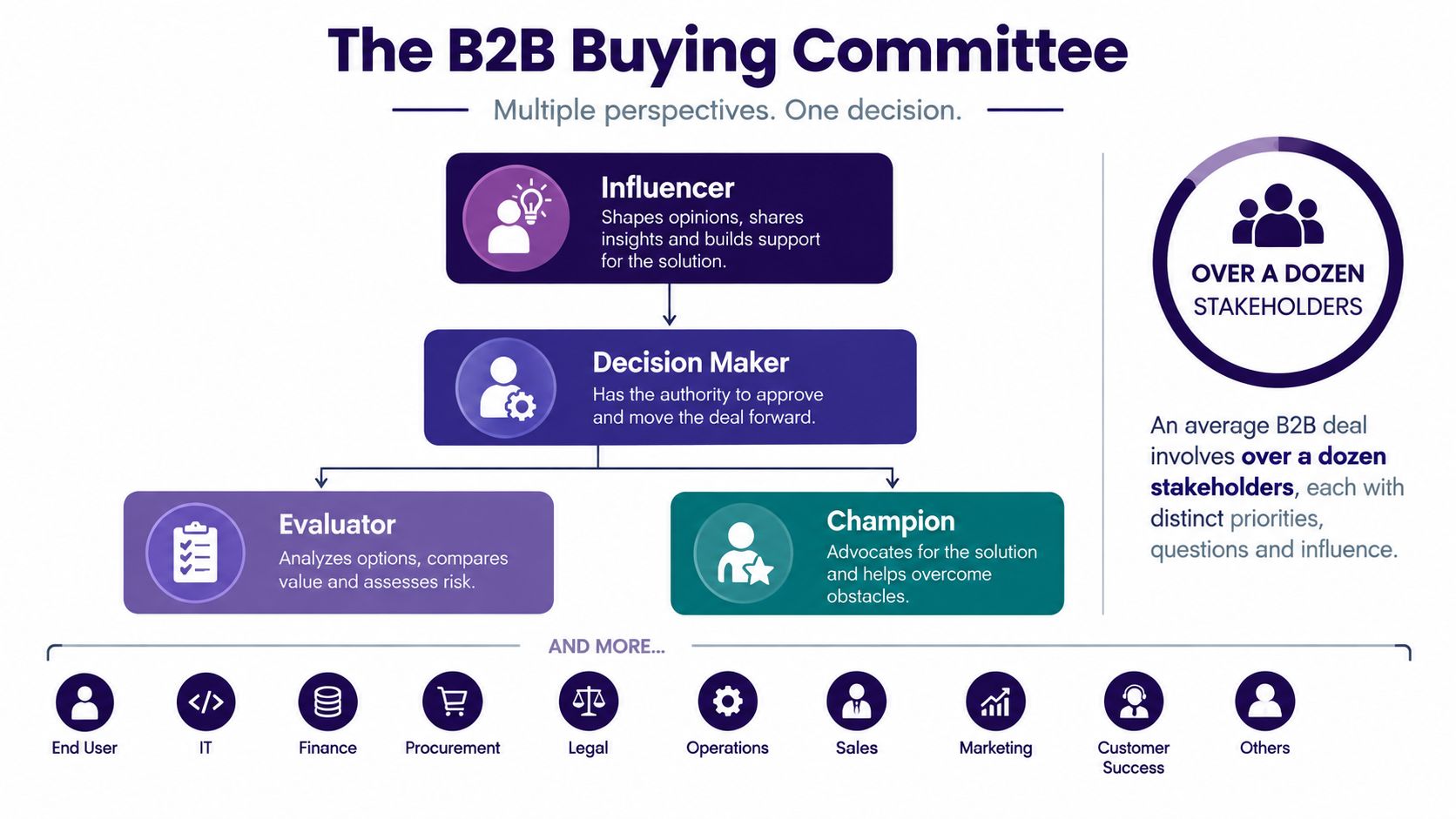
Messaging only the VP of Sales can produce an enthusiastic first call and a silent pipeline later. The technical evaluator may reject the integration. The finance owner may question the business case. The champion may like the product but lack the internal language to defend it.
Build a role map, not a contact list
Start with the account and assign likely responsibilities:
- Decision maker: Owns the commercial outcome or budget.
- Champion: Wants the problem solved and will carry your argument internally.
- Evaluator: Tests product fit, workflow, security, or integration.
- Influencer: Shapes the shortlist through experience, authority, or peer advice.
- Blocker: Can delay or reject the purchase through procurement, legal, finance, or operations.
You won't always identify every person immediately. That's fine. The point is to create a working hypothesis and test it during discovery.
Ask questions that expose the network. Who else needs to approve this? Which team will use the product every day? What does procurement need before a contract can move? What would make an internal stakeholder uncomfortable?
A practical guide to sales intelligence tools can help teams organize account signals and enrich stakeholder research, but software won't replace judgment. Your CRM should show not only who you've contacted, but also which roles remain unrepresented.
Give each stakeholder a reason to care
Don't send the same message to every person at an account. The decision maker may care about business impact and risk. The evaluator may care about workflows and technical limits. The champion may need a short internal narrative that connects the problem to a priority already recognized by leadership.
Create a small proof library for each role. Include a relevant use case, likely objection, validation asset, and next step. When you map stakeholders, you turn outreach from isolated conversations into coordinated deal navigation.
The goal isn't to pressure every stakeholder at once. It's to make the buying group more confident, with each person receiving information that helps them perform their part in the decision.
Building an ICP That Actually Filters Noise
A useful ideal customer profile should remove accounts from consideration, not describe an entire market. “SaaS companies with 50 to 500 employees” gives a starting category, but it does not tell you which accounts deserve attention now. A practical ideal customer profile vs buyer persona comparison helps keep account fit separate from the individual roles involved in a deal.
Poor qualification creates pipeline leakage before the first message is sent. Benchmark data reports that only 1%–3% of website visitors become leads, 85%–90% of captured leads never become MQLs, and 70%–80% of MQLs never become SQLs. The reported overall lead-to-customer conversion rate is 2%–5%. Better copy cannot compensate for weak account selection.
Start with the problem pattern
Build the ICP around conditions that make the problem urgent. A company can match your industry target and still be a poor prospect if the relevant team is too small, its workflow is immature, or the problem has no visible owner.
Use four layers:
- Firmographic fit: Industry, business model, geography, team structure, and operating environment.
- Operational fit: The workflow your product improves, the current toolset, and the cost of leaving the problem unresolved.
- Trigger fit: Hiring, leadership changes, product launches, expansion, funding activity, migration projects, or public complaints about the problem.
- Buying fit: Evidence that the company can evaluate, approve, implement, and maintain the solution.
The strongest accounts match all four layers. An account that only matches the first belongs in research, not an active outbound sequence.
Turn signals into segments
Do not build one giant audience. Group accounts by the reason they may act, then tailor the message to that situation.
A company hiring several sales development representatives needs a different opening from one replacing its customer support stack. Both may fit the same software category, yet their urgency, internal language, and likely champion differ. Public discussions on X can add useful context here, especially when an operator describes a problem before it becomes a formal project. Those signals can support automated outbound, provided the message reflects the account's situation rather than repeating a generic template.
For each segment, document:
- Trigger: What changed?
- Affected role: Who feels the impact first?
- Business consequence: What gets slower, more expensive, or harder to control?
- Proof required: What would make the account comfortable taking a call?
- Disqualifier: What tells you to stop pursuing it?
This structure gives automation boundaries. It prevents every prospect from becoming the same persona and makes high-signal outreach easier to review.
Let qualification protect your team
A tight ICP protects sales capacity, sender reputation, and brand trust. Every irrelevant message signals that your company does not understand the audience it targets.
Score accounts using fit, signal strength, and access to a likely champion. Review accepted and rejected accounts with sales and customer success. If customers repeatedly mention a trait missing from the ICP, add it. If replies come from accounts that never progress, record that pattern as a disqualifier.
The best ICP is a working filter, updated as your team learns which problems produce real buying conversations.
Choosing the Right Channels for SaaS Distribution
Channel selection shouldn't follow fashion. It should follow the kind of signal your team can act on.
LinkedIn often offers stronger direct B2B conversion, while X, formerly Twitter, can reveal conversations earlier. Founders, operators, developers, marketers, and niche communities often discuss problems in public on X before those problems become formal buying projects. That makes the platform useful for listening, engaging, and identifying context, even when it isn't your only acquisition channel.
The cost trade-off is also concrete. A 2026 lead-generation roundup reports average cost per lead of $41 on X, compared with $82 on LinkedIn, $24 on Facebook, and $20 on TikTok. Cost alone doesn't decide the channel. Lead quality, buyer access, conversion intent, and the amount of manual work required matter just as much.
B2B Social Channel Trade-offs
| Platform | Avg Cost Per Lead | Visitor-to-Lead Rate |
|---|---|---|
| X | $41 | 0.69% |
| $82 | 2.74% | |
| $24 | 0.77% | |
| TikTok | $20 | Not provided |
The visitor-to-lead comparison comes from reported B2B lead-generation benchmarks, which list 0.69% for X, 2.74% for LinkedIn, and 0.77% for Facebook. The numbers point to a clear trade-off. LinkedIn may convert a larger share of visitors, while X can offer lower average lead cost and more visible, real-time context.
Use X for signals, not just reach
A practical X motion has three layers:
- Listen: Track discussions around the problem you solve, relevant tools, buying frustrations, and competitor alternatives.
- Contribute: Add useful replies that demonstrate judgment without turning every conversation into a pitch.
- Reach out: Send a short DM when the person's public activity gives you a legitimate reason to start a conversation.
This approach works better than scraping broad audiences and sending the same offer to everyone. The platform's value comes from context. A recent post, product launch, complaint, or hiring signal gives your message a starting point.
Treat LinkedIn, email, content, and X as complementary channels. Use the channel where your target audience reveals intent, then move the conversation into the format that suits the buyer. A founder-led SaaS team may build trust on X, educate through search content, and use a call only after the prospect has enough evidence to want one.
Automating Personalized Outreach at Scale
Automation works when it handles repetitive execution while leaving audience judgment and message quality to the team. The fastest way to make an outbound campaign sound robotic is to automate the wrong account, trigger, or assumption.
Start with narrow account rules. Filter by role, industry, location, interests, keywords, recent activity, or engagement with a relevant topic. Then add exclusions for competitors, existing customers, irrelevant job titles, private accounts, and profiles without a meaningful signal. In complex SaaS deals, the goal is not a large contact list. It is a usable set of people whose public activity helps explain how an AI-researched buying committee may be thinking.
Build a message around a real signal
A useful dynamic template has three parts:
- Context: Mention the activity or situation that made the person relevant.
- Observation: State the problem you think may exist, without presenting an assumption as fact.
- Low-friction question: Ask whether the issue is on their radar instead of pushing immediately for a meeting.
A founder who publicly discusses outbound hiring should receive a different message from a growth lead discussing trial activation. Personalization means choosing the right problem and giving the recipient an easy way to confirm or reject your assumption. A first name alone does not create relevance.
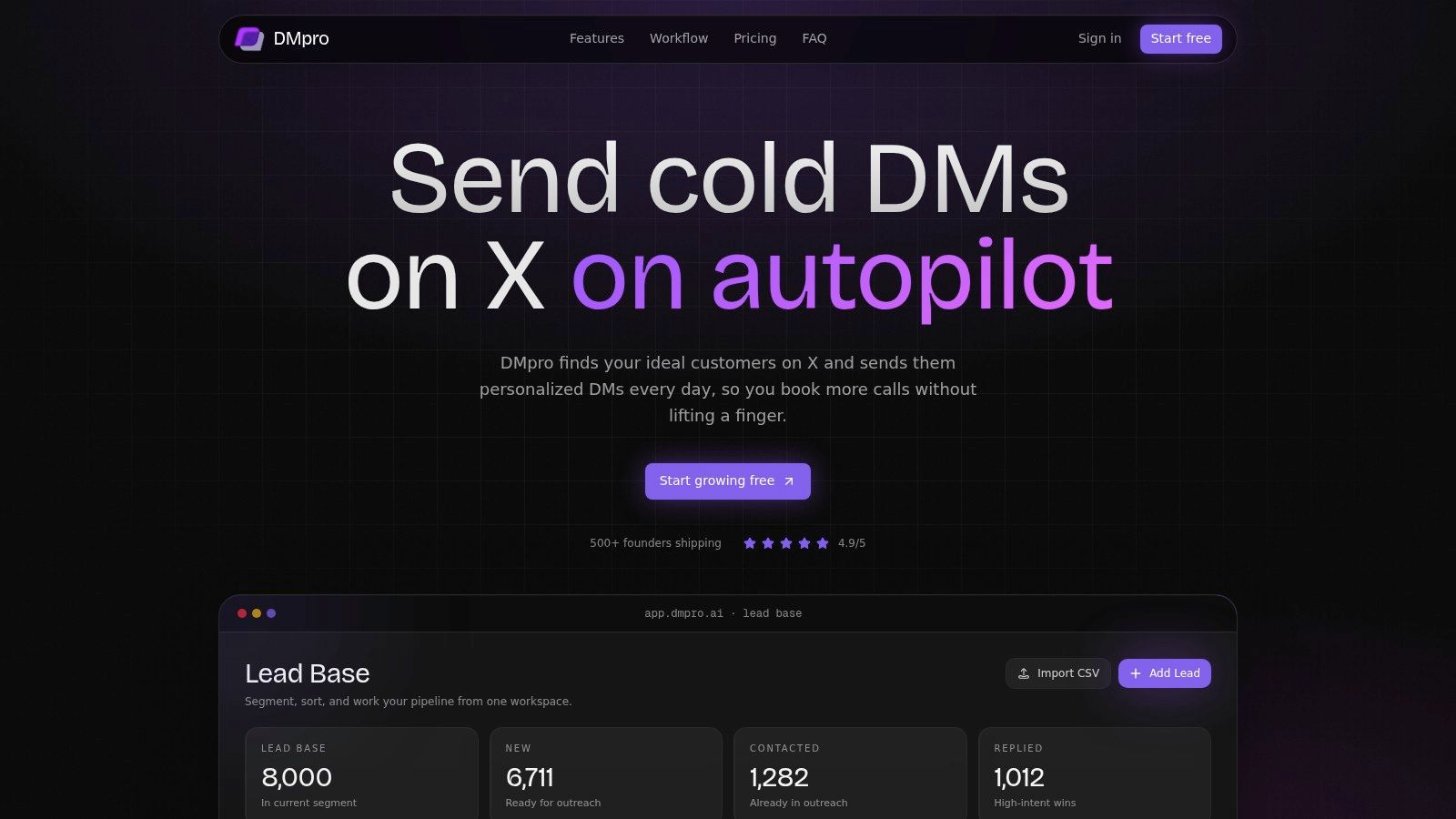
DMpro can support X campaigns with profile-based lead discovery, personalized message templates, campaign management, and follow-up workflows. Set the audience rules and message logic first. Automation should remove repetitive work, not remove judgment, as explained in this guide to growth marketing automation.
A useful test: Remove the personalization fields from your message. If the remaining copy could go to anyone, the campaign is not personalized enough.
Sequence without becoming a nuisance
Each follow-up should add information or offer a graceful exit. Avoid repeated “just bumping this” messages. A second touch might share a relevant observation. A later one could ask whether another person owns the problem. The final message should let the prospect close the loop without pressure.
A 2026 outbound benchmark reports an 8.5% average reply rate for campaigns using verified lists and three or more personalized follow-up touches. The practical lesson is to connect data hygiene, message relevance, and persistent but respectful sequencing rather than copy the figure blindly.
<iframe width="100%" style="aspect-ratio: 16 / 9;" src="https://www.youtube.com/embed/tbe8LBJOSSc" frameborder="0" allow="autoplay; encrypted-media" allowfullscreen></iframe>Keep a human review step before launch. Sample records, check that signals are current, and read generated messages as a recipient would. Pause campaigns for replies, negative signals, and account changes. Automation can run continuously, but the standards governing it still require deliberate decisions.
Measuring Pipeline Health and Fixing Leakage
Founders often track activity because activity is easy to see. Messages sent, profiles scraped, and replies received can look healthy while qualified pipeline remains flat.
A better dashboard follows the buyer across stages. Track qualified accounts reached, positive conversations, meetings with the right role, opportunities with multiple stakeholders engaged, proposal progression, and closed revenue. Measure each channel separately so a cheap source doesn't hide poor fit.
Read the funnel as a diagnosis
Benchmark data reports that 87% of buying groups include four or more stakeholders, while Gartner-linked coverage says buyers spend only 5%–17% of their time meeting with suppliers. That combination creates a measurement problem. A deal can appear active because one contact is replying, while the wider committee remains untouched.
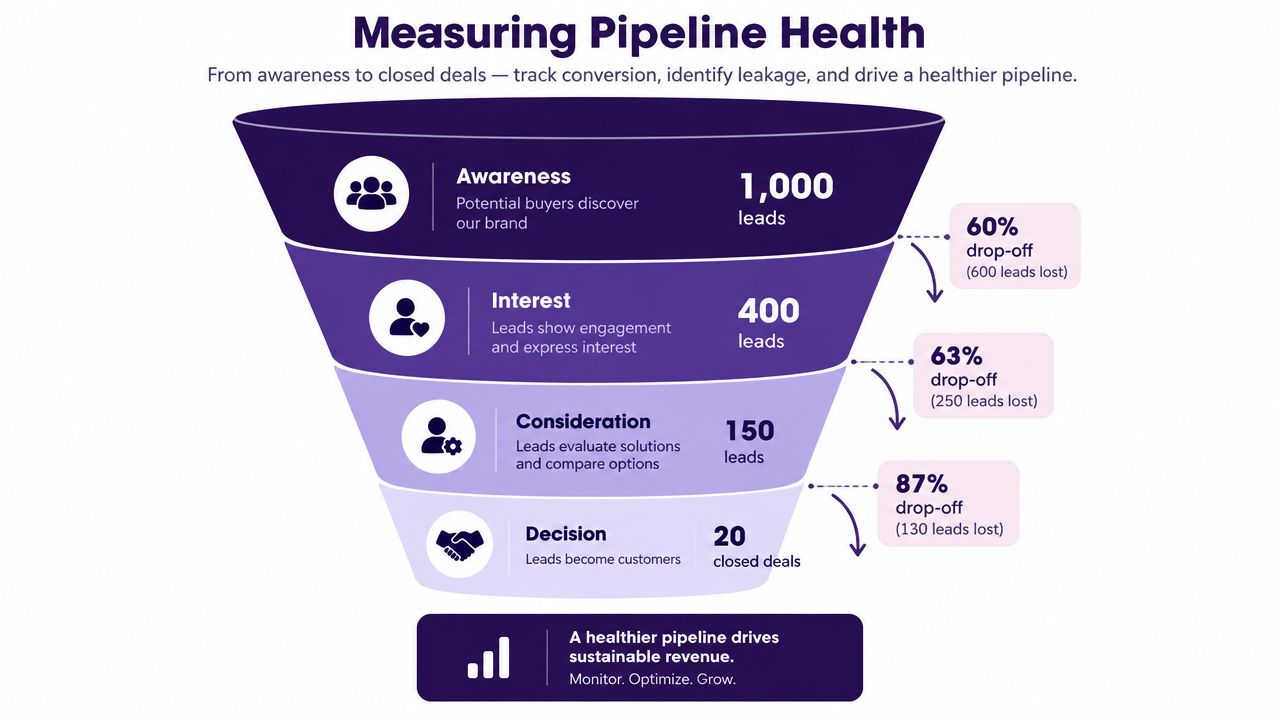
Use stage-level questions to find the leak:
- Reach to reply: Is the account list relevant, and does the opening message match the trigger?
- Reply to meeting: Did the conversation expose a real problem, or did the prospect respond out of politeness?
- Meeting to opportunity: Is there a business case, a champion, and a defined next step?
- Opportunity to decision: Have technical, financial, legal, and procurement concerns entered the plan?
- Decision to close: Does the buyer have the internal proof and operational confidence to act?
The fix depends on the answer. More sending won't solve a weak handoff. Better copy won't solve an absent champion. A stronger demo won't solve an unresolved security review.
Create a feedback loop
Review lost and stalled deals with the people closest to them. Ask sales what objections appeared, customer success which expectations were unrealistic, and product which capabilities buyers repeatedly requested. Turn those findings into new landing-page sections, sales notes, objection responses, and stakeholder-specific proof.
Track engagement depth at the account level. Record how many roles are active, which roles have seen the relevant material, and whether the champion can explain the business case internally. This is more useful than celebrating a single enthusiastic contact.
Pipeline health is not message volume. It is the number of qualified accounts moving forward with enough internal support to reach a decision.
Review the dashboard on a regular operating cadence. Keep the metrics that change decisions, remove vanity counts, and assign an owner to every corrective action.
Your Next Steps to Scale Outbound
A resilient B2B sales strategy starts before the first message. It filters accounts, identifies the buying committee, and defines what should happen after a reply.
Start with the account list. Remove companies that fit your demographics but show no relevant problem or buying signal. Then map the people around each qualified account. If one contact carries the entire deal, treat that dependence as a risk.
Audit the motion in practical order
- Tighten the ICP: Define what makes the problem urgent, then add explicit disqualifiers.
- Prioritize signals: Rank accounts by recent, observable reasons to care. A contact list is not a readiness model.
- Map the committee: Identify the champion, decision maker, evaluator, influencer, and likely blocker.
- Match the channel: Use X for public context and timely signals, email or calls for deeper progression, and content for independent validation.
- Automate carefully: Let software handle discovery, sequencing, and tracking. Keep targeting standards and conversations under human control.
- Measure movement: Track qualified progression, stakeholder coverage, and opportunity quality rather than raw activity.
The first improvement is usually a clearer definition of who deserves attention. Once audience and signal rules hold up in manual reviews, automation can make the process consistent without turning it into a broadcast.
Define the response path before launch. Decide who qualifies the problem, which proof goes to the evaluator, when the champion receives an internal summary, and what triggers outreach to additional stakeholders. A campaign ends when the buyer has a clear next step, not when a platform records a reply.
Run a small, controlled test. Review accounts manually, inspect early conversations, and adjust segmentation before expanding. Use X to surface high-signal context and automate repetitive outbound work, while salespeople spend time on the committee dynamics that software cannot judge reliably.
The target is a repeatable system that helps the right buying network build confidence faster.
If manual X prospecting is slowing your SaaS pipeline, DMpro can automate lead discovery, personalized cold DMs, and follow-up campaigns around the audience and signals you define. Visit DMpro via the link above to test a more focused outbound motion and spend your time on qualified conversations instead of copying and pasting profiles.
Ready to Automate Your Twitter Outreach?
Start sending personalized DMs at scale and grow your business on autopilot.
Get Started Free