
Ideal Customer Profile vs Buyer Persona Explained
Ideal customer profile vs buyer persona explained clearly. Learn the real differences, when to use each, and how to turn one into the other for outreach.
Most advice on ideal customer profile vs buyer persona starts with the wrong question: which one should you build first?
That framing sounds tidy, but it creates bad outbound. Teams spend weeks polishing a persona, then blast thousands of contacts at companies that were never a fit. Or they build an ICP as a vague list of industries and employee counts, then send the same lifeless message to every role inside those accounts.
The useful question is different: which one should govern qualification, routing, and messaging at each stage?
The ICP decides which companies deserve attention. The buyer persona decides how to reach the people inside those companies. In an X-based outbound system, they aren't competing documents. They're separate inputs to the same operating stack.
Why the ICP vs Buyer Persona Debate Misses the Point
The standard “build the ICP first, then create personas” advice treats outbound like a paperwork sequence. Revenue teams don't work that way either. Account-level qualification must control where outreach capacity goes, while role-level relevance must shape every message. Each artifact has a separate job.
An ICP describes the organization. A buyer persona describes the human role inside that organization. The history of these ideas supports that distinction. Alan Cooper created the first persona, named “Kathy,” in 1985, and Steve Mulder and Zeve Yaar formalized persona frameworks in 2006. Modern B2B practice continues to separate company fit from individual influence the history of buyer personas.
The costly mistake is allowing one vague persona to govern an entire campaign. A persona can show that a VP of Sales cares about forecast accuracy, yet it cannot tell you whether the company has the budget, systems, growth stage, or operational complexity to buy your product. Reaching the right person at the wrong account still wastes the campaign.
Practical rule: Give the ICP control over account selection and scoring. Give the persona control over the message hook and channel.
A widely cited B2B benchmark found that 65% of high-growth companies, defined there as companies growing revenue more than 40% year over year, had a documented ICP, compared with 14% of no-growth firms the B2B ICP and persona benchmarks. The same benchmark reported 36% higher revenue growth and 38% higher sales win rates where sales and marketing shared ICP alignment, plus 171% higher average annual contract value for tightly scoped account-based programs.
Those figures do not prove that documentation creates growth by itself. They show why account discipline matters. A strong outbound engine assigns the ICP and persona different decisions instead of ranking one above the other.
For X-based outbound, operationalize the overlap across the stack:
- ICP layer: Score the company using industry, size, revenue, technology, growth stage, and buying signals.
- Routing layer: Send the account to an SDR, AE, partner, or nurture workflow.
- Persona layer: Identify the role, current priorities, objections, and likely influence.
- Message layer: Select the opening angle, proof point, CTA, and follow-up sequence.
- Feedback layer: Feed replies, meetings, disqualifications, and closed-won patterns back into both models.
The answer founders need is direct. ICP decides who. Persona decides how. Build and refine both around the decision each one controls, then let their overlap govern qualification, routing, and messaging at the right stage of outbound.
What an Ideal Customer Profile Is
An ideal customer profile, or ICP, is a company-level model. It identifies the accounts most likely to buy, retain, and expand. It does not describe the individual who replies to your DM. In outbound, the ICP should govern qualification and account routing before persona data shapes the message.
A useful ICP combines several signal types:
- Firmographic: Industry, location, employee count, revenue, and business model.
- Technographic: CRM, billing system, analytics stack, sales tools, and infrastructure.
- Budget: Whether the account can fund the problem you solve.
- Growth stage: Whether the company is expanding, restructuring, entering a new market, or adding operational capacity.
- Operational complexity: Whether the company has enough process, volume, and internal coordination for your product to matter.
Take a SaaS product for revenue teams. A workable ICP might describe a 200 to 800 employee SaaS company in the US or UK, using Salesforce and Stripe, running a modern web stack, employing a RevOps leader, generating $20M to $80M in ARR, and showing a visible B2B sales motion. Rather, it is a testable account pattern.
A weak ICP says, “B2B companies that need better growth.” A working ICP specifies which signals matter, which conditions disqualify an account, and what a rep or automation system can verify quickly.
Build the profile around evidence
Start with closed-won and closed-lost accounts. Look for patterns among companies that adopted quickly, expanded usage, required manageable support, and fit the way your team sells. Then separate correlation from wishful thinking. An industry label may sound useful, while the technology stack or operational trigger may predict fit more accurately.
Document the profile in four blocks:
- Green-light signals: Conditions that increase fit.
- Red flags: Conditions that make the account expensive or unlikely to close.
- Verification method: Where a rep or automation system can confirm each signal.
- Score weight: How much each signal should influence prioritization.
Your segmentation work should sit alongside the ICP, not replace it. Use this guide to understanding market segmentation as a practical reference for organizing market groups.
Make the ICP operational
RevOps should own the scoring logic with input from sales, marketing, product, and customer success. Product marketing can clarify the account's problem and buying context, but the ICP must stay tied to pipeline decisions.
Set a refresh rule based on evidence, not habit. Review the profile when win rates change, a new product enters the market, pricing shifts, or disqualification reasons start clustering. Store the criteria where the list-building system can apply them.
In an X campaign, the ICP filters accounts before contact discovery. It can guide searches for companies, founders, executives, hiring patterns, technology references, and relevant activity. Only after an account passes the fit threshold should the system identify the right people.
That ordering protects budget. Personalizing a bad-fit account more efficiently still wastes time. The account must qualify first, then routing and messaging can use the overlap between company fit and human role.
What a Buyer Persona Is
A buyer persona is a human-role model. It describes the person you must influence inside an account that already meets the ICP. The ICP qualifies the company. The persona determines how your team routes the opportunity and frames the first conversation.
Build the persona around practical questions:
- What is the person's job title and level of authority?
- What does their day look like?
- What outcome are they responsible for?
- What personal motivation sits behind that outcome?
- What objections could stop the deal?
- What decision criteria do they use?
- Which channels and formats do they pay attention to?
Demographics alone create weak personas. “A marketing leader at a growing SaaS company” gives an outbound rep little to work with. A useful profile sounds like a real operating role: a RevOps Director who hates spreadsheet-based lead routing, a VP of Sales tired of managing disconnected tools, or a Head of Growth allergic to vanity metrics.
Focus on the pressure attached to the role rather than inventing a colorful character. That pressure should shape qualification after the account passes the ICP threshold, then guide routing and messaging in the campaign.
Build the persona around the decision
Start with the job the person was hired to perform. Map the gap between the result they need and the process they use today. A RevOps Director may care about clean routing, but the stronger message could address missed handoffs, unreliable attribution, or executive pressure to explain pipeline quality.
Separate the persona's concerns by influence:
- User concern: Will this make daily work easier?
- Functional concern: Will it improve the team's operating result?
- Economic concern: Can the buyer justify the spend?
- Executive concern: Will the decision support company-level priorities?
One person can carry several concerns, but the same argument rarely works across every stakeholder. A stakeholder mapping guide can help teams distinguish who uses the product, controls the budget, blocks the purchase, or needs confidence before approval.
That distinction matters in X-based outbound automation. Route a qualified account to the stakeholder whose role matches the detected problem. Then select proof and language for that role instead of sending the same sequence to every contact at the company.
Give the persona control over the message
The persona should govern the first message, follow-up cadence, channel choice, and proof points. On X, read public activity as context, not as a gimmick. A recent post about hiring, pipeline, attribution, or sales operations may indicate a relevant problem, but it does not prove the person's complete situation.
A strong opener connects a visible signal to a role-specific problem. It avoids a feature dump and tests whether the issue deserves a conversation.
The persona also sets boundaries for what your team should say. A CFO may want financial control. A sales leader may care about adoption and rep productivity. An end user may want fewer manual steps. The account can fit the ICP perfectly while the first message fails because it targets the wrong pressure.
Buyer personas have broad use in marketing. Use them to shape persuasion, routing, and message relevance after account qualification, rather than treating them as a substitute for the ICP.
Side by Side Where They Diverge
The ideal customer profile vs buyer persona comparison becomes useful when each one owns a different operating decision. The ICP governs account fit, qualification, routing, and campaign capacity. The persona governs relevance, message angle, and conversation context.
| Dimension | Ideal Customer Profile | Buyer Persona |
|---|---|---|
| Resolution level | Company or account | Individual human role |
| Primary data inputs | Firmographics, technographics, budget, growth stage, operational complexity | Job goals, motivations, objections, decision criteria, behavior, preferred channels |
| Typical owner | RevOps, sales leadership, and go-to-market operations | Product marketing, demand generation, and sales |
| Output artifact | Scored target account list and routing rules | Message brief, role map, and conversation tracks |
| Main question | Is this company worth pursuing? | Why would this person care? |
| Failure mode | SDRs spend time on poor-fit accounts | Messages reach people who can't influence or advance the purchase |
The ICP works at the account level. It evaluates the building, buying capacity, operating model, and likely business fit. The persona works inside that account, identifying the role, pressure, priorities, and decision context that shape a response.
A three-row example
| Scenario | ICP signal | Persona signal |
|---|---|---|
| SaaS pipeline | Uses Salesforce, has a B2B sales team, and shows operational complexity | RevOps Director needs reliable routing and cleaner handoffs |
| Sales tooling | Has a multi-person sales organization and budget for infrastructure | VP of Sales wants fewer disconnected tools and clearer rep adoption |
| Growth motion | Has a measurable acquisition engine and a defined revenue process | Head of Growth wants qualified pipeline instead of surface-level engagement |
Using the persona as the account filter surfaces relevant people at companies that can't buy; using the ICP as the message produces outreach that sounds technically accurate but reads as generic.
Put ownership where the decision lives
RevOps should maintain the account model because the ICP affects scoring, territories, routing, and reporting. Product marketing and sales should maintain the role model because the persona affects positioning, objections, enablement, and conversation quality.
The handoff between the models matters more than either document. A target account list should give the contact researcher enough company context to identify the right roles. A persona brief should give the sender enough role context to adapt the message without inventing facts.
In X-based outbound automation, apply the models in sequence. Let the ICP qualify the account and route it to the right campaign or owner. Let the persona select the contact, message angle, proof, and conversation track. The overlap becomes an operating rule: pursue accounts that fit the business model, then tailor outreach to the person who can influence the purchase.
The ICP is a gate. The persona is a lens.
Set the gate before spending contact or message capacity. Apply the lens after the account passes.
Which One to Use at Each Stage of Outbound
Outbound performance depends on assigning the right model to each decision. The ICP should govern account eligibility and commercial fit. The buyer persona should govern contact selection, message relevance, and conversation handling. Treating either model as a universal filter wastes research time and produces generic outreach.
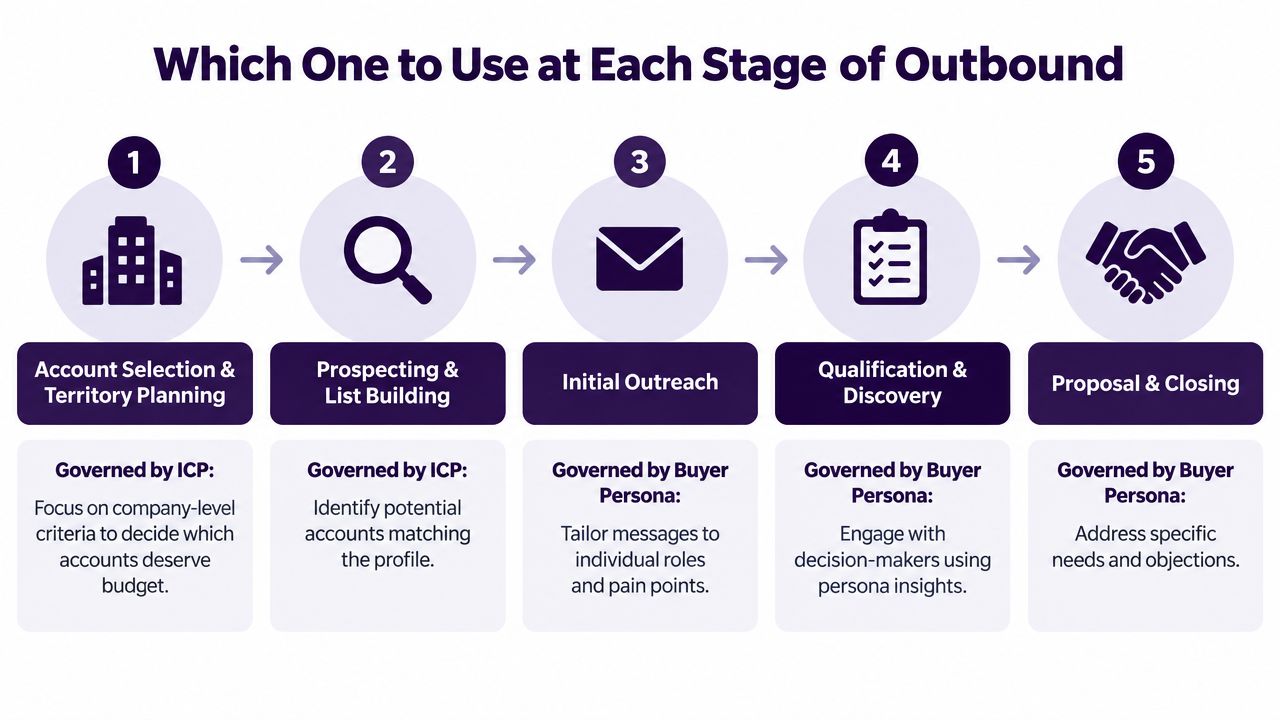
Account selection and territory planning
Begin with the ICP. Decide which companies deserve research time, sales capacity, and campaign budget. Industry, size, revenue, technology, growth stage, and operational complexity indicate whether an account can buy and benefit.
Set exclusions at the same stage. Remove companies without the required stack, an incompatible sales motion, or a fit with your service model before anyone searches for contacts. A relevant job title cannot fix a weak business case.
List building and contact sourcing
Use the ICP to qualify accounts, then use the persona to identify people connected to the problem. Searching X for every VP of Sales creates a contact list, not a market.
Use this sequence:
- Identify accounts that match the ICP.
- Find roles connected to the problem.
- Rank people by authority, influence, and visible relevance.
- Add public activity signals for message context.
- Exclude roles that cannot advance the conversation.
If your team needs more execution capacity, Best place to hire SDRs can help you separate list research, qualification, and sending responsibilities.
Message angle and channel choice
The persona controls the message once the contact is known. A RevOps Director needs a process and accuracy angle. A VP of Sales needs a team and pipeline angle. A Head of Growth needs a quality and measurement angle.
Channel selection also depends on the person. X can work when the contact publishes, replies, or follows conversations about the problem. If the role rarely engages there, automation cannot create attention. The ICP still shapes buying-committee coverage, while the persona determines whether the channel can produce a conversation.
Qualification and routing
Qualification returns to the ICP after a response. Confirm that the account matches the commercial and operational pattern, then use persona signals to assess influence, urgency, objections, and the appropriate next step.
Founders building an X motion can apply this outbound prospecting guidance without collapsing account and role logic into one filter. Automation can store both criteria in one sequence, but the filters should drive different downstream actions. Route ICP-fit accounts to the right owner or campaign. Use persona data to select the follow-up, proof, and conversation path.
The ICP decides who enters the system. The persona decides what the system says.
Turning One Into the Other Without Losing Fit
Treat the ICP and persona as living documents that update through a translation loop. Closed-won, closed-lost, reply, meeting, and disqualification data should sharpen both models over time. The core test is whether those updates improve qualification, routing, and message selection at each stage of X-based outbound.
Translate ICP into persona
Start with the three company attributes most closely tied to successful deals. Use the attributes your CRM and sales notes repeatedly connect to purchases, rather than signals that look impressive in a spreadsheet.
For each attribute, identify:
- The role that owns the budget.
- The role that feels the operational pain.
- The role that can veto the purchase.
- The role most likely to discuss the problem publicly.
- The intent signal that makes outreach timely.
Build separate message tracks from those findings. A technology signal may matter to a technical evaluator, while a growth-stage signal may matter to an executive buyer. Preserve the decision criteria and objection patterns. Remove niche job titles that do not generalize. Split any persona covering two materially different ICPs. That usually indicates two products, two buying motions, or both.
Translate persona into ICP
Begin with personas that produce qualified conversations and customers. Group the employers behind those personas by industry, size, revenue, technology, growth stage, and operational complexity. The recurring account pattern becomes a candidate ICP.
Score the remaining market against that pattern, then review the exceptions manually. One successful contact does not define a universal profile. That person may be unusually motivated, well connected, or reacting to a temporary event.
A useful automated lead scoring workflow can turn these criteria into repeatable prioritization. Keep human review in the process so scoring reflects current commercial judgment and unusual accounts do not pass through unnoticed.
Contractor handoff template
Target accounts: Companies matching these firmographic and technographic signals. Exclude: Accounts with these disqualifiers. Target roles: These decision-makers, users, and blockers. Message tracks: Use this problem angle for each role. Personalization: Reference only verified public activity or account context. Routing: Send qualified replies with these fit signals to this owner. Feedback: Record the reply, objection, meeting outcome, and disqualification reason so RevOps can update the model.
This template gives a contractor a bounded job. It prevents invented personalization, audience expansion, and qualification decisions based on instinct. Keep the handoff current, because stale criteria create bad routing faster than weak copy creates bad replies.
Picking Your Anchor for the Next Campaign
Use a simple decision rule. Anchor on the ICP when the contract is large, the buying committee is broad, and the sales cycle is long. Anchor on the persona when the deal is smaller, the buying unit is narrow, and message-market fit is the main barrier.
The thresholds below are practical campaign defaults, not universal laws.
| Campaign Variable | Anchor on ICP | Anchor on Persona |
|---|---|---|
| Deal size | Enterprise SaaS above $50k ACV | SMB or PLG motion below $10k |
| Buying committee | Five or more stakeholders | One or two people |
| Sales cycle | Extends beyond 60 days | Shorter, simpler buying process |
| Main risk | Wasting time on accounts that won't buy | Failing to earn attention from the right person |
| X campaign design | Score accounts first, then map multiple roles | Find the role first, then verify account fit |
For enterprise SaaS above $50k ACV with five or more stakeholders, profile first and persona second. Disqualification costs more than personalization, and the ICP should control account prioritization before you build a multi-threaded sequence.
For an SMB or PLG motion below $10k, persona first and profile second is usually more efficient. One or two people may make the decision, and a sharp message on X can create momentum before you need a complex account model.
Don't scale volume until you know which anchor failed. Audit the last 20 closed-won and 20 closed-lost deals against the campaign's chosen model. Ask whether the failure came from poor account fit, the wrong role, weak relevance, bad timing, or weak qualification. Fix that gap, then increase automation.
The decision is not ICP versus persona. It's deciding which one controls the next expensive action.
DMpro can automate X-based account discovery, cold DMs, reply handling, and persona-aware message tracks after you define the fit rules. Visit DMpro to set up your next campaign around the right accounts and the right people.
Ready to Automate Your Twitter Outreach?
Start sending personalized DMs at scale and grow your business on autopilot.
Get Started Free