
A Founder's Twitter Marketing Strategy That Works
Tired of generic advice? Learn a founder-focused Twitter marketing strategy for lead generation and scaling your SaaS. Practical, actionable tips inside.
Building a solid Twitter marketing strategy isn't about chasing likes or followers. It's about creating a predictable way to find customers. Think of it as your blueprint for turning conversations on Twitter into qualified leads and real revenue for your business.
This guide is about building a customer acquisition pipeline, not just a social media profile. We'll connect with the right people, share content that matters, and scale up what works.

Why a Founder-Led Twitter Strategy Wins
Let's be real—most Twitter advice is generic fluff for social media managers. As a founder, your time is everything. You need a game plan that actually drives growth, not just keeps you busy. This isn't about hoping for a viral tweet; it's about building a system.
Forget the hamster wheel of creating endless content. We're focusing on what truly matters:
- Generating Qualified Leads: Finding people who are actively talking about the problems your SaaS solves.
- Scaling Distribution: Systematically getting in front of more ideal customers every single day.
- Building Real Relationships: Turning cold DMs into warm conversations that lead to demos and sales.
This is a founder-to-founder guide. It’s a no-nonsense plan to make Twitter a core growth channel, not another chore.
The Power of an Authentic Presence
As a founder, you have an ace up your sleeve: your voice. People on Twitter want to connect with other people, not a faceless logo. When you share your insights, your journey, and your expertise, you build genuine trust.
This authentic approach is the secret sauce. It attracts followers who are genuinely interested in what you're building. For more on this, check out our dedicated guide for startup founders.
Tapping into a Ready-to-Buy Audience
Think of Twitter as a massive, real-time focus group. With over 500 million monthly active users, it's an incredible place to find early adopters and decision-makers hungry for new solutions.
The numbers back this up. Research shows that 36% of users are more likely to be the first to buy new products. And in the US, a whopping 69% of adult users turn to the platform for news. This means people are actively looking for solutions, making it the perfect place to connect with them when they need you.
How to Find High-Intent Customers on Twitter (X)
Let's get one thing straight: your entire Twitter strategy lives or dies by who you talk to. You can have the best content in the world, but if you're targeting the wrong audience, you're just shouting into the void.
Forget chasing broad keywords. We're going to zero in on high-intent signals—the little clues people leave that show they're actively looking for a solution like yours.

This is about shifting from passive broadcasting to active prospecting. Stop waiting for leads to find you. Go find them right when they need you most.
Look for Buying Signals
So, what does a "high-intent signal" look like on Twitter? It’s usually subtle. You're basically a detective looking for tweets that show someone is feeling a pain your product can solve.
Here’s where to look:
- Pain Point Keywords: Look for people complaining. Think "frustrated with [competitor tool]," "hate using spreadsheets for [task]," or "anyone know a good tool for..." These are direct cries for help.
- Competitor Mentions: Anyone following or engaging with your direct competitors is already in your market. They know the problem, which makes them prime candidates for a conversation.
- Influencer Engagement: People who interact with top influencers in your niche are invested. They're actively trying to get better at what they do, which means they're open to new tools.
When you focus on these signals, you're finding people who are already halfway to a purchase. They’ve admitted they have a problem and are now looking for the solution.
Mastering Twitter Advanced Search
Twitter's basic search is fine, but Advanced Search is your secret weapon. It lets you build incredibly specific queries to laser-target your ideal customer.
For example, if you run a simpler alternative to a clunky CRM, you could search for tweets containing phrases like "HubSpot is too complicated" or "Salesforce alternative." You can even add a filter to exclude links, which removes most of the promotional spam.
The goal isn't to find everyone who might be a customer. It's to find the few people who need to be your customer right now.
Of course, doing this manually every day is a soul-crushing grind. This is where you need a system.
Automating Your Lead Finding
Finding these high-intent leads consistently is the foundation of a scalable distribution plan. Manually running searches and copy-pasting profiles into a spreadsheet gets old fast.
This is a perfect job for automation.
By automating this part of your strategy, you can build fresh, targeted lead lists while you sleep. For instance, the lead scraping feature in DMpro can constantly scan Twitter for these buying signals and feed them directly into your outreach pipeline.
This frees you up to do what you do best: building relationships and closing deals. You graduate from being a prospector to a closer—a much better use of a founder's time.
Creating Content That Starts Real Conversations
Once you’ve found the right people, you need to give them a reason to listen. Your content has one job: pull your ideal customer in and push everyone else away.
As a founder, your content should solve a small, nagging piece of your customer's problem for free. Do that consistently, and you build incredible trust long before you ever mention your product.
The Problem, Solution, Proof Framework
Stop guessing what to post. Use a simple, repeatable framework. This is about being intentional with every tweet.
The idea is to guide people from "I have this problem" to "You are the solution."
Here’s how it works:
- Problem-Aware Content: Short, punchy tweets that articulate a specific pain point so clearly your ideal customer thinks, "Wow, that's me."
- Solution-Oriented Content: This is where you deliver real value. Threads work well here. Offer a mini-framework, actionable tips, or a new way of looking at their problem.
- Social Proof: Nothing builds trust faster than showing results. Share client wins, testimonials, or quick case studies.
By rotating through these three pillars, you create a feed that educates, resonates, and converts. You become a valuable resource, not just another voice.
How to Structure Content That Actually Gets Read
On a fast-moving feed, structure is everything. Package your ideas well, or they'll get lost.
Your hook is 80% of the battle. The first line of a tweet or thread has to be magnetic. It needs to promise a clear benefit or spark enough curiosity to make someone click "Show more."
Next, use formatting to your advantage. No one wants to read a giant wall of text.
Keep paragraphs short—one or two sentences, max. Use bullet points and numbered lists to guide the reader's eye. Think of it as creating visual breathing room.
Finally, wrap up with a simple call to action. It doesn't always have to be "buy my thing." Ask a question, encourage a follow, or invite people to DM you with their own experience.
Sparking Conversations That Lead to DMs
Remember, the real goal is to start conversations. Likes and retweets are vanity metrics. Conversations lead to customers.
The easiest way to do this is by ending your tweets with open-ended questions.
For instance, after sharing a tip on cold outreach, ask, "What's your biggest challenge with cold DMs?" That tiny shift turns a one-way broadcast into a two-way dialogue.
As people reply, engage with them. These public interactions are powerful—they show everyone you're an active, helpful expert. Often, these chats are the perfect, most natural way to slide into the DMs. This is where a tool like DMpro becomes a lifesaver, helping you manage these conversations so nothing falls through the cracks.
This flow—from public reply to private message—is the engine of a great Twitter lead gen strategy.
If you’re tired of manually sending DMs every day, try DMpro.ai — it automates outreach and replies while you sleep.
Mastering Personalized Cold DM Outreach
Your content has warmed up your audience. You've pinpointed people talking about problems your product solves. Now, it's time to take the conversation into the DMs.
Let's be honest: most cold DMs are awful. They're generic, self-serving, and instantly ignored. A winning Twitter strategy depends on making your outreach feel like a genuine, one-to-one conversation.
This comes down to a careful balance of personalization and efficiency. You need a system that lets you connect in a human way without chaining you to your inbox all day.
The whole process boils down to this: find their problem, offer your solution, and back it up with proof.
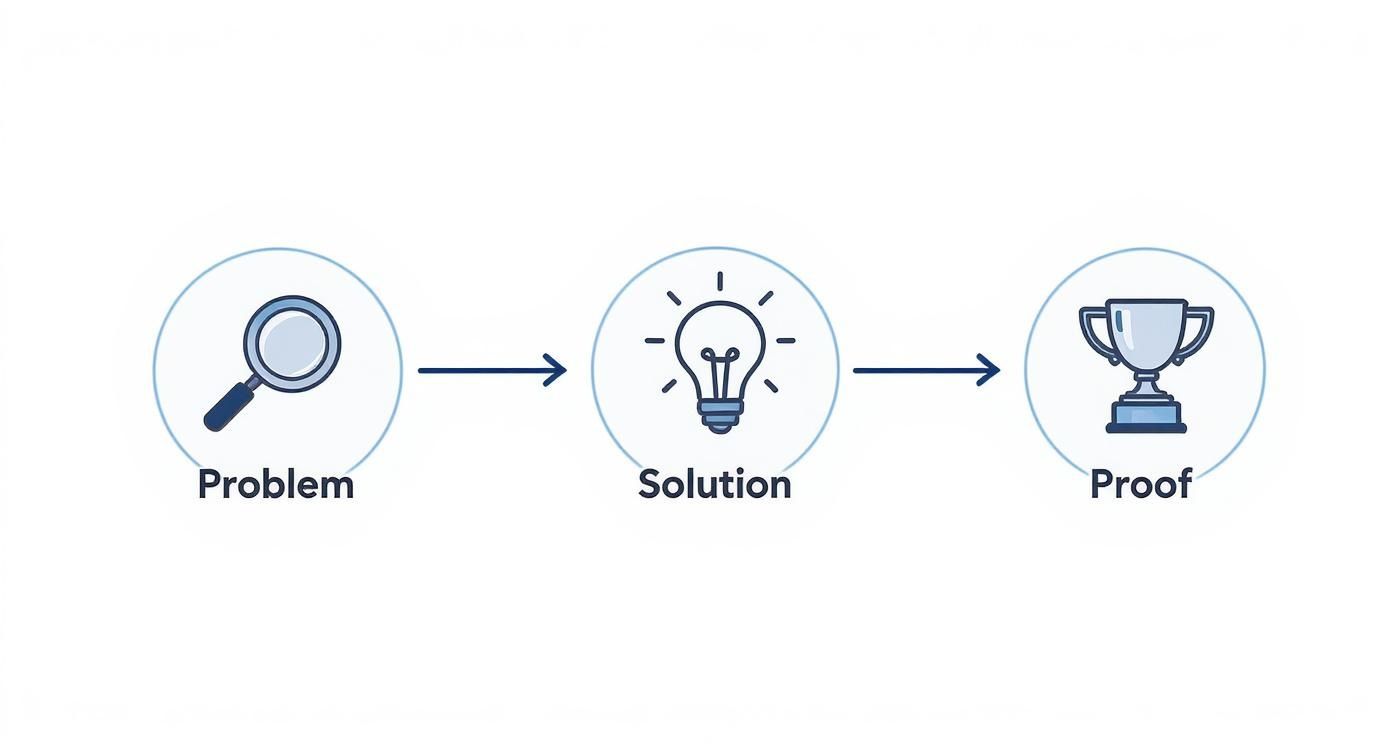
This is a great reminder: identify a clear problem, present a compelling solution, and then offer proof to build trust.
The Proven Three-Step DM Framework
To steer clear of the spam folder, I use a simple but effective three-step framework for every first DM. It’s built to be helpful, not salesy.
The framework is: Reference, Value, Question.
- Reference: Start by referencing something specific to them. It could be a recent tweet, a project in their bio, or a comment they left. This shows you’ve paid attention.
- Value: Next, offer a piece of value with zero strings attached. This might be a useful resource, a quick thought on their tweet, or a sincere compliment. Give before you ask.
- Question: Wrap it up with a low-pressure, open-ended question. Your only goal is to start a conversation. Don't ask for a demo yet.
This completely flips the script from "What can I get from you?" to "How can I help you?"—and that's how you build real relationships.
Scaling Outreach Without Sacrificing Personalization
Here’s the founder’s dilemma: doing this manually for hundreds of prospects is an absolute grind. It just doesn't scale.
This is where smart automation becomes a must-have. I'm not talking about spam bots. The right tool lets you send personalized messages at scale by using dynamic snippets of information.
For example, a platform like DMpro.ai allows you to build outreach sequences that automatically pull in a prospect's name or reference their specific tweet. This is how you maintain a personal touch while reaching hundreds of targeted leads. You can see how this works in our guide on sending automated Twitter DMs.
A Note on Automation: Think of it as your assistant. It should handle the repetitive work of sending initial messages and follow-ups. This frees you up to jump in and have real conversations the moment someone replies.
Manual vs. Automated DM Outreach
| Aspect | Manual Outreach | Automated Outreach (e.g., DMpro.ai) |
|---|---|---|
| Time Investment | Extremely high; hours per day | Low; set up once, then minimal daily management |
| Scalability | Very limited; maybe 20-30 DMs a day | Highly scalable; hundreds of personalized DMs daily |
| Personalization | High, but difficult to maintain at scale | High with dynamic fields (name, tweet content, etc.) |
| Follow-up | Prone to error; easy to forget | Systematized and reliable; never miss a follow-up |
| Lead Flow | Inconsistent and unpredictable | Consistent and predictable lead generation |
| Best For | Very early stages, testing messaging | Scaling a proven message to a larger audience |
While manual outreach is great for finding your footing, automation is what turns your outreach into a predictable, scalable machine.
How to Measure and Scale Your Success
<iframe width="100%" style="aspect-ratio: 16 / 9;" src="https://www.youtube.com/embed/kpVshEJZ9XU" frameborder="0" allow="autoplay; encrypted-media" allowfullscreen></iframe>You can't improve what you don't measure. But most founders get this wrong by tracking things that don't matter. Likes, retweets, and follower count are vanity metrics. They feel good, but they don't pay the bills.
A truly effective Twitter marketing strategy is laser-focused on numbers tied directly to revenue. Your key performance indicators (KPIs) should be brutally simple.
Defining Your Founder-Friendly KPIs
Let's cut through the noise. It all boils down to just a few core numbers. This is about clarity, not complexity.
Here’s what you should be obsessed with:
- Qualified Conversations Started: How many real, two-way conversations are you starting with ideal prospects each week? This measures your outreach effectiveness.
- DM-to-Demo Conversion Rate: Of the chats you start, what percentage book a demo or sales call? This tells you if your messaging is working.
- Cost Per Acquisition (CPA): How much time and money are you spending on Twitter to bring in a single paying customer? This grounds your strategy in business reality.
These are the only numbers you need to live and breathe. Everything else is a distraction.
Setting Up Your Simple Tracking System
You don't need a fancy tool for this. A simple Google Sheet is more than enough. Create columns for each KPI and update it every week. This forces you to be honest about what's working.
Founder's Tip: I add a "Notes" column to my tracking sheet. In it, I jot down what I tried differently—a new DM angle or a better search query. Over time, this becomes an invaluable log of your own experiments.
This simple act of tracking transforms your Twitter activity from random tasks into a predictable, data-driven system. That’s where real scaling begins.
For a more detailed view, you can explore the analytics and reporting features within DMpro to see how automation tools can track these key metrics for you.
From Measurement to Scaling Your Distribution
Scaling isn't about tweeting more. It’s about building a system around what's already proven to work. Once your tracking sheet shows you have a winning approach, it's time to pour gasoline on that fire.
This is where understanding the bigger picture becomes critical. As of 2025, Twitter still has a massive global audience. But general engagement rates have dropped. You can find more details on these Twitter statistics on Proxidize.com.
The key insight? Niche communities and top brands still see high engagement. This proves that targeted, community-driven strategies win today.
This data reinforces our whole approach: forget trying to appeal to everyone. Your success lies in focusing on that small slice of the platform where your ideal customers hang out.
As you gather data, using a tool like DMpro.ai becomes a natural next step. It lets you automate the proven parts of your system, freeing you up to focus on the high-value conversations that actually close deals.
If you’re tired of manually sending DMs every day, try DMpro.ai — it automates outreach and replies while you sleep.
Time to Put Your Twitter Growth Plan to Work
Alright, we’ve covered the entire playbook. You have everything you need to build a Twitter marketing strategy that actually drives business.
There’s no secret hack. Winning on Twitter comes from doing the simple things consistently.
It all comes down to a repeatable process:
- Find your people—the ones who have the exact problem you solve.
- Give them real value through your content, no strings attached.
- Take the conversation to the DMs and start talking one-on-one.
- Track the few key metrics that actually show you're making progress.
For most founders, the problem isn't a lack of knowledge. It's a lack of time.
The Founder's Dilemma: Time vs. Scale
Let's be real. Engaging with leads and sending hundreds of personalized DMs every week is a full-time job.
You can't be expected to build a product, manage a team, and also act as a full-time sales rep. Trying to do it all manually is a recipe for burnout.
This is where smart automation comes in. It’s not about replacing you with a robot. It’s about cloning your most effective outreach so it can run 24/7.
By building a system for your outreach, you escape the daily grind of prospecting. This frees you up to have quality conversations with warm, qualified leads who have already shown interest.
Platforms like DMpro.ai are built for this. It can take the outreach messages you’ve perfected and send them to a targeted list, personalizing each one while you focus on bigger things.
Making this shift—from manual labor to a smart, automated system—is the difference between a Twitter account that feels like a chore and one that becomes a predictable engine for your company's growth.
If you’re tired of the daily DM grind, check out DMpro.ai. It can handle the outreach and replies for you, even while you sleep.
Frequently Asked Questions
Jumping into a full-blown Twitter strategy can bring up questions. As a founder, your time is everything, so let's tackle the most common ones.
How Much Time Does This Actually Take Per Day?
It all comes down to whether you're going it alone or using automation.
Doing everything by hand—finding leads, crafting DMs, tracking follow-ups—you could easily sink 2-3 hours a day into this and still feel like you're treading water.
The smarter approach is to build a system. Spend a few hours upfront getting your strategy dialed in, then let tools handle the grunt work. For example, with a tool like DMpro.ai managing your outreach, your daily time investment plummets to maybe 30 minutes. That's just enough time to engage with warm replies.
Is It Safe to Automate DMs on Twitter?
Yes—but only if you do it intelligently. The key is to avoid anything that looks like spam. Twitter flags accounts that blast out hundreds of identical, generic messages.
Smart automation is about mimicking real human behavior. It means using personalization, staggering your message timing, and staying within platform limits. The goal isn't to bombard everyone; it's to start genuine conversations at scale.
What If I'm Not a Great Writer?
You don't need to be a professional copywriter. Your audience is looking for genuine value from someone who knows their stuff. As a founder, your expertise is your biggest advantage.
Just stick to the simple frameworks:
- Problem-Aware Content: State a clear pain point you know your audience has.
- Solution-Oriented Content: Share a quick tip or insight that helps them solve it.
- Social Proof: Talk about a real win you helped a customer achieve.
Your unique perspective is what makes your content stand out. Write like you're talking to a friend. Be helpful and consistent, and let your authentic voice shine through.
If you’re tired of manually sending DMs every day, try DMpro.ai — it automates outreach and replies while you sleep.
Ready to Automate Your Twitter Outreach?
Start sending personalized DMs at scale and grow your business on autopilot.
Get Started Free