
A Founder’s Guide to Twitter Automatic Tweets
Learn to use Twitter automatic tweets for lead generation. This guide covers the best tools, safety rules, and strategies to scale your outreach.
As a founder, your time is your most valuable asset. Using Twitter automatic tweets isn't about setting up a spammy, robotic feed. It's about buying back your time to focus on what really matters: building your SaaS.
This is how you move from random, "I-just-remembered-to-post" updates to running a strategic, always-on distribution channel. Let's dive in.
The Unfair Advantage of Smart Automation

You're always looking for an edge. Smart automation is one of the biggest ones you can get on Twitter.
When you plan and schedule your content, your brand stays visible even while you’re buried in code or pitching investors. It turns your Twitter profile from a social page into a lead generation machine.
That consistency is what builds authority. When your audience sees you sharing valuable insights regularly, they start to trust you. That trust is what eventually turns followers into customers.
Building an Always-On Presence
Think of automatic tweets as your marketing engine that never sleeps. It guarantees you're connecting with your audience during their peak hours, whether that’s early morning in Europe or late at night on the West Coast.
You can sit down for an hour on Monday and map out a whole week of content. Once it's scheduled, you're free to focus on the work that actually moves the needle, like talking to customers and closing deals.
The data backs this up. A small group of users drives most of the conversation on X (formerly Twitter). Just 10% of users are responsible for 92% of all tweets. You can bet a lot of that output is powered by automation. With about 79% of users following brands, showing up consistently is the only way to stay on their radar.
More Than Just Scheduling
Smart automation goes way beyond just filling a content calendar. It’s the foundation for a distribution strategy that scales. Once you have a steady stream of valuable content going out, you can focus on the next step: engaging the leads that content brings in.
For a founder, the goal isn't just to be on Twitter; it's to be there with a purpose. Every automated tweet should be a potential conversation starter.
This is where your tools can work together. While scheduled tweets build broad awareness, you can add another layer for targeted outreach. For instance, when a high-value prospect likes one of your automated posts, a tool like DMpro can follow up with a personalized DM. This creates a smooth path from a public post to a private conversation, which is one of the most effective Twitter automation strategies for startup founders.
Choosing Your Automation Toolkit
Picking the right tool to set up automatic tweets can feel overwhelming, but it really boils down to what you need right now. For a founder, the best tool is the one that fits your current goals and budget.
You don't need a massive, expensive platform on day one. Starting simple is the smartest play. It lets you figure out a workflow without a big financial commitment.
Starting With The Basics
For most founders just starting to automate content, Twitter’s own tools are more than enough. They’re free, built-in, and you don’t have to learn a new interface.
- Twitter's Native Scheduler: This is as easy as it gets. When you're writing a tweet, just click the calendar icon to schedule it. It's perfect for planning out a few days of content. No extra logins, no cost. It just works.
- TweetDeck (now X Pro): Think of TweetDeck as the native scheduler on steroids. It gives you a dashboard to manage multiple accounts, schedule tweets, and monitor your timeline, mentions, and lists all at once. It’s a fantastic free tool for getting organized.
Here’s a look at TweetDeck's column-based layout. It’s a game-changer for monitoring everything in one place.
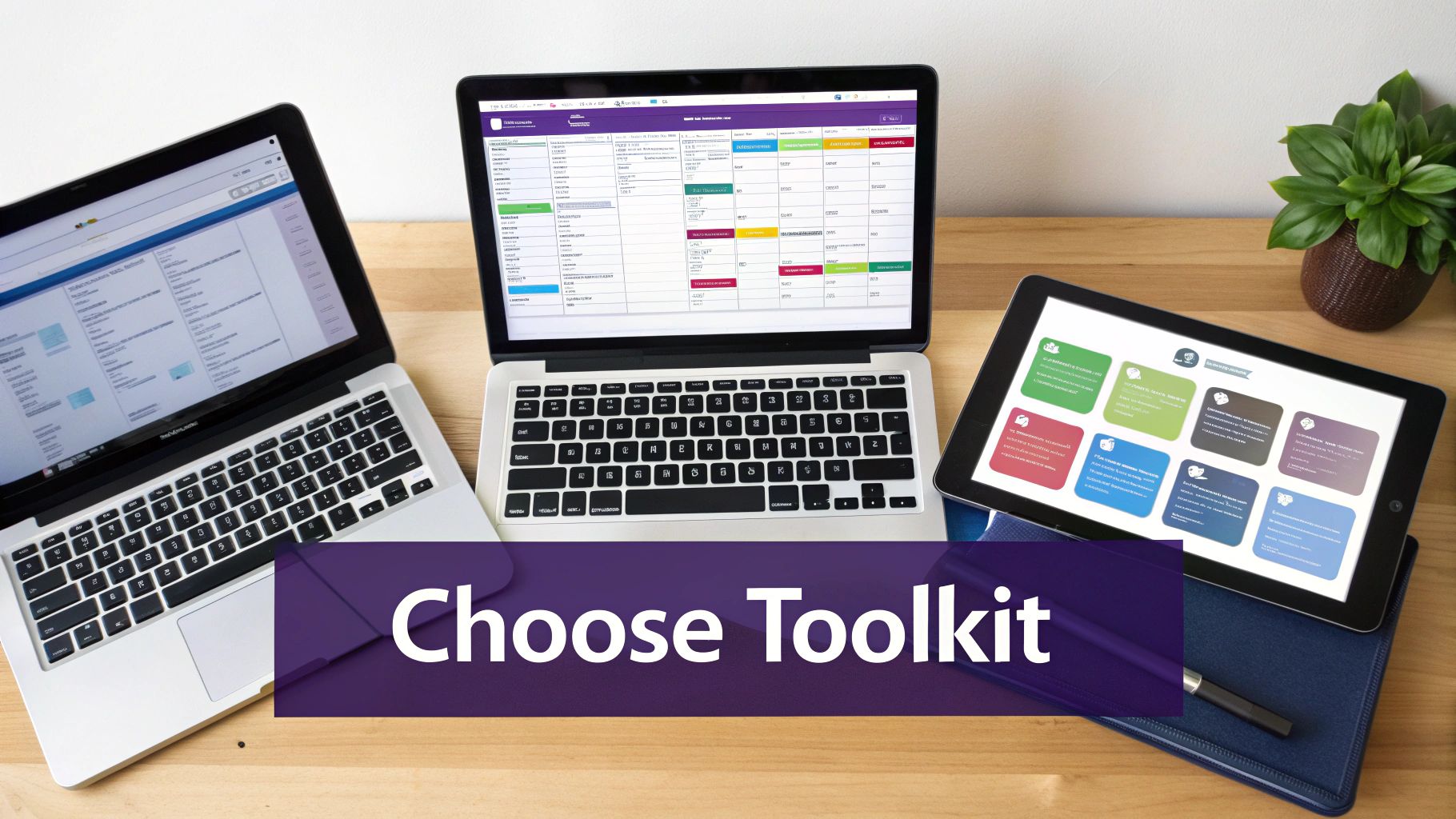
Seeing your scheduled posts right next to your live mentions makes it much easier to stay on top of both planned content and real-time conversations.
When To Upgrade To Third-Party Tools
You'll know it's time to upgrade when you start feeling boxed in. Maybe you need better analytics, want to manage multiple social platforms in one spot, or need more advanced scheduling features.
This is where platforms like Buffer or Hootsuite come in. They offer things like visual content calendars, AI to suggest the best times to post, and deep analytics that tell you what’s working. The tradeoff is they’re subscription-based.
The real question isn't 'Which tool is the best?' It's 'Which tool gives me the most leverage right now?' You're looking for that sweet spot between powerful features and a price that makes sense for your stage.
Here’s a quick breakdown to make the decision easier.
Comparing Twitter Automation Methods
| Method | Best For | Key Feature | Typical Cost |
|---|---|---|---|
| Native Scheduler | Individuals & beginners just starting with content planning. | Simple, built-in scheduling directly on Twitter/X. | Free |
| TweetDeck (X Pro) | Founders managing a few accounts or monitoring specific topics. | Multi-column dashboard for scheduling and monitoring. | Free |
| Third-Party Tools | SaaS businesses & creators needing analytics and cross-platform management. | Content calendar, advanced analytics, AI suggestions. | $10 - $100+/mo |
| API/Custom Bots | Tech-savvy founders & scaling companies with unique automation needs. | Fully customized workflows and integrations. | $100 - $1,000+/mo |
As you can see, the "best" choice really depends on your needs. Start free, and only pay for more power when you're sure you'll use it.
Advanced Automation For Scaling Outreach
As your SaaS grows, your marketing needs to keep pace. This is where more specialized automation tools shine. They don’t just schedule—they optimize. They can use AI to post your content at the perfect moment for maximum impact.
Some even have slick features like "RSS auto-posting," which automatically tweets out your latest blog post the second it goes live. We cover this and other powerful workflows in our complete guide to Twitter automation for lead generation.
Ultimately, this level of automation is about building a system that works for you 24/7. While these tools manage your public-facing content, you can pair them with a service like DMpro to handle the private conversations your tweets spark. This creates a powerful lead generation engine: automated tweets warm up prospects, and automated DMs start the sales conversation. It’s how you scale outreach without scaling your payroll.
Staying Safe with Automation Rules
Let's be real: using Twitter automatic tweets is a superpower for growing your brand, but nobody wants to wake up to that dreaded "account suspended" notification. The good news is, staying out of trouble is simple if you understand what X cares about.
It's not about avoiding automation. It's about avoiding spam. The platform's goal is to protect the user experience, so your job is to make your automation serve up real value, not just noise.
What Twitter’s Rules Actually Mean for You
Twitter's policies boil down to one core idea: don't be a robot. They're looking for accounts that perform aggressive, repetitive, or deceptive actions at scale.
For a founder trying to generate leads, this means steering clear of a few common mistakes:
- Don't post the same tweet over and over. This is the number one way to get flagged. Even changing a few words or swapping the image makes a huge difference.
- Be careful with automated engagement. That automated "Thanks for the follow!" DM might seem helpful, but algorithms spot it easily and it feels impersonal.
- Keep your scheduled content relevant. If your feed is just a firehose of promotional links, you're sending a massive spam signal. Make sure you're posting things your audience actually wants to see.
The trick is to use automation to amplify your real voice, not create a fake one.
The Art of Content Variation
One of the biggest mistakes I see founders make is crafting one perfect tweet and scheduling it on a loop. A much smarter—and safer—approach is to create variations on a theme.
Think about it. You wouldn't walk into five different meetings and recite the exact same script. You'd rephrase your key points and adjust your tone. Your tweets deserve the same treatment.
Let's say you just published a new blog post. Instead of just tweeting the link with the title, you could create a series of unique tweets from it:
- Pull out a surprising statistic and lead with that.
- Ask a question that your blog post answers.
- Turn a powerful quote from the article into a graphic.
- Tell a short, personal story related to the topic.
This keeps your feed interesting for both your followers and the platform's spam filters.
A Quick Word on Rate Limits and Pacing
X has technical limits on how frequently you can post. Good scheduling tools handle this for you, but the principle matters. Firing off a dozen tweets in an hour isn’t a growth hack; it’s a good way to annoy people and look like a bot.
Your goal isn't to shout the loudest; it's to make every post count. Spacing out your automatic tweets gives each one a chance to find an audience and spark conversation.
A solid rule of thumb is to focus on quality over quantity. Scheduling 3-5 genuinely valuable tweets per day will almost always outperform 20 low-effort ones. This pacing feels more human and respects your audience's time.
The Hybrid Approach: Automation Meets Real-Time Engagement
The most successful founders I know blend scheduled content with real-time, spontaneous interaction. Your automated tweets are the backbone of your strategy, but it's the real-time replies and conversations that build actual relationships.
Here’s how to think about it:
- Automation for Distribution: Schedule your foundational content—links to articles, case studies, and evergreen advice. This keeps your value pipeline flowing 24/7.
- Manual for Connection: Carve out time each day to be a real person. Reply to comments, ask questions, and jump into conversations in your niche.
This two-pronged strategy gives you the efficiency of automation and the authenticity of a human. While your public tweets build brand awareness, a tool like DMpro can help manage the one-on-one conversations that your content generates, turning public visibility into private lead nurturing.
A Playbook for Automated Lead Generation
Alright, let's get into the good stuff. Setting up twitter automatic tweets is one thing, but turning them into a machine that consistently brings in new SaaS leads? That’s where the magic happens.
This is about moving past chasing likes and starting to craft tweets that spark actual conversations. Think of each automated tweet as a lure designed to get a bite and create an opening for a real opportunity.
From Content to Conversation
The foundation of this strategy is sharing genuinely valuable content. We're talking case studies, deep-dive blog posts that solve a real problem for your audience, or threads that share hard-won insights.
When you consistently put out content that helps people, you build authority and attract followers who are actually interested in what you do. This warms up your audience so they see you as a trusted resource, not just another company trying to sell something.
A simple but powerful trick is to end your tweets with a question or a soft call-to-action that nudges people toward a private message.
- Instead of this: "Read our new case study here."
- Try this: "We helped a client 3x their leads. Curious how? Shoot me a DM for the full story."
That small change shifts the dynamic from a one-way broadcast to a two-way dialogue.
This visual flow breaks down the core principles of safe, effective automation.
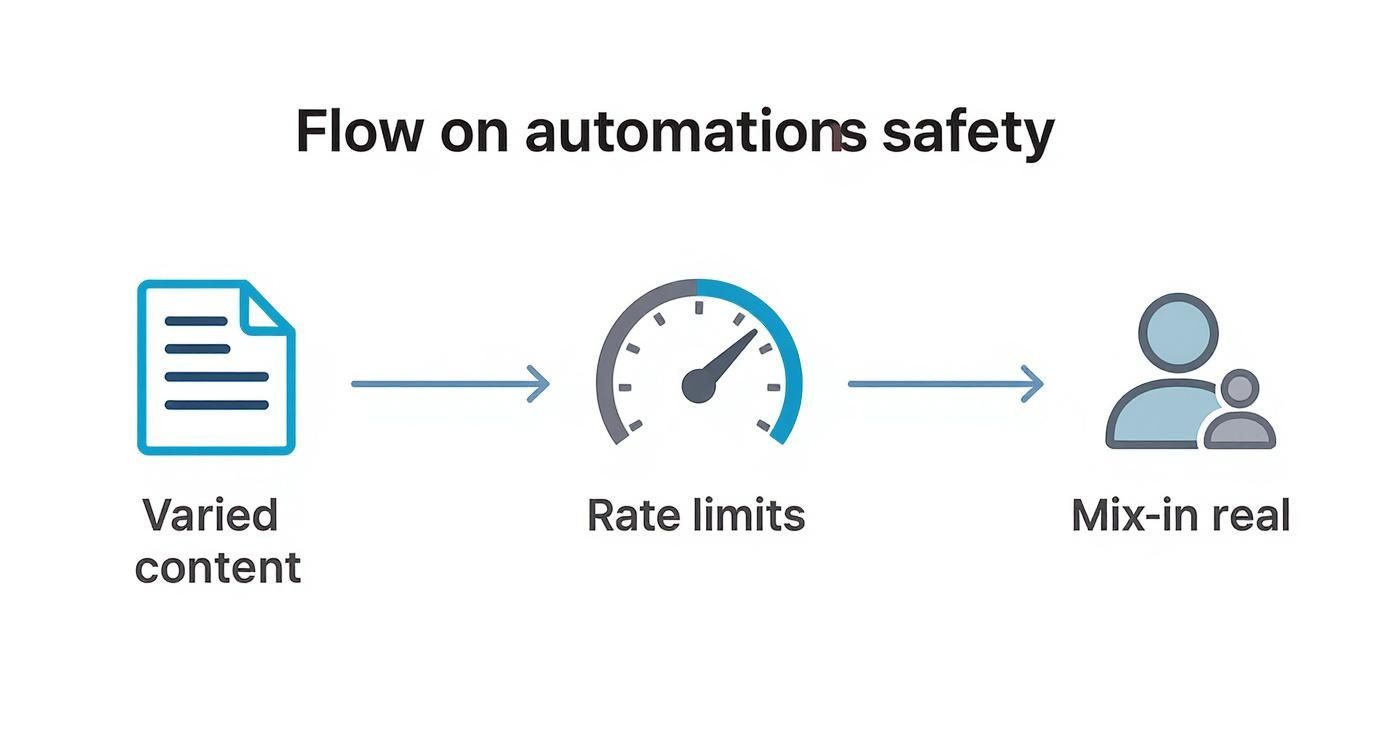
As the infographic shows, a winning strategy is a mix of varied content, respecting platform limits, and always weaving in authentic human interaction.
Engineering Engagement for the Algorithm
The Twitter algorithm loves tweets that get attention right away. The secret is to schedule your posts for peak times when you know your audience is scrolling. Interaction within the first 30 minutes is a huge predictor of a tweet's long-term reach, and scheduling is your best tool for nailing that window. Find out more about how the X algorithm works on PostNext.io.
That early activity signals to the algorithm that your content is worth showing to more people.
Think of your automated content as the conversation starter. Your job—or the job of another automation layer—is to see that conversation through. The public tweet gets the attention; the private DM builds the relationship.
When you get this right, you can build a truly scalable system.
Scaling Your Outreach System
Once your content starts getting replies and DMs, you'll hit a wall trying to manage it all manually. This is where a layered automation approach shines. While one tool handles your public content, another can manage the flood of private messages.
For instance, when someone interacts with one of your automated tweets, a tool like DMpro can send a personalized, automated follow-up. This isn't spam; it's being incredibly responsive at a scale you could never achieve by yourself.
Picture this workflow:
- An automated tweet shares a compelling stat from your latest report.
- A potential lead likes the tweet, signaling their interest.
- DMpro instantly sends them a personalized message: "Hey [Name], saw you liked our tweet on [topic]. We actually have the full report with more data if you're interested."
This creates a seamless bridge from public interest to a private sales conversation. You’re meeting potential customers right where they are, at the exact moment they’re most engaged.
By connecting your content strategy to a smart outreach tool, you stop just "posting on Twitter" and start building a real, measurable pipeline. You can see how it's all working by tracking everything from open rates to replies using built-in analytics and reporting features.
When DMs Outperform Tweets for Outreach
https://www.youtube.com/embed/CrdmNs0JCKM
Automating your tweets is a brilliant strategy for building brand awareness and casting a wide net. But casting a wide net isn’t always the best way to land the biggest customers.
For the kind of targeted, high-value outreach that moves the needle for your SaaS, you need to switch gears from the public timeline to a private conversation.
The Real Power Is in Precision
Think of it this way: Public tweets build your reputation one-to-many. Direct messages build relationships one-to-one.
A great tweet might get seen by thousands, which is fantastic for top-of-funnel awareness. But a DM is sent to a handpicked audience of one. It’s the difference between shouting in a crowded stadium and having a quiet, focused conversation.
This is critical when you're chasing specific growth goals:
- Reaching high-value leads: You have a list of 50 perfect-fit companies. A public tweet is a shot in the dark, but a direct message lands right in their inbox.
- Building strategic partnerships: You don't propose a major partnership in a public tweet. That’s a conversation that demands a personal, direct approach.
- High-touch sales: If you’re selling a big-ticket SaaS product, the sales process is consultative. It starts with a genuine connection, not a mass-market blast.
In these situations, the personalization and intimacy of a DM will beat a public post every single time.
How to Mimic Human Conversation at Scale
This is where the right tools change the game. Manually sending hundreds of DMs is a soul-crushing grind. But modern automation platforms are now built to handle this with surprising nuance.
AI-powered tools can send up to 400–450 direct messages per day through carefully scheduled campaigns. These aren't just spam bots; they use AI to analyze target profiles, personalize messages, and automate follow-ups in a way that mimics real human behavior.
Our own analytics show campaigns referencing a user’s recent tweet achieve a 10% higher reply rate than generic messages. That's proof of how effective targeted automation can be.
Public tweets warm up the audience, but personalized DMs are what close the deal. The goal is to build a system where public content creates opportunities for private, meaningful conversations.
Tools like DMpro.ai are designed for this exact purpose. The AI can scan a user’s profile to craft an opening message that feels genuinely personal, creating an instant, relevant connection that a generic message could never achieve.
Building Your Dual-Channel Funnel
The smartest founders don’t choose between tweets and DMs—they use them together.
Think of your automated tweets as the top of your funnel, working 24/7 to build authority and attract inbound interest. Then, your automated DMs act as your mid-funnel, turning that passive interest into qualified, one-on-one conversations.
This hybrid approach gives you the best of both worlds: broad reach and targeted precision. Your public feed builds the brand, while your private messages build the pipeline. For a deeper dive, check out our guide on how to send automated Twitter DMs effectively.
With this system, you can scale your outreach without losing the personal touch that actually converts leads into customers.
Common Questions About Automating Tweets
Automating your Twitter is a game-changer, but it’s smart to have questions. Let's walk through the most common concerns I hear from other founders.
Can Twitter Ban You for Automating Tweets?
This is the first question people ask. The short answer is no, not if you do it right. Twitter doesn't have a problem with automation; it has a problem with spam.
You’ll land in hot water if your automation looks like a bot blasting out the same link over and over. That's what gets accounts suspended.
But if you're using automation to schedule your own valuable content and maintain a human presence, you have nothing to worry about. The goal is to use tools to be more consistent, not to fake engagement.
What’s the Best Posting Frequency?
There's no single magic number, but a solid baseline for most founders is 3-5 quality tweets per day.
The key here is consistency, not volume. Three insightful tweets spread throughout the day will always outperform ten rushed, low-value posts. Use a scheduling tool to space them out and hit different time zones.
Once you’ve established a rhythm, pay attention to your analytics. Is engagement dipping? You might be overdoing it. Is growth flat? Maybe you have room to post more.
Your audience's engagement is your best guide. Let the data tell you when to adjust your posting schedule.
How Can I Measure the ROI of My Automated Tweets?
Likes and retweets feel good, but they don't pay the bills. As a founder, you need to track the metrics that actually move your business forward.
Instead of vanity metrics, zero in on these KPIs:
- Profile Clicks: Are people curious enough to learn more about you?
- Website Visits: How many people are clicking the link in your bio or your tweets?
- Leads Generated: Are those visits turning into sign-ups or demo requests?
Your scheduling tool will give you some basic data, but you can get more granular by adding UTM parameters to your links. This lets you see exactly how much traffic and how many new leads came from your Twitter efforts right inside Google Analytics.
Should I Automate Replies and DMs, Too?
This is where you need to be careful. Automating public replies is almost always a bad idea. It’s incredibly hard to pull off without sounding like a clumsy bot, which can kill your credibility.
On the other hand, automating the first DM after someone engages with you can be incredibly powerful. Imagine a potential customer likes your tweet. An automated DM that says, "Hey, saw you liked my tweet on the new feature. Here's a link to a demo if you're curious," comes across as helpful and responsive.
This is precisely what a tool like DMpro.ai is built for. It helps you kickstart those crucial one-on-one conversations at scale, turning a simple 'like' into a meaningful dialogue.
Time to Put Your Twitter Outreach on Autopilot
So, there you have it—a founder's playbook for turning your Twitter account into a serious growth engine.
The secret isn't just about scheduling a bunch of tweets. It’s about pairing public-facing posts that build your authority with a targeted, automated outreach system that works behind the scenes. This one-two punch is what fills your pipeline.
Stop letting the manual grind of social media slow you down. By putting these strategies into action, you can transform your Twitter presence into a consistent, reliable source of new leads for your SaaS. It’s all about working smarter, not harder.
Now it's your turn. Go reclaim your time so you can get back to what truly matters—building an amazing product and closing deals.
If you’re tired of manually sending DMs every day, try DMpro — it automates outreach and replies while you sleep.
Ready to Automate Your Twitter Outreach?
Start sending personalized DMs at scale and grow your business on autopilot.
Get Started Free