
A Founder's Guide to Lead Generation for Consultants
A founder-to-founder guide on lead generation for consultants. Learn proven outreach and automation tactics to build a repeatable client pipeline.
Forget casting a wide net and hoping for the best. Real lead generation is about building a predictable system that brings your ideal clients to you, consistently. The secret isn't some complex funnel; it's knowing exactly who you serve and crafting an offer they can't ignore.
Building Your Client Acquisition Foundation
Before you send a single cold DM, we need to lay the groundwork. This is the stuff most founders skip because it’s not as exciting as seeing messages go out, but it's the absolute bedrock of a successful consulting business.
Skipping this foundational work is like trying to build a house on sand. You're just guessing, which is why so many outreach campaigns fall flat. Get this part right, and every single step that follows becomes ten times more effective.
It’s tempting to jump straight to the sexy stuff—automation tools, messaging scripts, outreach tactics. But if you don't have a crystal-clear target and a killer offer, you’re just automating a broken process. We're building a well-oiled engine that attracts the right people and repels the wrong ones.
Defining Your Ideal Client Profile
First things first: who are you really trying to help? An Ideal Client Profile (ICP) is more than just a job title and an industry. You need to get inside their head.
What are their biggest daily frustrations? What specific goals are they trying to hit this quarter? What’s the one problem that keeps them up at night?
A vague ICP like "small business owner" is useless. A strong ICP is so specific you can almost picture the person.
Here's a quick reference table to help you build out your own ICP.
Ideal Client Profile (ICP) Core Components
| Component | What to Define | Example (for a SaaS Consultant) |
|---|---|---|
| Demographics | Industry, company size, revenue, role/title | B2B SaaS, 50-200 employees, Series A/B funding, Head of Growth |
| Psychographics | Goals, values, challenges, what they read/follow | Goal: Build an organic channel to drive demo requests. Frustration: High CAC from over-reliance on paid ads. |
| Pain Points | The specific, urgent problem they need to solve | "We have a great product but struggle with scalable user acquisition. We need predictable leads without just throwing more money at ads." |
| Watering Holes | Where they spend their time online | X (formerly Twitter), LinkedIn, specific SaaS-focused communities and newsletters. |
Once you've mapped this out, you'll know exactly who you're talking to.
When you have this level of clarity, everything changes. You'll know what language to use in your outreach, what kind of content will resonate, and exactly where to find them. You stop talking about your services and start talking about their problems.
"Your ICP isn't just a marketing exercise; it's the lens through which you make every decision in your business. When you know who you're for, you know what to say, where to say it, and how to price your value."
This foundational process is all about defining your client, finding their online hangouts, and crafting an offer that feels like it was made just for them.
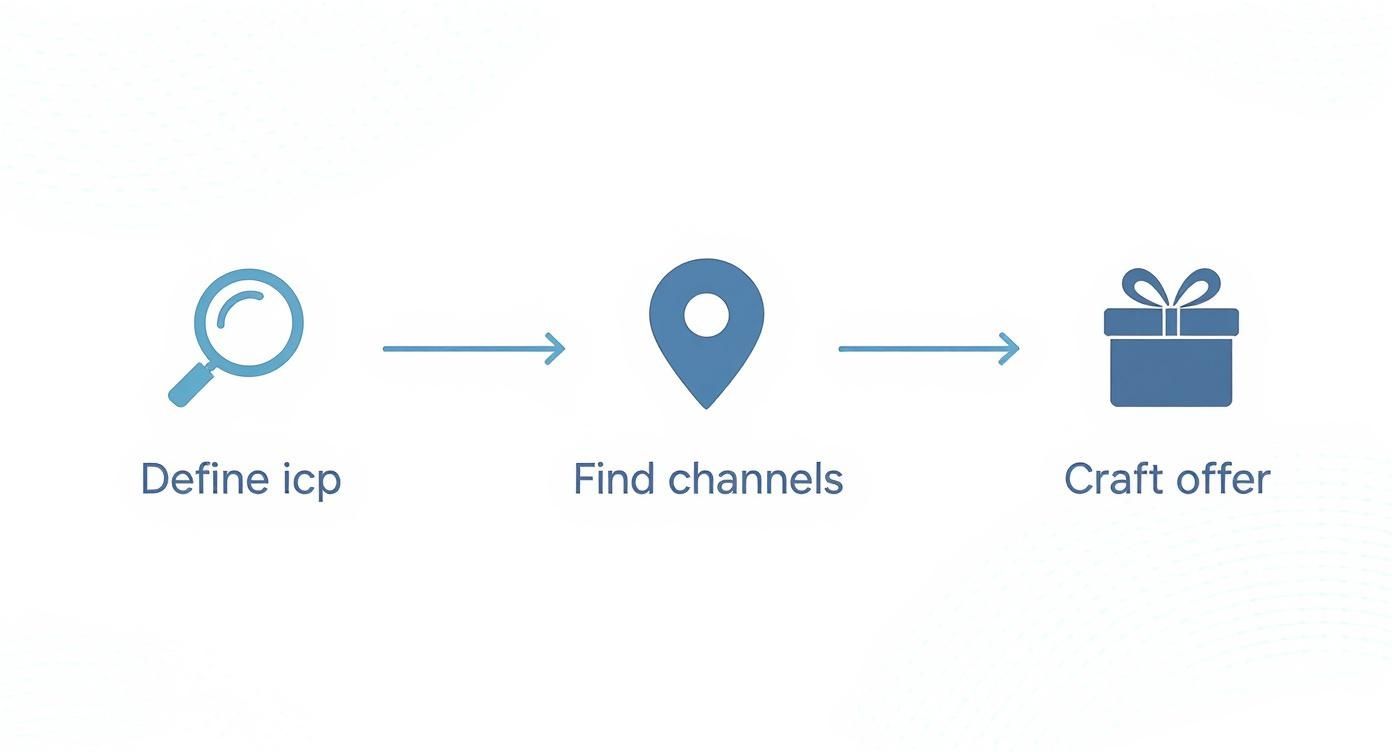
As you can see, it all starts with deep client understanding. That insight directly informs which channels you choose and how you structure your offer.
Locating Your Ideal Clients Online
Okay, you know who you're looking for. Now, where do they hang out online?
For B2B founders and decision-makers, platforms like X (formerly Twitter) and LinkedIn are goldmines. Your ideal clients are openly discussing their biggest business challenges there every single day.
You can start by manually searching for relevant keywords or following industry hashtags. This process, called lead scraping, can be a grind, but it’s crucial for building a high-quality prospect list. To speed things up, tools offering automated lead scraping can be a game-changer, helping you build targeted lists based on bio keywords and recent engagement. For instance, DMpro can build you a list of founders on Twitter who are talking about scaling their distribution.
Crafting an Irresistible Offer
Finally, your offer. It needs to be the clear, obvious solution to their most painful problem. A generic "I offer consulting services" won't cut it. Your offer needs to be about a specific, desirable outcome.
Think about the difference:
- Vague: "Marketing Consulting"
- Irresistible: "I help Series A SaaS founders build a distribution engine on X that adds 20 qualified demos to their pipeline every month."
See the difference? One is a commodity. The other is a result.
The numbers don't lie. While lead generation is the top goal for a whopping 91% of marketers, a staggering 80% of new leads never convert to sales. That gap exists because most outreach is unfocused. By laying this foundation first, you ensure the leads you generate are far more likely to buy.
Crafting Outreach That Actually Gets Replies
So, you’ve laid the groundwork. You know who you're trying to reach and have a fantastic offer. Now for the fun part: writing messages that people actually reply to.
This is where so many consultants trip up. They lean on the same old generic, copy-paste templates that scream "SALES PITCH!". We're going to do the opposite. Every message needs to feel personal, relevant, and valuable—even at scale.
The secret isn't volume—it's precision. I'd rather send ten hyper-personalized messages than blast out a thousand generic ones. The response rates are on a completely different level.
The 60-Second Prospect Research Sprint
Before you write, you need an angle. My go-to is a quick, 60-second research sprint on their X (formerly Twitter) or LinkedIn profile. You’re hunting for a genuine "hook" to build your message around.
Here’s what I look for:
- Recent Activity: Did they just share an interesting article or post about a win? This is gold. It’s fresh, relevant, and on their mind right now.
- Bio and Headline: People tell you what's important to them right in their bio. It often spells out their current focus or biggest professional goal.
- Pinned Posts: This is prime real estate. Whatever they've pinned is what they want the world to see first.
- Company News: Did their company just launch a new product or raise funding? Mentioning this shows you're paying attention.
You just need one relevant tidbit to make your opening line about them, not you.
The Anatomy of a High-Converting Cold DM
Once you have your hook, you can build the message. Forget long, stuffy introductions. A cold DM, especially on a platform like X, should feel short, direct, and conversational.
I swear by a simple framework: Observation > Connection > Question.
Observation: Start with the specific thing you found.
- "Saw you just launched your new integration with..."
- "Loved your post on the challenges of scaling a remote team..."
- "Big congrats on the funding round..."
Connection: Gently bridge their activity to what you do. This isn't a hard pitch.
- "...we helped a few other SaaS companies triple their sign-ups from that exact integration."
- "...that's a puzzle I've spent the last three years helping founders solve."
Question: End with a simple, open-ended question that’s easy to answer. Don't ask for a meeting.
- "Curious, is user onboarding a big focus for you all right now?"
- "What's been the biggest hurdle with that so far?"
- "Open to hearing how we did it for a similar company?"
This simple structure flips the entire dynamic. You’re no longer a random stranger. You're a peer who did their homework and started a relevant conversation.
Real-World Examples That Land Clients
Let's see this in action. Imagine you’re a consultant who helps SaaS companies with user onboarding.
The Bad (Generic & All About You): "Hi Jane, I'm a consultant who helps B2B SaaS companies optimize their onboarding flow. Can we schedule a 15-minute call next week?"
Deleted.
The Good (Personalized & Genuinely Curious): "Hey Jane, saw your post about the new dashboard you just shipped. Looks slick. Curious, now that it's live, is optimizing the onboarding for new users a focus for your team?"
The second one is a real conversation starter. It’s relevant, not demanding, and opens a door instead of trying to kick it down.
While this manual approach is effective, doing it one by one is a grind. This is where tools that provide AI-driven personalization for outreach become a game-changer. For example, a tool like DMpro can scan someone's latest tweets on X and suggest custom opening lines. This blend of smart automation and personalization is how you win at lead generation today.
Automating Outreach Without Sounding Like a Robot

Let's be real: sending DMs one by one is a soul-crushing grind. And while a manual approach is great for top-tier prospects, you can't build a predictable client pipeline on it alone.
This is where smart outreach automation comes in. The goal isn't to fake a personal connection. It's about taking repetitive, top-of-funnel tasks off your plate so you can pour your energy into the conversations that actually close deals.
Think of it as building a system that works for you 24/7, teeing up conversations so you can wake up to interested replies.
The Right Way to Think About Automation
I see so many founders make the same mistake: they try to make automation do everything. They build out a ten-message sequence that just wears prospects down. All that does is get you a reputation as a spammer.
Instead, think of automation as a tool to handle just the initial touchpoint and a gentle follow-up. Its only job is to get a human response.
The moment someone replies, the automation stops, and you take over. This gives you the scale of technology with the authenticity of a genuine one-on-one conversation.
The purpose of automation isn't to close the deal for you; it's to create the at-bat. Your job is to step up to the plate and have a real conversation.
You're not building a robot to replace yourself. You're building an assistant that tees up more meaningful conversations for you.
Building Your First Automated DM Campaign
On platforms like X (formerly Twitter), automation is a game-changer for lead generation. A tool like DMpro, for instance, lets you build campaigns that run on autopilot based on specific triggers.
You can target people who:
- Follow a specific account: Target the followers of a major influencer or even a direct competitor.
- Use a certain keyword: Find people talking about the problems you solve (e.g., "low user retention," "high CAC").
- Engage with a specific tweet: Reach out to everyone who liked a viral post relevant to your industry.
Once you have your audience, create a simple, multi-step sequence. A three-message flow, spaced out over a few days, is a great place to start.
- Message 1 (Day 1): Your initial, personalized outreach using the "Observation > Connection > Question" framework.
- Message 2 (Day 3): A gentle nudge. "Hey [FirstName], just wanted to make sure this didn't get buried. No worries if the timing isn't right."
- Message 3 (Day 7): The "break-up" message. "Circling back one last time. If this isn't a priority, I'll close the loop. Let me know if that changes!"
This simple structure covers your bases without being pushy. If they don't reply, you move on without burning bridges. You can learn more about setting this up with campaign automation tools built for this kind of outreach.
Keeping the Human Touch at Scale
The secret to making automation feel authentic is in the details.
First, get your personalization variables right. Double-check that your tool is pulling [FirstName] and [Company] accurately. Nothing screams "lazy automation" like "Hi [FirstName] from [Company],".
Second, write like you talk. Use short sentences and casual language. Your automated messages should sound identical to ones you'd type by hand.
Finally, keep a close eye on your campaigns. Monitor your reply rates. If a message isn't landing, pause and tweak the copy. This isn't "set it and forget it"; it's a process of constant iteration.
Turning Conversations into Consulting Clients
<iframe width="100%" style="aspect-ratio: 16 / 9;" src="https://www.youtube.com/embed/bZaKKiu9TEY" frameborder="0" allow="autoplay; encrypted-media" allowfullscreen></iframe>Getting that first reply is a great sign. But it's just the starting line. Now the real work begins: steering that interest toward a signed contract, without sounding like a pushy salesperson.
This is where so many consultants fumble the ball. They get an interested response and immediately lunge for the sales call. That’s a jarring move.
The goal is to build trust and show off your expertise. You want the move to a discovery call to feel like the most natural next step for both of you.
From DM to Discovery Call the Right Way
Guiding a conversation from a DM to a formal call is an art. It’s all about qualifying the person while building rapport. You have to figure out quickly if this person is a genuine fit. Your time is your most valuable asset.
Here's a simple flow that works:
- Acknowledge and Ask: Thank them for their reply. Then, ask an open-ended question to get them talking. "Glad that resonated. What's the biggest hurdle you're facing with [their problem] right now?"
- Diagnose the Pain: Listen to their response and dig a bit deeper. "How has that impacted your team's ability to hit its goals?" or "What have you already tried to solve this?"
- Bridge to a Call: Once you have a clear picture of their pain and know you can help, suggest a call. Frame it as a benefit for them.
Here’s my go-to line: "Based on what you've shared, I have a few specific ideas that could help. It's probably easier to walk through them on a quick call than type it all out here. Open to that?"
This reframes the call from a "sales meeting" into a "strategy session"—something people are far more likely to say yes to.
Qualifying Prospects Without Wasting Time
As you’re guiding the conversation, you should also be quietly qualifying them. Platforms like LinkedIn are fantastic for this. In fact, by 2025, LinkedIn Lead Gen Forms are projected to hit a 13% average conversion rate, which is why 40% of B2B marketers say it’s their number one channel for high-quality leads. You can read the full analysis on LinkedIn's effectiveness if you want to dive into the data.
Run through a quick mental checklist during your chat:
- Problem: Is their problem specific, urgent, and something you are uniquely good at solving?
- Authority: Are you talking to a decision-maker?
- Timeline: Are they trying to solve this now?
If you get a solid "yes" on all three, you have a qualified lead. If not, you can de-prioritize the conversation.
Positioning Your Pricing as an Investment
You can't be afraid to talk about money. When you position your services the right way, the price reflects the value you deliver, not just a cost.
Always frame your packages around outcomes, not your time. Clients aren’t buying "10 hours of consulting"; they’re buying a solution to a problem.
Instead of saying, "My rate is $200 per hour," try this:
"We'll build a system that adds 20 qualified demos to your pipeline every month. The investment for that is $5,000."
See the difference? The first is a commodity. The second is a high-value investment with a clear return. By the time you send a proposal, the client should already be sold on the value, making the price a no-brainer.
How to Measure and Scale Your Lead Generation

You can't improve what you don't measure. If you’re just firing off messages without tracking what works, you’re flying blind.
Scaling your consulting business isn’t about working more hours; it’s about making smarter, data-backed decisions. This is where we cut through vanity metrics and get down to the numbers that actually move the needle.
Understanding a few key performance indicators (KPIs) transforms your outreach from random efforts into a machine you can optimize.
Focusing on the Metrics That Matter
To keep things simple, focus on just a handful of core metrics. These paint a clear picture of your pipeline’s health.
- Reply Rate: What percentage of people are responding to your initial outreach? A low rate (under 10%) is a red flag that your targeting or opening message needs work.
- Positive Reply Rate: This hones in on the percentage of replies that are positive or neutral, signaling actual interest.
- Lead Qualification Rate: Of those interested replies, how many turn out to be a good fit? This tells you how well your ICP is aligned with reality.
- Meetings Booked Rate: What percentage of your initial messages lead to a discovery call? This is crucial for forecasting your sales pipeline.
Tracking these doesn’t have to be complicated. But as you scale, a dashboard that shows campaign performance is a game-changer. Tools like DMpro provide these kinds of analytics and reporting features out of the box, so you can see what’s working at a glance.
Calculating Your True Client Acquisition Cost
Now for the big one: your Client Acquisition Cost (CAC). This is the total cost of winning a new client. Understanding your CAC is fundamental to running a profitable business.
To figure it out, add up all your sales and marketing expenses over a period and divide that by the number of new clients you won.
CAC Formula: (Total Sales & Marketing Costs) / (Number of New Clients) = Client Acquisition Cost
Your costs should include software subscriptions (like your outreach tools), any ad spend, and the value of your own time. Knowing this number helps you make smart decisions about where to invest.
It's also important to have realistic expectations. The average cost per lead (CPL) for small companies is just $47, but for large enterprises, it can skyrocket to $349. You can discover more about these lead generation benchmarks to see how your own efforts stack up.
A Simple Framework for Testing and Iterating
Once you’re tracking your KPIs, you can run experiments to improve them. The secret is to change only one variable at a time so you know what caused the shift.
Here’s a simple A/B testing framework:
- Form a Hypothesis: Start with an educated guess. "I believe using a question as my opening line will get a higher reply rate than starting with a compliment."
- Run the Test: Create two versions of your message (A and B). Send Version A to 50 prospects and Version B to another 50 from the same list.
- Measure the Results: Track the reply rate for both versions.
- Analyze and Implement: If one version performed significantly better, it becomes your new "control" message. Now, come up with a new hypothesis to test against it.
This continuous loop of testing is how you build a truly scalable lead generation engine. You stop guessing what works and start knowing.
Got Questions? Let's Get Them Answered.
Whenever I walk founders through building a proper lead generation system, the same questions always pop up. Let's tackle them so you can move forward with a clear plan.
How Much Time Should I Actually Spend on Outreach?
This depends on your stage.
If you're just starting out with zero clients, outreach is your number one job. It should take up 50-70% of your day. Nothing else moves the needle as much as getting in front of potential clients.
Once you have a few clients, you can ease off. For an established consultant, 60-90 minutes of focused, daily outreach is the sweet spot. That consistency prevents the "feast or famine" cycle.
Where's the Best Place to Find Clients?
The best channel is simply wherever your ideal clients hang out. This is why we nailed down your ICP earlier.
For most B2B consultants, you can't go wrong with LinkedIn and X (formerly Twitter).
- LinkedIn is a powerhouse for its search capabilities.
- X is fantastic for jumping into real-time conversations and connecting authentically.
Don't spread yourself thin. Pick one, get really good at it, and then think about adding a second channel.
Am I Following Up Too Much?
Honestly, you’re probably not following up enough. Most consultants send one or two messages and give up, but most deals happen after the fifth touchpoint.
My rule of thumb for cold outreach is a simple three-message sequence over a week. If they don't respond, I move on.
For a warm lead who has already engaged, I'll follow up until I get a definitive "yes" or "no." Just make sure your follow-ups are helpful, not annoying.
This is where automation becomes your best friend. A tool like DMpro can run that 3-message sequence for you, making sure nobody gets missed and freeing you up to focus on the people who reply.
If you’re tired of manually sending DMs every day, try DMpro.ai — it automates outreach and replies while you sleep.
Ready to Automate Your Twitter Outreach?
Start sending personalized DMs at scale and grow your business on autopilot.
Get Started Free