
how to grow consulting business: From Scratch to Scale
how to grow consulting business: Discover proven client acquisition, pricing practices, and automated lead generation in this actionable guide.
Growing a consulting business is simpler than you think. It comes down to three things: carving out a specific niche, creating an irresistible offer, and knowing exactly who you're selling to. Get these right, and you’re on your way to predictable growth, leaving the feast-or-famine referral cycle behind for good.
Build a Rock-Solid Consulting Foundation
Before you dream of scaling, you need a solid base. We're founders, so let's skip the theory and get straight to what works. The secret isn't just being good at your job; it's becoming the only logical choice for a specific group of people with a painful, expensive problem.
This means getting ruthless with your focus. Stop being a generic "marketing consultant." It's too broad. Become the "go-to consultant who helps B2B SaaS founders double their demo bookings." See the difference? One is a commodity; the other is a specialist who commands premium rates.
This clarity sharpens every decision, from your website copy to where you find clients online, like on Twitter.
Nail Your Niche and High-Ticket Offer
The consulting market is massive, and it’s the small, specialized firms that are winning. They're nimble and hyper-focused.
Your mission is to package your expertise into a high-ticket offer that solves one critical pain point. This is how you escape the trap of trading time for money. Start thinking in terms of the outcome you deliver, not the hours you work.
"Stop selling your time. Start selling a transformation. Clients don't buy hours; they buy a solution to a problem that's costing them far more than your fee."
It all starts with defining your niche, packaging your offer, and then pinpointing your ideal client.
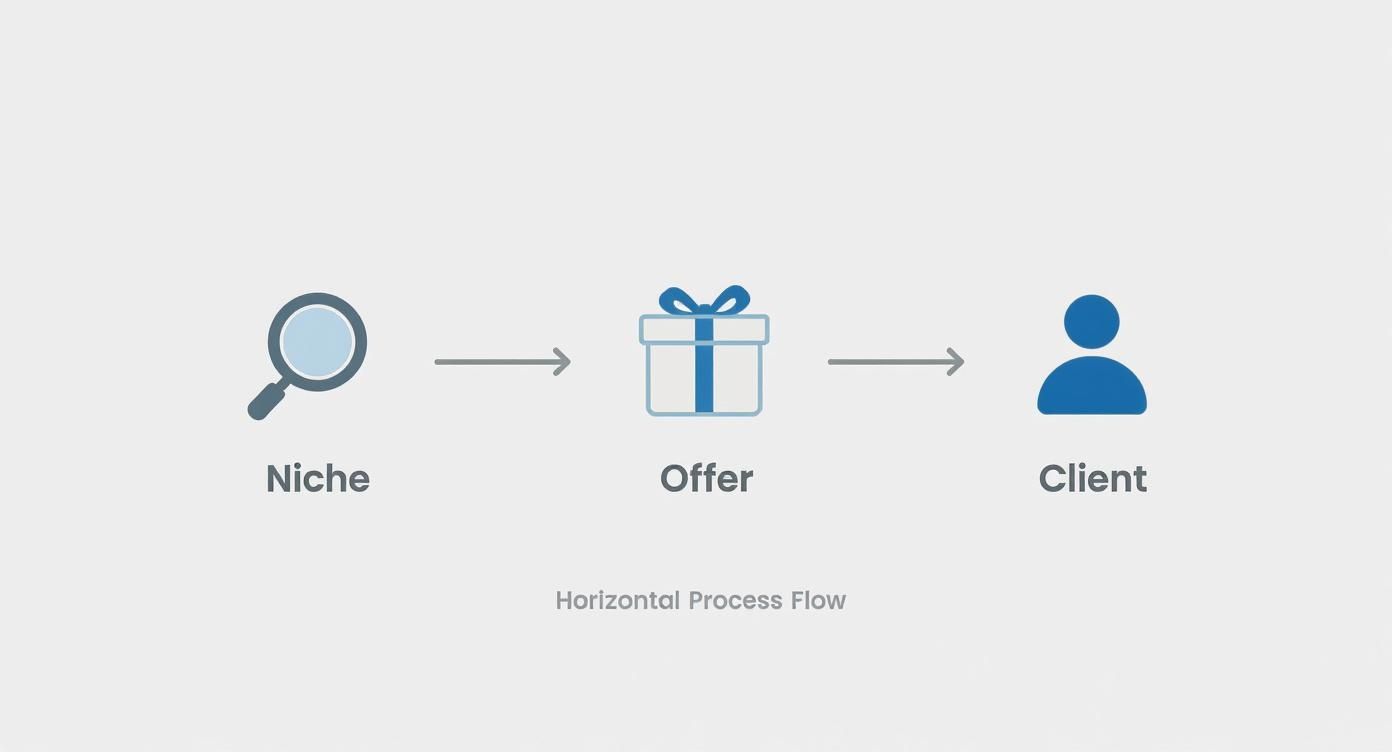
As you can see, each piece builds on the next, creating a focused business strategy that actually works.
Define Your Ideal Client Profile
Once your niche and offer are locked in, get crystal clear on who you're selling to. An Ideal Client Profile (ICP) is more than just demographics; it's about getting inside their head.
- What are their biggest frustrations? What keeps them up at night?
- Where do they hang out online? Are they active on Twitter, in specific LinkedIn groups, or private Slack channels?
- What language do they use to describe their problems? Use their words, not yours.
Knowing this helps you create marketing that feels like you’re reading their mind. If your ideal clients are SaaS founders active on Twitter, your outreach can speak directly to their pain points. We’ve seen firsthand how DMpro helps coaches and consultants connect with their ideal clients online by using this level of specificity.
This foundation separates struggling freelancers from thriving firm owners.
Create a Predictable Client Acquisition System
Referrals are great, but they aren't a growth strategy. Relying on them is a one-way ticket to the feast-or-famine rollercoaster. To scale, you need a system—a repeatable engine that brings in qualified leads every single week.
The biggest opportunity right now? Direct outreach on platforms where decision-makers hang out. I'm talking about Twitter (X). The founders and execs you want to reach are right there, talking openly about their struggles. You just need a smart way to start a conversation that doesn't feel like spam.

This isn't about blasting a generic pitch. It's about targeted, thoughtful engagement that feels personal. The goal is to start a real conversation, not to shove a meeting link in the first message.
Anatomy of a Cold DM That Actually Gets a Reply
A good cold DM is short, relevant, and focused on them. It should be obvious you've done your homework.
Here’s a simple structure that works:
- Personalized Hook: Start with something specific to them. Did they just tweet about a challenge? Mention it.
- Connect to a Problem: Gently connect what they said to a problem you solve. "Saw your post about hiring. Ramping up a new team without a solid playbook is tough."
- Offer Value (No Strings Attached): Give a quick piece of advice or a helpful resource with zero expectation.
- Low-Friction Question: End with an easy, open-ended question. "Curious how you're thinking about onboarding?" is way better than "Can I have 15 minutes of your time?"
A great outreach message makes the recipient feel seen and understood. The goal isn’t to sell; it's to start a dialogue by offering value upfront.
The demand for sharp consultants is exploding. Companies want flexible, project-based help from specialists like you.
Scaling Your Outreach Without Losing Your Mind
Sending a few thoughtful DMs a day is one thing. For serious growth, you need hundreds of these conversations happening at scale. This is where smart automation comes in. Manual prospecting is a full-time job and not the best use of your expertise.
This is exactly why tools like DMpro exist. Instead of burning hours searching for prospects and crafting messages, you set up automated campaigns. You define your ideal client on Twitter, write a few personalized message templates, and the system finds the right people and starts those initial conversations for you, 24/7.
This frees you up to talk to warm, qualified leads who are already interested. If you want to see how this works, check out our guide on how to send automated Twitter DMs effectively.
The right system turns client acquisition from a daily grind into a reliable process that fuels your growth.
Master Your Sales Process Without Being Salesy
Once your lead gen engine is running, you need a solid process for turning conversations into clients. This isn't about becoming a high-pressure salesperson. It's about designing a sales experience that feels like a collaborative strategy session.
The goal is to build immediate trust and prove your value. When you do that, getting to "yes" becomes the logical next step for the right clients.

Run Discovery Calls That Uncover Real Client Pains
The discovery call is your most important sales tool. Your only job here is to listen and diagnose, not to sell. Dig deep to find the root of their problems—the ones costing them money or keeping them up at night.
The secret is asking great questions that go beyond the surface.
- Instead of, "What are your goals?" try, "If we were talking a year from now, what would have happened for you to be thrilled with our work?"
- Instead of, "What are your challenges?" ask, "What’s the one thing that, if solved, would make everything else easier?"
Questions like these change the dynamic. You're no longer a vendor; you're a partner co-creating a solution.
Craft Proposals That Focus on Outcomes
Your proposal shouldn't be a long, boring list of tasks. Nobody cares about the deliverables; they care about the outcomes. A winning proposal is sharp, concise, and focused on the results.
Structure your proposals like this:
- Current Situation: Summarize their challenges using their own words from the discovery call.
- Desired Future State: Clearly spell out the measurable outcomes they want.
- Your Solution: Frame your offer as the bridge that gets them from here to there.
- The Investment: Present your pricing as an investment connected to the value of the outcome.
A great proposal is just a confirmation of the conversation you've already had. By the time they receive it, the client should already be confident you're the right choice.
This is also a great place to show you’ve been listening. You can tailor the language based on what you learned. Think of it as a manual version of what AI-powered outreach does at scale. To bring that same relevance to your initial outreach, you can learn about the power of AI personalization for DMs.
Handle Objections and Set Clear Expectations
If you've done a great discovery call, objections are rare. But when they come up—usually about price or timing—don't get defensive. An objection is often just a request for more information.
Address their concerns honestly and guide the conversation back to the value of the outcome.
Once they say yes, immediately set clear expectations. A kickoff email outlining the next steps, communication, and first milestone prevents future headaches and makes for a smooth transition.
Deliver World-Class Results to Drive Referrals
Landing a new client is when the real work starts. Your ability to deliver exceptional results is what turns a one-time project into a long-term partnership.
More importantly, it’s what fuels your referral engine. This is how you build a reputation that brings new clients to you.
Great delivery is about the entire experience. From the moment the contract is signed, every interaction needs to show they made the right call. Master this, and you'll build a business that practically grows itself.
Design a Seamless Client Onboarding Process
Onboarding is their first real taste of working with you. A clunky start plants a seed of doubt. A smooth, professional process builds instant confidence.
The goal is to make the client feel secure and clear on what’s next. A solid onboarding system includes:
- The Welcome Packet: A quick doc outlining communication, contacts, and links to tools like Asana or Google Drive.
- The Kickoff Call: A structured strategy session to lock in goals and confirm the timeline.
- Tool & Access Setup: Get them into the shared Slack channel or project board right away.
A strong start smooths out so many potential bumps down the road. It shows you're a pro.
Communicate Progress and Manage Scope Creep
You know what makes clients nervous? Silence. Proactive communication is key. Send regular updates, even if there's no massive news. A simple weekly email summary keeps them feeling informed and confident.
The best consultants don't just solve problems; they manage expectations flawlessly. Over-communication is always better than under-communication.
And then there's scope creep. It happens. When a client asks for something outside the original agreement, address it immediately.
Don't just say "no." Frame it as an opportunity. Acknowledge their idea, explain it falls outside the current scope, and propose tackling it as a future phase. This respects their input while protecting your time and often lines up your next project with them.
Tracking your own performance is also non-negotiable. To get a better handle on this, you can learn more about the importance of analytics and reporting for consultants and see how hard data can back up your value.
When you deliver fantastic results and a fantastic experience, you create a true advocate who will become your best marketing channel.
If you’re tired of manually sending DMs every day, try DMpro.ai — it automates outreach and replies while you sleep.
Scale Your Operations Beyond Yourself
As a solo consultant, you are the business. That's great at first, but it’s also the biggest bottleneck. There’s a hard cap on your time, which limits your income. To really grow, you have to break that connection.
This is about building systems, and eventually a team, that can deliver results without you doing everything. This is the leap from consultant to true business owner. It’s the only path to meaningful scale.
Know When and What to Outsource First
Hiring feels like a huge step. The trick is to start small. Your first move should be identifying the low-value, repetitive tasks that drain your time.
Take a look at your week. What could someone else handle?
- Admin Overload: Calendar management, sending invoices, chasing payments.
- Marketing Grunt Work: Formatting blog posts, creating social media graphics.
- Early-Stage Prospecting: Building lead lists based on your specific criteria.
These are perfect for a virtual assistant (VA). Bringing on a VA for just 5-10 hours a week is a low-risk way to buy back your time. It frees you up to focus on what actually moves the needle—talking to clients and strategy.
Making Your First Strategic Hires
Once you’ve delegated admin tasks and your revenue is steady, it’s time to think bigger. Strategic hires help with actual client delivery. This could be a contractor with a specific skill or a part-time junior consultant.
The perfect time is right before you hit your breaking point. If you’re consistently turning down good projects because you’re at capacity, that’s your cue. This person should directly expand your ability to serve more clients.
Your first hires should amplify your ability to deliver results. They aren't just an expense; they are an investment in your capacity to grow.
By bringing someone on, you can shift your focus to being the primary rainmaker for the business—sales, high-level strategy, and key client relationships.
Track the Metrics That Matter for Growth
As you start to build a team and invest in growth, you have to get serious about the numbers. "Gut feeling" isn't enough. A few key performance indicators (KPIs) will tell you if your scaling efforts are working.
- Client Acquisition Cost (CAC): How much do you spend to land one new client?
- Lifetime Value (LTV): What’s the total revenue you can expect from a client?
- Profit Margin: After all expenses, what percentage of revenue is pure profit?
A healthy business should have an LTV that's at least 3x its CAC. This simple ratio tells you if your client acquisition is profitable and sustainable. Keeping a close eye on these numbers helps you make smart, data-backed decisions.
Common Consulting Growth Questions
<iframe width="100%" style="aspect-ratio: 16 / 9;" src="https://www.youtube.com/embed/2lA_A8BGRRs" frameborder="0" allow="autoplay; encrypted-media" allowfullscreen></iframe>Once you start putting these strategies into action, questions will come up. That’s a good sign. Every successful consultant has wrestled with these same things. Let’s tackle some of the most common ones.
How Long Until I See Results From Automated Outreach?
It varies, but probably faster than you think. If you’ve nailed your ideal client and your offer is a no-brainer for them, you can start booking calls within the first few weeks.
Consistency is the game-changer. You'll likely test a few message angles at first. But once you find one that clicks, you can build a predictable stream of leads within 30-60 days. Using a tool like DMpro.ai to automate outreach on Twitter can definitely speed this up by handling the heavy lifting.
What's The Biggest Mistake Consultants Make When Scaling?
The single biggest mistake is trying to be everything to everyone. When you have a vague offer for a broad market, your message is just noise. Niching down feels scary, but it's the only way to cut through and get noticed.
The second-biggest mistake is waiting until you're drowning to build systems. Many consultants don't think about automation until they're overwhelmed. You have to build your systems for lead gen and onboarding before you're desperate.
Getting ahead of this prevents the bottlenecks that kill momentum and helps you scale without the chaos.
Should I Use Retainers or Project-Based Pricing?
You should use both, strategically. Project-based pricing is a fantastic way to get your foot in the door. It’s a lower-risk commitment for a new client and lets you deliver a quick, high-impact win.
But for predictable growth, your goal should be to move clients to retainers. Retainers create consistent recurring revenue, which stabilizes your cash flow and gives you room to plan for bigger moves, like hiring. A great approach is to start with a project and then upsell them to a monthly retainer for ongoing support.
How Do I Know When It's Time to Hire?
You’ll know it’s time to hire right before you feel like you're completely underwater. Look for two clear signs. First, you're consistently turning down good projects because you lack bandwidth. Second, you're spending more than 20% of your week on admin tasks that don’t generate revenue.
Start by outsourcing those admin tasks to a VA. Your first strategic hire should be someone who helps with client delivery. That’s what frees you up to do what only you can do: focus on sales and growing the business.
If you’re tired of manually sending DMs every day, try DMpro.ai — it automates outreach and replies while you sleep.
Ready to Automate Your Twitter Outreach?
Start sending personalized DMs at scale and grow your business on autopilot.
Get Started Free