
How to get coaching clients: A proven playbook for founders
Discover how to get coaching clients with a founder-tested playbook. Build your offer, master outreach, and scale your coaching business.
Getting coaching clients comes down to a simple, repeatable process: find where they hang out, start a conversation, and make a compelling offer. The secret sauce is in the prep work. The most successful coaches I know start by creating a razor-sharp profile of their ideal client and then build an offer so specific it feels custom-made.
When you get that foundation right, everything else—from your content on Twitter to your outreach—just clicks. It works ten times better.
Build a Foundation That Attacts Clients
Before you even think about outreach, clients need a way to find you and immediately get what you're about. This isn't about casting a wide net. It's about building a magnet that pulls in the exact people you are uniquely positioned to help.
Forget generic advice like "find your niche." We're going deeper. Your foundation isn’t just about what you do; it’s about who you do it for and the specific transformation you promise. Nailing this is what separates coaches constantly hustling for leads from those who seem to attract them effortlessly.
Think of it as tuning an engine before a race. Getting this right makes every other strategy, especially lead generation on Twitter, infinitely more powerful.
Define Your Ideal Client with Precision
So many coaches start with a fuzzy picture of their client. They'll say, "I help entrepreneurs grow their business." Honestly, that's too broad. It doesn't tell you where to find them online, what language resonates, or what problems keep them up at night.
You need to get painfully specific. The goal is to build an Ideal Client Profile (ICP) so detailed you feel like you know them personally.
Founder-to-founder truth: A vague audience leads to vague marketing. A specific client profile leads to marketing that feels like a one-on-one conversation and actually gets a response.
Instead of a general description, dig into the details. What industry are they in? What's their company's revenue? What SaaS tools are they using that they complain about? What podcasts are they listening to? The more granular you get, the easier it becomes to find them and speak their language.
Let's look at why this matters.
Ideal Client Profile vs Generic Target Audience
| Attribute | Generic Audience | Specific Ideal Client |
|---|---|---|
| Industry | Tech Entrepreneurs | B2B SaaS Founders |
| Business Stage | "Small Business" | Pre-Series A, under $15k MRR |
| Primary Pain Point | Needs more leads | Struggles to scale SaaS distribution |
| Current Tools | CRM, Email Marketing | Using HubSpot but not getting ROI |
| Where They Hang Out | LinkedIn, Business Events | Actively posting on Twitter, listens to the "My First Million" podcast |
Having a generic audience is like shouting into a crowded stadium. A specific ICP is like walking up to one person, knowing their name, and starting a meaningful conversation. That's the difference.
Craft an Irresistible Offer
Once you know exactly who you're talking to, you can craft an offer that solves their most pressing problem. A great coaching offer isn't just a list of sessions; it's a clear bridge from their current pain to their desired future.
Your offer needs to nail three things:
- The Specific Problem: What single, urgent pain point are you solving?
- The Tangible Outcome: What specific, measurable result will they get?
- The Unique Process: How do you deliver that result in a way no one else does?
For example, a vague offer is "Business coaching for SaaS founders." An irresistible one sounds more like this: "I help B2B SaaS founders under $10k MRR implement an automated outbound system on Twitter to book 5 qualified sales calls per week, guaranteed in 90 days."
See the difference? The second one is a solution, not a service. It's specific, time-bound, and speaks directly to a real business goal, making it an easy "yes" for the right founder.
Design Your Client Acquisition System
You’ve got an irresistible offer. Now, how do you get it in front of the right people consistently? Relying on one channel is a classic feast-or-famine cycle that kills momentum.
A smarter approach is to build a system with multiple channels working together. We're not talking about being everywhere at once—that's a recipe for burnout. We'll focus on a few key strategies that are gold for coaches: creating high-value content on Twitter and building a simple referral engine.
The whole system is built on the foundation you've already laid: knowing your ideal client, understanding their headaches, and having an offer that’s the perfect solution.
This visual breaks down the simple but powerful flow, from defining that ideal client to crafting an offer that speaks directly to their problems.
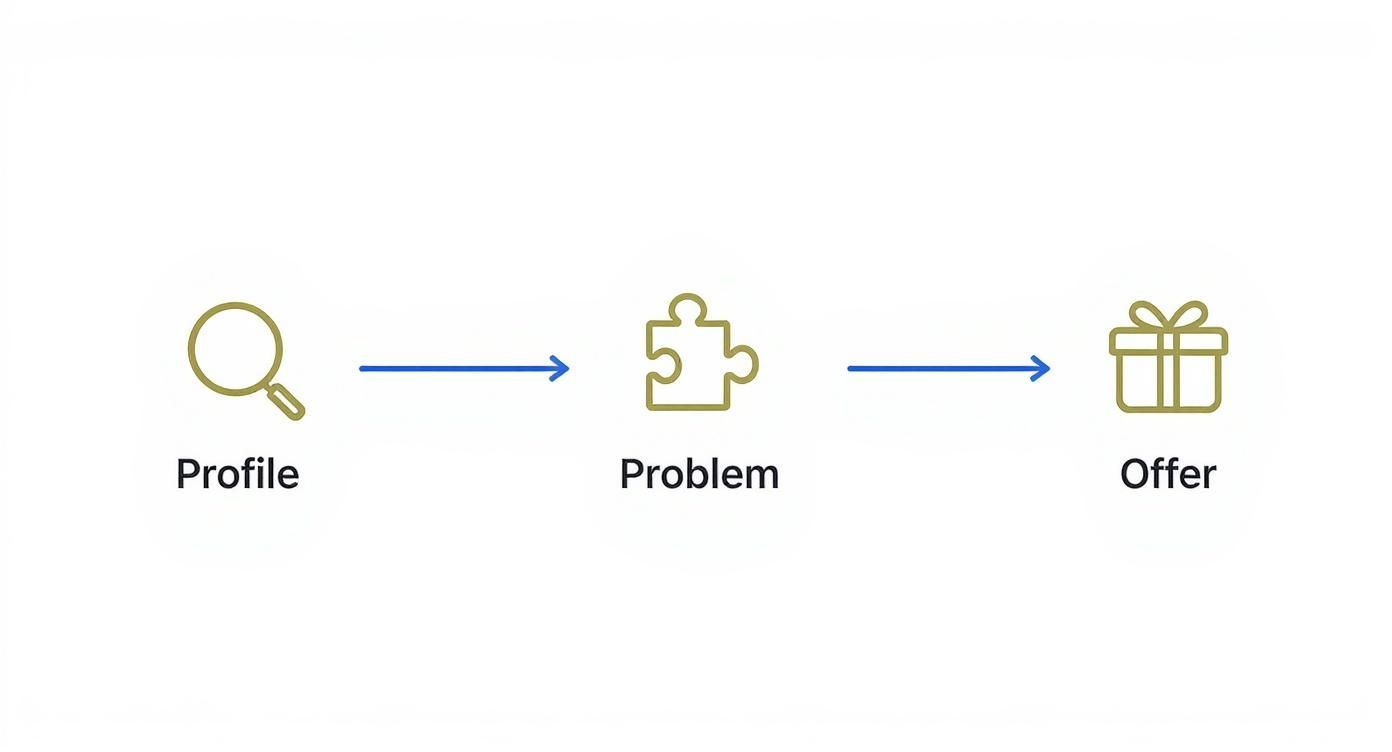
When every part of your system is aligned, you naturally attract the exact people you want to work with.
Create Content That Pulls Clients In
Let's get one thing straight: your content's main job is to attract your ideal client by proving you understand their world. Forget chasing viral trends. The real goal is to become an indispensable resource for a very specific group of founders.
On a platform like Twitter, this means sharing insights your ideal clients are looking for. Break down complex topics into simple frameworks. Share your unique take on common industry problems. Give them "aha!" moments they haven't found anywhere else.
Think of your content as a series of conversations. Every post is a chance to educate, build authority, and spark curiosity. When you do it right, people naturally want to learn more, and sliding into your DMs becomes the obvious next step for them.
A few content pillars that just work for coaches:
- Problem-focused threads: Go deep on a common pain point your ideal SaaS founder faces. Unpack it, show you get it, and hint at the solution.
- Client case studies: Share stories (with permission, of course) that highlight the transformation you facilitate.
- Actionable tips: Give away small, practical pieces of advice they can use today. This builds trust fast.
The secret here is consistency. You don't need to post ten times a day. But showing up regularly with genuinely helpful content is what builds the trust someone needs before they invest in you.
Tap into a Referral System
While content is a great long-term play, don't ignore the single most powerful client acquisition channel: referrals. A happy client is your best salesperson, period. But you need a process to activate them.
Relying on clients to remember to refer you isn't a strategy. You need a simple, repeatable process that makes it easy for them to send quality leads your way.
The perfect time to ask for a referral is right after a client has a big win. They're excited and most likely to want to share that feeling. A simple, low-pressure message works wonders. Try something like, "So thrilled we hit this milestone! By the way, if you know any other SaaS founders struggling with lead gen, I'd be happy to chat with them."
Don't just take my word for it. Referrals are the number one source of new business for coaches. The International Coaching Federation’s 2025 Global Coaching Study found that over 60% of coaches get most of their clients from referrals. That number jumps to 68% in North America. You can read the full research on the coaching industry's growth to see just how critical this is.
Build Your Lead List Systematically
As your organic channels hum along, you also need a way to proactively find potential clients. This isn’t about randomly scrolling feeds. It's about a methodical process for identifying and gathering leads who perfectly match your ideal client profile.
This is where you get smart with tools. For instance, using a tool with a lead scraping feature lets you automatically pull lists of Twitter users who follow specific accounts, use certain keywords in their bio, or engage with relevant content.
This approach lets you build a highly targeted list of prospects. A tool like DMpro, for example, can find hundreds of these potential leads for you every day, giving you a steady stream of founders to talk to. The goal is to spend less time hunting and more time having the conversations that lead to new clients.
Master Outreach and Prospecting on Twitter
Sure, organic content is great long-term, but what about getting clients now? When you need to fill your roster, proactive outreach on Twitter is where the real action is.
Forget vague advice. We're diving into smart, targeted prospecting that can turn Twitter into a reliable client-generating machine. The goal isn't to spam people. It's to find founders who are already talking about the problems you solve and start a real conversation.

This hands-on approach is non-negotiable. A strong digital presence is a must for any coach. The online coaching market is projected to hit $11.7 billion by 2025, and over 70% of new clients are finding their coaches online.
A 2025 report from CoachRanks even showed that coaches active on social platforms see a 50% higher client acquisition rate. The message is clear: if you're not prospecting online, you're falling behind.
Find Prospects with Surgical Precision
The magic of Twitter is its search function. You can literally find people asking for help. Stop endlessly scrolling your timeline and start using advanced search to pinpoint high-intent prospects.
Think about the exact words your ideal SaaS founder uses when they're stuck. They aren't tweeting "looking for a business coach." They're tweeting frustrations like "struggling to scale our MRR" or "our SaaS distribution is broken."
Here are a few search queries that work wonders:
"looking for a coach" OR "recommend a coach""how to" [solve a specific problem you address][competitor's name] "alternative""frustrated with" [a problem your ICP has]
Create a running list of these "buying signal" keywords. Checking these searches for a few minutes each day will give you a constant stream of warm leads to connect with.
The Art of the Non-Spammy Cold DM
Okay, you've found a perfect fit. Time to slide into the DMs. This is where most people blow it. They go straight for a pitch, which comes off as impersonal and desperate.
Your first message should be about them, not you. The only goal is to open a genuine conversation.
A great cold DM feels like a helpful tap on the shoulder, not a sales pitch. It should be personalized, relevant, and offer value before asking for anything.
Here’s a simple framework that works almost every time:
- Reference: Mention something specific they recently posted. This shows you're not a bot.
- Relate: Briefly connect their post to a problem you solve, but frame it as a helpful observation.
- Question: End with an open-ended question to get the ball rolling.
Example DM Template
"Hey [Name], saw your thread about the challenges of scaling your SaaS distribution. The point you made about finding the right channels really hit home.
A lot of founders I know struggle with that same bottleneck.
Just curious, what's been the biggest hurdle for you on the distribution side so far?"
This approach isn't about selling; it's about showing you understand their world. It opens the door for a real discussion.
Scale Your Outreach Without Losing Your Mind
Let's have a founder-to-founder reality check. Manually finding prospects, personalizing dozens of DMs, and following up daily is not a sustainable way to grow. It’s a one-way ticket to burnout.
This is where automation becomes your best friend—but it has to be smart automation.
You don't want to blast generic messages. The key is to automate the tedious parts—the prospecting and the initial contact—so you can spend your time having meaningful conversations with qualified leads who have already replied.
Tools like DMpro.ai are built for this. You can set up campaigns that automatically find users based on keywords, who they follow, or tweets they engage with. Then, it can send that personalized first-touch DM for you.
Imagine having hundreds of targeted, personalized conversations starting every week without lifting a finger. If you want a full breakdown, we have a complete guide on how to send automated Twitter DMs that walks through the process. This kind of system builds a predictable client acquisition pipeline, so you're systematically creating leads while you focus on coaching.
Turn Conversations Into Paying Clients
Getting a reply to your DM is a great start, but it’s just the first step. The real magic happens when you skillfully guide that casual chat into a booked discovery call and, ultimately, a signed contract. This is where a lot of coaches get stuck, but nailing this process builds a consistent flow of clients.
<iframe width="100%" style="aspect-ratio: 16 / 9;" src="https://www.youtube.com/embed/W0CCc7EOfZY" frameborder="0" allow="autoplay; encrypted-media" allowfullscreen></iframe>Let's walk through the entire conversion journey. We'll cover how to smoothly transition from that first message, what to say to get them on a call without being pushy, and how to structure that call for a confident "yes."
This isn't about cheesy sales tactics. It's about building genuine connections, showing you can help, and creating a clear path for them to become a client.
Moving From DMs to a Discovery Call
Once someone replies, your only goal is to shift the conversation from small talk to a deeper dive into their problems. Don't jump straight to pitching a call. Your first move is to ask smart questions.
If they engage, keep the spotlight on them. Ask open-ended questions that invite them to tell you more about what they're up against.
- "That's interesting. What's the biggest roadblock you're hitting with that right now?"
- "What have you already tried to solve that?"
- "If you could wave a magic wand, what would the perfect outcome look like?"
Your job here is to listen more than you talk. As they open up, you’ll get a clear picture of their pain points. Once you truly understand their struggle—and know you can solve it—suggesting a call feels like the natural next step.
The key takeaway: Don't "sell" the call. Position it as the logical next step to explore a solution to the specific problems they just told you about.
Try a line like this: "Based on what you've told me about [their specific problem with SaaS distribution], I have a few ideas that could really help. It'd be easier to walk you through them on a quick call than type it all out. Got any time this week?"
This frames the call as a helping hand, not a sales pitch. It’s for their benefit.
Structuring Your Discovery Call for Success
The discovery call is where it all comes together. This is your moment to build trust and give them a taste of what it's like to work with you. Forget rigid scripts. A great discovery call is a conversation with a clear structure.
Here’s a simple, founder-tested framework that works:
- Connect and Set the Agenda: Kick things off with some rapport. Then, quickly outline how the call will go so they know what’s coming. This puts you in the driver’s seat.
- Dig for the Pain: This is the most important part. Ask thoughtful questions to understand their current reality, their biggest goals, and the gap between the two. What’s not working? What happens if they do nothing?
- Paint the "After" Picture: Once you understand their pain, help them visualize life on the other side. Ask, "What would it mean for your business if you finally solved this?" This connects their problem to an exciting outcome.
- Position Your Offer as the Bridge: Only after the first three steps should you mention your coaching program. Frame it as the most direct path from their current pain to their desired future. Explain how each part of your program is the direct answer to the challenges they just shared.
This approach transforms the call from a sales pitch into a collaborative problem-solving session. You’re not selling coaching; you're building a solution with them on the call.
Handling Objections and Onboarding
If you’ve structured the call well, objections are rare. But when they pop up—usually about price or timing—don't get defensive. An objection is almost always a request for more information or reassurance.
Address their concern head-on. If it’s about the investment, gently bring the conversation back to the value and ROI, based on the goals they shared with you earlier.
Once they say "yes," your job isn't done. A smooth, professional onboarding process locks in their decision. Get the contract and invoice over right away. Schedule their first session. Send a welcome packet that gets them excited and sets clear expectations. This proves you’re a pro and starts the relationship on a high note.
If you’re tired of the daily grind of sending DMs, check out a tool like DMpro.ai — it can automate your outreach and even handle initial replies while you sleep.
Scale Your Coaching Business Beyond One-on-One
There comes a point where you hit a wall. You've got steady one-on-one clients, but your calendar is maxed out. If you want to grow your impact—and income—without adding more hours, you have to stop trading time for money.
This is where you shift from being a coach to being a founder. It’s a different mindset—all about systems, leverage, and smart growth. The first step? Getting honest about the numbers that actually drive your business.

Key Metrics to Guide Your Growth
If you're not tracking your numbers, you're flying blind. To make smart decisions, you have to understand the health of your client acquisition engine. Forget vanity metrics. Focus on the numbers that directly impact your bank account.
There are two non-negotiable metrics for any founder:
- Client Acquisition Cost (CAC): How much does it cost you to get a new client? This is your total sales and marketing spend divided by the number of new clients.
- Lifetime Value (LTV): How much is a client worth to you over their entire journey? This is the total revenue you expect from a single client.
The magic ratio to aim for is an LTV that is at least 3x your CAC. If you've hit that, you have a business model ready to scale. If not, it's a sign you need more efficient client acquisition or need to increase client LTV.
Evolving Your Offer for Scale
Once you have a grip on your metrics, you can strategize how to evolve your offer. The goal is to decouple your income from your hours. This is how you serve more people and open up leveraged revenue streams.
The most common path is moving from a one-on-one to a one-to-many model.
Moving from 1:1 to a group model isn't just about making more money. It's about creating a community where clients learn from each other, which often leads to even better results.
Here are a few proven ways to scale your coaching offer:
- Group Coaching Program: This is the logical first step. You deliver your core methodology to a group, often at a more accessible price than your 1:1 work. This immediately multiplies your earning potential per hour.
- High-Ticket Mastermind: This is a premium, intimate group for your most dedicated clients. It blends high-level coaching with peer accountability. You can charge a significant premium for these spots.
- Digital Courses or Workshops: This involves packaging your expertise into a self-paced product you can sell an infinite number of times. It's a fantastic way to serve people who aren't quite ready for high-ticket coaching.
The strategy is to build a "value ladder." Your lower-cost offers act as a feeder system into your premium programs, creating a natural and profitable journey for your clients.
Automation Is Non-Negotiable
As you grow, you'll realize you can't do it all yourself. Admin and marketing tasks become a massive bottleneck. At this stage, automation stops being a "nice-to-have" and becomes essential.
Your time is your most valuable asset. Every minute on repetitive tasks is a minute you're not spending coaching or strategizing. For a closer look, our guide on how DMpro is used by coaches and consultants breaks down how to streamline this.
Manually prospecting on Twitter, sending DMs, and following up is a soul-crushing time suck. A tool like DMpro.ai can take that entire workload off your plate. It can automatically find people who fit your ideal client profile and initiate conversations for you, 24/7. This frees you up to focus only on warm, qualified leads.
Scaling is about building systems that work for you. By embracing automation, you can finally break free from the "time for money" trap and build a business that truly serves you.
Common Questions About Getting Coaching Clients
Getting those first few clients can feel like a mystery. You've done the work, built your foundation, designed a killer offer... and yet, a few nagging questions always pop up. Let's clear the air and tackle the most common ones I hear from fellow founders.
My goal is to get you unstuck so you can get back to building your business.
How Long Does It Realistically Take to Get Your First Client?
The honest, founder-to-founder answer? It depends. But it’s probably faster than you think if you’re proactive.
If your strategy is just posting content and hoping people find you, you're playing the long game. That could easily take 3-6 months to see consistent results.
But if you combine content with direct, targeted outreach, you could land your first paying client in as little as 30 days. The trick is to be methodical. Spend a week clarifying your ideal client and offer. Then, dedicate the next three weeks to consistent, daily outreach.
This isn't about spamming. It's about finding 5-10 highly qualified prospects each day on Twitter and starting a genuine conversation. It's still a numbers game, but one you can win much faster with focused effort.
How Should I Price My Coaching Packages?
Pricing feels like a black box for many new coaches. My first piece of advice? Stop thinking in hourly rates. Anchor your pricing to the value of the outcome you deliver.
Ask yourself this: what's the tangible result a client gets from our work?
- If you help a SaaS founder land five new enterprise clients, what’s that worth to their business?
- If you help a creator build a system that saves them 10 hours a week, what is that freedom worth?
When you frame it around a clear ROI, a $3,000 or $5,000 package becomes an incredible investment, not an expense. Start with a price that feels a little uncomfortable but you can justify with confidence. Plan to raise your rates after every 3-5 clients.
What if a Prospect Says They Can't Afford It?
First, don't panic. "I can't afford it" is rarely about the money. It's usually a polite way of saying, "I'm not convinced of the value yet."
Your job isn't to be a salesperson. It's to get curious and understand the real hesitation.
Instead of defending your price, gently shift the conversation to the cost of inaction. What will it cost them if this problem is still unsolved six months from now?
A great way to handle this is to ask: "I understand. If the investment wasn't an issue, is this the solution you'd want to move forward with to solve [their specific problem]?"
Their answer tells you everything. A "yes" means you have a value gap to close, not a pricing problem. A "no" means they were never the right fit.
If you’re tired of manually sending DMs every day, a tool like DMpro.ai can be a game-changer. It automates outreach and replies so you can focus on real conversations.
Time to Put Your Client Outreach on Autopilot
Look, getting a full roster of clients doesn't happen by accident. It's about building a smart system that does the heavy lifting for you.
When you nail your offer, get good at outreach, and learn how to turn conversations into clients, you've built a real engine for growth. The secret is to stop wasting time on the repetitive parts of prospecting and focus your energy where it matters—on building real connections.
If you want to go deeper on how to streamline this, our guide on Twitter automation is the perfect next step. It's all about creating a client pipeline that doesn't rely on you being glued to your screen 24/7. This is how you build a business that grows without the burnout.
If you’re tired of manually sending DMs every day, try DMpro.ai — it automates outreach and replies while you sleep.
Ready to Automate Your Twitter Outreach?
Start sending personalized DMs at scale and grow your business on autopilot.
Get Started Free