
B2B Lead Generation for SaaS: A Founder's Playbook
A practical guide to b2b lead generation for saas, covering inbound and outbound channels, key metrics, and playbooks to build a scalable pipeline.
You've had the month every SaaS founder wants. A few customers signed, users are activating, and the product finally feels like it has a place in the market. Then the pipeline slows down. The team tries cold email, switches to paid ads, posts more often on X, and still can't explain why activity is rising while opportunities aren't.
That's the challenge with B2B lead generation for SaaS. Lead generation isn't a channel. It's a measurement system that connects attention, intent, sales conversations, and revenue. The tactics matter, but only after you know which stage they're supposed to move.
The Pipeline Problem Most SaaS Founders Hit First
The stall usually starts after product-market fit shows up in a narrow segment. The founder closes early deals through personal relationships, product demos, or sheer persistence. Those customers create confidence, but they don't automatically create a repeatable acquisition motion.
When referrals slow down, the team reaches for whatever channel looks successful elsewhere. One week, someone builds a cold email list. The next, they test ads. Then a founder starts posting daily on social media. Each tactic can generate activity, but none gets a fair evaluation because the team hasn't agreed on what counts as a qualified lead or which conversion should improve.
A website visitor, a signup, an activated user, and a booked sales conversation aren't interchangeable. Treating them as the same “lead” makes the dashboard look healthy while hiding the leak between interest and revenue.
Where the early system breaks
Three problems appear repeatedly:
- The team copies a channel without copying the conditions: A channel that works for an established company may depend on brand demand, a large audience, mature data, or a sales team you don't have.
- Qualification stays subjective: Marketing sends contacts to sales, sales rejects them, and nobody records the reason in a usable way.
- Sales feedback disappears: Call notes mention pricing objections, missing integrations, or poor fit, but the marketing message never changes.
The funnel then becomes a collection of disconnected tasks. A founder may spend hours enriching accounts, writing sequences, and reviewing signups without knowing whether any of those actions increase sales-accepted conversations.
Practical rule: Every lead-generation activity needs a stage, an owner, and a conversion metric.
Data quality is part of this system. If account records contain incomplete roles, outdated companies, or weak firmographic context, even thoughtful outreach becomes guesswork. A useful reference for building cleaner prospect records is Fetchin's guide to enrichment best practices for SaaS.
The operating model described in sales pipeline management follows the same principle. Keep the stages visible, define the hand-offs, and force every conversation to produce learning. The point isn't to run more campaigns. It's to make the path from first signal to closed account understandable enough that the team can improve it every week.
Mapping the SaaS Lead Funnel From Visitor to Customer
A SaaS funnel should fit on one whiteboard. Give each stage a job, an owner, and a measurable hand-off. If a stage has no decision rule, it is not a stage. It is a reporting label.
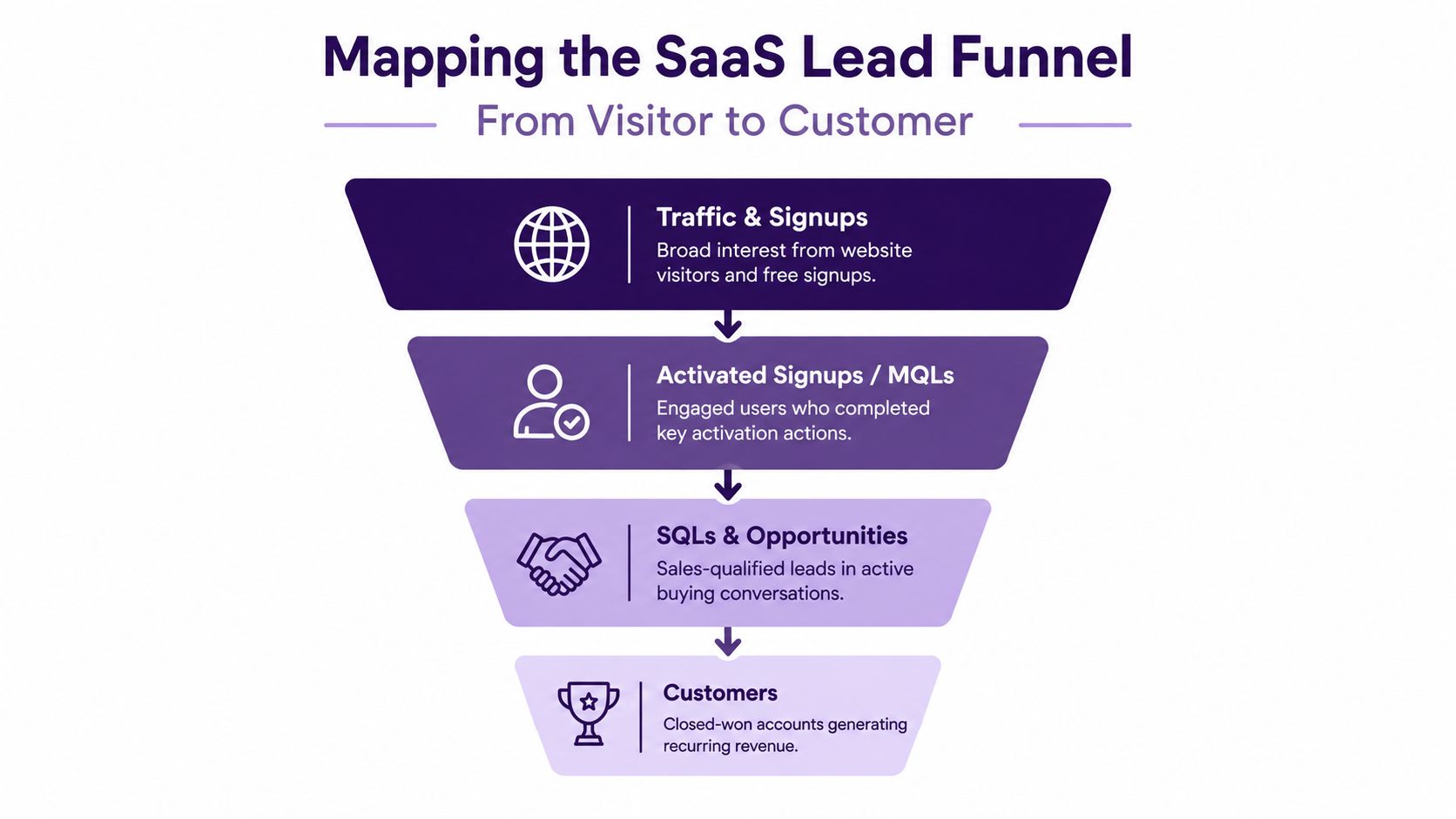
Stage one is attention and signup
SEO, founder content, partnerships, comparison pages, and paid acquisition feed the top of the funnel. Track more than visits and form fills. A useful first-stage measure combines visitor quality with a meaningful action, such as starting a trial, requesting pricing, or completing a high-intent form.
The reported median visitor-to-lead conversion range is 1.5% to 2.35%, while top performers range from 4.8% to 8%, depending on segment and channel, according to B2B SaaS conversion benchmarks. The same source cites 1.9% to 2.6% visitor-to-lead conversion for organic search and around 0.7% for paid search. Use those differences to test message-match and landing-page clarity before increasing traffic spend.
Stage two is activation and MQL status
A signup becomes activated after reaching the product's first meaningful value. That event might be connecting an integration, inviting a teammate, or completing a core workflow. Define it before launching acquisition campaigns, or the team will optimize for accounts that never experience the product.
An MQL should signal fit and intent, not merely a completed form. Combine product usage, repeat visits, content engagement, and account fit in the definition. Document the lead generation process so marketing and sales apply the same rule.
Stage three is sales readiness
SQLs and booked demos represent active buying conversations. Sales needs the problem, use case, company fit, product behavior, and requested timeline before accepting the hand-off. Record rejection reasons as carefully as accepted meetings. They show whether targeting, qualification, or positioning needs correction.
Stage four is revenue
Closed-won customers are the stage that creates recurring revenue. Historical funnel benchmarks report 2.3% median visitor-to-lead conversion, 13% median MQL-to-SQL conversion, 21% median SQL-to-closed-won conversion, and a 102-day median sales cycle, according to the 2025 B2B lead generation platform benchmarks.
Review all four stages weekly. Signups show whether attention exists. Activation shows whether the product earns engagement. Sales conversations show buying intent. Customers show whether the system produces revenue.
<iframe width="100%" style="aspect-ratio: 16 / 9;" src="https://www.youtube.com/embed/yZuz2VmkMxU" frameborder="0" allow="autoplay; encrypted-media" allowfullscreen></iframe>Inbound Channels That Actually Compound for SaaS
Inbound works best when it creates an asset that keeps attracting the right buyer after the original effort ends. That usually means search demand, product usage, distribution through a partner, or an audience that remembers the founder and returns directly.
The mistake is treating every inbound channel as equally suitable for every SaaS model. Choose one motion that matches the product's buying behavior, then measure the first useful signal instead of waiting for a vague sense of momentum.
| Channel | Cash Cost | Time to Signal | Realistic MQLs/Month | Common Failure |
|---|---|---|---|---|
| SEO blog and comparison content | Low direct cost, high internal effort | Often months rather than weeks | Qualitative until the site has enough relevant demand | Publishing broad topics with weak buyer intent |
| Product-led signup flow | Product and onboarding effort | Depends on how quickly users reach value | Qualitative and product-dependent | Driving signups without an activation event |
| Partnerships and integrations | Relationship and engineering effort | Slow to establish | Qualitative and partner-dependent | Building an integration without a shared distribution plan |
| Founder or LinkedIn content | Low cash cost, consistent time cost | Can produce early attention, but compounds gradually | Qualitative and audience-dependent | Chasing impressions instead of branded demand |
| YouTube education and demos | Production effort and distribution time | Builds gradually through searchable content | Qualitative and topic-dependent | Making videos that explain features without a buyer problem |
Search content needs a commercial spine
A focused site can build authority through problem-led articles, comparison pages, integration guides, and templates. The strongest pages answer a buying question and offer a natural next step, such as a trial, product walkthrough, or qualification form.
SEO has a long feedback loop. Don't judge it by early traffic alone. Track qualified organic sessions, signup quality, activation, and the eventual sales source. Video can extend the same strategy. For founders building a repeatable YouTube motion, this B2B YouTube lead generation playbook is useful for thinking beyond isolated product demos.
Product-led growth only works after activation
A free signup is not a pipeline achievement if users never reach value. Remove unnecessary setup, show the first successful outcome quickly, and trigger nurture based on actual product behavior.
Partnerships and integrations can be slower, but they're valuable when your product becomes part of an existing workflow. A partner that sends the right accounts can outperform a large audience with poor fit.
Founder content also has a specific role. It builds awareness and trust, then sends demand back to the site through search, direct visits, or conversations. The practical principles behind awareness building are simple: teach from real customer problems, repeat the point of view, and connect attention to a measurable next step.
Outbound Channels and How to Compare Them Honestly
Outbound earns its place when inbound demand has not matured enough to create qualified conversations. The measurement problem comes first: track qualified replies, meetings held, opportunities created, and pipeline value by channel. Sending volume is only an activity metric.
The three common lanes are cold email, cold calling, and X DMs. Their costs and feedback cycles differ, but the qualification standard should remain consistent. A reply matters only when the account fits, the problem is real, and the buyer is willing to discuss a next step.
| Channel | Setup Cost | Weekly Time Per Rep | Realistic Response Rate | Best For |
|---|---|---|---|---|
| Cold email | List research, sending infrastructure, copy, and deliverability work | Moderate, including research and replies | Well-targeted SaaS outreach typically gets 4% to 9% response, according to B2B SaaS cold email benchmarks | Focused account lists and structured nurture |
| Cold calling | Calling tool, accurate numbers, scripts, and coaching | High live activity and follow-up effort | Use a qualitative expectation unless your own data establishes a rate | Urgent problems and accounts with reachable buyers |
| X DMs | Account research, thoughtful engagement, and compliant tooling | Moderate, with high personalization requirements | Signal and relationship quality matter more than a universal band | Founder-led social selling and active conversations |
Cold email usually supports awareness-to-consideration work by creating a repeatable path from a defined account list to a conversation. It offers structured follow-up and a durable record, but poor targeting or weak sending practices can reduce inbox placement. Teams planning this motion should learn more about what outbound prospecting entails. Before increasing volume, use the Email Deliverability Tutorial to understand operational risks. Keep lists current, write for a narrow use case, and stop contacting people who do not want the conversation.
Cold calling moves qualified prospects into active evaluation faster because objections appear in real time. It demands live activity, emotional energy, accurate numbers, and coaching, so it often wastes time when the ICP and trigger event are unclear. Use calls for accounts facing a time-sensitive problem or situations where a conversation can clarify technical or operational complexity.
X DMs work best later in the awareness and consideration stages, after a prospect has created context through posts, replies, community participation, or a clear profile. X's own automation rules for Direct Messages prohibit unsolicited bulk or automated DMs and advise thoughtful contact frequency. Independent coverage also reports that automation must use the official API, while scraping, browser automation, and unofficial APIs are prohibited, with automated accounts clearly labeled, as described in X automation rules and limits.
A tool such as DMpro can support X prospect discovery, personalized cold DMs, follow-up sequences, and multi-account management. Treat it as execution support, not a replacement for signal selection, consent-aware outreach, or qualification. Check X operating limits before scaling a campaign, since current X DM automation guidance reports soft caps and reset behavior that affect planning.
Channel stacking can work when each touch serves the same account hypothesis. A prospect may see a useful post, receive a relevant email, and later respond to a social message. Compare the resulting qualified pipeline, not the loudest activity count, and remove anyone who asks not to be contacted.
A Weekly Operating Rhythm for Small SaaS Teams
A small team doesn't need a complicated revenue-operations calendar. It needs protected blocks, a shared tracker, and a Friday habit of killing work that didn't produce learning.
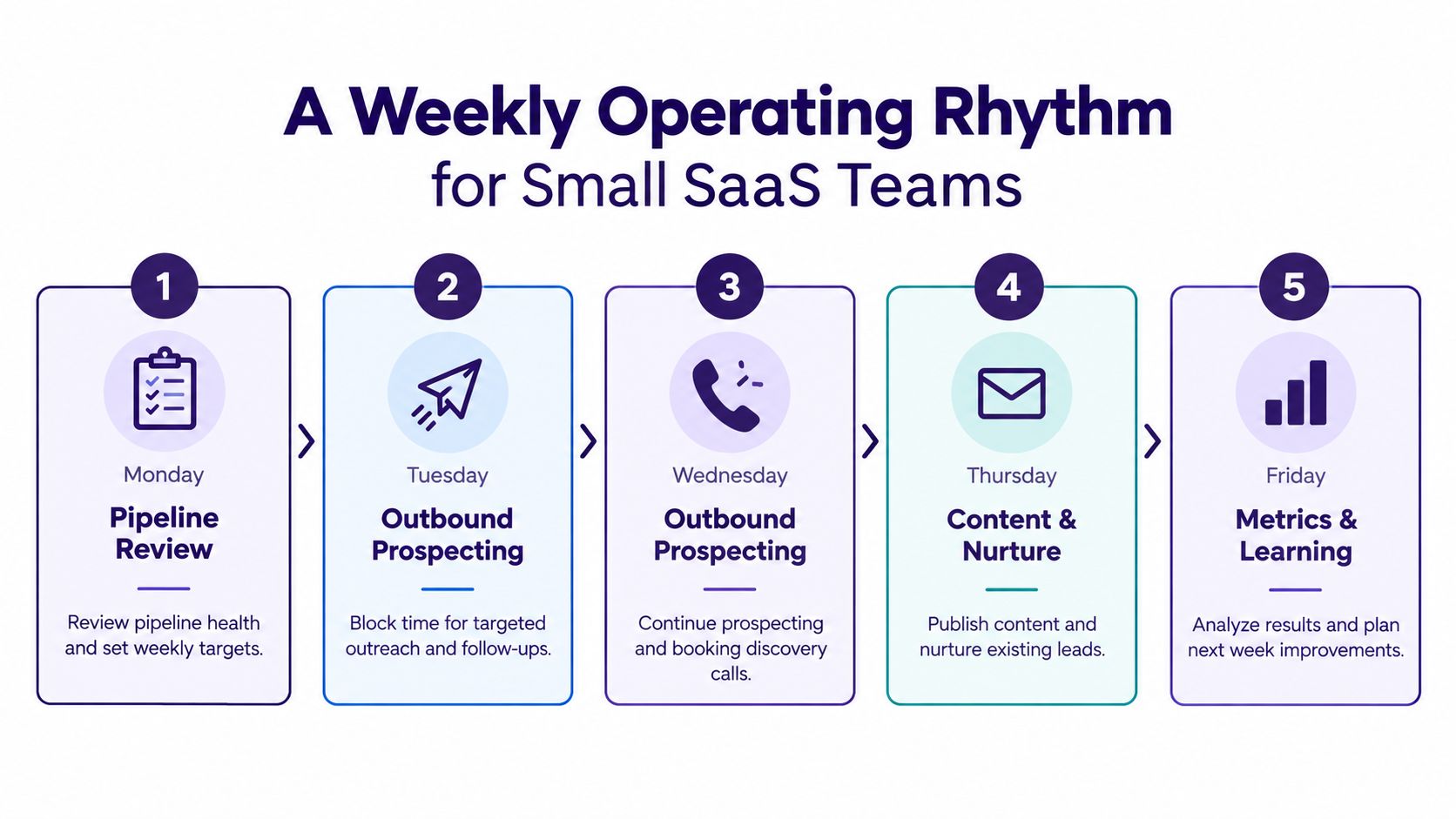
Monday sets the constraints
Review every open opportunity, new qualified lead, stalled conversation, and next action. Set the week's targets by stage, not just by activity. A founder should own the forecast and review the quality of recent conversations, while a marketer or SDR can maintain campaign and list details.
Ask three questions:
- What changed: Which accounts entered, advanced, stalled, or left the pipeline?
- What did we learn: Which objection or use case appeared repeatedly?
- What must happen next: Who owns each follow-up, and by when?
Tuesday and Wednesday belong to prospecting and reply handling. Put research, personalization, calls, email follow-ups, and X engagement into calendar blocks. Don't let notifications consume the entire day. The person running outreach should also log the reason for every positive, negative, or unclear reply.
Thursday creates future demand
Use Thursday for one meaningful content asset, customer education, or nurture sequence. Repurpose sales questions into an article, short video, comparison page, or onboarding email. The founder should stay close to positioning and customer language, while production and publishing can be delegated once the editorial standard is clear.
Protect deep work by ending the metrics meeting at a fixed time. If the review runs long, move unresolved questions into the tracker instead of stealing the next block from product or customer work.
Friday is for experiments and maintenance:
- Review channel quality: Compare accepted conversations and opportunities, not just sends or clicks.
- Refresh the list: Remove bad-fit accounts, update roles, and record new buying signals.
- Write the retro: Keep one observation, one decision, and one test for the following week.
Measuring Lead Quality Instead of Lead Volume
A SaaS team can add signups every week and still have a broken acquisition system. If sales-qualified conversations and closed revenue remain flat, the team has created sorting work rather than demand. Treat lead generation as a measurement problem first, then choose tactics that improve the funnel stage you need to move.
Define quality before a contact reaches sales. Start with fit, check engagement depth, then record source attribution. Fit covers the company, role, use case, and buying environment. Engagement depth separates a casual visitor from someone who returns, activates, requests information, or answers a targeted message. Attribution shows which motion deserves more resources.
The metrics worth defending
The dashboard should follow each hand-off, from first action to revenue:
| Metric | What It Measures | Healthy Benchmark Range |
|---|---|---|
| Visitor-to-lead conversion | Whether relevant traffic takes a first action | 1.5% to 2.35% median, with 4.8% to 8% reported for top performers, according to 2026 SaaS conversion benchmarks |
| MQL-to-SQL conversion | Whether marketing-qualified contacts become sales conversations | 13% median, according to 2025 B2B SaaS funnel benchmarks |
| Sales-accepted lead rate | Whether sales accepts the leads marketing sends | 26% average, across 5,500 sales professionals in 27 countries, according to sales benchmark data |
| SQL-to-closed-won conversion | Whether qualified opportunities become customers | Track your own baseline by segment and source |
| Sales cycle | How long revenue takes from active opportunity to close | Track median days from opportunity creation to close |
| Pipeline value by source | The commercial output of each channel | Set your own baseline from CRM data |
| First-touch to closed-won velocity | How quickly a source produces revenue | Set your own baseline from CRM data |
Use three tags in qualification: fit, intent, and evidence. Mark each as strong, uncertain, or weak before booking a call. High engagement cannot compensate for a poor ICP match.
Record the original source, campaign, first touch, latest touch, qualification reason, opportunity value, and closed-won status. Review those fields by funnel stage, not just by channel. Content should improve visitor-to-lead conversion, outbound should create qualified conversations, and nurture should help opportunities advance. That attribution trail gives the founder a defensible basis for deciding what to scale, repair, or stop funding.
Your First 90 Days Building a Scalable SaaS Pipeline
The first 90 days shouldn't produce a finished marketing machine. They should produce a defensible view of what creates qualified pipeline and what wastes the team's time.
Days 1 to 30 build the baseline
Lock the four funnel definitions, owners, qualification rules, and source fields. Install tracking in the website, product, CRM, and outreach workflow. Ship one pillar page, one nurture sequence, and one outbound sequence. Build a list of 500 targeted prospects, but don't treat the list size as success.
The founder owns the ICP, message, and call review. Marketing or operations owns the tracker and source hygiene. The exit criterion is simple: every new contact has a stage, a reason for qualification, and a next action.
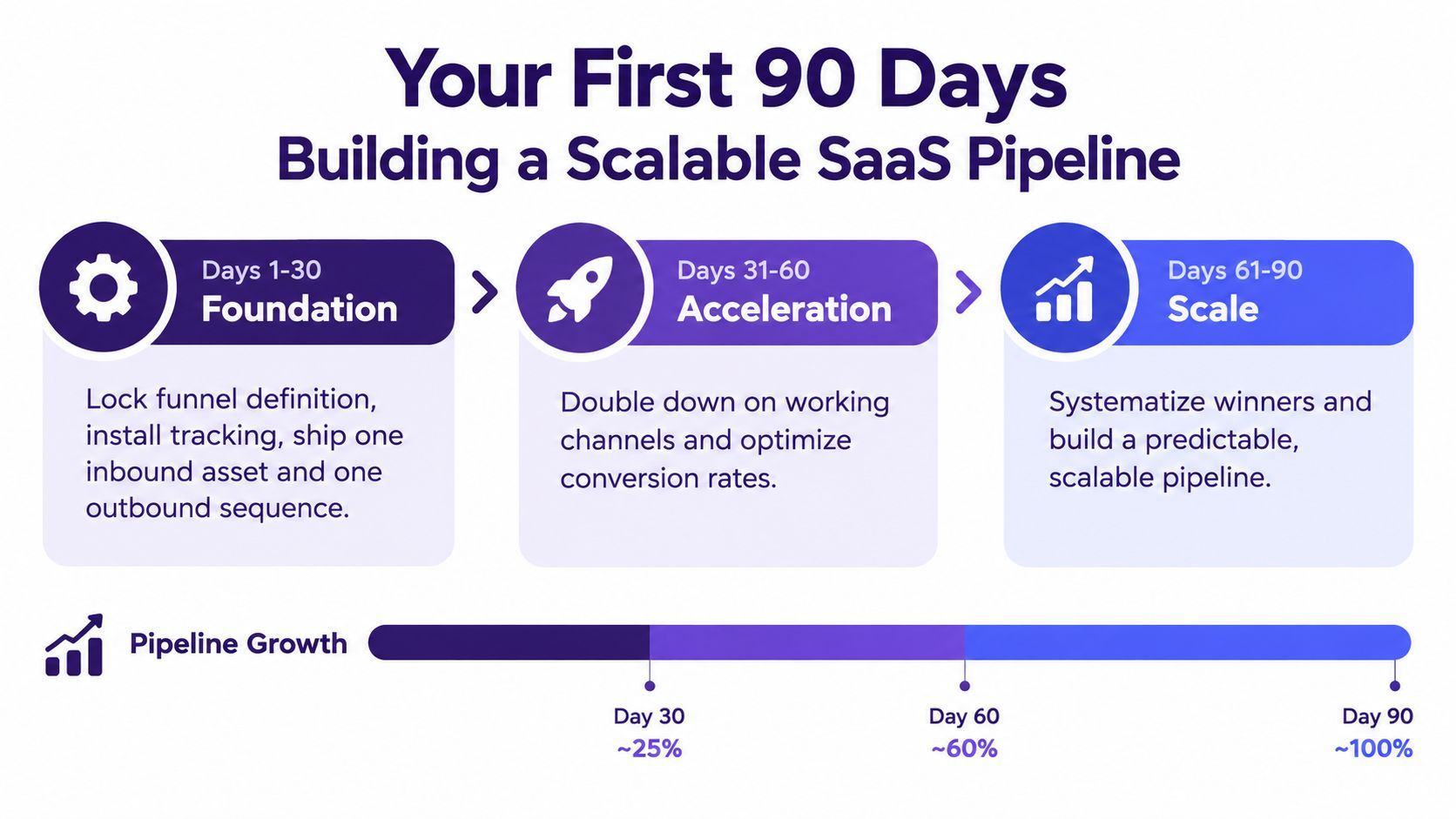
Days 31 to 60 concentrate effort
Review the first SQLs and sales-accepted conversations. Double down on the channel that produced the strongest evidence of fit, not the one that generated the most clicks. Prune the underperformer, revise the message from actual objections, and document the weekly rhythm the team followed.
Your dashboard should contain five metrics: visitor-to-lead, MQL-to-SQL, sales acceptance, SQL-to-closed-won, and pipeline value by source. The exit criterion is a repeatable review process and a clear reason for continuing each active motion.
Days 61 to 90 add controlled complexity
Layer in a second inbound motion, such as founder content, an integration, or video. Test a second outbound lane only after the first has a usable qualification process. Set CAC and payback targets from your own economics, then decide what to scale, repair, or kill.
By day 90, your forecast should show where opportunities came from, how they progressed, and which assumptions remain uncertain. That's a scalable pipeline foundation. It's more valuable than a crowded dashboard full of unqualified names.
If manual X outreach is taking time away from qualification and closing, try DMpro to discover ICP-matched prospects and automate personalized cold DM sequences on X. Use it as part of a measured funnel, with clear qualification rules and platform-compliant outreach, so your team can spend more time turning relevant conversations into pipeline.
Ready to Automate Your Twitter Outreach?
Start sending personalized DMs at scale and grow your business on autopilot.
Get Started Free